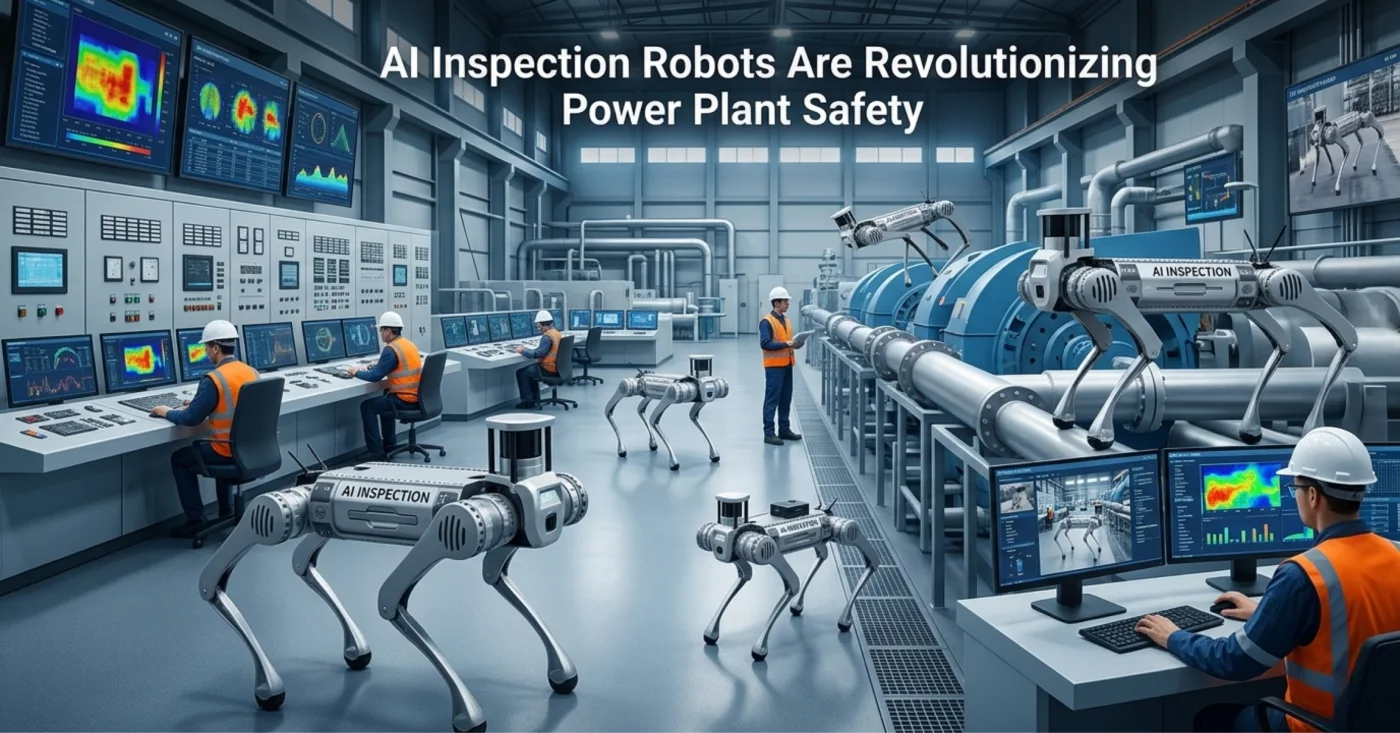
AI inspection robots are transforming how we manage extreme conditions in energy facilities. These intelligent machines eliminate the need for human workers to enter dangerous zones, collecting precise data and identifying potential equipment failures to keep power plants running smoothly.
Manual inspections in power plants involve high risks, massive costs, and inevitable human error. By deploying these advanced robotic systems, facility managers drastically reduce workplace accidents while minimizing costly operational downtime through continuous, automated surveillance.
This comprehensive guide explores exactly how these advanced systems function and why they matter. You will learn about their core applications, major benefits, and how they are shaping the future of industrial safety across the globe.
Challenges of Traditional Power Plant Inspections
Traditional manual inspections in energy facilities are inherently dangerous, highly inefficient, and prone to error. Robots for hazardous industrial inspections directly address the severe limitations that have plagued maintenance routines for decades.
Extreme Safety Risks for Personnel
Human workers face immense hazards when inspecting active power generation facilities. Exposure to high-voltage equipment, toxic gases, and extreme heat poses a constant, daily threat to life and health.
Traditional maintenance methods often require technicians to climb high scaffolding or enter tight, confined spaces. These hazardous activities carry a high risk of falls, severe burns, and respiratory complications.
- High-voltage exposure: Workers risk electrocution when checking active substations.
- Toxic environments: Boilers and cooling towers often harbor dangerous gases.
- Physical hazards: Navigating slippery, elevated platforms increases fall risks.
- Thermal dangers: Extreme heat from turbines can cause severe burns and heatstroke.
Inconsistent Data Collection
Human fatigue and distraction frequently lead to inconsistent inspection results. A technician might easily miss a hairline fracture in a pipeline or overlook a subtle change in equipment vibration after a long shift.
When workers rush through dangerous areas to limit their exposure, the quality of their reporting naturally drops. This lack of reliable, consistent data makes predicting catastrophic equipment failures incredibly difficult for engineering teams.
Costly Operational Downtime
Shutting down a power plant for manual inspections costs energy companies millions of dollars in lost production. Stringent safety protocols dictate that machinery must be completely powered down and cooled before humans can safely approach.
These forced outages disrupt the local energy grid and severely impact a facility’s bottom line. The industry desperately needs modern solutions that allow for continuous monitoring without halting critical energy production.
What Are AI Inspection Robots?
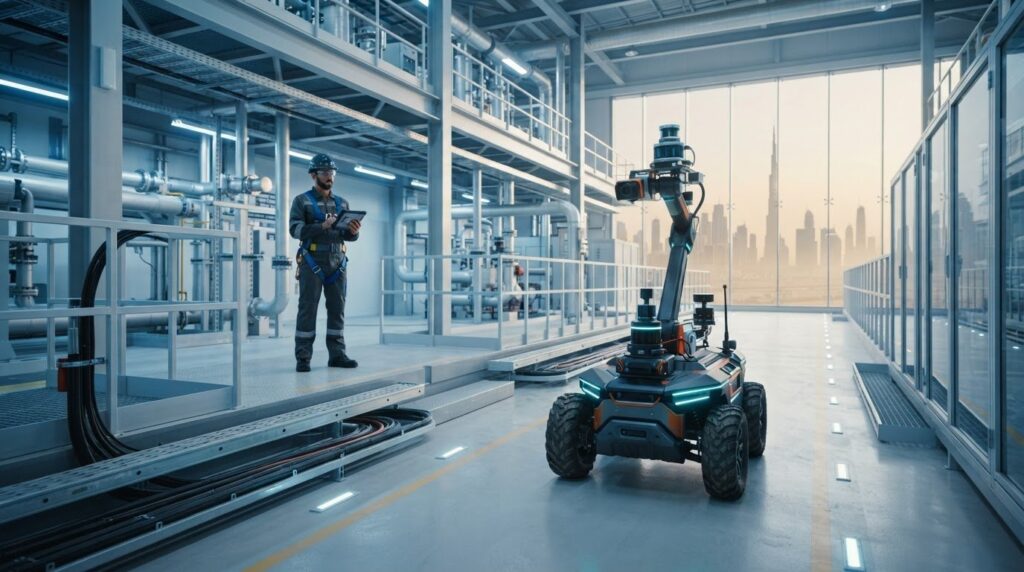
AI inspection robots are autonomous, highly mobile machines equipped with artificial intelligence, advanced sensors, and spatial mapping capabilities. They are specifically built to navigate and monitor complex industrial environments completely without human intervention.
These machines act as the ever-vigilant eyes and ears of a facility’s maintenance team. They roam continuously through power plants, collecting vast amounts of data to assess the structural and operational health of critical machinery.
Unlike traditional remote-controlled drones, AI robots for power plant monitoring make independent, intelligent decisions. They use complex machine learning algorithms to recognize anomalies, navigate around unexpected obstacles, and optimize their daily inspection routes.
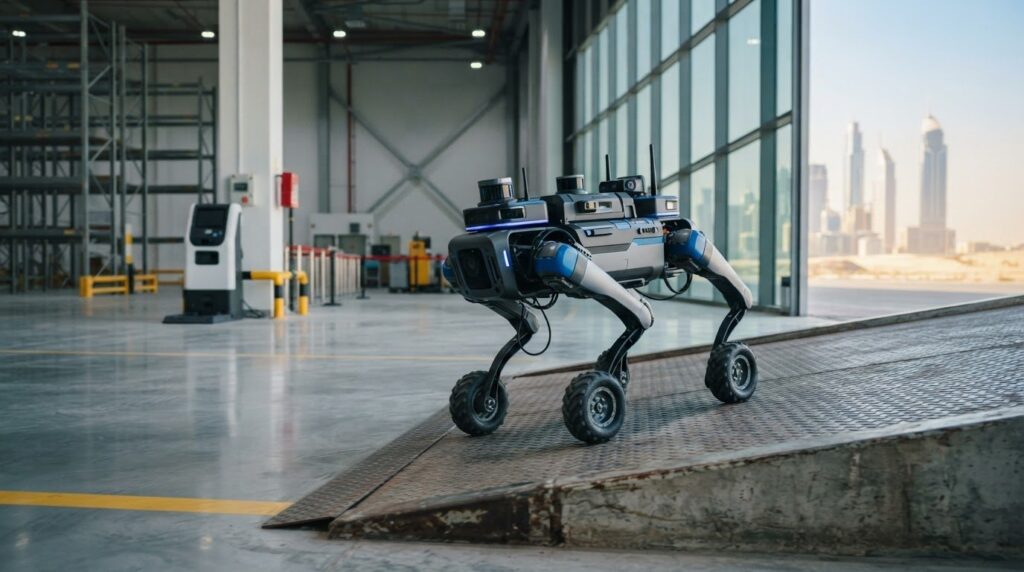
- Quadruped robots: Four-legged machines that climb stairs and step over pipes.
- Wheeled rovers: Fast-moving units perfect for flat, sprawling substations.
- Aerial drones: Flying units that inspect towering cooling units and exhaust stacks.
- Magnetic crawlers: Specialized units that scale the vertical metal walls of boilers.
How AI Inspection Robots Work in Power Plants
Understanding how AI inspection robots work in power plants requires looking at their unique combination of hardware and software. They rely on a seamless, real-time integration of sensitive sensors, edge processing power, and dynamic mobility.
Advanced Sensor Payloads
The true value of an industrial inspection robot lies in the specialized diagnostic equipment it carries. These machines are loaded with high-definition thermal cameras, acoustic sensors, and LiDAR mapping systems.
Thermal imaging allows the robot to instantly spot overheating electrical components before they catch fire. Acoustic sensors listen for the specific high-frequency sounds of pressurized gas or steam leaks that humans cannot hear.
- Optical zoom cameras: Capture high-resolution images of analog gauges and dials.
- Gas sniffers: Detect methane, hydrogen sulfide, and other hazardous emissions.
- Vibration sensors: Measure the structural stability of heavy, rotating machinery.
- Infrared scanners: Identify invisible thermal anomalies in live electrical panels.
Autonomous Navigation and Mapping
AI allows these robots to build highly accurate 3D maps of the power plant in real-time. Using LiDAR and spatial computing, they understand exactly where they are within the facility at any given second.
They do not need a human pilot to guide them via remote control. Operators simply set a schedule, and the robot independently plans the safest, most efficient path to complete its assigned inspection route.
Real-Time Data Processing
AI powered monitoring systems for power plants do not just record video; they analyze the environment instantly. Onboard edge computing processors allow the robot to evaluate data the exact moment it is captured.
If the robot detects a critical issue, such as a major steam leak or a sparking transformer, it immediately alerts human operators. This rapid, on-site processing is essential for preventing localized failures from escalating into facility-wide disasters.
Key Applications in Power Plants
Automated inspection robots for energy facilities perform a wide variety of highly specialized tasks. Their modular adaptability makes them invaluable across many different sectors of a power generation plant.
Boiler and Confined Space Inspections
Boilers are incredibly hostile environments, filled with toxic chemical residue and towering vertical structures. AI inspection robots can easily enter these confined spaces to check for corrosion, blockages, and structural fatigue.
Using magnetic crawlers or small confined-space drones, the robots navigate the vertical walls of the boiler tubes. They capture high-definition visual data that human inspectors would struggle to obtain safely.
- Weld seam inspection: Checking for micro-fractures in critical structural joints.
- Corrosion mapping: Identifying rust and degradation on interior boiler walls.
- Residue analysis: Monitoring the buildup of toxic byproducts inside exhaust vents.
Turbine Monitoring
Turbines are the beating heart of any power plant, and their continuous, flawless operation is vital. Robotic inspection in power plants involves constantly monitoring turbine vibrations, heat signatures, and lubrication fluid levels.
The robots listen to the exact acoustic profile of the spinning turbine blades. If the AI detects a slight change in the sound frequency, it immediately flags the component for predictive maintenance.
High-Voltage Area Surveillance
Substations and high-voltage switchyards carry severe electrocution risks for human personnel. Smart robotic inspection for power generation facilities keeps human workers safely away from these lethal, high-energy hazards.
Robots patrol these zones daily, using thermal cameras to detect hot spots on transformers and circuit breakers. They identify failing insulators long before a dangerous arc flash or power outage can occur.
Benefits of AI Inspection Robots
Deploying AI robots for predictive maintenance in power plants offers massive operational and financial advantages. Facilities that adopt this technology see immediate improvements across multiple key performance metrics.
Drastically Improved Workplace Safety
The most significant benefit of benefits of AI robots for power plant safety is the immediate reduction in human risk. By sending robots into extreme temperatures, high radiation zones, or toxic environments, plants prevent severe injuries and save lives.
Workers are elevated from dangerous physical labor to safe, analytical roles in a remote control room. This fundamental shift completely transforms the safety culture of the entire energy organization.
- Zero confined space entries: Eliminates the need for humans to enter toxic tanks.
- Reduced fall risks: Drones replace humans on high scaffolding and towers.
- Eliminated electrocution hazards: Rovers handle all live substation checks.
Exceptional Return on Investment (ROI)
While the upfront cost of an AI robot is substantial, it pays for itself very quickly. Power plant inspection robots prevent catastrophic equipment failures that would otherwise cost millions in emergency repairs.
They also eliminate the need to build expensive temporary scaffolding for routine manual checks. Furthermore, they significantly reduce insurance premiums by proving to underwriters that the facility maintains rigorous, automated safety standards.
Unmatched Data Accuracy and Consistency
Machines do not suffer from fatigue, boredom, or lapses in concentration at the end of a shift. They perform every single inspection with the exact same level of precision, lighting, and attention to detail.
This robotic consistency allows engineers to track the slow degradation of equipment over time accurately. It forms the perfect foundation of a true predictive maintenance strategy, ensuring parts are replaced precisely when needed.
Real-World Use Cases
Energy companies around the globe are already utilizing power plant inspection robots to protect their critical infrastructure and their workforce.
Nuclear Power Generation
In nuclear facilities, ionizing radiation exposure is the primary concern for any maintenance crew. Facilities use specialized, radiation-hardened AI robots to patrol reactor buildings and handle routine valve checks.
These robots map radiation levels continuously, ensuring the working environment remains stable. They keep human exposure well below strict regulatory safety limits while maintaining operational oversight.
Renewable Energy Substations
Massive solar and wind farms rely on sprawling electrical substations to distribute generated power to the grid. Wheeled AI rovers patrol these remote substations autonomously, checking for overheating solar inverters and damaged transmission cables.
Because these sites are often located miles away from the nearest human maintenance crew, the robots serve as a critical first line of defense. They alert off-site engineers to impending electrical problems instantly.
Coal and Natural Gas Plants
Traditional fossil fuel plants use agile quadrupeds to navigate the complex, multi-level grated flooring of their facilities. These robots sniff out invisible methane leaks and monitor the structural integrity of massive cooling towers.
They operate 24 hours a day, providing facility managers with a continuous, uninterrupted stream of actionable health data.
- Offshore platforms: Robots permanently live on rigs to conduct daily safety rounds.
- Hydroelectric dams: Drones inspect concrete spillways for structural cracking.
- Geothermal plants: Thermal sensors monitor extreme heat variances in steam pipes.
Integration with Smart Energy Systems
AI inspection robots reach their full potential when connected to a broader, facility-wide digital ecosystem. They function as highly mobile nodes within the Industrial Internet of Things (IIoT).
Powering Digital Twins
A digital twin is a highly detailed, 3D virtual replica of the physical power plant. The continuous spatial mapping and sensor data provided by the robots keep this virtual model perfectly synchronized with physical reality.
Engineers use the digital twin to run advanced simulations and plan major maintenance overhauls. The robot ensures that the virtual model always reflects the exact, current state of the facility’s aging machinery.
Cloud Analytics and Machine Learning
Data captured by the robots flows directly into centralized, secure cloud servers. Here, powerful machine learning algorithms analyze historical hardware trends across multiple power plants simultaneously.
This massive global data pool makes the AI smarter and more intuitive over time. The system actively learns to predict equipment failures with astonishing accuracy, shifting the plant from reactive repairs to proactive management.
Challenges and Limitations
Despite their incredible utility, deploying automated inspection robots for energy facilities still presents a few notable hurdles. The robotics technology is rapidly evolving, but some friction remains during initial integration.
Battery Life and Power Management
Navigating complex industrial terrain and processing heavy AI algorithms requires a massive amount of electricity. Most industrial quadruped robots can only operate for two to three hours before needing to dock and recharge.
Facilities must strategically place automated wireless docking stations throughout the plant. This requires careful logistical planning to ensure the robot never runs out of power while deep inside a hazardous zone.
Complex Integration Processes
Integrating a brand-new robotic workforce into legacy power plant systems is often difficult and time-consuming. Older energy facilities may lack the strong, pervasive Wi-Fi or 5G networks required for real-time robotic data transmission.
Companies must invest heavily in upgrading their networking infrastructure before deploying the robots. Without a strong, unbroken wireless connection, the robot cannot transmit its critical findings back to the central control room.
High Initial Deployment Costs
Purchasing the actual robots, recurring software licenses, and specialized sensor payloads requires a significant capital expenditure. For smaller energy cooperatives, this initial price tag can represent a major barrier to entry.
However, as the core technology matures and manufacturing scales up globally, these hardware and software costs are steadily decreasing.
Future of AI Inspection Robots in the Energy Sector
The future of smart robotic inspection for power generation facilities looks incredibly promising. We are only scratching the surface of what these autonomous machines will eventually achieve in heavy industry.
Advanced Robotic Manipulation
Currently, most AI inspection robots simply observe their environment and report issues back to humans. In the near future, they will be equipped with highly dexterous robotic arms powered by advanced spatial AI.
These advanced models will be able to physically intervene during an emergency situation. They will dynamically turn high-pressure valves, flip massive circuit breakers, and perform temporary mechanical repairs entirely on their own.
Autonomous Swarm Operations
Instead of relying on a single robot to patrol a facility, future power plants will deploy entire swarms of specialized machines. Aerial drones, quadrupeds, and magnetic crawlers will communicate directly with each other via local networks to divide tasks efficiently.
If a ground-based quadruped detects a thermal anomaly high up on a boiler, it will automatically dispatch an aerial drone to investigate closer. This collaborative, multi-domain approach will drastically speed up massive facility inspections.
Conclusion
AI inspection robots are fundamentally rewriting the rulebook for power plant safety, efficiency, and maintenance. They offer an elegant, high-tech solution to the heavy energy industry’s most dangerous and expensive operational problems.
By completely removing humans from hazardous industrial environments, these machines prevent severe injuries and save lives. They deliver a constant stream of highly accurate data, enabling predictive maintenance strategies that save energy companies millions of dollars in avoided downtime.
As artificial intelligence models become smarter and robotic hardware becomes more capable, robotic integration will shift from an optional upgrade to a mandatory industry standard. The power plants of tomorrow will be continuously monitored, fiercely protected, and safely optimized by these intelligent machines.
Ready to completely eliminate hazardous manual inspections and secure your power generation facility? Discover exactly how intelligent automation can transform your maintenance strategy, reduce your operational downtime, and protect your workforce.
Contact Ednex Automation today to schedule a comprehensive site evaluation and an interactive robot demonstration!
Serving the GCC Region:
- United Arab Emirates (UAE)
- Kingdom of Saudi Arabia (KSA)
- Qatar
- Oman
- Kuwait
- Bahrain
Frequently Asked Questions (FAQ)
What is an AI inspection robot?
An AI inspection robot is an autonomous machine equipped with sensors, cameras, and artificial intelligence. It navigates complex industrial environments to monitor equipment health, read gauges, and detect safety hazards without human intervention.
How do these robots improve power plant safety?
They take over highly dangerous tasks such as inspecting high-voltage substations, entering confined spaces, and navigating toxic environments. This keeps human workers safely out of harm’s way, drastically reducing workplace accidents and fatalities.
Can AI robots actually fix the problems they find?
Currently, most AI robots focus exclusively on observation, data collection, and anomaly detection. However, next-generation models are actively being developed with robotic arms to perform minor physical repairs, open doors, and manipulate valves.
How do AI robots detect equipment failures before they happen?
They use specialized diagnostic payloads like thermal imaging to spot overheating parts and acoustic sensors to hear pressurized gas leaks. The onboard AI analyzes this data instantly to identify minute deviations from normal operating conditions.
Are AI inspection robots expensive to implement in an older facility?
While the initial investment in robotic hardware and facility network upgrades is significant, the long-term ROI is exceptional. They save facilities money over time by preventing catastrophic equipment failures and reducing costly, unplanned operational downtime.
Author Bio – Ednex Automation
Ednex Automation is a premier provider of industrial robotic solutions and smart facility integrations. We specialize in deploying cutting-edge AI inspection robots, digital twins, and predictive maintenance technologies. Our mission is to help energy companies maximize workplace safety, improve efficiency, and build operational resilience for the future.