High-payload industrial robots are transforming how heavy manufacturing operates by taking over the most demanding physical tasks. These powerful machines handle massive weights with extreme precision, fundamentally changing facility workflows. Factories using them see dramatic increases in throughput, fewer workplace injuries, and significantly lower long-term operational costs.
Implementing heavy-duty industrial robots solves immediate labor shortages while future-proofing your production line. We will explore exactly what these machines are, how they integrate into modern smart factories, and why they represent a critical investment for large-scale operations.
What Are High-Payload Industrial Robots?
High-payload industrial robots are automated robotic systems specifically engineered to lift, move, and manipulate extremely heavy objects, typically those exceeding 100 kilograms and often reaching up to several tons. They combine massive mechanical strength with highly precise control systems. This allows them to perform repetitive, heavy lifting with exact accuracy every single time.
Core Components and Capabilities
These robust systems rely on heavy-duty servomotors, reinforced robotic arms, and specialized end-of-arm tooling (EOAT). Industrial robots in manufacturing use these components to safely grip and transport massive components like car chassis, steel beams, or heavy machinery parts.
Why Weight Capacity Matters
The defining feature of high payload robots for factories is their payload-to-reach ratio. They can maintain their heavy lifting capacity even when extending their arms across large work envelopes. This structural integrity ensures they do not drop loads or lose positional accuracy during intense operations.
Role of High-Payload Robots in Modern Factories
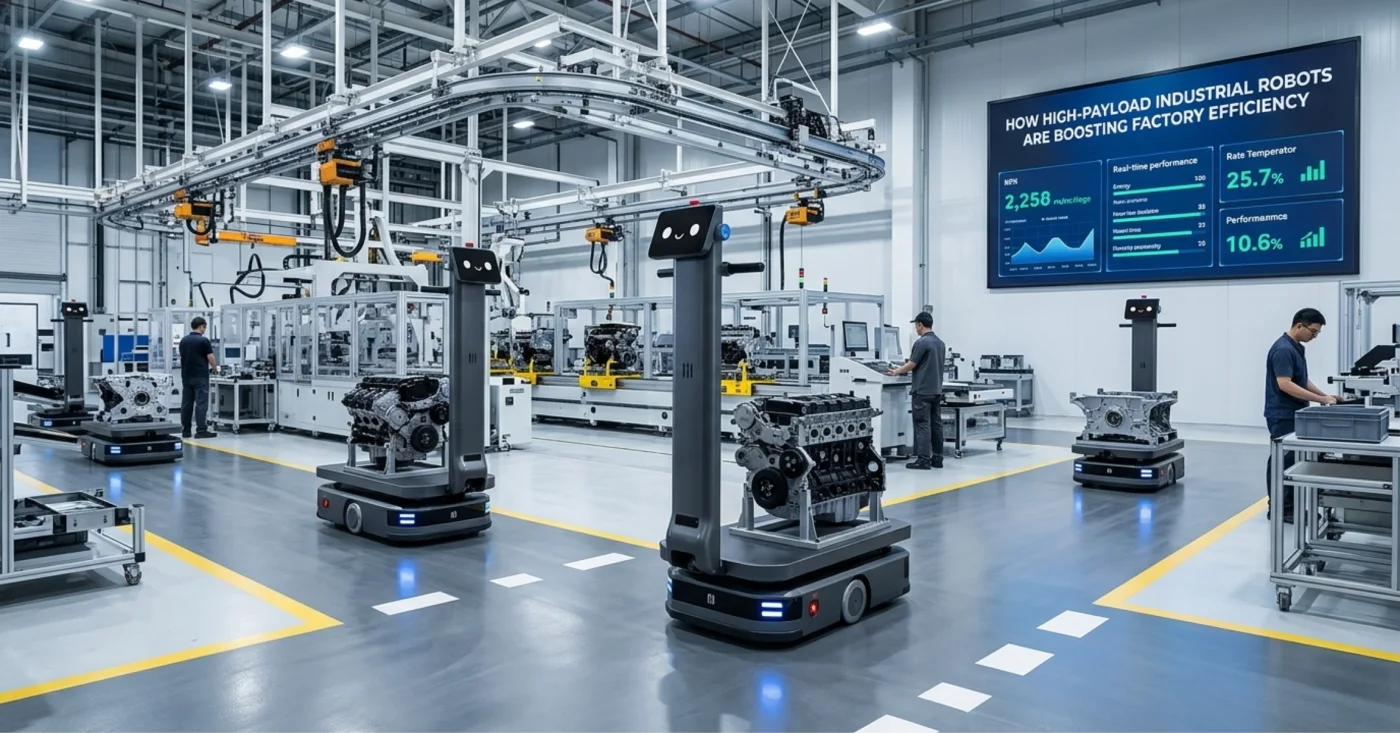
Robotic automation in manufacturing centers heavily on using high-payload machines as the primary movers on the factory floor. They act as the central muscle of production lines, seamlessly transferring heavy work-in-progress materials between different machining stations. Their presence eliminates the need for manual hoists and forklifts in tightly packed production zones.
Streamlining Production Workflows
The integration of industrial robot automation allows facilities to operate continuously without physical fatigue breaks. These robots maintain a constant, predictable pace that helps factory managers accurately forecast production timelines. Factory automation robots synchronize perfectly with conveyor systems and automated guided vehicles (AGVs) to create a smooth, uninterrupted flow of materials.
Common Applications in Manufacturing
Industrial robots for heavy manufacturing tasks excel in environments where human strength is entirely insufficient or poses a severe safety risk. Their applications span across multiple heavy industries, handling tasks that require both immense power and steady precision.
Heavy Material Handling
High payload robots for material handling are primarily used to load and unload heavy raw materials into CNC machines, presses, and forges.
- Metal Foundry: Moving red-hot metal castings safely.
- Construction Materials: Transporting concrete blocks and heavy timber.
- Aerospace: Maneuvering large fuselage sections.
Robotic Palletizing and Lifting Systems
Modern robotic palletizing and lifting systems easily stack heavy bags, boxes, or metal parts onto shipping pallets. They can organize heavy loads in precise geometric patterns to ensure stability during transport. This prevents pallet collapse and maximizes shipping container space.
Spot Welding and Assembly
In automotive manufacturing, heavy-duty arms carry massive spot-welding guns that humans cannot manually operate. They maneuver these heavy tools around vehicle frames with millimeter precision, completing hundreds of complex welds in minutes.
Benefits of High-Payload Industrial Robots
Understanding how high-payload industrial robots improve factory efficiency begins with looking at the direct impact on production speed and safety. These machines offer a massive return on investment by optimizing the most labor-intensive parts of the manufacturing process.
Dramatic Increases in Throughput
The most significant among the benefits of heavy-duty robots in manufacturing is the sheer volume of work they can accomplish. They operate at high speeds 24/7 without slowing down, instantly boosting the total units processed per shift.
Enhanced Workplace Safety
By taking over the heavy lifting, these robots drastically reduce workplace injuries related to overexertion, crushed limbs, and falling objects. Automation solutions for large-scale factories remove human workers from the most dangerous zones on the floor, shifting their roles to system oversight and maintenance.
Unmatched Consistency and Quality
Even when lifting heavy loads, these robots place items with exact precision. This consistency reduces product damage caused by clumsy handling and ensures that heavy assemblies fit together perfectly every time.
Integration with Smart Factory Systems
Smart manufacturing robots do not operate in isolation; they connect directly to a factory’s central digital network. This integration allows production managers to monitor the robot’s performance, health, and output in real-time from a central dashboard.
Leveraging Data for Predictive Maintenance
Modern industrial robots feature built-in IoT sensors that track motor temperature, vibration, and energy usage. By analyzing this data, maintenance teams can replace worn parts before a catastrophic failure occurs, preventing expensive unplanned downtime.
Synchronization with Factory Software
These heavy-duty machines communicate effortlessly with Enterprise Resource Planning (ERP) and Manufacturing Execution Systems (MES). When an order comes in, the software automatically adjusts the robot’s programming to handle the specific heavy materials required for that batch.
Challenges of Implementing High-Payload Robots
While the benefits are clear, deploying massive robotic systems requires careful planning and significant capital investment. Facilities must prepare their infrastructure to support these heavy, powerful machines safely and effectively.
High Initial Costs
Purchasing the robot, the end-of-arm tooling, and the necessary safety fencing requires a substantial upfront budget. However, most facilities recover these costs within a few years through increased productivity and reduced labor expenses.
Floor Space and Foundation Requirements
High-payload robots are massive and require a large physical footprint. Automation solutions for large-scale factories often necessitate pouring reinforced concrete foundations to withstand the intense dynamic forces generated when the robot swings a heavy load.
Specialized Workforce Training
Operating and programming these advanced machines requires a skilled workforce. Factories must invest in training their staff to become robotic technicians who can troubleshoot software and manage routine maintenance.
Real-World Use Cases
AI powered industrial robots for factories are already proving their worth across various global heavy industries. Their versatility allows them to adapt to highly specific and challenging environments.
- Automotive Manufacturing: Heavy-duty arms lift entire car bodies and transfer them between the welding line and the paint shop, entirely replacing overhead crane systems.
- Battery Gigafactories: High-payload robots safely transport massive, multi-ton electric vehicle battery packs, ensuring delicate chemical components are not jolted or dropped.
- Lumber and Steel Mills: Robotic systems sort and stack massive raw steel pipes and heavy timber logs, tasks that previously required dangerous manual rigging.
Future Trends in High-Payload Robotics
The next generation of high-payload industrial robots will feature enhanced artificial intelligence and spatial awareness. Manufacturers are continuously pushing the boundaries of what these heavy lifters can achieve.
AI and Advanced Machine Vision
AI powered industrial robots for factories are gaining the ability to “see” their environment using 3D camera systems. This allows them to locate and pick up heavy, unorganized parts from a bin without needing strict, pre-programmed coordinates.
Heavy-Duty Collaborative Robots (Cobots)
Traditionally, high-payload robots required strict safety cages. New technologies are developing heavy-duty sensors that allow these massive robots to slow down or stop safely when a human worker approaches, blurring the lines between industrial robots and cobots.
Conclusion
High-payload industrial robots are the undisputed heavy lifters driving modern manufacturing success. They provide the raw power needed for intense industrial applications while delivering the precise control characteristic of advanced automation. By investing in these robust systems, manufacturers can drastically increase their operational efficiency, protect their human workforce, and scale their production to meet growing global demands.
Embracing industrial robots in manufacturing is no longer just a technological upgrade; it is a fundamental requirement for staying competitive in heavy industry.
Ready to transform your production line?
Contact Ednex Automation today to schedule a consultation and discover how our high-payload robotic solutions can revolutionize your facility’s efficiency and output.
Serving industries across the GCC:
- Saudi Arabia
- United Arab Emirates (UAE)
- Qatar
- Kuwait
- Oman
- Bahrain
Frequently Asked Questions (FAQ)
What is considered a high-payload industrial robot?
A high-payload industrial robot is generally any robotic arm capable of lifting over 100 kilograms. Some of the largest models can lift payloads exceeding 2,300 kilograms, making them ideal for handling cars, metal castings, and heavy pallets.
How do heavy-duty industrial robots improve safety?
They completely remove human workers from dangerous heavy-lifting tasks. By automating the handling of massive, hazardous materials, factories immediately eliminate the risk of crushed limbs, spinal injuries, and worker fatigue.
Can high-payload robots be reprogrammed for different tasks?
Yes, these robots are highly versatile and fully reprogrammable. By simply changing the end-of-arm tooling and updating the software instructions, a robot used for heavy spot welding can be repurposed for heavy palletizing.
Are AI-powered industrial robots difficult to maintain?
No, they are often easier to maintain due to predictive analytics. Built-in AI and IoT sensors constantly monitor the robot’s physical health, alerting your maintenance team to perform minor servicing long before a major breakdown occurs.
Author Bio: Ednex Automation
Ednex Automation is a leading provider of advanced industrial robotics and smart manufacturing solutions. We specialize in designing and deploying custom automation systems that help factories optimize production, enhance safety, and scale their operations efficiently.