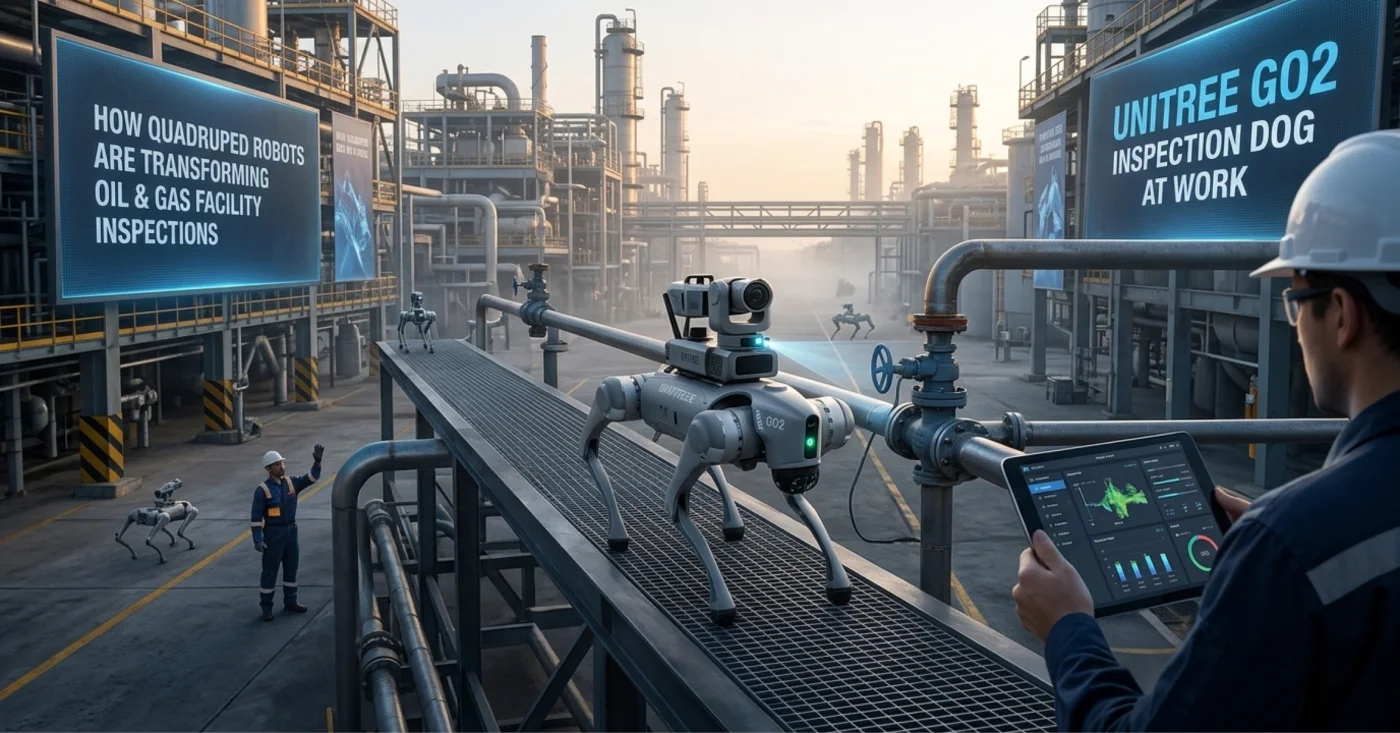
Oil and gas facilities operate in some of the most dangerous and complex environments on earth. Maintaining safety and operational efficiency requires constant monitoring and precise facility inspections.
Traditional manual inspections often put human workers at risk and lead to significant facility downtime. Quadruped robots are changing this reality by taking over hazardous tasks with unmatched precision.
These agile, four-legged machines navigate complex terrains where wheeled robots simply cannot go. They carry advanced sensors, cameras, and gas detectors to monitor equipment continuously.
In this guide, you will learn exactly how these robotic systems work, their key applications, and the major benefits they bring to the energy sector. We will also explore the future of robotic inspection in oil and gas.
What Are Quadruped Robots?
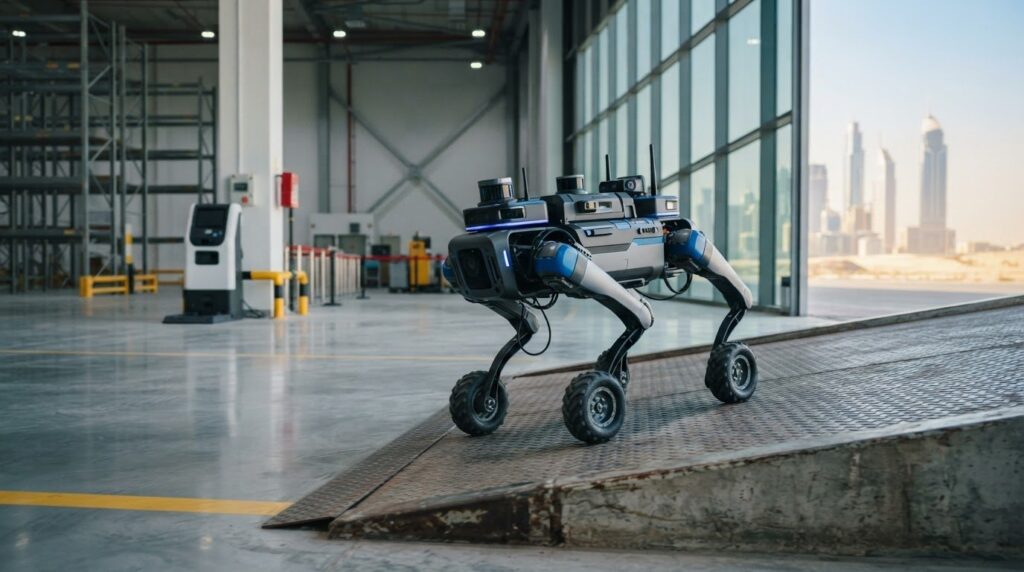
Quadruped robots are four-legged mechanical devices designed to mimic the movement of animals like dogs. Their unique biological design allows them to traverse rough, uneven, and unpredictable terrains.
Unlike wheeled or tracked vehicles, these machines can step over obstacles, climb stairs, and navigate tight industrial spaces. This makes them highly suitable as industrial quadruped robots.
They operate using advanced algorithms and artificial intelligence to maintain balance and avoid collisions. Operators can control them remotely, or the robots can run on fully autonomous pre-programmed routes.
These robots act as mobile sensor platforms in industrial settings. They carry thermal cameras, acoustic sensors, and gas sniffers to gather critical data without human intervention.
Understanding the Role of Cobots in Industry
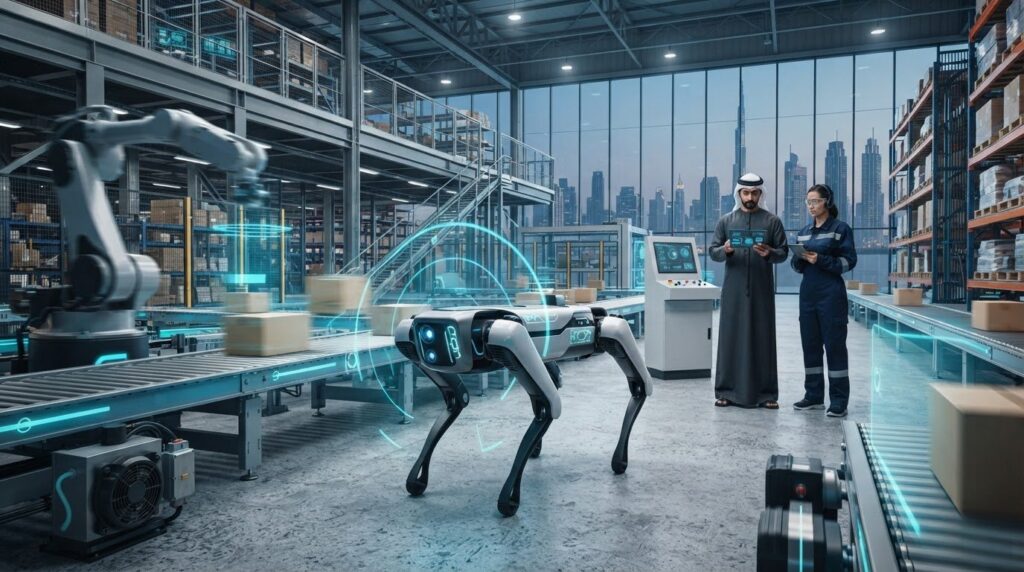
Before diving deeper into quadrupeds, it helps to understand collaborative robots, or “cobots.” Cobots work alongside human workers to enhance productivity and safety rather than completely replacing human labor.
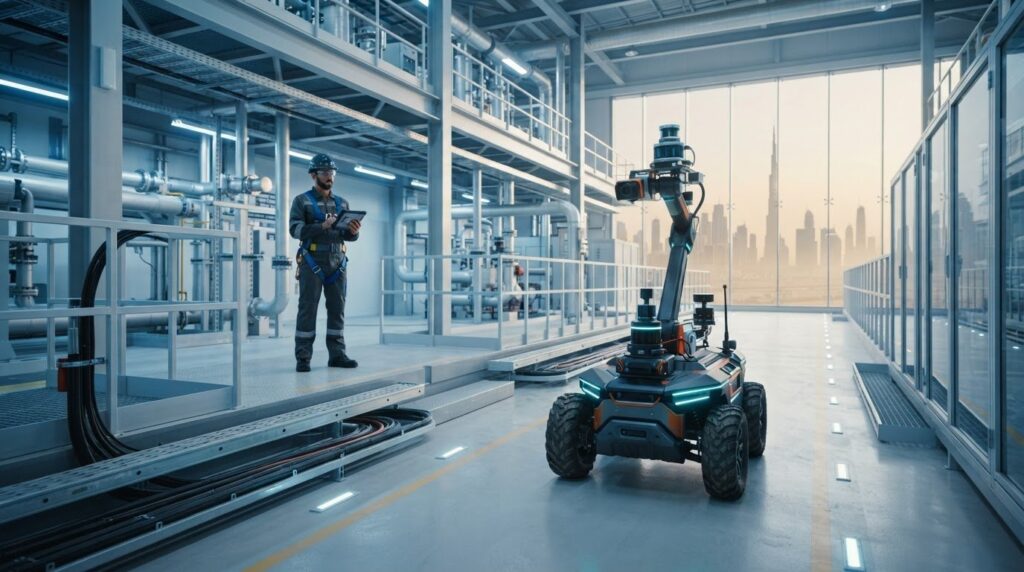
Industrial quadruped robots often function as highly mobile cobots. They handle the dangerous data-collection tasks, while human engineers analyze the data from a safe control room.
This collaboration reduces human exposure to toxic gases, extreme temperatures, and high-pressure zones. It represents a major shift toward safer, smarter industrial operations.
Challenges of Traditional Oil & Gas Facility Inspections
Manual inspections in the energy sector come with severe limitations. Oil and gas inspection robots solve many of the problems that have plagued human inspectors for decades.
High Safety Risks for Human Workers
Sending personnel into active refineries or offshore rigs is inherently dangerous. Workers face exposure to volatile chemicals, extreme heat, and the risk of explosions.
Automated inspection robots for hazardous environments eliminate this risk by doing the physical walkthroughs. Humans remain safely out of the blast zones.
Human Error and Inconsistency
Human inspectors can suffer from fatigue, leading to missed signs of equipment degradation. A slight drop in attention might cause a worker to overlook a small leak or a vibrating pump.
Machines do not get tired or distracted. Autonomous inspection robots deliver consistent, repeatable data every single time they perform a route.
High Costs and Operational Downtime
Shutting down a facility for a comprehensive manual inspection costs millions of dollars in lost production. Scaffolding must be built, and safety protocols carefully managed.
Using robotic inspection solutions for oil and gas plants allows facilities to conduct continuous monitoring while the plant remains fully operational.
How Quadruped Robots Work in Industrial Inspections
How quadruped robots work in oil and gas facilities relies on a blend of cutting-edge hardware and sophisticated software. These machines are marvels of modern engineering.
Advanced Mobility and Kinematics
Four articulated legs give the robot the ability to dynamically shift its center of gravity. It can recover from slips, walk on grated flooring, and crouch under low-hanging pipes.
Artificial Intelligence and Machine Learning
AI inspection robots use machine learning models to understand their surroundings. They map the facility in real-time using LiDAR and stereo vision, creating 3D point clouds of the environment.
Sensor Payloads for Data Collection
The core value of these robots comes from what they carry on their backs. AI powered quadruped robots for facility monitoring integrate various specialized payloads:
- Optical Cameras: For visual inspections of gauges, valves, and structural integrity.
- Thermal Imaging: To detect overheating equipment or hidden pipeline leaks.
- Acoustic Sensors: To listen for the specific high-frequency hiss of a gas leak.
- Gas Detectors: To identify the presence of methane, hydrogen sulfide, or other toxic emissions.
Key Applications of Quadruped Robots in Oil & Gas Facilities
The versatility of these robots makes them invaluable across various segments of the energy industry. Here are the primary applications for robots for oil and gas industry.
Routine Visual and Thermal Inspections
Robots patrol facilities multiple times a day to check analog gauges, read dials, and ensure valves are in the correct position. Their thermal cameras instantly spot anomalous heat signatures in motors and pumps.
Gas Leak Detection and Emissions Monitoring
Fugitive emissions represent a massive safety and environmental concern. Smart robotic inspection for oil and gas industry utilizes gas sniffers to detect incredibly small leaks long before a human would notice them.
Confined Space Entry
Inspecting the inside of storage tanks or pressure vessels requires extensive safety permits and breathing apparatus for humans. Quadrupeds can enter these confined spaces easily, drastically speeding up the turnaround time.
Pipeline Monitoring
Quadruped robots for pipeline inspection walk along exposed pipe corridors to check for corrosion, physical damage, and structural weak points. They navigate the uneven ground beneath the pipes with ease.
Benefits of Using Quadruped Robots
Deploying autonomous robots for oil refinery inspections offers immense advantages for forward-thinking energy companies.
Drastically Improved Worker Safety
The primary benefit is the reduction of human exposure to dangerous environments. Keeping workers out of hazardous zones prevents injuries and saves lives.
Cost Reduction and ROI
While the initial investment is significant, the return on investment comes quickly. Facilities save money by preventing unplanned outages, reducing scaffolding costs, and lowering insurance premiums.
Continuous, High-Quality Data
Automated daily patrols mean engineers have access to a constant stream of high-fidelity data. This enables true predictive maintenance, allowing teams to fix problems before they cause a shutdown.
Real-World Use Cases
Major energy companies are already deploying quadruped inspection robots with great success.
Offshore Oil Rigs
On remote offshore platforms, sending specialized personnel via helicopter is extremely expensive. Quadruped robots now live on these rigs permanently, conducting daily inspections and streaming data back to onshore headquarters.
Liquefied Natural Gas (LNG) Plants
LNG plants require strict temperature monitoring to keep the gas in a liquid state. Robots perform routine thermal scans across the massive facilities, ensuring all cryogenic equipment functions perfectly.
Oil Refineries
In massive, sprawling refineries, autonomous robots for oil refinery inspections follow miles of pre-mapped paths. They check for corrosion and listen for bearing wear in thousands of individual pumps.
Integration with Smart Industrial Technologies
Quadruped robots do not operate in a vacuum. They serve as a crucial mobile link in the broader Industrial Internet of Things (IIoT).
Creating Digital Twins
A digital twin is a virtual replica of a physical facility. The continuous 3D mapping and visual data collected by quadrupeds keep the digital twin perfectly updated in real-time.
Cloud Computing and Analytics
Data collected by the robots uploads instantly to the cloud. Advanced AI algorithms process this massive volume of data to predict equipment failures and optimize maintenance schedules.
Challenges and Limitations
Despite their incredible capabilities, robotic inspection solutions for oil and gas plants still face some hurdles.
Battery Life and Power Constraints
Walking requires a massive amount of energy compared to rolling on wheels. Most quadruped robots currently max out at around 90 to 120 minutes of continuous operation before needing to dock and recharge.
Hazardous Location Certifications
Equipment used in volatile environments must be intrinsically safe (ATEX or C1D1 certified) to prevent sparks. Creating a fully certified quadruped robot that meets these strict explosion-proof standards is difficult and expensive.
High Initial Deployment Costs
The hardware, software licenses, payload integration, and training require a large upfront budget. Smaller operators may find the initial barrier to entry challenging.
Future of Quadruped Robots in Industrial Inspections
The technology behind autonomous inspection robots is advancing at a staggering pace. The next decade will see massive transformations.
Fully Autonomous Swarm Robotics
Future facilities will not rely on just one robot. We will see fleets of quadrupeds working together autonomously, communicating with each other to divide tasks and cover large areas rapidly.
Enhanced Manipulation Capabilities
Currently, most quadrupeds only observe and report. Soon, they will feature highly advanced robotic arms capable of physically turning valves, opening doors, and performing minor mechanical repairs.
The Growing Role of Robotic Automation in the Oil and Gas Sector
The transition toward AI inspection robots is part of a larger automation trend sweeping the energy sector. Companies realize that digital transformation is essential for survival.
As environmental regulations tighten, the ability to monitor and prevent emissions automatically will become mandatory. Automation bridges the gap between traditional heavy industry and modern environmental responsibility.
The companies that embrace robotic inspection in oil and gas today will hold a massive competitive advantage in safety, efficiency, and profitability tomorrow.
Conclusion
Quadruped robots are fundamentally changing how the energy sector manages its infrastructure. They provide a safer, faster, and more accurate way to monitor complex industrial environments.
By integrating AI, advanced sensors, and unparalleled mobility, these machines eliminate the need to put humans in harm’s way. They detect leaks, spot overheating equipment, and deliver actionable data continuously.
While challenges like battery life and high initial costs remain, the rapid pace of innovation is quickly solving these issues. The future of the oil and gas industry is undoubtedly automated, and four-legged robots are leading the charge.
Ready to enhance safety and automate inspections at your facility? Discover how advanced robotics can transform your operations. Contact Ednex Automation today to schedule a personalized consultation and robot demonstration!
Serving the GCC Region:
- United Arab Emirates (UAE)
- Kingdom of Saudi Arabia (KSA)
- Qatar
- Oman
- Kuwait
- Bahrain
Frequently Asked Questions (FAQ)
What is a quadruped robot?
A quadruped robot is a mechanical device with four legs designed to navigate complex and uneven terrains. They use AI and sensors to maintain balance and avoid obstacles.
How do quadruped robots help in the oil and gas industry?
They perform hazardous inspections, detect gas leaks, monitor equipment temperatures, and map facilities. This keeps human workers safe and reduces facility downtime.
Can quadruped robots operate autonomously?
Yes. Operators can program these robots to follow set routes and conduct inspections completely on their own. They dock themselves to recharge when their batteries run low.
Are these robots safe to use in explosive environments?
Many manufacturers are currently developing intrinsically safe (ATEX/C1D1 certified) versions. These specialized models prevent electrical sparks, making them safe for volatile zones.
How much does a quadruped inspection robot cost?
Costs vary widely based on the sensor payloads and software integrations. A fully equipped industrial robot can range from tens of thousands to over a hundred thousand dollars.
Author Bio – Ednex Automation
Ednex Automation is a leading provider of cutting-edge robotic and automation solutions for the industrial sector. We specialize in integrating advanced AI, quadruped robots, and IoT technologies to help energy companies improve safety, increase efficiency, and drive digital transformation across their facilities.