Manufacturing facilities across the UAE and GCC are rapidly upgrading their operations to stay globally competitive. Next generation industrial robots offer unprecedented flexibility, challenging the dominance of traditional robotic arms. Facility managers must now choose between specialized machines and versatile humanoid systems.
You need the right automation strategy to maximize production and minimize downtime. Traditional industrial robots excel at high-speed, repetitive tasks in fixed locations. However, new humanoid models are designed to step into human workspaces and handle varied, complex duties.
This post delivers a comprehensive industrial robotics comparison to help you make informed decisions. We will explore the exact capabilities of both systems, highlight their distinct differences, and explain how to apply them to your production floor.
The Evolution of Automation Technology
Factory automation traditionally relied on massive machines bolted to the floor. These systems require strict safety cages and absolute predictability to function correctly. While incredibly fast, they lack the ability to adapt to sudden changes in their environment.
Today, advanced artificial intelligence and agile mechanics are changing the rules of manufacturing. Next generation industrial robots can walk, balance, and use tools originally designed for human hands. This shift opens entirely new possibilities for automating tasks previously thought impossible for machines.
What Defines Traditional Industrial Robots?
Traditional industrial robots are highly specialized machines built for singular, repetitive tasks. You typically see them welding car frames, palletizing heavy boxes, or assembling electronics on a fast-moving conveyor belt. They offer unmatched speed, precision, and heavy-lifting capabilities within a strictly controlled zone.
These machines demand significant infrastructure changes before installation. You must build safety enclosures, program precise coordinates, and ensure human workers never enter their operational radius. They are incredibly efficient but completely inflexible if your product line suddenly changes.
Enter the Unitree G1 Humanoid Robot
The Unitree G1 Humanoid Robot represents a massive leap forward in general-purpose automation. It mimics the human form, featuring articulated arms, hands, and legs driven by sophisticated AI algorithms. This allows it to navigate stairs, step over obstacles, and operate machinery designed for human workers.
Unlike fixed robotic arms, the Unitree G1 thrives in dynamic, unstructured environments. It uses advanced vision systems and force sensors to understand its surroundings in real-time. This robot learns by imitating human movements, making it incredibly versatile for tasks that require a delicate touch.
Humanoid Robots vs Industrial Robots: Core Differences
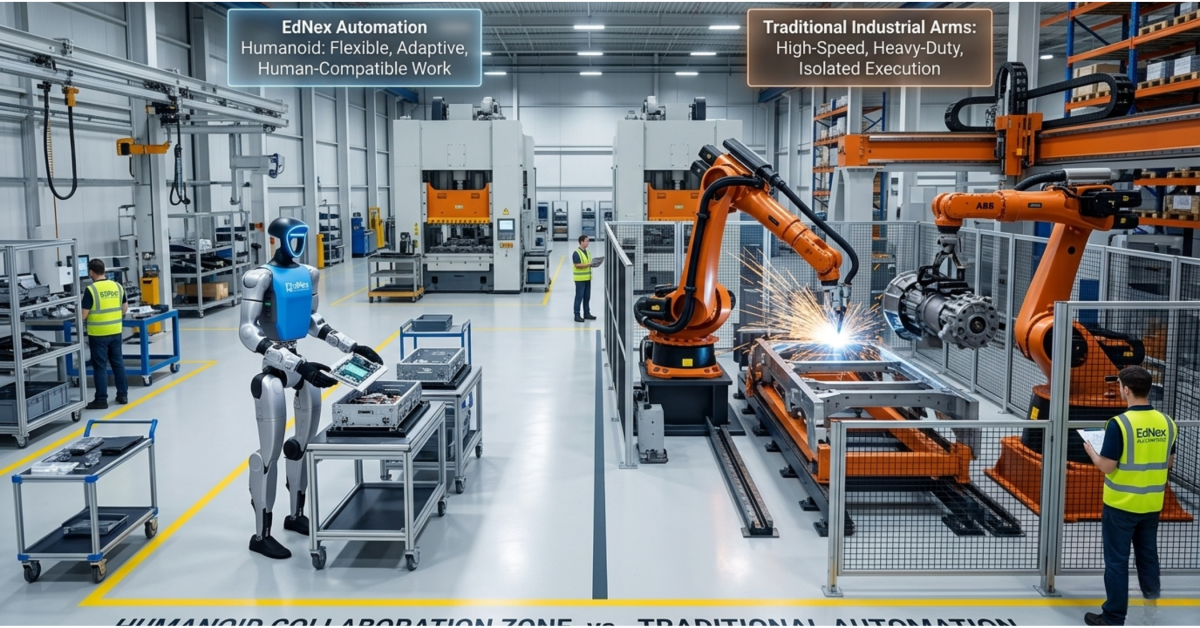
Comparing humanoid robots vs industrial robots reveals fundamentally different approaches to facility automation. Your choice depends entirely on whether your facility prioritizes raw speed or operational flexibility.
Flexibility and Physical Mobility
Mobility is the most obvious difference between these two technologies. Traditional industrial robots remain bolted to a single workstation for their entire lifecycle. If you need a robot on the other side of the factory, you must unbolt it, move it, and recalibrate the entire system.
The Unitree G1 Humanoid Robot walks freely across your entire facility. You can deploy it to the warehouse in the morning for inventory checks and move it to the assembly line in the afternoon. Its bipedal design allows it to navigate narrow aisles and standard staircases seamlessly.
Task Specialization vs. Generalization
Fixed robotic arms are masters of specialization. They will perform the exact same weld or placement millions of times without a millimeter of deviation. However, if a part arrives slightly out of alignment, the traditional robot will fail or damage the product.
Humanoids are masters of generalization and adaptability. The Unitree G1 Humanoid Robot adjusts its grip, angle, and force dynamically based on what it sees and feels. It handles variable tasks that require visual confirmation and physical adjustments, much like a human operator.
Space Requirements and Safety Infrastructure
Implementing fixed automation requires a massive footprint on your factory floor. You must install physical safety fences, light curtains, and emergency stop systems to protect human workers. This infrastructure consumes valuable floor space and creates rigid operational zones.
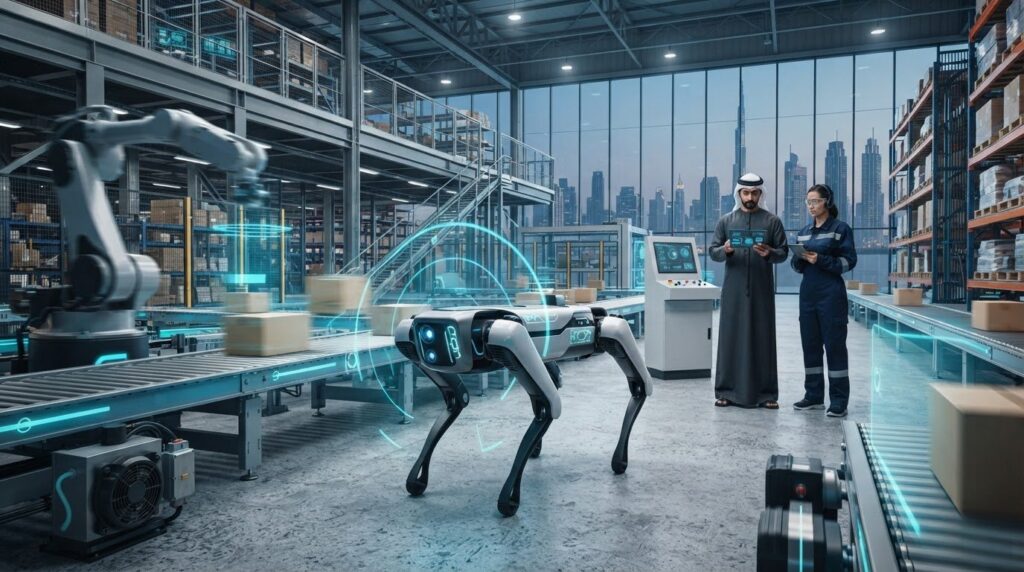
Humanoid robots are built specifically to share workspaces with people. The Unitree G1 Humanoid Robot features collision detection and force-limiting joints. If it bumps into a human worker, it stops instantly, eliminating the need for expensive safety cages.
Exploring Humanoid Robots in Manufacturing
Integrating humanoid robots in manufacturing solves critical labor shortages and ergonomic challenges. They step directly into roles that are too dangerous, dirty, or dull for human workers, without requiring a complete factory redesign.
Adapting to Human-Centric Workspaces
Most factories in the UAE were built around human proportions and capabilities. Shelves are positioned at human height, and tools feature handles designed for human fingers. Humanoid robots in manufacturing utilize this existing infrastructure perfectly.
You do not need to buy specialized end-effectors or redesign your workstations. The robot simply picks up the standard drill or inspection tool and goes to work. This plug-and-play capability drastically lowers the hidden costs of automation.
Handling Complex, Unstructured Tasks
Modern manufacturing often involves high-mix, low-volume production runs. This requires constant changeovers and varied assembly steps. Humanoids excel here by rapidly learning new tasks through AI-driven imitation learning.
- Machine Tending: Loading and unloading CNC machines without rigid part fixtures.
- Quality Inspection: Walking the floor to visually inspect products from multiple angles.
- Logistics: Picking varied, non-standard items from warehouse bins.
- Maintenance: Carrying tools and assisting human technicians with heavy or awkward repairs.
A Complete Industrial Robotics Comparison
A thorough industrial robotics comparison requires looking at long-term financial impacts. Both systems offer strong returns on investment, but they deliver those returns on entirely different timelines.
Implementation Time and Complexity
Setting up traditional industrial robots takes months of planning, engineering, and custom programming. You must hire specialized integration engineers to map every millimeter of the robot’s movement. Any change to the product line requires weeks of reprogramming and testing.
Deploying a humanoid is significantly faster and more intuitive. Operators teach the Unitree G1 Humanoid Robot by physically guiding its arms through a task or using virtual reality. The AI learns the intention behind the movement, allowing for rapid deployment in days rather than months.
Upfront Costs vs. Total Cost of Ownership
Traditional automation requires massive upfront capital for the robot, the safety cage, the custom grippers, and the programming. However, their lifespan spans decades, and their speed guarantees a high production output for standardized parts.
Humanoid robots carry a different cost structure. While the initial hardware is advanced, you save substantially on safety infrastructure and custom tooling. The true value lies in their versatility; one humanoid can replace multiple specialized machines by performing different tasks throughout the day.
Why the GCC Manufacturing Sector Needs Both
The UAE and GCC regions are pushing hard toward Industry 4.0 and smart manufacturing. To achieve true global competitiveness, facility managers should not view this as an either/or choice. The most efficient factories will utilize both technologies in tandem.
Use traditional industrial robots for your heavy, high-speed, and perfectly standardized production lines. Let them do the heavy lifting where raw speed translates directly to profit.
Deploy the Unitree G1 Humanoid Robot to bridge the gaps between those automated islands. Use them for logistics, quality control, custom assembly, and tasks that currently cause human ergonomic strain. This hybrid approach maximizes both throughput and operational agility.
Ednex Automation: Your UAE Robotics Partner
Implementing advanced robotics requires deep technical expertise and reliable local support. Ednex Automation leads the UAE and GCC markets in deploying cutting-edge manufacturing solutions. We help you choose the exact right mix of fixed and mobile automation for your specific facility.
Our team analyzes your production bottlenecks and recommends the most profitable automation path. Whether you need a high-speed robotic arm or the versatile Unitree G1, we handle the integration, training, and ongoing maintenance to guarantee your success.
Conclusion
Manufacturing success relies on choosing the right tool for the right job. Traditional industrial robots deliver unmatched speed for fixed tasks, while the Unitree G1 Humanoid Robot offers incredible flexibility for dynamic environments. Combining these technologies allows you to build a highly resilient, future-proof production facility.
Ready to explore how advanced robotics can transform your manufacturing operations? Contact Ednex Automation today to schedule a comprehensive facility audit in the UAE or GCC.
Frequently Asked Questions
The Unitree G1 Humanoid Robot is an advanced, bipedal robot designed to mimic human movement and dexterity. It uses artificial intelligence to learn tasks, balance autonomously, and safely operate tools within human-centric workspaces.
Traditional industrial robots require physical safety cages and will severely injure a person if they cross its path. Humanoid robots feature force sensors and AI vision to detect humans instantly, safely stopping on contact without requiring safety fences.
Traditional industrial robots excel in high-speed, high-volume manufacturing. They are best suited for repetitive tasks like spot welding, heavy palletizing, and precise assembly where the product and environment never change.
The biggest benefit is incredible versatility. Humanoid robots in manufacturing can walk between workstations, use standard human tools, and adapt to unstructured environments. They can perform multiple different tasks in a single shift.
Yes, Ednex Automation provides complete, localized support across the UAE and GCC. We handle facility assessments, hardware integration, customized software setup, and 24/7 technical maintenance for all robotic systems.