What if recurring defects and production stoppages point less to operator mistakes than to a process that makes errors easy to repeat? Reducing human error in production lines starts with looking beyond blame to the conditions shaping each task, from unclear instructions and demanding workloads to difficult interfaces and inconsistent controls.
When defects return, rework grows, or production is interrupted, it’s understandable to look for a quick fix. But adding automation before identifying the source of an error can introduce cost and complexity without resolving the underlying issue. A more reliable approach is to pinpoint where mistakes occur, examine what contributes to them, and make the correct action easier to perform.
This guide explains how to identify error patterns, assess process, training, interface, and workload factors, and choose proportionate controls. It also covers where collaborative robots, inspection robots, and PLC and SCADA integration can support repeatable tasks while maintaining appropriate human oversight. The result is a practical improvement path that considers automation when it fits the line and its operational needs.
Key Takeaways
- Reducing human error in production lines begins with tracing recurring defects, delays, and near misses to the conditions surrounding the work.
- Map task steps and record where problems occur to distinguish process, training, interface, and workload factors before choosing a fix.
- Match controls to the error pattern, from clearer instructions and visual cues to mistake-proofing and targeted automation.
- Establish consistent baseline measures, pilot changes, and review their effect on quality and process performance.
- Robotics and PLC and SCADA integration can support repeatable workflows while keeping human oversight appropriate.
Reducing Human Error in Production Lines Starts With Understanding the Error
Reducing human error in production lines begins with understanding what happened and under what conditions, not immediately assigning blame. In production, a human error is an action or omission that contributes to an unintended process outcome. It might be a missed inspection, an incorrect assembly sequence, or a component placed in the wrong position. The action is the observable event; the conditions that made it more likely are a separate part of the investigation.
The broader study of Human error distinguishes categories such as slips, lapses, and mistakes. On a production line, a slip might be selecting the wrong control while intending to choose the correct one. A lapse could mean forgetting a required check, while a mistake may stem from misunderstanding an instruction or applying an incorrect assumption.
What counts as human error on a production line?
Errors can have different causes, even when they lead to the same defect. A worker may follow a procedure that omits a critical verification step, struggle to distinguish similar interface indicators, or receive delayed feedback that an operation was incomplete. Each scenario points to a different contributing condition and may need a different response.
Separate the immediate action from the system around it. If a component is misplaced, record what happened and examine whether the parts were difficult to distinguish, the work area was crowded, or the instructions clearly showed the correct orientation. This keeps the review grounded in evidence rather than assumptions about intent or capability.
Why does a blame-first response fail to prevent repeat errors?
Punishment can discourage people from reporting mistakes, near misses, or confusing steps. The underlying issue then remains: an unclear procedure stays unclear, an interface still gives weak feedback, and the next shift may face the same conditions. Accountability matters, but it cannot replace a review of how the work is designed and performed.
A learning-focused review considers the task, equipment, work environment, and training together. Ask what the person was expected to do, what information and feedback were available, and whether workload or interruptions affected the task. Several factors can combine, and people can make mistakes even when trained and attentive. Understanding those interactions provides a stronger basis for preventing recurrence than treating one visible action as the whole cause.
Find the Conditions Behind Production-Line Errors Before Choosing a Fix
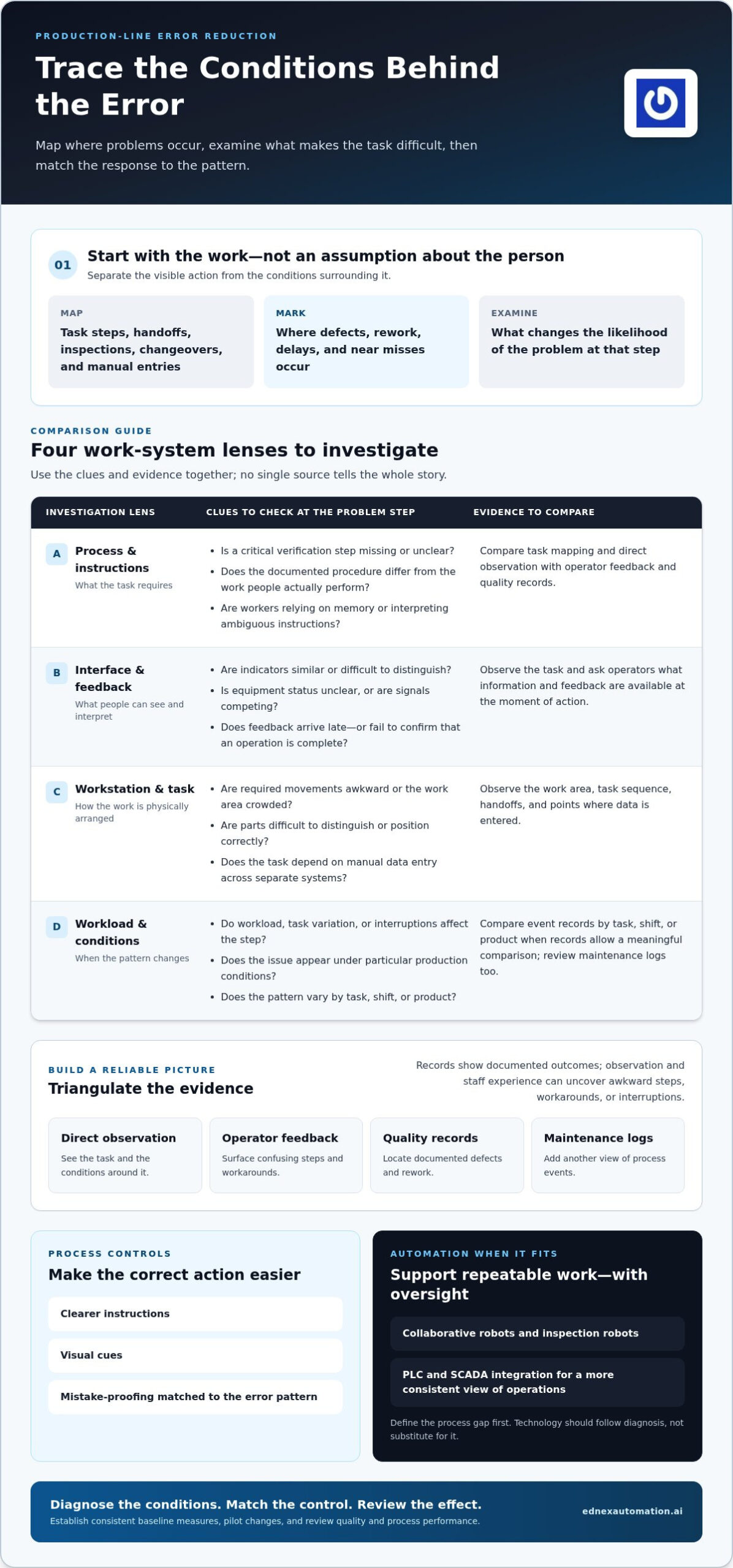
Trace the work from start to finish before selecting a control or technology. Map each task step, handoff, inspection, changeover, and point of manual data entry. Then mark where defects, rework, delays, or near misses occur. This creates a shared view of the process and helps teams distinguish recurring patterns from isolated events.
Recurring errors often signal a mismatch between task demands and work-system design. The mismatch may be tied to one specific step or emerge only under particular production conditions. First establish where and when the problem occurs, then investigate what changes its likelihood.
How can teams identify error-prone steps and patterns?
Combine direct observation with operator feedback, quality records, and maintenance logs. Each source has limits: records show documented outcomes, while observation and staff experience can reveal awkward steps, workarounds, or interruptions that reports may not capture. Compare the evidence instead of treating any one source as a complete account.
- Map handoffs, inspections, changeovers, repetitive tasks, and manual entries.
- Record the process stage and type of event, including rework and near misses.
- Compare findings by task, shift, or product when records allow a meaningful comparison.
Keep reporting focused on learning and work conditions. A fair process makes it easier to surface small problems before they recur or contribute to a larger disruption.
Which system conditions should an investigation examine?
At the problem step, assess whether instructions are clear, the workstation supports the required movements, and relevant parts or indicators are easy to see. Consider workload, task variation, interruptions, and whether workers receive timely feedback confirming an action or signalling the next step. Examine alarms and control interfaces too: unclear status or competing signals can make the correct response harder to identify.
Look for differences between the documented process and the process people actually perform. If a step depends on remembering information, interpreting an ambiguous display, or entering data across separate systems, document that dependency and how errors are detected. Human-factors guidance, including resources from the Human Factors and Ergonomics Society, can inform reviews of how people interact with equipment and work systems.
When process visibility or control logic is part of the problem, PLC and SCADA integration can support a more consistent view of operations. Define the specific gap the integration should address first. Technology should follow diagnosis, not substitute for it. For teams assessing that fit, EdNex Automation’s industrial automation solutions provide a relevant point of reference.
Compare Process Controls and Automation for Reducing Human Error
Once an error pattern is clear, match the intervention to the task instead of defaulting to new equipment. The right control depends on the error mechanism and task variability. A missed check may call for a prompt or checklist; a repeated, well-defined handling step may suit targeted automation. The comparison below outlines where each option can help and what it cannot solve on its own.
| Intervention | Best suited to | Potential benefit | Limitation |
|---|---|---|---|
| Clearer standard work | Steps performed inconsistently | Defines the expected sequence and method | Instructions must reflect actual work and stay current |
| Visual cues | Selection, orientation, or status errors | Makes the correct part, position, or next step easier to recognise | Cluttered or outdated cues can add confusion |
| Checklists | Tasks with required verification points | Prompts completion of steps that may be overlooked | Can become a box-ticking exercise if poorly designed |
| Poka-yoke | A likely mistake can be blocked or detected at the point of work | Prevents an incorrect action or signals it immediately | Must account for variations in products and procedures |
| Interface improvements | Incorrect selections or unclear equipment status | Clarifies choices, feedback, and next actions | Changing a display won’t fix a flawed process behind it |
| Targeted automation | Defined, repeatable operations | Reduces selected manual steps and supports consistency | Requires suitable integration, oversight, and process design |
When are standard work, visual controls, or poka-yoke enough?
For stable, routine tasks, make instructions concise and place visual status cues where decisions happen. Poka-yoke means designing a task or process to prevent a likely mistake or reveal it immediately, such as using a fixture that accepts a component only in the intended orientation. Review these controls whenever products, procedures, or operating conditions change. A safeguard that once helped can become misleading if the work changes.
When can robotics and control systems support more consistent work?
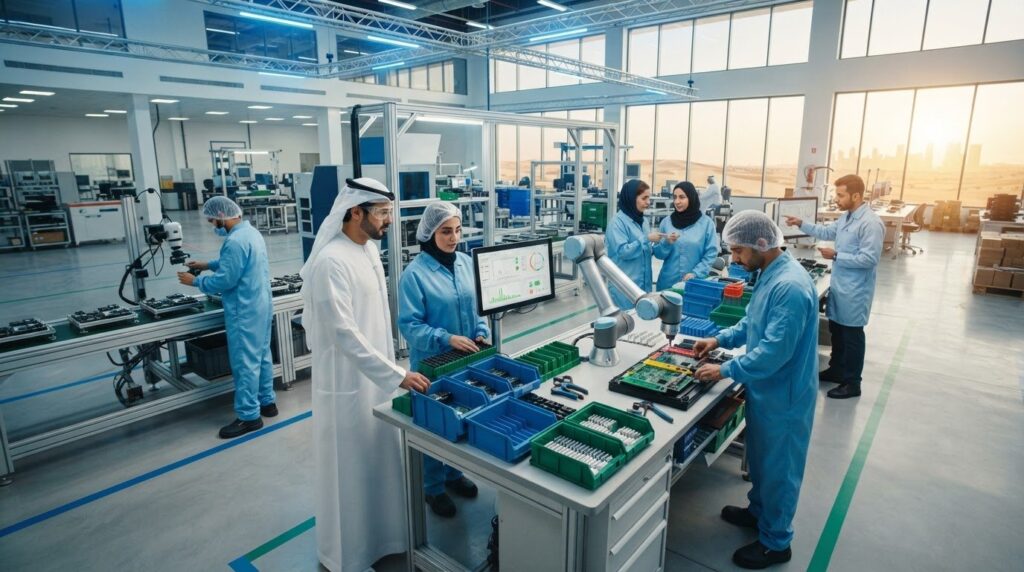
Collaborative robots can support suitable repetitive operations, while people retain oversight and handle judgment-based work. Each application needs a task-specific risk assessment, including how workers interact with the equipment. PLC and SCADA integration can coordinate equipment and make process states more visible, supporting a consistent workflow. Neither can correct unclear instructions by itself. For human-robot collaboration context, see this collaborative robots strategic guide.
Because reducing human error in manufacturing involves balancing control with practical work needs, select technology only after defining the task and the problem it should address. EdNex Automation supplies and integrates robotics and industrial systems, including relevant robotics and integration options described in its industrial automation capabilities.
How to Implement a Production-Line Error-Reduction Plan
A practical plan turns diagnosis into a controlled change, then checks whether it improves the work without creating new problems. Begin with a clear baseline: define what counts as a defect, rework event, near miss, or process interruption, and record each measure consistently. Where production volume varies, compare rates against a consistent denominator, such as units produced, rather than relying on raw totals alone.
What steps should a manufacturer take from diagnosis to pilot?
Prioritise one well-defined error pattern using its frequency, operational impact, and the strength of the evidence. Choose a control that addresses its likely cause. A missed verification step, for example, may call for a revised instruction or prompt, while a repeatable task with a clearly defined sequence may be suitable for a targeted automation pilot.
Before the pilot starts, assign an implementation owner and, where practical, a separate person to review results. Brief the affected team on what is changing, why, and how to report unexpected outcomes. Document the revised work method, operating limits, and escalation steps so people know what to do if the process behaves differently than expected. Capture operator feedback throughout the pilot, including workarounds, usability issues, and constraints that could affect consistent use.
How should teams evaluate and sustain improvements?
Track measures tied to the original problem, such as defects, rework, near misses, or interruptions. Also check workflow effects: a control that reduces one error but creates delays or shifts the problem to another process stage needs further adjustment. Don’t treat one favourable result over a short period as proof of lasting improvement. Review the measure across comparable operating conditions and note changes in product mix, staffing, production volume, or procedures that could influence the comparison.
Use a simple review cycle:
- Compare: Review baseline and pilot results using the same definitions and measurement periods.
- Learn: Discuss the results with operators and investigate unexpected effects, not just the target metric.
- Adjust: Refine the control, instructions, training, or settings when evidence points to a gap.
- Sustain: Revisit the measure after changes to products, equipment, or operating procedures.
For automation pilots, keep appropriate human oversight and define how exceptions will be identified and escalated. A repeatable review process helps determine whether a change is ready to expand, needs refinement, or should be replaced. To explore robotics and industrial automation options for a defined production need, review EdNex Automation’s solutions.
Where EdNex Automation Fits in a Human-Error Reduction Strategy
Automation is most effective when it addresses a defined process need within a broader improvement plan. Across the UAE, EdNex Automation supplies and integrates robotics and industrial systems for commercial and industrial operations. Start with the work itself: identify the recurring error, clarify what the process needs to do, and determine whether a technology-supported control is a proportionate fit.
Which automation capabilities may support production consistency?
Different technologies address different operational needs. They aren’t interchangeable, and no single option suits every production line.
- Collaborative robots (cobots): Can support suitable repeatable operations where people and machines need to coordinate. The task, workflow, and human oversight requirements should guide the application.
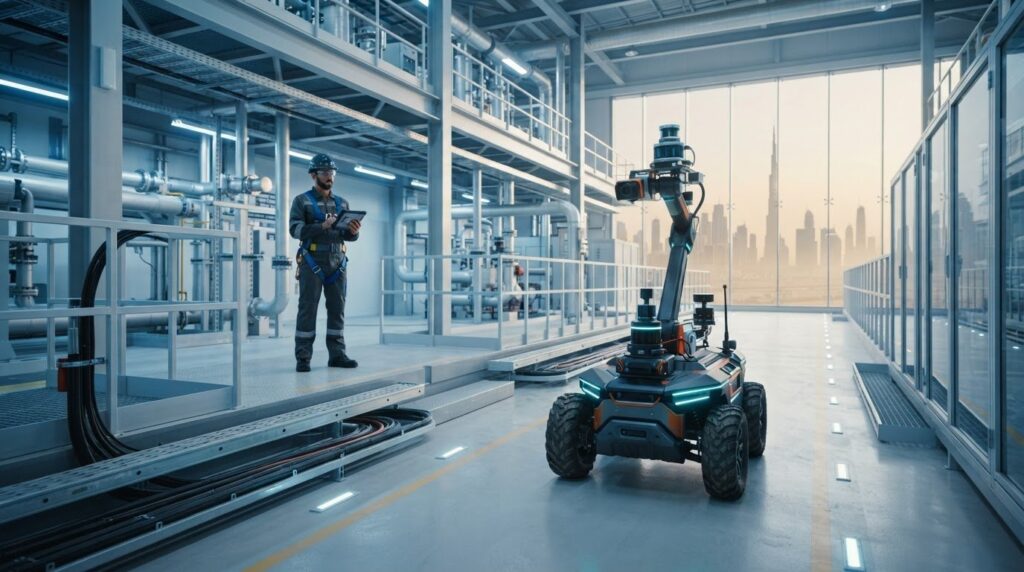
- Inspection robots: Can support repeatable inspection tasks when the application and inspection requirements are appropriate. They complement defined inspection processes rather than resolving unclear acceptance criteria.
- PLC and SCADA integration: Can connect equipment behaviour with process monitoring and control, helping make operating states more visible and workflows more consistent.
- Autonomous mobile robots (AMRs) and ASRS: Can be relevant where material movement or storage and retrieval processes are part of the operational challenge.
These systems can reduce selected manual steps or improve process visibility, but they don’t independently correct ambiguous instructions, unsuitable workflows, or poorly defined responsibilities. Appropriate human oversight helps teams manage exceptions and respond when actual conditions differ from the expected process.
How can manufacturers take the next step with EdNex Automation?
Before selecting an approach, define the task and the pattern you want to address. Specify where the error recurs, which operational outcome matters, and how the current process is performed. This provides a practical basis for assessing whether robotics, control-system integration, or a process adjustment is the right direction.
EdNex Automation supplies and deploys robotics and integrates industrial systems, including PLC and SCADA systems and Automated Storage and Retrieval Systems (ASRS). Start with the operational need and the existing workflow, then assess how the technology can support a clear purpose rather than add complexity for its own sake. As part of reducing human error in production lines, automation should strengthen a well-understood process and be evaluated against the conditions it was selected to address.
Ready to explore a defined production need? Explore industrial automation solutions with EdNex Automation.
Build a More Reliable Production Line, One Control at a Time
Reducing human error in production lines starts with understanding how work is actually performed. Identify recurring error patterns, examine the conditions behind them, and choose controls that make correct work easier. Clear instructions or mistake-proofing may be enough for some tasks; others may benefit from carefully selected automation.
Measure changes against a consistent baseline, involve the people who use the process, and review whether improvements hold without creating new workflow problems. This disciplined approach helps manufacturers across the UAE modernise with purpose rather than adding technology for its own sake.
EdNex Automation supplies and integrates robotics and industrial systems for commercial and industrial operations, including cobots, inspection robots, PLC and SCADA integration, AMRs, and ASRS. The right approach depends on your task, existing workflow, and operational goals. Discuss an industrial automation approach with EdNex Automation and take the next step towards more consistent production.
Frequently Asked Questions
Is human error the main cause of production-line defects?
Not necessarily. A defect can result from several interacting conditions, such as unclear instructions, equipment design, material variation, workload, or process controls. Treating an incident only as an individual failure can leave these contributors untouched. Review the task and operating context alongside the event, then compare quality and process evidence to identify recurring, actionable conditions. This helps distinguish an isolated outcome from a pattern that calls for a process change.
How can manufacturers reduce human error on a production line?
Start by defining the recurring error pattern and mapping the work step where it occurs. Gather operator feedback, then review relevant quality, maintenance, and process records to understand contributing conditions. Match controls to likely causes: clarify standard work, improve visual feedback, add mistake-proofing, or automate a suitable repeatable task. Pilot the change and measure relevant outcomes consistently. Reviewing results and updating procedures as conditions change makes reducing human error in production lines an ongoing improvement effort.
Can automation eliminate human error in manufacturing?
No. Automation can reduce selected manual steps and support more consistent processes when the task, equipment, and integration are suitable, but it cannot eliminate every human error. It can also introduce new interface, maintenance, or workflow considerations. Assess the complete work system, retain appropriate human oversight, and evaluate performance under representative operating conditions. A focused pilot can help determine whether the technology addresses the intended error pattern without shifting problems elsewhere.
What happens if operators keep repeating the same production mistake?
A recurring mistake signals a need to examine the work system, not simply repeat a correction or retraining. Check whether instructions are clear, the task is feasible, feedback is visible, and equipment and materials behave consistently. Compare instances across process stages and operating conditions to see where the pattern occurs. Then test a targeted control and monitor whether the error changes. This approach can reveal whether the underlying issue is procedural, environmental, or related to task design.
Are checklists enough to prevent mistakes on production lines?
Checklists can make required steps visible and consistent, particularly for tasks with a defined sequence or verification points. They’re less effective if the process itself is confusing, conditions change quickly, or the checklist adds effort without useful feedback. Validate checklist wording and placement with the people performing the task, then observe how it works in practice. If the underlying process remains difficult, pair the checklist with clearer instructions, visual controls, or an engineering change.
How should a manufacturer choose between process changes and robotics?
Base the choice on the error mechanism, task repeatability, process variation, integration needs, and required human oversight. Clearer instructions or visual controls may address some errors without automation. Robotics may suit selected repetitive operations or inspection tasks when the application is appropriate. Define operational measures before comparing options, then pilot the most proportionate intervention. Assess both the intended outcome and any effects on workflow before deciding whether to refine or expand the change.