New robotic systems require more than a walkthrough: training operators for new robotic systems should combine role-based instruction, technical skills and supervised practice. Theoretical foundation courses typically last 40-80 hours, while hands-on practical training typically spans 1-2 weeks. The right content depends on each person’s responsibilities, from operating the robot to maintaining or supporting its wider system.
It’s understandable to expect operators to learn by using the equipment, but practice alone can leave gaps in safe operation, programming and troubleshooting. Virtual and augmented reality exercises, digital twins and live equipment practice each build different capabilities. Simulation also lets teams rehearse procedures without taking equipment out of operation.
This guide explains how to assign training by role, build core operating and programming skills, and combine virtual learning with hands-on assessment. It also shows how to evaluate readiness through demonstrated tasks and supervised live operation, giving teams a more structured way to prepare to operate and support robotic systems.
Key Takeaways
- Match instruction to each team member’s responsibilities, so operators, maintenance technicians, IT administrators and safety officers know the tasks they must perform.
- Assess instructor experience and relevant credentials against the robot system and training objectives, rather than relying on attendance alone.
- Build technical capability through practice with programming, coordinate systems, HMI interfaces and diagnostic information.
- Combine simulation with practical exercises, then assess readiness through task demonstrations and supervised operation.
Training responsibilities for operators, maintenance technicians, IT administrators, and safety officers
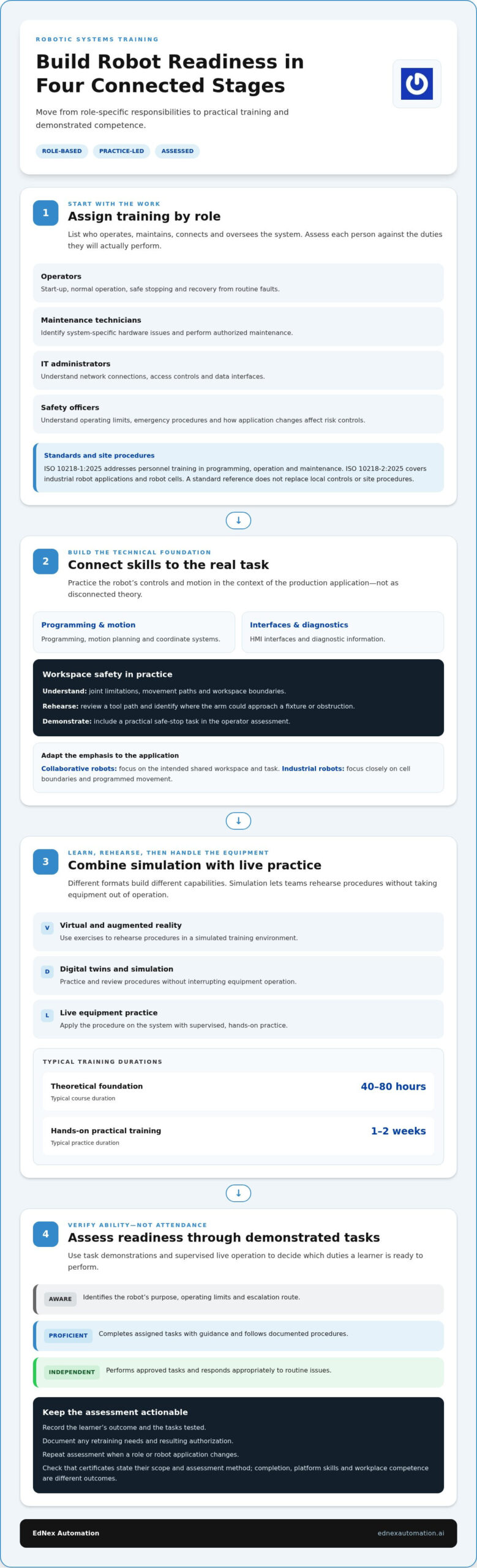
Training should follow each role’s interaction with the robot, its equipment, and the production application. In UAE facilities, separate standard references from site procedures: ISO 10218-1:2025 addresses personnel training in programming, operation, and maintenance, while ISO 10218-2:2025 covers industrial robot applications and robot cells.
Role-Specific Training Responsibilities
Operators need instruction in start-up, normal operation, safe stopping and recovery from routine faults. Maintenance technicians need system-specific practice identifying hardware issues and performing authorized maintenance. IT administrators should learn the robot’s network connections, access controls and data interfaces. Safety officers should understand operating limits, emergency procedures and how application changes affect risk controls.
Build the training plan around a task list. Identify who operates, maintains, connects and oversees each system, then assess each person against those duties. Inadequate instruction can leave operators unable to stop safely or recognize collision risks. Maintenance and IT errors can also disrupt robot operation.
Kinematics and Workspace Safety
Robot kinematics describe how joint movement positions the arm and its tool. Before running a production task, operators should learn joint limitations, movement paths and workspace boundaries. Rehearsing a tool path, for example, helps identify where the arm could approach a fixture or another obstruction.
Safety officers and operators should review the cell layout together, including access points, equipment and the robot’s programmed motion. Include a practical safe-stop demonstration in the operator assessment. In UAE facilities, align instruction with applicable site procedures and the robot-cell design. A standard reference does not replace local controls.
Collaborative and Industrial Robot Training
How does training differ for collaborative robots and industrial robots? Both require instruction in operation, stopping and the specific application. Collaborative robot training should emphasize the intended shared workspace and task. Industrial robot training should focus closely on cell boundaries and programmed movement.
Anaesthetic safety is relevant to surgical robot applications, not ordinary industrial robot operation. In clinical settings, training should address coordination between the surgical team and anaesthesia staff, including access to patient-care equipment.
Which UAE providers offer robotic systems operator training? For a specific installation, training should be grounded in the equipment, model and application. EdNex Automation supplies and deploys robotic systems, including collaborative robots, autonomous mobile robots and cleaning robots. Define the tasks operators will perform so training can address the relevant system and its actual use.
Instructor experience and certification
Instructor knowledge matters most when it connects robot theory to the actual application. Look for direct experience with the robot’s programming environment, hardware and production tasks. An instructor who demonstrates fault recovery in simulation, then explains the same process on the equipment, helps trainees connect procedure with practice.
For a course described as UR-certified, assess what the certificate represents: course completion, skills on a specific robot platform, or demonstrated workplace competence. These are different outcomes. Compare course topics with the tasks trainees will perform, including programming, operation, troubleshooting and maintenance. A certificate should document its scope and assessment method.
Assessing Instructor Fit
Before sessions begin, match the instructor’s experience to the system and learner level. Ask for a sample lesson plan covering a real task, such as changing a programmed path or interpreting a diagnostic message. Check that practical exercises let trainees repeat the task and receive direct feedback, rather than only watch a demonstration.
Use three training depth levels to structure assessment:
- Aware: identifies the robot’s purpose, operating limits, and escalation route.
- Proficient: completes assigned tasks with guidance and follows documented procedures.
- Independent: performs approved tasks and responds appropriately to routine issues.
These levels help supervisors assign work based on demonstrated ability, not attendance alone. Record each learner’s assessment outcome, the tasks tested and any retraining needs. Pairing experienced operators with new trainees also provides a practical source of feedback during workplace instruction.
Operator Certification and Renewal
Treat operator certification as evidence of assessed competence for defined tasks, not a substitute for site-specific instruction. Manufacturing companies should conduct regular competency assessments and renew certifications. Repeat assessment when a role or robot application changes, and document the resulting authorization and training record.
In the UAE, choose instructors based on the robot model, application and language of the training materials. A structured course plan and recorded assessment make skills easier to review as equipment and work requirements evolve.
Technical programming and robot operation skills
Effective technical training links programming knowledge to the production task and the robot’s specific components. Operators need practice with programming, motion planning, interfaces and operating procedures.
Programming and Operations Training
Training should cover robot programming languages, trajectory planning and coordinate systems. Operators need proficiency in both online programming at the robot and offline programming in a separate environment. They should also learn to navigate HMI interfaces, interpret diagnostic data and manage automated workflows. Use a production example, such as adjusting a path, to connect each programming change with its effect on operation.
How long does robotic systems operator training take? Theoretical foundation courses typically last 40-80 hours, while hands-on practical training typically spans 1-2 weeks. The balance depends on the system, application, and skills the role requires.
Proficiency-Based Progression
Progress through three levels: Aware, Proficient and Independent. An Aware trainee explains the relevant procedures; a Proficient trainee completes assigned tasks with guidance; an Independent operator performs approved tasks without routine assistance. Assess each level through demonstrated work, not course attendance alone.
Use a task assessment to identify the next learning step. For example, a trainee who can run a saved program but cannot edit a waypoint needs focused practice in robot programming and trajectory changes. Cross-training across robot types can transfer core skills while highlighting model-specific controls.
Steps for Training on a New Robot
What are the steps for training operators on a new robot? Start with the production task and required permissions, then build instruction from fundamentals toward independent work. A practical sequence is:
- Review the robot’s application, coordinate systems, and operating procedures.
- Demonstrate HMI navigation, program selection, and safe stopping.
- Guide trainees through online programming and approved edits.
- Practice interpreting diagnostics and responding to routine faults.
- Assess a complete production task, then record gaps for follow-up.
Manufacturing facilities should provide monthly skill updates and refresher sessions. Use them to address software or firmware updates, hardware revisions, new robot models, personnel changes, incidents, and configuration changes. This keeps training aligned with the equipment and supports successful transfer from instruction to daily operation.
Virtual and hands-on robot-system training
Virtual exercises and equipment practice build different capabilities, so effective training combines both. A digital twin lets trainees rehearse tasks using a replica of their production environment. Virtual and augmented reality can provide risk-free practice without taking equipment out of operation. These tools help learners prepare for complex automation procedures before working with the live system.
Start with a defined task, such as moving a robot tool between workstations. In a virtual simulation, trainees can review the sequence, test programmed movements and identify errors without operating production equipment. An instructor can then use the same task in a practical session, connecting the simulated procedure to the actual robot controls and workspace.
A useful learning sequence is:
- Prepare: Review the task, operating procedure, and simulation controls.
- Rehearse: Practise the sequence in a virtual environment or digital twin.
- Apply: Repeat the task on the live system under supervision.
- Demonstrate: Complete a practical task and show observed performance during live operation.
This progression makes assessment practical: instructors can compare the trainee’s simulated approach with their actions on the live system. For example, a trainee who selects the wrong waypoint in a digital twin can correct the sequence before applying it to production equipment. Simulation supports rehearsal; it does not replace operating the actual system.
Set completion criteria around demonstrated performance, not time spent in a module. Record whether the trainee completes the assigned task, follows the relevant procedure and applies feedback during supervised live operation. If errors recur, return to the simulation to practise that step, then reassess it on the equipment.
For teams planning automation around real production tasks, explore robotic systems for your application and consider how hands-on instruction can align with the selected equipment.
EdNex Automation: Collaborative Robots (Cobots)
EdNex Automation supplies and deploys collaborative robots for commercial and industrial applications. If your team is assessing a new robotic system, first define the task, work area and operator responsibilities. These factors shape the equipment choice and the practical skills employees will need.
For workflows involving mobile transport or routine cleaning, autonomous mobile robots, cleaning robots and delivery robots are also relevant options. Matching the robot type to the work helps teams focus training on the system’s role, controls and operating procedures.
Explore EdNex Automation’s robotic offerings to identify a suitable direction for your application. Contact EdNex Automation to discuss your requirements.
Build Capability for the Next Stage of Automation
Robotic deployment is a long-term operating decision, not simply an equipment milestone. As workflows change, teams benefit from treating learning as part of system planning, with clear ownership for updating procedures and keeping role-specific knowledge current. This helps new technology fit an evolving operation, rather than tying capability to a single launch or operator.
A considered approach to training operators for new robotic systems also starts with the work the business needs to improve. EdNex Automation offers Collaborative Robots (Cobots), Autonomous Mobile Robots (AMRs), and cleaning robots, giving businesses options for different industrial tasks. Selecting a system around its intended role creates a practical foundation for aligning people, processes, and automation.
Ready to explore which robotic solution fits your operation? Contact EdNex Automation to discuss your automation plans. Your next step can turn a clear operational need into a more capable, future-ready workplace.
Frequently Asked Questions
What skills do operators need to use new robotic systems?
Operators need system-specific control skills, situational awareness and clear communication about exceptions. A plan for training operators for new robotic systems should also cover accurate fault reporting. For example, operators can practise identifying an unexpected status message, pausing work under the approved procedure and reporting the displayed information without attempting an unauthorized adjustment.
What training methods work best for industrial robot operators?
Task-based instruction works best when it reflects actual shift conditions, not isolated button drills. When training operators for new robotic systems, practise job changes, interrupted cycles and shift handovers using realistic scenarios. Instructors can vary the sequence of events, then ask trainees to explain their decisions. This helps distinguish understanding from memorized steps and keeps practice relevant to daily work.
How should employers assess operator competency after robot training?
Assess competency by observing operators complete representative work without coaching, then reviewing their response to a changed condition. Use a written rubric covering task completion, procedure adherence, recognition of abnormal conditions and accurate reporting. Record each operator’s strengths and development needs. If someone struggles with a task, assign focused practice and reassess before authorizing independent work.