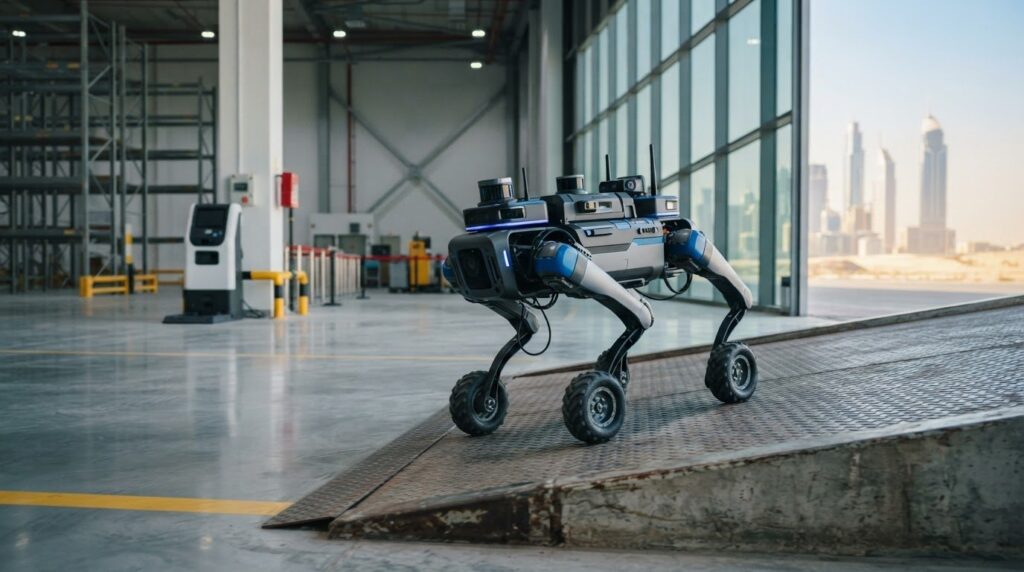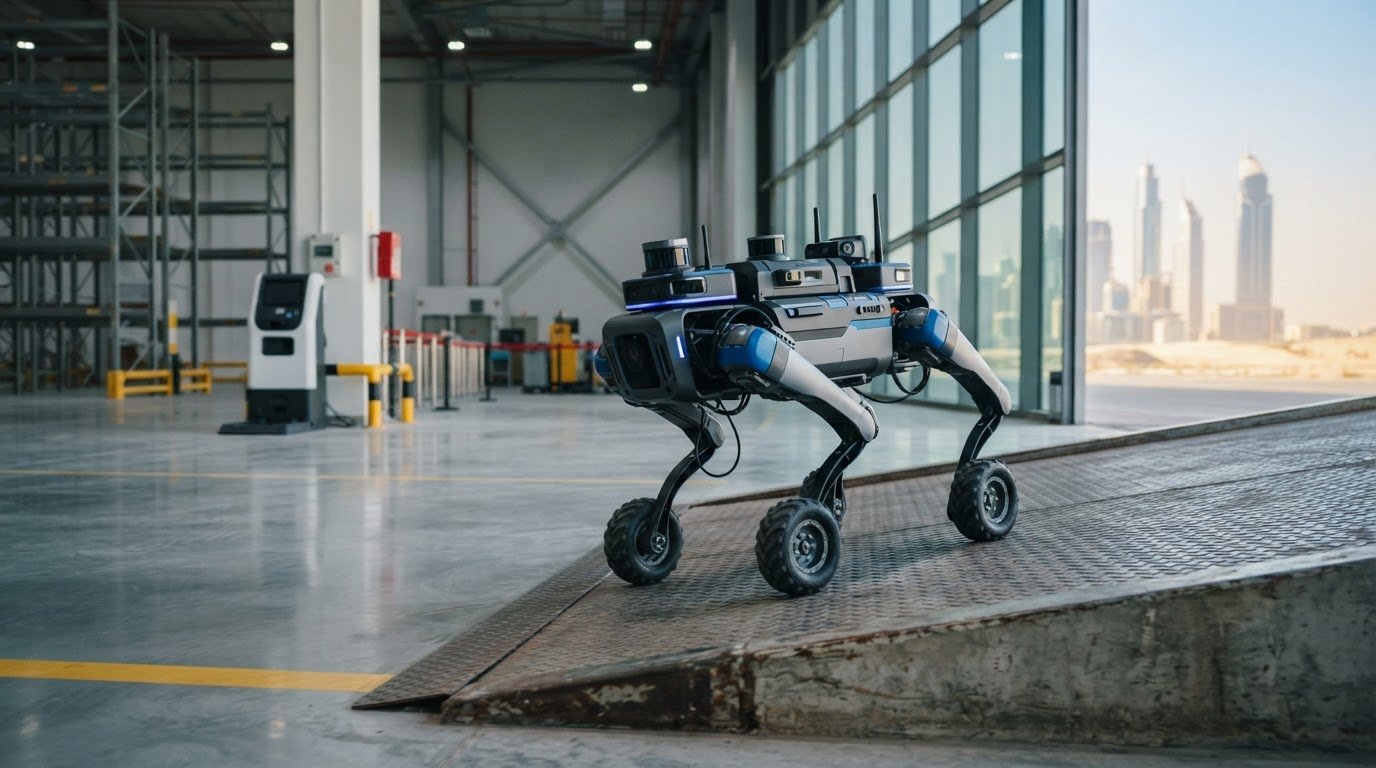
What if a robot designed to roll efficiently on clear floors could also handle terrain that challenges conventional mobile platforms? That is the question behind the b2-w, Unitree Robotics’ wheeled quadruped variant of its B2 robot. The name identifies a mobility category, but it does not tell you whether the platform fits your facility, routes, or tasks.
It is easy to focus on headline capabilities and overlook the conditions that determine whether a robot can deliver value on site. A wheeled quadruped differs from a standard AMR and a conventional legged quadruped in how it moves, where it may be useful, and what deployment requires. The right choice depends on operational requirements, not appearance alone.
This article explains what the B2-W designation means, compares wheeled quadrupeds with relevant alternatives, and outlines what to assess before planning an industrial application. Use the practical questions on routes, surfaces, task demands, autonomy, safety, and integration to judge whether the category merits closer evaluation. For operations across the UAE, this framework can turn interest in a robot category into a grounded assessment of site fit and readiness.
Key Takeaways
- Read the b2-w label as a mobility category, not a complete specification. Evaluate the exact configuration using verified documentation.
- Compare wheeled quadrupeds, AMRs, and conventional quadrupeds against your routes, surfaces, tasks, and operating environment.
- Map the workflow from assigned task and route through supervision, system interfaces, and operational review.
- Build readiness in sequence: define the task, survey the site, assess interfaces, plan safety, and validate the workflow.
- Match robotics and control-system integration to the operational need, whether that calls for AMRs, inspection robots, cleaning robots, or PLC and SCADA integration.
What Is the B2-W, and What Does the Wheeled Quadruped Label Mean?
The Unitree B2-W is categorized as a wheeled quadruped robot. “Quadruped” describes a four-legged robot platform, while “wheeled” signals a wheel-based mobility element. The category helps identify the broad design approach, but it is not a complete technical specification. Wikipedia’s robotic dogs list places the B2-W among quadruped robots, providing context for the wider platform category.
In short: B2-W is a model designation associated with a wheeled quadruped platform from Unitree Robotics. The category describes the general robot type, not its verified payload, speed, runtime, sensors, software, or precise movement modes. Establish those details from authoritative documentation for the specific configuration being evaluated.
How Is a Wheeled Quadruped Different from a Legged Robot?
Legged robots move by placing and repositioning their limbs. Wheeled platforms travel through wheel rotation. A wheeled quadruped combines these terms at the category level, but the label alone does not explain how its wheels and legs work together or whether it changes movement modes. Those model-specific mechanics require documentation.
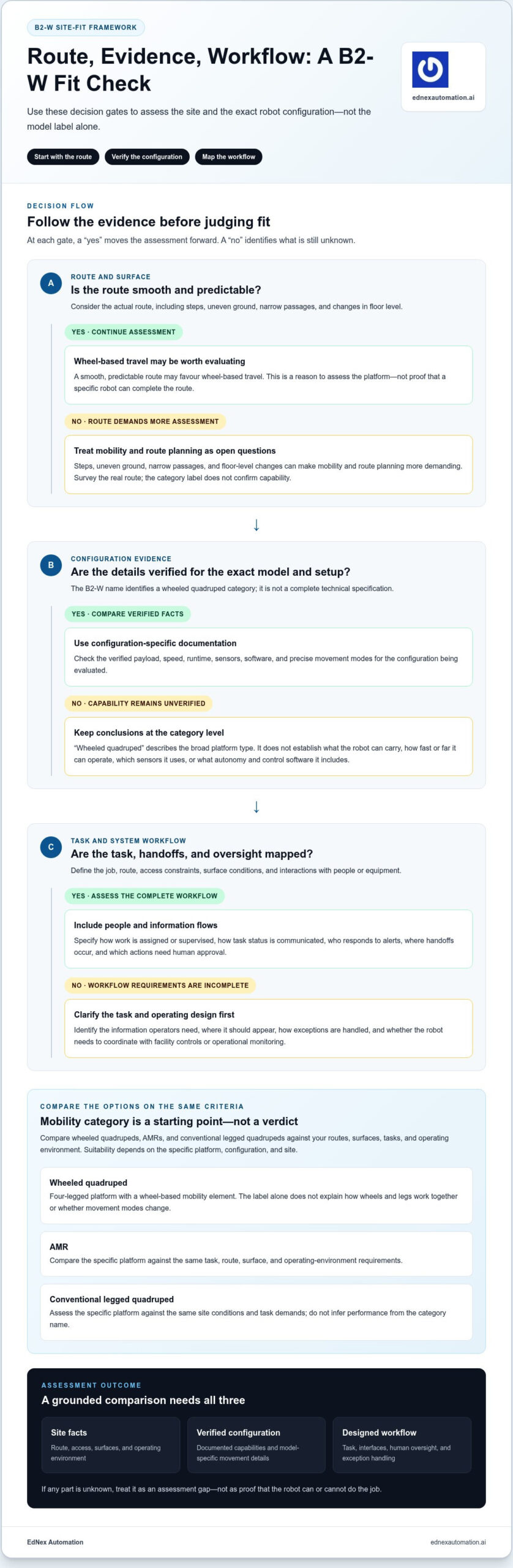
The distinction matters on site. A smooth, predictable route may favour wheel-based travel, while steps, uneven ground, narrow passages, or changes in floor level can make mobility and route planning more demanding. Assess the actual route and surfaces rather than assuming the robot can handle them based on its category.
What Does the B2-W Name Tell You, and What Does It Not?
Treat B2-W as a model designation unless the manufacturer’s documentation defines the name more specifically. “Wheeled quadruped” is a useful starting point for comparison, but it does not establish what the robot can carry, how fast or far it can operate, which sensors it uses, or what autonomy and control software it includes.
For an industrial assessment, separate category-level information from configuration-specific facts. Use the category to decide whether the platform merits further evaluation, then check technical claims against documentation for the exact model and setup. This keeps a product label from becoming a substitute for evidence when comparing mobility options or planning deployment.
How a Wheeled Quadruped Fits Into an Industrial Robotics System
A mobile robot becomes part of an industrial system when its task, route, supervision, and handoffs are designed as one workflow. The b2-w category alone does not establish which interfaces or autonomous functions are available. Those depend on the specific configuration and project design.
Task definition and accurate site data shape robotics integration: they determine where a robot needs to travel, what information it must exchange, and where human oversight belongs. Start by defining the job, such as visiting inspection points, monitoring a designated area, or moving materials along a planned route. Then map the route, access constraints, surface conditions, and interactions with people or equipment. A repeatable route with clear checkpoints can make a use case easier to assess, but it does not prove that a specific platform can complete it autonomously or withstand every site condition.
From Mobile Platform to Operational Workflow
A standalone mobile platform may perform a task within its own control environment. A connected deployment also requires decisions about how operators assign or supervise work, how task status is communicated, and how exceptions are handled. For example, an operator might review a task, the robot might follow an approved route, and a team member might respond to an alert or complete a handoff. Treat these as workflow design questions, not assumed B2-W features.
Research on a quadruped robot with passive wheels illustrates that combining legs and wheels involves specific control considerations. It provides broader technical context, but it is not evidence of the B2-W’s exact mechanics or movement modes.
Where Do Controls and Data Interfaces Matter?
Before integration, identify what information operators need, where it should appear, and which actions require human approval. Connectivity, data exchange, and control interfaces vary by robot configuration and project architecture. Define them around the facility’s actual workflow rather than assuming a standard connection.
PLC or SCADA integration is relevant when the mobile robot needs to coordinate with a wider process architecture. It can connect robot activity with facility controls or operational monitoring when the design calls for that connection. For background on these systems, see the PLC and SCADA integration guide.
For operations across the UAE, document the task, route, information flow, oversight responsibilities, and exception handling before selecting an integration approach. EdNex Automation provides robotics and automation integration alongside PLC and SCADA integration for industrial operations. Its robotics and automation integration work can be considered as part of the wider system design.
B2-W vs AMRs and Other Quadrupeds: How to Compare the Options
Choose by task and site conditions, not by the robot’s label. A wheeled quadruped, an autonomous mobile robot (AMR), and a conventional legged quadruped use different mobility approaches. Their suitability depends on the specific platform, configuration, and operating environment. The comparison below describes general categories, not performance claims about the b2-w.
| Comparison factor | Wheeled quadruped | AMR | Conventional legged quadruped |
|---|---|---|---|
| Mobility approach | Combines a quadruped platform category with wheel-based mobility; exact mechanics require model documentation. | Typically uses wheels to travel through a facility. | Moves through legged locomotion; movement capabilities vary by platform. |
| Route predictability | Assess how the configured robot handles planned routes and transitions. | Often considered for defined routes in organized indoor operations. | Assess route planning against the robot’s documented locomotion and controls. |
| Terrain | Verify surface, threshold, gradient, and obstacle limits for the specific model. | Check route surfaces, floor transitions, and access constraints. | Verify terrain capability and movement limits from technical documentation. |
| Task fit | Evaluate against the required movement, inspection, or monitoring workflow. | Consider for material movement when planned routes match the task. | Assess whether legged movement supports the intended site task. |
| Integration needs | Confirm available interfaces and control options for the configuration. | Plan task dispatch, traffic interaction, and facility-system connections. | Define supervision, data flow, and operational handoffs. |
When Should Teams Evaluate an AMR Instead?
If the main requirement is moving materials along planned indoor routes, an AMR is a relevant option to assess. Compare route design, interactions with people and equipment, payload requirements, and any facility changes using project data and the selected robot’s documentation. EdNex Automation’s autonomous mobile robots guide provides broader context on AMR applications.
Which Site Conditions Should Influence the Comparison?
Map the intended route and record floor surfaces, thresholds, gradients, access restrictions, nearby equipment, and areas where people and robots may cross paths. Clarify whether the job requires movement, inspection, monitoring, or a combination. These details help narrow the platform category before you compare verified specifications.
Use the table as a screening matrix, not a substitute for technical validation. For the B2-W, mark unknown payload, speed, runtime, sensor, terrain, or software values as “verify” rather than estimating them. A documented match between task, site, and platform gives teams a sounder basis for integration planning than category labels alone.
What to Assess Before Planning a B2-W Deployment
A robot’s category can guide an initial shortlist, but it cannot establish whether that platform fits a particular facility. Before planning a b2-w deployment, translate the intended job and site conditions into measurable requirements. Set performance thresholds, environmental limits, and technical requirements using verified documentation for the exact configuration and project.
How Do You Define the Task and Site Requirements?
Start with the work, then map the environment where it must happen. Record task frequency, route length, operating windows, handoffs, and the outcome the operation needs. Survey floors and transitions, access points, restricted areas, people, and other moving equipment. These details help teams define acceptance criteria before comparing robot specifications.
- 1. Define the task. Specify the activity, frequency, operating window, handoff points, and intended outcome.
- 2. Survey the site. Map the complete route, floor conditions, thresholds, gradients, access constraints, restricted areas, people, and moving equipment.
- 3. Assess interfaces. Document what operational data must move between the robot, its operators, and relevant facility systems. Identify the interfaces the workflow requires.
- 4. Plan safety and oversight. Assess human-robot interactions, operating procedures, restricted zones, and escalation paths for interruptions or exceptions.
- 5. Validate the workflow. Set measurable acceptance criteria, then plan commissioning and validation stages to assess the designed workflow against them.
How Should Teams Plan Safety and Integration?
Base safety planning on actual interactions along the route, not assumptions about a product category. Identify where workers and equipment may cross paths, who supervises operation, how exceptions are escalated, and what procedures apply when the planned workflow is interrupted. Record those decisions alongside the risk assessment.
Next, map data flows and facility-system interfaces before designing connections to operational controls. PLC or SCADA integration fits projects where the wider process architecture calls for it. Define its purpose and interface requirements as part of the project design. Commissioning and validation are stages for checking the agreed workflow against acceptance criteria. Set the sequence and tests for the project rather than assuming they are B2-W-specific procedures.
For operations across the UAE, a clear readiness record turns site observations into practical requirements for robotics selection and integration planning. Plan robotics integration around the task, documented interfaces, and site conditions.
How EdNex Automation Connects Robotics Selection to Operational Needs
A robotics project is strongest when selection starts with the work a facility needs to perform, then connects that requirement to suitable equipment and system architecture. The b2-w category can be part of an evaluation, but its label alone cannot establish whether a platform fits a particular workflow. EdNex Automation supplies and integrates robotics and industrial automation systems for commercial and industrial operations across the UAE, aligning equipment selection and integration planning with operational requirements.
From Robot Category to a Defined Automation Project
Prepare a concise project brief before comparing platforms. Describe the task, operating environment, workflow, and intended outcome. Include the route or work area, frequency of operation, interactions with people and equipment, handoffs, and relevant system interfaces. This gives the evaluation a practical basis and helps distinguish an operational need from interest in a particular robot category.
Different robotics options address different requirements. AMRs can be considered for material movement along planned routes. Inspection robots may suit inspection or monitoring activities, while cleaning robots address cleaning tasks. If a project must connect robotic activity with facility controls or operational data, PLC and SCADA integration may form part of the wider system design. The right combination depends on the defined task and project architecture, not a platform’s appearance or label.
EdNex Automation supplies and deploys robotics for commercial and industrial applications, and provides technical integration for PLC and SCADA systems and ASRS. A project brief helps focus equipment selection and integration planning on the intended workflow without assuming a particular robot, specification, or outcome.
What Should a Robotics Project Discussion Cover?
Bring the practical details that shape implementation: planned routes and work areas, task frequency, operating conditions, access constraints, safety considerations, handoffs, and the people or equipment sharing the environment. Note what data operators need, how the workflow should interact with facility systems, and which measurable outcomes will show whether the project meets its objectives.
This information guides project-specific planning, including how robotics fits into existing operations and whether control-system integration is part of the design. Tie requirements and technical thresholds to verified documentation and the project’s agreed design. That keeps decisions grounded in operational evidence rather than assumptions about what a robot can do.
For a robotics or industrial automation project in the UAE, Discuss your automation requirements with EdNex Automation and build the conversation around your tasks, operating environment, workflow, and integration priorities.
Turn Robotics Evaluation Into a Deployment Plan
The b2-w designation identifies a wheeled quadruped category, but the label alone cannot establish whether a robot fits your operation. Compare mobility options against the task and site, then ground decisions in verified technical documentation for the configuration under consideration.
Before moving toward deployment, define the work, map routes and operating conditions, assess safety and system interfaces, and set acceptance criteria. This turns an interesting platform into a practical evaluation, with integration needs considered alongside mobility.
EdNex Automation supplies and integrates commercial and industrial robotics, including AMRs, inspection robots, and cleaning robots, and provides PLC and SCADA integration for operational requirements. Discuss your automation requirements with EdNex Automation to explore an approach shaped around your facility, workflow, and integration priorities.
With clear requirements and a task-first plan, your next robotics decision can be deliberate, informed, and aligned with your operation’s long-term goals.
Frequently Asked Questions
What is the B2-W robot?
The B2-W is identified in product listings as a wheeled quadruped robot associated with Unitree Robotics. “Quadruped” refers to a four-legged robot platform, while “wheeled” describes a mobility element. This classification establishes the broad type, but it does not confirm the capabilities of a particular configuration. For industrial evaluation, verify technical specifications, movement functions, sensors, and software against authoritative documentation for the exact model.
What does B2-W stand for?
B2-W is a model designation. Do not assume each letter has a formal expansion unless Unitree documentation defines it. The designation is associated with a wheeled quadruped category, which identifies the broad platform type, not its payload, speed, runtime, sensor package, or autonomy features. Treat those as separate specification questions and use verified manufacturer documentation to establish the details for your application.
How is a wheeled quadruped different from an AMR?
A wheeled quadruped combines a quadruped platform category with wheel-based mobility, while an autonomous mobile robot (AMR) is a mobile robot category commonly assessed for tasks such as material movement along planned routes. The labels do not establish a universal difference in capability. Compare specific platforms by route, floor conditions, task, payload requirements, interactions with people, and required system interfaces. Choose based on site fit, not terminology alone.
Can a wheeled quadruped operate on uneven terrain?
That depends on the specific robot’s verified design and operating limits. The wheeled quadruped label alone does not establish whether a model can manage uneven floors, thresholds, gradients, obstacles, or outdoor surfaces. Map the actual route and identify its most demanding sections, then compare those conditions with authoritative documentation for the exact configuration. Do not infer terrain capability from the category or assume all quadrupeds handle the same environments.
What should I check before considering a B2-W for industrial use?
Start by defining the task, route, operating frequency, handoffs, and intended outcome. Survey floor conditions, thresholds, access points, restricted areas, and interactions with people and equipment. Then identify safety procedures, supervision needs, data flows, and facility interfaces. Set measurable acceptance criteria before comparing specifications. Verify technical requirements against documentation for the exact configuration, since a category label cannot establish suitability for your site or workflow.
Does B2-W integrate with PLC or SCADA systems?
Compatibility depends on the robot’s configuration, available interfaces, and project architecture. The B2-W designation alone does not confirm a direct PLC or SCADA connection. Define the operational data or control signals the workflow requires, then establish how those requirements relate to the selected robot and facility systems. EdNex Automation provides PLC and SCADA integration for industrial automation projects, with system design shaped around operational requirements.
Is a wheeled quadruped better than an AMR?
Neither category is universally better. Assess each against the task and operating environment. An AMR may suit material movement along planned routes, while another mobile platform may merit evaluation for a different task or site condition. Compare route predictability, surfaces, access, payload, interactions with people and equipment, and integration requirements. The right choice is the one that meets documented project criteria.