By the end of 2026, failing to migrate to the OPC UA 1.05 specification will effectively isolate your industrial network from the global standard of secure, interoperable automation. You likely understand that fragmented data silos and escalating cybersecurity vulnerabilities under the EU Cyber Resilience Act are no longer just operational hurdles; they’re existential risks to your manufacturing throughput. Implementing professional PLC and SCADA integration services provides the critical bridge between legacy machinery and the intelligence of the modern cloud, transforming isolated hardware into a unified, data-driven ecosystem.
You recognize that maintaining high availability while upgrading aging infrastructure requires a methodical, engineering-led approach to avoid catastrophic downtime. We promise to provide the expert framework necessary to master these unified industrial controls, ensuring your plant achieves the real-time visibility and predictive maintenance capabilities required for long-term viability. This guide explores the transition to software-defined PLCs, the adoption of MQTT over QUIC for 5G reliability, and the strategic alignment with IEC 62443 standards to secure your competitive edge in the GCC industrial landscape.
Key Takeaways
- Analyze the four-layer industrial automation pyramid to synchronize real-time machine logic with high-level supervisory oversight for improved plant visibility.
- Evaluate the transition from legacy protocols to modern standards like OPC UA and MQTT to ensure seamless interoperability across multi-vendor hardware environments.
- Follow a structured, two-phase integration roadmap that prioritizes comprehensive hardware audits and precise network topology design to mitigate operational risk.
- Leverage professional PLC and SCADA integration services to establish the foundational architecture required for deploying advanced robotics, including AMRs and Cobots.
- Transition from manual data logging to intelligent predictive maintenance by unifying disparate machine-level data into a secure, scalable control interface.
The Strategic Necessity of PLC and SCADA Integration in 2026
Integrated automation represents the sophisticated convergence of localized machine execution and high-level supervisory oversight. By deploying professional PLC and SCADA integration services, manufacturers transform isolated equipment into an intelligent, responsive network. Manual data logging, once a standard practice, has become a significant liability in the 2026 industrial landscape. Relying on paper-based or disconnected records introduces unacceptable latency, increases the probability of human error, and prevents the real-time responsiveness required to meet aggressive production targets. Modernizing these systems is a prerequisite for any organization aiming to align with the UAE’s national industrial objectives, such as Operation 300bn, which demands a drastic increase in manufacturing efficiency and technological self-reliance. Moving from reactive “run-to-fail” models to data-driven predictive strategies ensures that maintenance is performed only when necessary, preserving the lifespan of expensive assets; it’s the foundation of a truly modern facility.
Bridging the Gap Between OT and IT
Historically, Operational Technology (OT) and Information Technology (IT) existed as separate silos with incompatible protocols and conflicting priorities. Integrating these layers allows for a seamless flow of shop-floor data directly into enterprise-level management systems. Understanding the specific nuances of PLC vs SCADA systems UAE is essential during this transition to ensure hardware compatibility. This synergy ensures that every sensor reading contributes to high-level business intelligence, enabling leaders to make informed decisions based on live operational metrics rather than historical reports. When these systems communicate effectively, manufacturers don’t just see data; they see opportunities for immediate optimization.
Economic Impact of Unified Control Systems
Implementing unified control delivers a measurable ROI by optimizing raw material usage and reducing energy consumption through precise process tuning. Beyond hardware efficiency, these systems facilitate a shift toward high-skill job creation, moving the workforce from manual monitoring to strategic system management. This transition is reflected in the rapid growth of the regional process automation market, which is projected to reach $28 billion by 2034. Utilizing a comprehensive SCADA systems overview allows engineers to visualize how supervisory control mitigates risks while enhancing overall plant safety. By adopting predictive strategies, organizations can anticipate failures before they occur, which drastically reduces the cost of unplanned downtime and stabilizes supply chains. This methodical approach to innovation ensures long-term business viability in an increasingly competitive global market.
Designing the Architecture: How PLC and SCADA Systems Synchronise
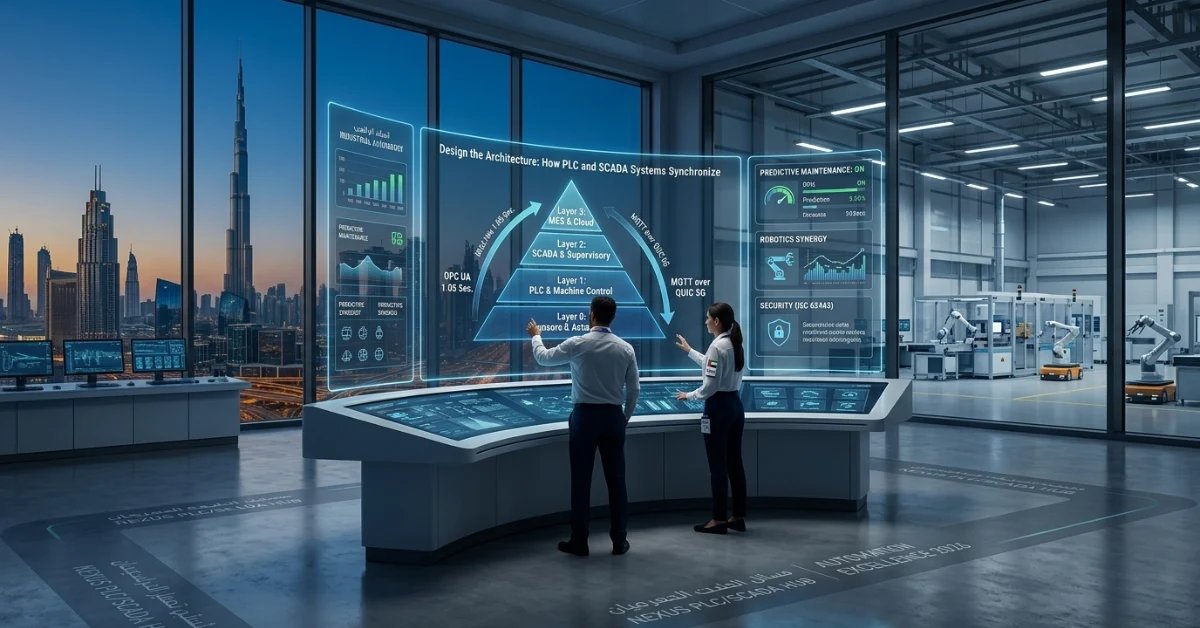
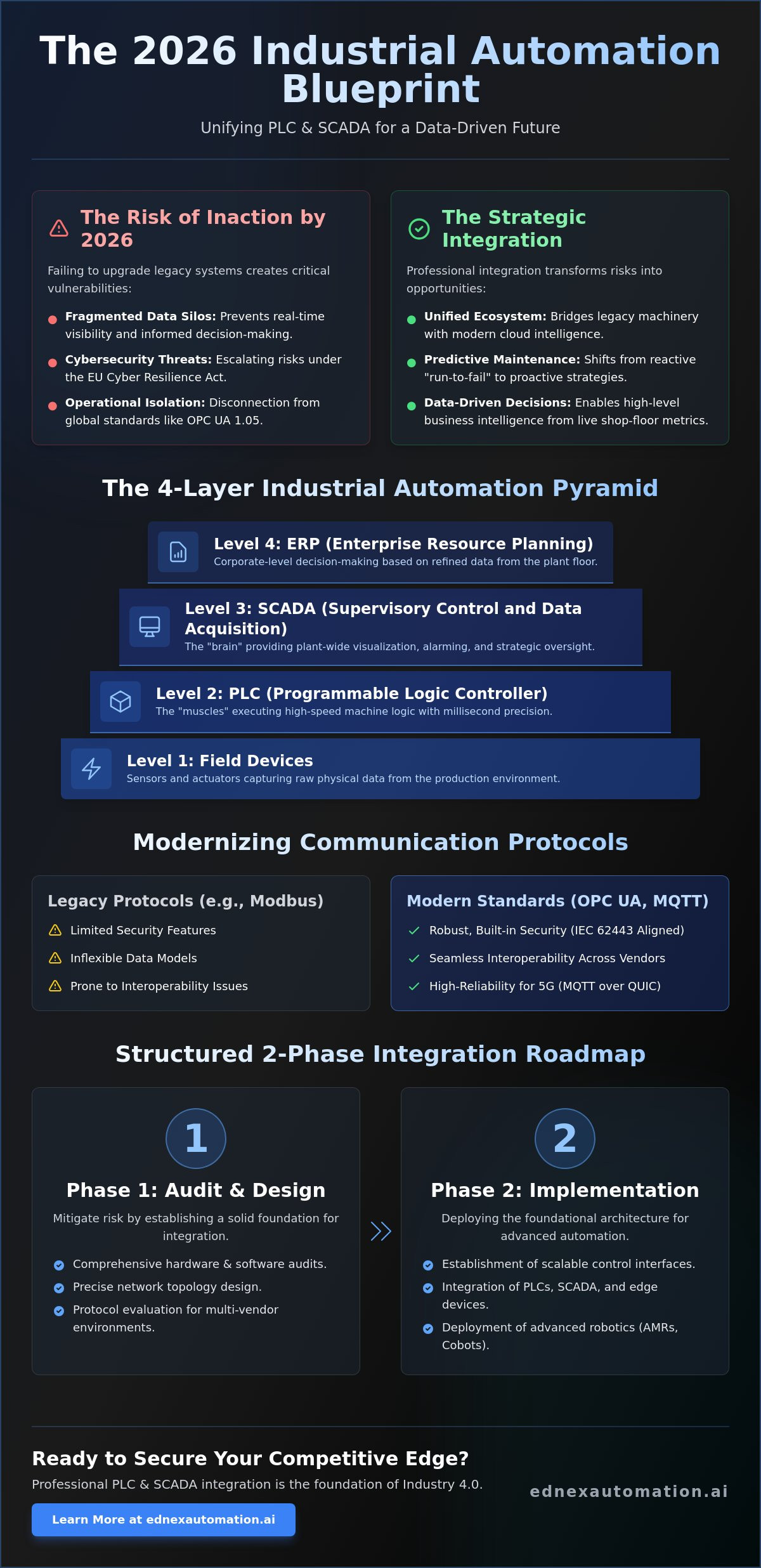
Constructing a resilient industrial ecosystem requires a deep understanding of the four-layer automation pyramid. At the base, sensors and actuators capture raw physical data from the production environment. Above this, Programmable Logic Controllers (PLCs) function as the operational “muscles,” executing high-speed logic commands with millisecond precision to maintain machine-level stability. Professional PLC and SCADA integration services bridge these execution layers with the supervisory tier, where SCADA acts as the centralized “brain.” This supervisory layer provides the visualization, alarming, and historical archiving necessary for long-term strategic oversight. At the apex, Enterprise Resource Planning (ERP) systems ingest this refined data to drive corporate-level decision-making, ensuring that every shop-floor action aligns with business goals.
Modern 2026 architectures increasingly incorporate edge computing within the SCADA framework to enhance system responsiveness. Processing data closer to the source reduces latency and minimizes the bandwidth burden on cloud-based systems. This distributed intelligence ensures that critical alarms and localized optimizations occur instantaneously, even if the primary network connection experiences instability. It’s a shift from centralized processing to a more resilient, hybrid model that prioritizes uptime and local autonomy. For organizations seeking to modernize, partnering with an automation specialist ensures these complex subsystems operate within a single, cohesive architecture.
The Role of Human-Machine Interfaces (HMI)
Human-Machine Interfaces (HMIs) serve as the essential local interaction point for technical staff on the plant floor. We’re seeing a decisive transition from traditional, fixed physical panels to dynamic, web-based, and mobile HMI solutions. This evolution allows operators to monitor critical parameters from any location within the facility, significantly enhancing responsiveness to process deviations. Prioritizing user-centric design in these interfaces is vital for reducing operational errors. When complex data remains actionable and intuitive, the workforce can manage sophisticated machinery with greater confidence and safety.
Integrating Robotics into the Control Loop
Integrating robotics into the existing control loop represents the next frontier of industrial efficiency. Collaborative robots (Cobots) must interface directly with PLC logic to ensure safe, synchronized operation alongside human workers. Similarly, Autonomous Mobile Robots (AMRs) require deep integration with plant-wide SCADA systems to maintain logistics visibility and avoid bottlenecks in high-traffic zones. Robotic integration functions as a specialized sub-set of total plant automation, requiring precise synchronization between autonomous hardware and supervisory control layers. This unified approach ensures that robots aren’t just isolated tools, but active participants in a synchronized production flow.
Evaluating Communication Protocols: Modbus, OPC UA, and MQTT
Establishing a robust communication backbone defines the speed and reliability of your PLC and SCADA integration services. While legacy protocols like Modbus and Profibus provided the foundation for industrial networking, they often struggle with the data density and security requirements demanded in 2026. Transitioning to modern standards ensures that multi-vendor hardware environments remain interoperable; preventing the operational friction caused by proprietary silos. This choice directly influences system latency and data integrity, especially as facilities scale their automated footprint. Achieving true SCADA system integration UAE is paramount for synchronizing floor-level execution with Manufacturing Execution Systems (MES), creating a seamless data pipeline that fuels high-level analytics. Even legacy standards are evolving to meet these needs; the current Modbus Security protocol now integrates Transport Layer Security (TLS) to address modern vulnerability concerns in aging networks.
OPC UA: The Gold Standard for Interoperability
Leveraging the platform-independent nature of OPC Unified Architecture (OPC UA) allows for effortless data exchange across disparate operating systems and hardware brands. With the publication of the fourth edition of the OPC UA Information Model, IEC 62541-5:2026, in January 2026, the standard has expanded to include sophisticated new data types that enhance system intelligence. Security isn’t an afterthought; it’s built-in through mandatory encryption and authentication protocols that align with modern cybersecurity mandates. Migrating to version 1.05 is now a critical priority for industrial leaders, as support for the older version 1.03 concludes at the end of 2026. This standard future-proofs industrial assets by ensuring they can communicate with any modern supervisory platform without the need for bespoke, fragile drivers.
MQTT and the Rise of IIoT
Utilizing a publish-subscribe architecture, MQTT has emerged as the preferred protocol for low-bandwidth or unstable industrial environments. Unlike traditional polling protocols that constantly tax network resources, MQTT only transmits data when changes occur, which significantly reduces overhead and power consumption. This efficiency simplifies cloud connectivity for remote monitoring, allowing telemetry from edge devices to reach centralized dashboards via MQTT 5.0 streams. It’s particularly effective in 5G-enabled facilities where the adoption of MQTT over QUIC (Quick UDP Internet Connections) enhances reliability in fluctuating network conditions. Choosing MQTT over traditional polling is the logical step when feeding real-time data into AI models for predictive maintenance and large-scale logistics tracking.
The Integration Roadmap: From Legacy Systems to Industry 4.0
Transitioning to a unified architecture requires a disciplined, phase-based execution strategy to ensure operational continuity. Professional PLC and SCADA integration services are most effective when following a structured roadmap that identifies and mitigates risks before they impact production. It’s not a singular event; it’s a methodical progression from isolated hardware to an intelligent, networked ecosystem. By following a five-phase approach, manufacturers can achieve digital transformation without compromising current throughput.
- Phase 1: Comprehensive Audit. Engineers perform a deep-dive assessment of existing hardware, software versions, and network capacity to identify potential bottlenecks.
- Phase 2: Architecture Design. This involves designing the network topology and selecting the protocol stack, ensuring compliance with the latest OPC UA 1.05 standards for future-proofing.
- Phase 3: Development. Technical teams execute logic programming, HMI interface design, and SCADA database configuration based on the audited requirements.
- Phase 4: Site Acceptance Testing (SAT). Rigorous testing and a phased cut-over strategy are implemented to minimize downtime during the final transition.
- Phase 5: Continuous Optimization. Post-launch monitoring allows for iterative adjustments, ensuring the system evolves alongside production demands.
Overcoming Legacy Hardware Constraints
Many industrial facilities rely on aging serial devices that lack native Ethernet connectivity, creating significant data gaps. Utilizing industrial gateways and protocol converters allows these legacy assets to communicate with modern supervisory platforms without immediate, high-cost hardware replacements. Adopting a “wrap and extend” strategy enables companies to layer advanced control systems over existing infrastructure, providing a bridge to modern capabilities. However, identifying assets that have reached total end-of-life is critical. If a component can’t support the encryption required by modern standards, it’s a candidate for total replacement to maintain system integrity. Engaging specialized PLC programming services Dubai ensures that legacy code migration and multi-vendor controller integration are handled with the precision required to avoid costly production disruptions.
Prioritizing Industrial Cybersecurity
Integrating OT and IT networks increases the attack surface, making a “Defense in Depth” strategy a fundamental requirement for 2026 operations. Implementing network segmentation via VLANs ensures that a breach in the corporate IT network doesn’t propagate to critical machine logic. Adhering to SCADA security best practices provides the necessary intellectual framework to mitigate risks in a landscape shaped by the EU Cyber Resilience Act. By aligning with updated IEC 62443 standards, organizations protect their intellectual property and ensure long-term business viability against emerging threats.
To begin your facility’s digital evolution with a proven technical partner, consult with our integration specialists today.
EdNex Automation: Advanced Control Systems for National Industrial Excellence
Focusing on the transformative power of unified control, EdNex Automation serves as a visionary partner for organizations pursuing end-to-end industrial digital transformation. We don’t just provide tools; we provide the intellectual framework required to synchronize localized execution with high-level supervisory oversight. By offering comprehensive PLC and SCADA integration services, we ensure that your facility’s “nervous system” is robust, secure, and capable of supporting the next generation of autonomous hardware. Our expertise extends beyond traditional control logic to include the seamless integration of Collaborative Robots (Cobots) and Autonomous Mobile Robots (AMRs), creating a synchronized environment where robotics and human operators coexist within a single, data-driven loop.
Managing complex logistics demands high-precision coordination, which is why we specialize in the integration of automated storage and retrieval systems. These systems require a sophisticated interface between mechanical execution and supervisory databases to optimize throughput and storage density. By grounding global technological breakthroughs in the specific economic context of the UAE and GCC, we provide localized technical support that understands the unique operational challenges of the region. This proximity ensures that our partners receive the reliable, high-level expertise necessary to maintain critical infrastructure without the delays often associated with international vendors.
Bespoke Integration for Diverse Sectors
Developing scalable architectures that grow alongside your business, we serve a diverse range of sectors including manufacturing, high-volume logistics, and specialized industrial facilities. Our approach focuses on risk mitigation through methodical planning, ensuring that every integration project delivers a tangible business outcome. To maintain our status as a high-level consultant, EdNex prioritizes official global certifications and alliances with leading technology entities to guarantee that every solution meets international standards of excellence. Whether you’re deploying inspection robots or outdoor cleaning robots, our unified control systems provide the necessary transparency to manage your entire fleet from a single interface.
Securing the Future of UAE Industry
Reaffirming our commitment to the UAE’s Industry 4.0 aspirations, we act as a systematic organizer for facilities wishing to remain competitive in an evolving global market. We understand the gravity of large-scale industrial transformation and provide the steady, logical flow of innovation required to achieve long-term viability. By bridging the gap between cutting-edge AI and practical shop-floor application, we help secure the regional economic landscape for decades to come. To begin your journey toward a fully autonomous facility, consult with our integration experts to modernize your facility and establish a foundation for national industrial excellence.
Securing Industrial Resilience Through Intelligent Integration
Transitioning to a unified industrial architecture is a strategic necessity for organizations wishing to remain competitive in the 2026 landscape. Mastering the synchronization of machine-level logic with supervisory oversight allows manufacturers to move beyond reactive maintenance and embrace data-driven efficiency. By adhering to modern communication standards and a disciplined integration roadmap, you secure your facility against emerging cybersecurity threats while enabling the seamless deployment of advanced robotics. Professional PLC and SCADA integration services provide the essential intellectual framework to bridge the gap between global technological breakthroughs and regional industrial requirements.
EdNex Automation offers the comprehensive expertise required for this digital evolution. Utilizing our specialized Industry 4.0 division and official global technology alliances, we deliver end-to-end robotics and control synergy that transforms fragmented data into actionable intelligence. We act as a systematic organizer for your facility’s long-term business viability, ensuring your infrastructure is prepared for the autonomy of the future. Partner with EdNex for Strategic PLC and SCADA Integration to lead your organization toward national industrial excellence and operational superiority.
Frequently Asked Questions
What is the primary difference between PLC and SCADA integration?
PLCs function as the execution layer by managing real-time hardware logic; whereas SCADA acts as the supervisory layer for visualization and data archiving. Integration involves establishing a secure communication link that allows these two distinct tiers to exchange data seamlessly. This process ensures that machine-level actions remain visible to plant managers and that supervisory commands reach the shop floor without latency.
How long does a typical PLC and SCADA integration project take?
The duration of an integration project varies significantly based on the number of nodes, protocol complexity, and the state of existing hardware. Professional PLC and SCADA integration services typically range from several weeks for localized upgrades to several months for facility-wide digital transformations. Factors such as network audit depth and the requirement for phased cut-overs to minimize downtime play a critical role in determining the final project schedule.
Can modern SCADA systems integrate with older, legacy PLCs?
Modern SCADA platforms successfully interface with legacy PLCs through the strategic use of industrial gateways and protocol converters. These tools translate older serial communications into modern Ethernet-based packets, allowing aging machinery to contribute data to contemporary analytics engines. This “wrap and extend” strategy enables facilities to modernize their oversight capabilities without the immediate capital expenditure of a total hardware replacement.
What are the most common communication protocols used in the UAE?
Industrial operations in the UAE frequently utilize Modbus TCP/IP for its reliability while increasingly adopting OPC UA for secure, platform-independent interoperability. MQTT 5.0 has also gained significant traction for IIoT applications due to its low-bandwidth efficiency in remote monitoring scenarios. Selecting the appropriate protocol ensures that regional facilities remain compatible with global technological standards and national industrial targets like Operation 300bn.
How does PLC/SCADA integration improve industrial cybersecurity?
Professional PLC and SCADA integration services enhance security by implementing network segmentation and encrypted communication channels that align with IEC 62443 standards. Centralizing data flows allows for real-time monitoring of network traffic, enabling the immediate detection of unauthorized access or process deviations. By moving away from unencrypted legacy protocols to secured versions like Modbus TLS, organizations significantly reduce their vulnerability to cyber threats.
Does integration require a total plant shutdown?
Total plant shutdowns are rarely required when utilizing a phased cut-over strategy designed to maintain operational continuity. Technical teams implement new control layers in parallel with existing systems, allowing for rigorous testing before the final transition occurs. This methodical approach ensures that critical production lines remain active while the underlying automation architecture is modernized and synchronized.
What is the role of OPC UA in multi-vendor system integration?
OPC UA serves as the universal translator in multi-vendor environments by providing a platform-independent framework for secure data exchange. With the 2026 update to IEC 62541-5, this standard facilitates the seamless interaction of hardware from different manufacturers within a single SCADA interface. It eliminates the need for proprietary drivers, ensuring that diverse assets can communicate without the friction of technical silos.
How does SCADA integration support predictive maintenance?
Integration facilitates predictive maintenance by funneling real-time telemetry from PLCs into centralized SCADA databases for advanced trend analysis. These data streams allow AI models to identify subtle performance degradations that precede hardware failure. By anticipating maintenance needs based on actual equipment usage rather than fixed schedules, facilities reduce unplanned downtime and extend the operational lifespan of expensive industrial assets.