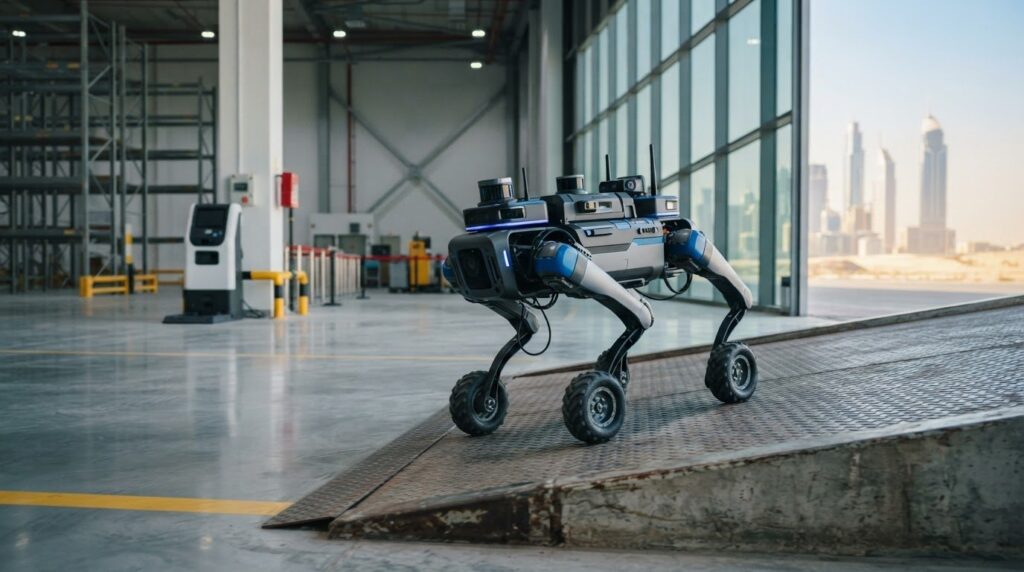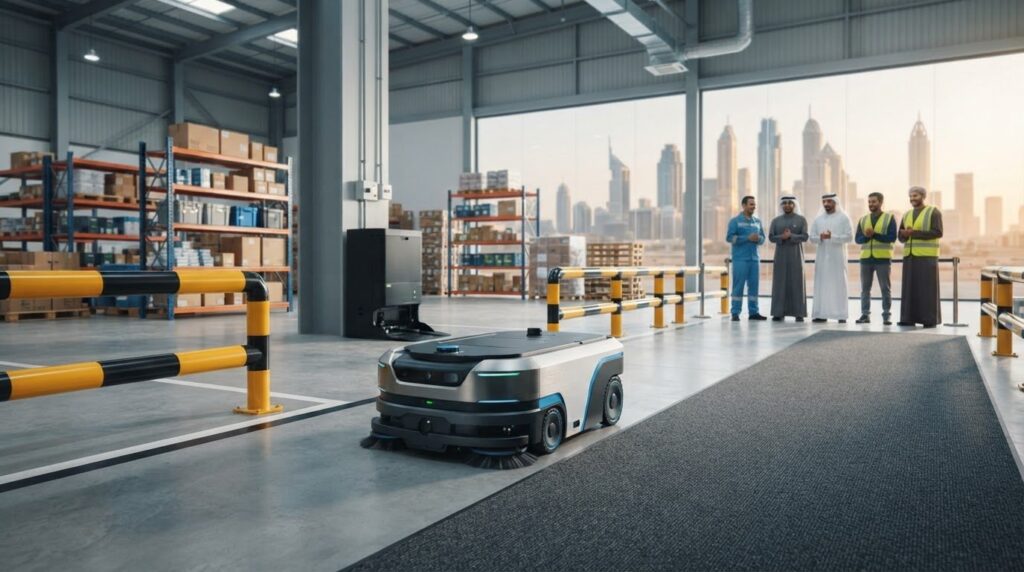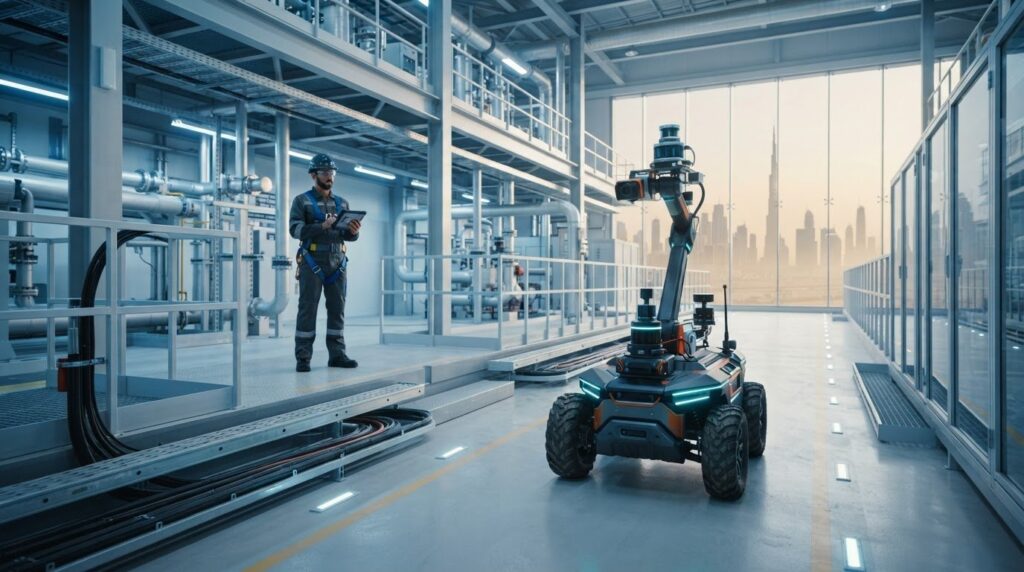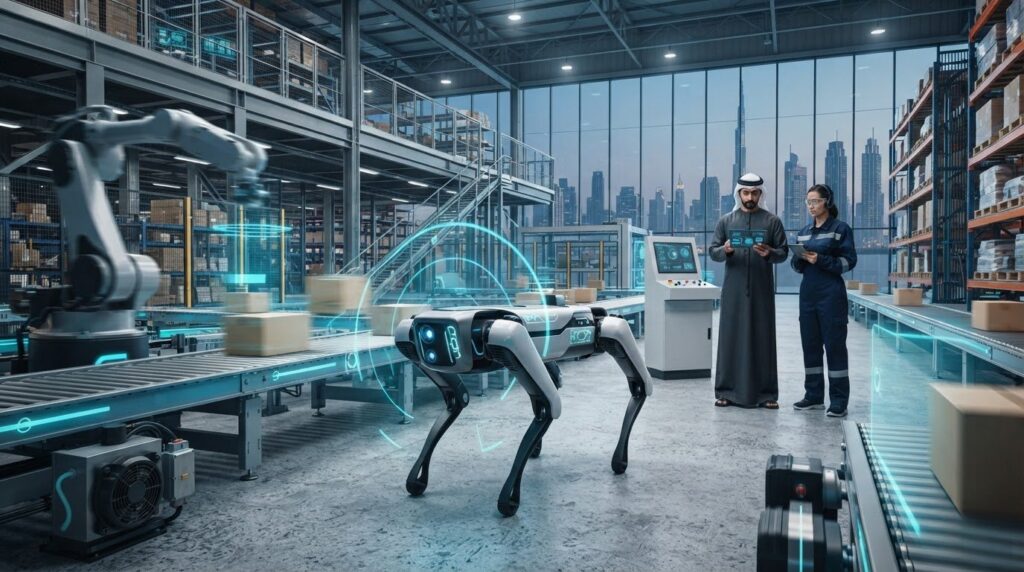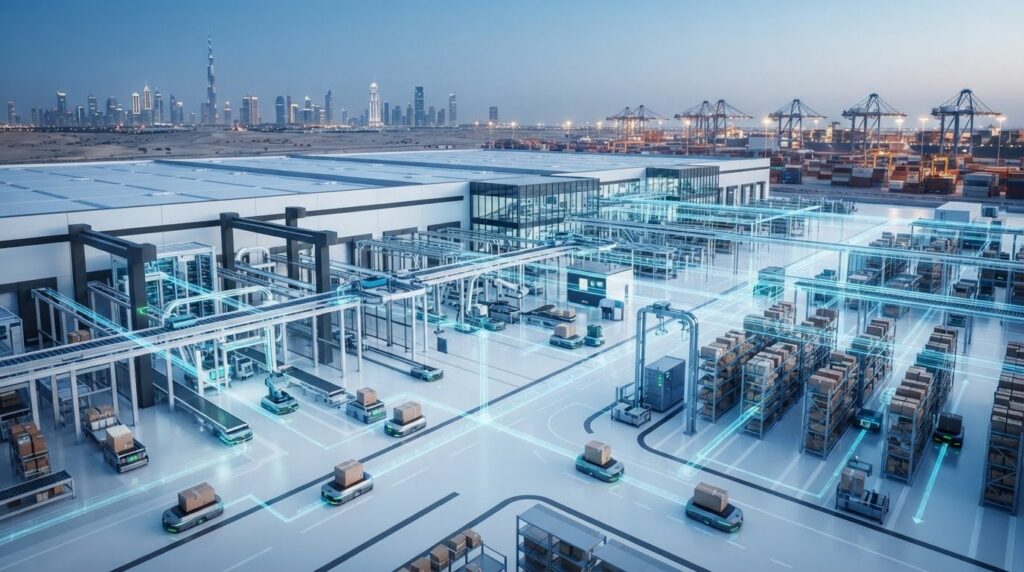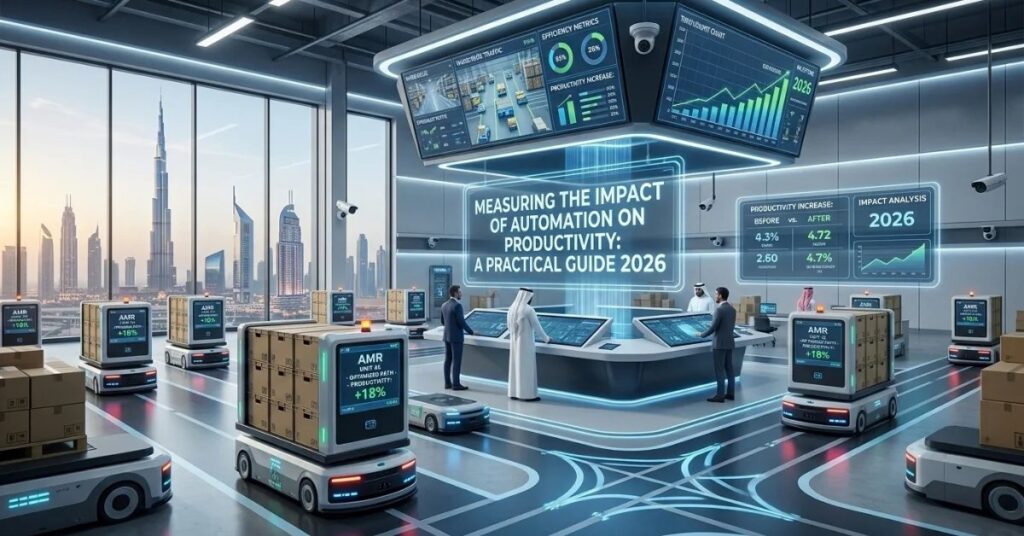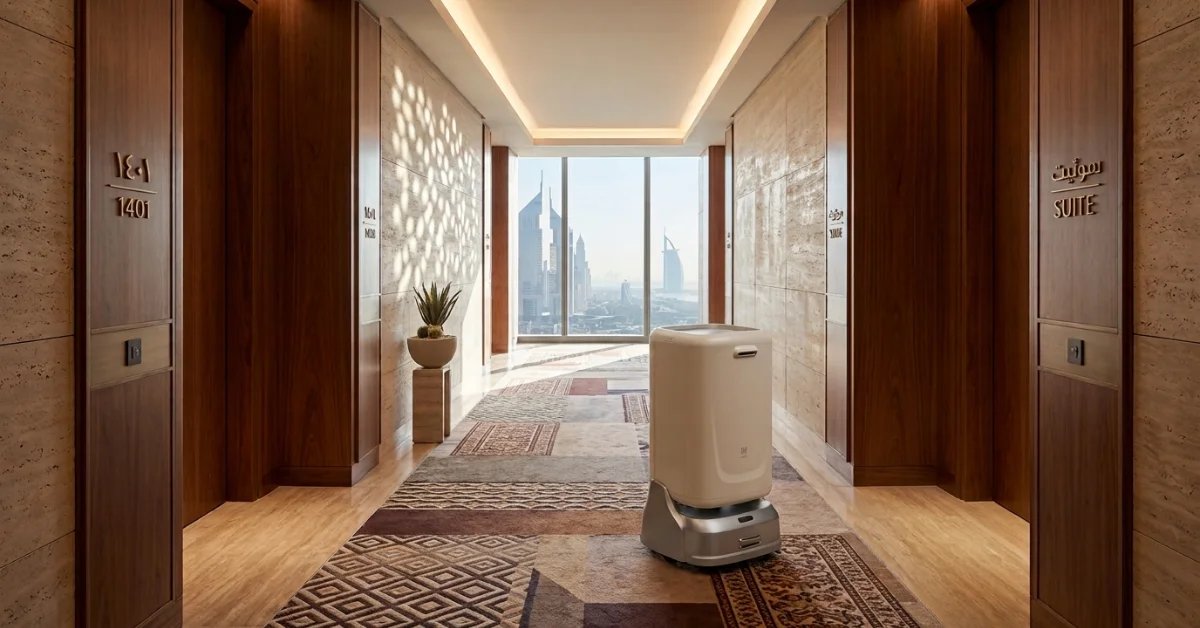
What if your hotel’s biggest operational liability in 2026 isn’t your staffing model, but the gap between your Property Management System and your guests’ doors? For any GM or operations director sourcing delivery robots for hotels UAE, that question cuts straight to the heart of a growing pressure point: rising costs for round-the-clock room service, inconsistent delivery windows during peak occupancy, and a persistent anxiety about whether autonomous systems will actually talk to your existing infrastructure.
You already know the demand is real. Guests in the UAE’s competitive luxury and business hospitality market expect seamless, on-demand service at 2 AM just as readily as at 2 PM, and your team simply can’t scale infinitely to meet it. The operational math no longer works in favor of a purely human-staffed delivery model.
This strategic guide is built specifically for that challenge. It examines how autonomous delivery robotics integrate with elevator controls, PMS platforms, and F&B workflows across UAE hotel environments, giving you a clear, technically grounded framework for evaluating, deploying, and operationalizing these systems for measurable gains in efficiency and guest experience.
Key Takeaways
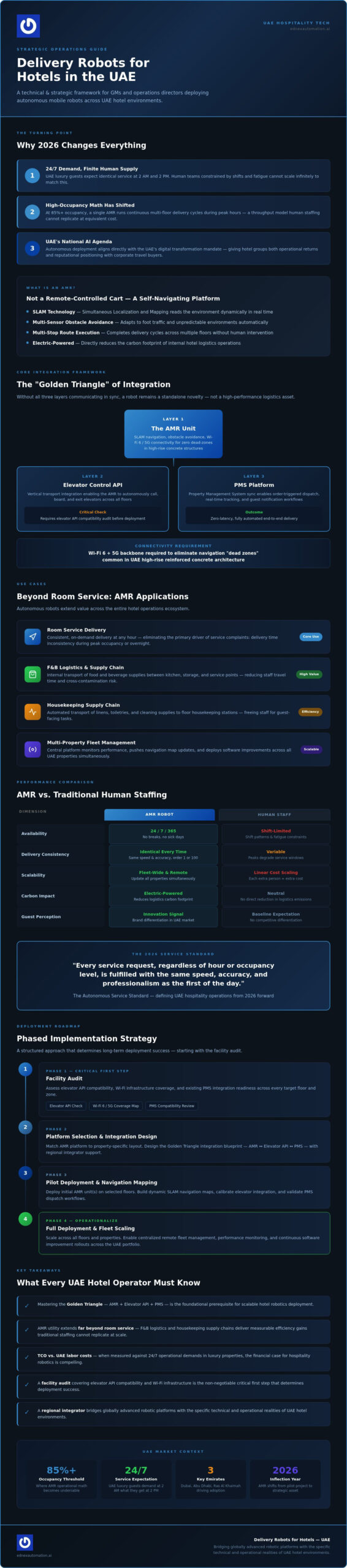
- Deploying delivery robots for hotels UAE operations requires mastering a “Golden Triangle” of integration — connecting the robot, elevator control systems, and your PMS — and this guide explains precisely how each layer functions together.
- Autonomous Mobile Robots extend well beyond room service, unlocking measurable efficiency gains across F&B logistics and housekeeping supply chains that traditional staffing models cannot replicate at scale.
- The Total Cost of Ownership for hospitality robotics, when measured against UAE labor costs and 24/7 operational demands, reveals a compelling financial case that this guide breaks down in concrete terms.
- A structured, phased implementation strategy — beginning with a facility audit covering elevator API compatibility and Wi-Fi infrastructure — is the critical first step that determines long-term deployment success.
- EdNex Automation’s role as a regional integrator bridges the gap between globally advanced robotic platforms and the specific technical and operational realities of UAE hotel environments.
The Autonomous Shift in UAE Hospitality: Why 2026 is the Turning Point
The UAE hospitality sector is entering a period of structural recalibration. Following years of aggressive post-pandemic recovery, major hotel groups across Dubai, Abu Dhabi, and Ras Al Khaimah are no longer simply competing on room design or F&B concepts. The competitive frontier has shifted inward, to operational architecture. In 2026, the properties that win on guest satisfaction are those that have systematically engineered the delivery of service itself, not just its surface presentation.
This is precisely where autonomous delivery robots have moved from an interesting pilot project to a strategic operational asset. Understanding what these systems actually are matters here. A modern Autonomous Mobile Robot is not a remote-controlled cart. It’s a self-navigating platform equipped with simultaneous localization and mapping (SLAM) technology, multi-sensor obstacle avoidance, and real-time decision-making capabilities. It reads its environment dynamically, adapts to foot traffic, and executes multi-stop delivery routes without human intervention. The distinction is fundamental for any operations director evaluating delivery robots for hotels UAE deployments.
The ‘novelty’ phase of hospitality robotics is over. In high-occupancy environments running at 85% capacity or above, the operational math demands it. A single AMR can execute continuous delivery cycles across multiple floors during peak hours, maintaining consistent delivery windows that a human team, constrained by shift patterns and physical fatigue, structurally cannot. The 24/7 room service model, long a financial pressure point for UAE luxury properties, becomes operationally sustainable when autonomous systems absorb the routine logistics burden.
From Concierge to Logistics: The Role of Service Robotics
It’s critical to distinguish between social humanoid robots, designed for front-of-house interaction and brand theater, and functional delivery AMRs engineered for logistics precision. The latter directly influences Guest Satisfaction Scores by eliminating the primary driver of service complaints: delivery inconsistency. The Autonomous Service Standard for 2026 is defined by this principle: every service request, regardless of hour or occupancy level, is fulfilled with the same speed, accuracy, and professionalism as the first of the day.
The Strategic Advantage for National Hotel Groups
For hotel groups operating across multiple UAE properties, the scalability argument is compelling. A centrally managed AMR fleet allows operations teams to monitor performance, update navigation maps, and deploy software improvements across every property simultaneously. Beyond efficiency, electric-powered AMRs directly reduce the carbon footprint of internal logistics operations, a metric increasingly scrutinized by international corporate travel buyers. This positions autonomous deployment as a direct alignment with the UAE’s national AI and digital transformation agenda, making it a strategic investment with both operational and reputational returns.
Technical Infrastructure: Elevators, PMS, and IoT Integration
Establishing a robust technical framework is the fundamental prerequisite for scaling delivery robots for hotels UAE operations. While the physical hardware of an Autonomous Mobile Robot (AMR) is impressive, its operational utility is entirely dependent on what we define as the ‘Golden Triangle’ of integration. This framework synchronizes the robotic unit, the vertical transport system, and the Property Management System (PMS) into a singular, cohesive ecosystem. Without this deep technical alignment, a robot remains a standalone novelty rather than a high-performance logistics asset.
Achieving zero-latency communication in the reinforced concrete and steel environments typical of UAE high-rise architecture requires a sophisticated connectivity layer. Utilizing Wi-Fi 6 and 5G protocols ensures that the AMR maintains a persistent heartbeat with the central server, preventing the navigation “dead zones” that often plague standard networks. Bespoke integration strategies, such as those provided by KINETIX IT Infrastructure for mesh network optimization, far outperform out-of-the-box deployments because they account for these specific structural variables, ensuring that the robot’s pathing remains fluid and its response times stay instantaneous.
Synchronizing with the Property Management System (PMS)
Integrating the AMR directly with the hotel’s PMS transforms the delivery workflow from a manual task into an automated sequence. When a guest initiates an order through a room tablet or mobile application, the PMS triggers the robot’s mission without requiring front-desk intervention. This seamless data exchange allows for real-time guest notifications, providing an “Uber-style” tracking interface that enhances the perceived value of the service. By harvesting the resulting delivery metrics, management can identify peak demand windows and optimize inventory levels based on hard operational data rather than anecdotal observation.
Elevator Integration: Overcoming the Vertical Barrier
Navigating multi-story environments represents the most significant technical hurdle in hospitality automation. We solve this through specialized elevator API modules that establish a secure handshake between the robot and the lift controller. Depending on the age and specifications of the property’s infrastructure, this is achieved via REST API protocols or hardware-level dry contact interfaces. Ensuring safety in these confined spaces requires advanced logic where the robot can detect elevator occupancy, defer to human passengers during high-traffic periods, and request priority “service mode” calls during urgent deliveries.
Implementing these complex communication layers requires the same level of precision found in large-scale PLC and SCADA integration services, where timing and reliability are non-negotiable. For hotel groups looking to future-proof their assets, partnering with an expert who understands these vertical protocols is essential. To ensure your property is ready for this transition, you should consult with a specialized robotics integrator who can map your existing infrastructure against 2026 technical requirements.
Operational Use Cases: Beyond Room Service Delivery
The most common misconception limiting ROI calculations for delivery robots for hotels UAE deployments is treating the AMR as a single-purpose room service tool. That framing dramatically underestimates the asset’s operational range. A correctly integrated AMR fleet operates as a distributed logistics engine, touching every service layer of the property, from the kitchen pass to the linen room to the administrative corridor.
Precision in F&B and In-Room Dining
Modern delivery AMRs are engineered with thermally regulated, enclosed compartments that maintain food temperature and hygiene standards throughout transit, eliminating the degradation that occurs when a human runner is delayed by a crowded service elevator. The capacity gains are equally significant. A coordinated fleet of three robots can absorb the delivery volume typically managed by two full-time runners during peak service windows, executing multi-stop routes across different floors simultaneously and without fatigue.
There’s also a guest preference dimension that operators frequently overlook. A measurable segment of today’s hospitality market, particularly business travelers and high-privacy guests, actively prefer robot delivery over human contact for in-room orders. Removing the social friction of a staff interaction at the door is itself a service enhancement, and properties that recognize this are converting it into a genuine differentiator.
Back-of-House (BOH) Logistics Optimization
The back-of-house application case is where AMR deployments generate their most underreported efficiency gains. Consider the physical toll of housekeeping logistics in a 200-room high-rise property:
- Laundry and linen transport: Autonomous units handle the repeated, physically demanding movement of heavy laundry bins and fresh linen carts between floor stations and the central laundry facility, directly reducing musculoskeletal strain on housekeeping staff.
- Toiletry and supply replenishment: AMRs deliver restocking loads directly to floor supervisors on demand, eliminating unnecessary trips to central storage and freeing staff to focus on room turnover quality.
- Internal document and mail routing: Administrative departments, from accounts to HR to operations, benefit from autonomous inter-office delivery that removes the low-value interruptions that fragment managerial productivity.
The compounding effect of these BOH efficiencies is substantial. Staff hours recovered from logistics tasks are reallocated to guest-facing roles where human judgment and interpersonal skill genuinely matter. Integrating delivery AMRs with autonomous cleaning robots creates a total facility automation solution where logistics and hygiene operations function as a coordinated, centrally managed system rather than isolated workflows.
For UAE hotel groups operating at scale, this integrated approach represents a structural shift in how back-of-house resources are deployed, transforming what was previously a cost center defined by physical labor into a precision logistics network governed by data.
The ROI of Hospitality Robotics: Labor, Speed, and Guest Satisfaction
Every capital investment conversation in UAE hospitality eventually arrives at the same question: when does this pay for itself? For delivery robots for hotels UAE deployments, the answer requires moving beyond a simple hardware cost comparison and examining the full financial architecture of what you’re replacing. UAE labor costs, when fully loaded with visa sponsorship, accommodation allowances, medical insurance, and end-of-service gratuity, represent a substantially higher per-employee cost than base salary figures suggest. An AMR fleet doesn’t carry any of those obligations.
The 24/7/365 operational advantage compounds this calculation decisively. A robot doesn’t clock out at shift end, doesn’t require overtime authorization during Ramadan peak hours, and doesn’t call in sick during a 95% occupancy weekend. It executes its delivery cycle at 2 AM with the same precision as at 2 PM. For UAE properties managing round-the-clock in-room dining, this structural consistency directly eliminates the premium labor cost that currently makes late-night service financially punishing.
Guest satisfaction data reinforces the financial case from a revenue protection angle. Delivery speed is consistently among the top variables correlating with positive post-stay review scores on platforms like TripAdvisor and Google. A reduction in average delivery time, achieved through autonomous routing and elimination of runner delays, translates directly into measurable score improvements. In UAE’s fiercely competitive hospitality market, even fractional gains in review ratings influence booking conversion rates at scale.
Calculating the Payback Period
ROI timelines vary based on three primary variables: deployment scale, integration complexity, and utilization rates. Properties that deploy AMRs across both front-of-house delivery and back-of-house logistics simultaneously achieve higher utilization rates and compress their payback window. Industry experience across comparable hospitality markets indicates that 3-star to 5-star hotel properties operating at sustained occupancy levels typically achieve full ROI within an 18 to 24-month window, though this figure should be modeled against your specific labor structure and service volume before treating it as a benchmark. There’s also a marketing ROI dimension that rarely appears in procurement spreadsheets: a well-designed delivery AMR is inherently photogenic, and guest-generated social media content featuring the robot extends brand visibility organically, generating earned media that would otherwise require a paid campaign budget.
The Hybrid Workforce: Humans and Robots
The most strategically significant shift enabled by AMR deployment isn’t cost reduction. It’s workforce transformation. Staff previously assigned to repetitive delivery and logistics runs can be repositioned as guest experience managers, handling complex service requests, personalization touchpoints, and relationship-driven interactions that genuinely require human judgment. This upskilling pathway also directly addresses the UAE hospitality sector’s persistent retention challenge: employees removed from physically taxing, low-autonomy roles report measurably higher job satisfaction. Combining this with the broader logistics efficiency gains explored in EdNex Automation’s analysis of autonomous mobile robots for industrial and commercial environments reveals how the same AMR architecture scales from warehouse logistics to hotel corridors within a unified operational framework.
Structuring this transition correctly from the outset determines whether your team embraces the technology or resists it. Speak with EdNex Automation’s integration specialists to model a hybrid workforce deployment plan calibrated to your property’s specific service structure and staffing profile.
Implementing Your Robotics Strategy with EdNex Automation
Knowing that autonomous delivery systems deliver measurable returns is one thing. Executing a deployment that actually integrates with your elevator infrastructure, PMS, and service workflows is another challenge entirely. EdNex Automation has structured a four-phase implementation methodology that eliminates the guesswork from this process, giving UAE hotel operations directors a clear, sequenced path from initial assessment to full operational scale.
Phase 1: Facility Audit and Technical Feasibility Study. Every engagement begins with a rigorous on-site audit covering three critical variables: elevator API compatibility, Wi-Fi coverage mapping across all guest and service floors, and structural layout analysis for AMR navigation. This phase produces a concrete technical blueprint, not a generic proposal, identifying any infrastructure gaps before a single unit is commissioned.
Phase 2: Custom Integration and PMS Mapping. With the audit findings in hand, EdNex engineers design the bespoke integration layer connecting the AMR fleet to your specific PMS platform. This includes configuring the automated order-trigger workflows, guest notification sequences, and elevator handshake protocols discussed earlier in this guide. Nothing is templated. Every mapping decision is calibrated to your property’s exact operational architecture.
Phase 3: Pilot Deployment and Staff Training. A controlled pilot, typically beginning with a single unit across defined delivery routes, validates the integration in live conditions before full commitment. Critically, this phase runs parallel staff training that repositions your team as supervisors and guest experience managers rather than logistics runners. Structured correctly, this transition builds staff confidence in the technology rather than resistance to it.
Phase 4: Full-Scale Launch and Ongoing Technical Support. National UAE coverage for technical support means that firmware updates, navigation map refinements, and hardware maintenance are handled by local engineers with rapid response capability, not routed through an overseas support desk.
Why EdNex is the UAE’s Strategic Partner
EdNex’s position as an authorized Gold Partner of Unitree provides direct access to advanced robotic hardware, including the PUDU series purpose-built for hospitality environments. This authorized status also extends to the broader robotics ecosystem, including humanoid robots for sale UAE deployments for properties exploring front-of-house innovation alongside logistics automation. The combination of globally advanced hardware access and deep regional integration expertise is what distinguishes EdNex from vendors who supply equipment without owning the technical outcome.
Securing Future-Proof Operations
Deployment isn’t the endpoint. EdNex applies AI analytics post-launch to continuously refine robot pathing, tasking sequences, and peak-hour scheduling based on real operational data from your property. The architecture is deliberately scalable: properties sourcing delivery robots for hotels UAE operations can begin with a single unit and expand to a coordinated multi-property fleet as utilization data confirms readiness. The investment grows with your confidence in the system.
Contact EdNex Automation to begin your hospitality transformation and receive a facility audit scoped to your property’s specific infrastructure and service model.
The Operational Window Is Open: Make Your Move in 2026
The case for delivery robots for hotels UAE properties is no longer theoretical. This guide has established three realities that UAE operations directors can’t afford to ignore: the Golden Triangle of AMR, elevator, and PMS integration is technically achievable today; the efficiency gains extend deep into back-of-house logistics, not just room service; and the financial payback timeline is measurable against your actual labor structure, not generic industry assumptions.
What separates properties that capture these returns from those still evaluating is a single decision: beginning the infrastructure audit now, before peak occupancy cycles expose the gaps in your current delivery model.
EdNex Automation brings three capabilities to that process that matter most: Authorized Gold Partner status with Unitree, proven PMS and elevator integration expertise built for UAE high-rise environments, and national technical support that keeps your deployment performing long after launch.
Your competitive window in 2026 hospitality is defined by how quickly you move from analysis to execution. Request a Strategic Robotics Integration Audit for Your Hotel and let EdNex map a deployment plan calibrated precisely to your property’s infrastructure and service model.
Frequently Asked Questions About Delivery Robots for Hotels UAE
How do delivery robots navigate hotel elevators in the UAE?
Hotel delivery robots interface with elevator control systems through either REST API protocols or hardware-level dry contact interfaces, depending on the age and specification of the lift infrastructure. This integration allows the robot to call a specific elevator, hold the doors open during loading, and select the correct floor autonomously, without any staff intervention required.
The robot’s onboard logic also governs social priority: it detects elevator occupancy through sensor arrays and defers to human passengers during high-traffic periods, requesting priority “service mode” calls only when delivery urgency requires it. Properties with older elevator controllers that lack native API support can still achieve integration through hardware bridging solutions designed for legacy systems.
Can hotel delivery robots integrate with Opera or other PMS systems?
Yes. Delivery robots for hotels UAE deployments can be integrated with Opera and other major PMS platforms through a bespoke middleware layer that maps guest order triggers directly to robot dispatch commands. When a guest places an in-room dining order, the PMS automatically initiates the delivery mission without requiring front-desk or F&B staff to manually assign the task.
The specific integration architecture varies by PMS vendor and version, which is why a custom mapping exercise is essential during the pre-deployment phase rather than relying on generic connectors. EdNex Automation engineers this integration layer to your property’s exact PMS configuration, including guest notification sequences and real-time delivery tracking interfaces.
What happens if a robot encounters a guest or a child in a hallway?
Modern AMRs deployed in hospitality environments use multi-sensor obstacle detection combining LiDAR, infrared, and camera arrays to identify and respond to dynamic obstructions in real time. When a person, including a child at a lower detection height, enters the robot’s path, the unit decelerates immediately, stops at a safe distance, and waits for the path to clear before resuming its route.
The robot doesn’t attempt to navigate around a stationary person by squeezing past in a confined corridor. It holds position and, if the obstruction persists beyond a defined threshold, alerts the central management system so a staff member can assist. Operating speeds in guest-facing corridors are deliberately capped below levels used in back-of-house environments, prioritizing safety over delivery velocity.
How long does the battery of a hotel delivery robot last?
Battery performance varies by unit model and payload weight, but hospitality-grade AMRs are generally engineered for continuous operational cycles that cover a full service shift before requiring a charge. Most units in active hotel deployments return autonomously to a docking station during natural lulls in demand, such as between the dinner service peak and late-night orders, enabling opportunity charging rather than full depletion cycles.
For properties running 24/7 delivery operations, fleet sizing accounts for charge rotation so that at least one unit remains available at all times. The specific charge duration and cycle specifications for any unit EdNex deploys are confirmed during the facility audit phase, ensuring the fleet configuration matches your property’s actual delivery volume and peak-hour patterns.
Are delivery robots in hotels secure against theft or tampering?
Hospitality AMRs use compartment-locking mechanisms that release only when the robot arrives at the correct room and the guest authenticates the delivery, typically via a code sent through the hotel’s guest app or room tablet. The compartment remains sealed throughout transit, preventing access by anyone other than the intended recipient.
The robot itself is tracked in real time by the central management system, so any deviation from its programmed route triggers an immediate alert. Physical tampering attempts are logged by the unit’s sensor suite. These security layers make AMR delivery measurably more tamper-resistant than traditional runner-based service, where handoffs in corridors or service elevators are inherently less controlled.
How much does a delivery robot for a hotel cost in the UAE?
Providing a specific price here wouldn’t be accurate or useful, because the total investment for delivery robots for hotels UAE properties depends on several variables: the number of units required, the complexity of your elevator and PMS integration, your existing Wi-Fi infrastructure, and whether you’re deploying for front-of-house delivery only or including back-of-house logistics routes. These factors shift the cost structure considerably from property to property.
Rather than working from a generic figure that may not reflect your actual deployment, the most reliable approach is to request a scoped assessment from EdNex Automation. That process produces a deployment model calibrated to your specific property size, service volume, and integration requirements, giving you a cost basis that’s actually comparable against your current labor expenditure.
Do I need to upgrade my hotel’s Wi-Fi for robotic deployment?
Not necessarily, but a structured Wi-Fi audit is a non-negotiable first step. AMRs require persistent, low-latency connectivity across all operational zones, including service corridors, elevator lobbies, and back-of-house areas that are frequently the weakest points in a hotel’s existing network. Standard guest-facing Wi-Fi infrastructure is rarely configured to cover these zones adequately.
The pre-deployment facility audit maps signal coverage against the robot’s planned navigation routes and identifies any dead zones that would interrupt the AMR’s communication heartbeat. In many UAE high-rise properties built with reinforced concrete cores, targeted access point additions or a shift to Wi-Fi 6 in specific zones resolves coverage gaps without requiring a full network overhaul. The audit determines exactly what’s needed rather than defaulting to a blanket infrastructure replacement.
What maintenance is required for a hospitality robot fleet?
Routine maintenance for hospitality AMRs covers three primary areas: sensor cleaning to maintain obstacle detection accuracy, mechanical inspection of drive components and compartment locking systems, and software updates that refine navigation maps as your property’s layout or furniture arrangements change. Most of this is scheduled preventively rather than reactively, following manufacturer-specified service intervals.
EdNex Automation provides national UAE coverage for technical support, meaning maintenance visits and firmware updates are handled by local engineers rather than routed through overseas support channels. Navigation map refinements, which are often needed after lobby renovations or seasonal furniture changes, are applied remotely where possible and on-site when physical re-mapping is required. This ongoing support structure is what keeps a deployed fleet performing at specification long after the initial launch.