The most capable autonomous vacuum on a specification sheet may still be the wrong system for your facility. Navigation features and cleaning claims matter only when they match your floor surfaces, traffic patterns, debris, and operating schedule.
Comparing systems can be difficult when autonomy is described in broad terms and facility layouts vary. Before shortlisting options, identify the areas that need cleaning, the obstacles and people the robot will encounter, and the level of staff support your team can provide. Then compare each system against those requirements.
This guide explains how to build a practical shortlist around facility needs. You’ll compare navigation and cleaning performance, assess whether vacuuming or another robotic floor-cleaning approach suits your surfaces, and identify layout, docking, connectivity, and integration needs before deployment. For commercial and industrial operations across the UAE, the goal is a system that fits the site and supports day-to-day cleaning, not simply one with a long feature list.
Key Takeaways
- Compare navigation, floor compatibility, scheduling, and human oversight against your operation’s needs, not a feature list alone.
- Assess whether an autonomous vacuum or robotic floor scrubber better matches the debris, surfaces, and cleaning result your facility requires.
- Review routes, floor transitions, obstacles, and operating-hour limits before deployment.
- Evaluate how cleaning automation can fit existing facility workflows and broader robotics integration needs.
- Use a pilot with defined criteria to assess practical fit and day-to-day operating requirements.
What Is an Autonomous Vacuum, and Where Does It Fit in Commercial Cleaning?
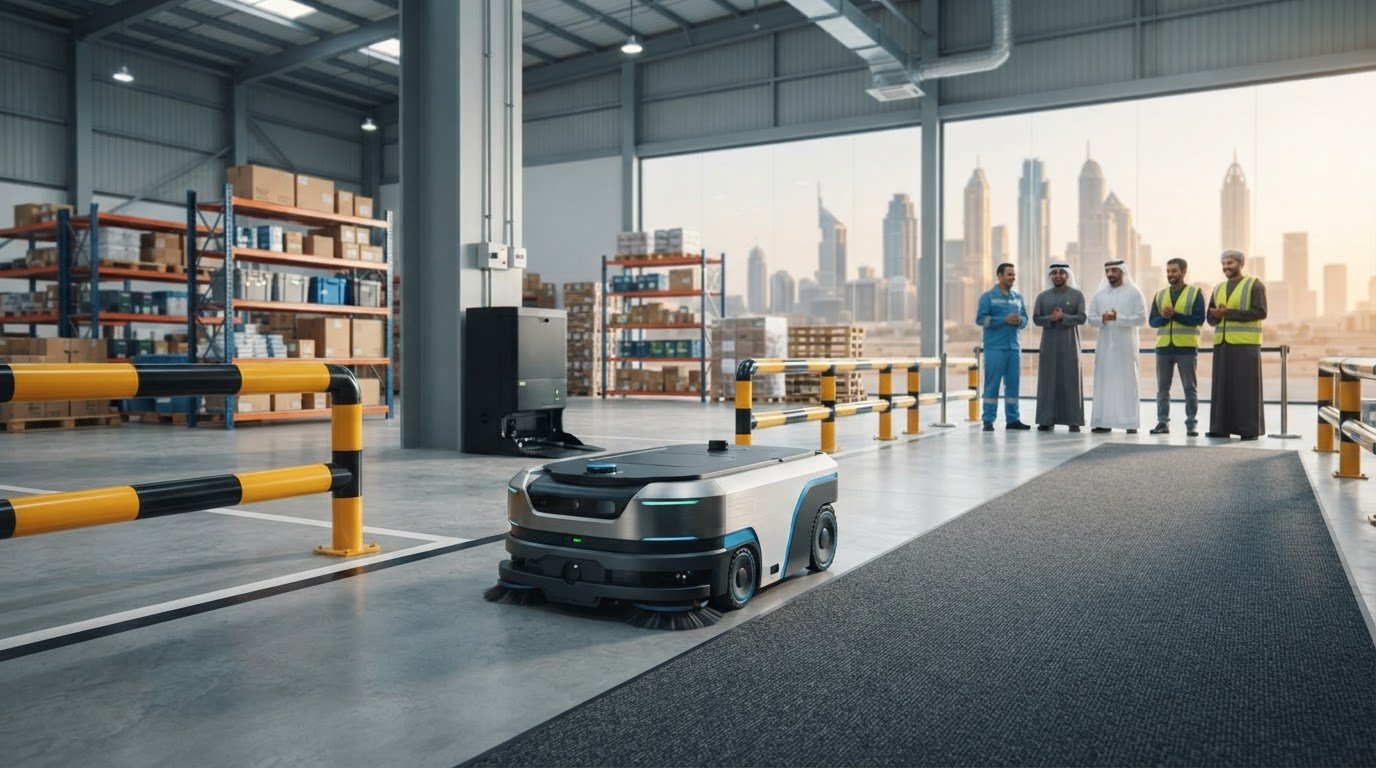
An autonomous vacuum is a robotic system that navigates a defined area and carries out assigned floor-cleaning tasks with limited direct steering. Depending on its design, it may use sensors and onboard controls to follow routes, respond to obstacles, and return to a designated location. The Robotic vacuum cleaner overview describes the technology’s general history and components. Commercial buyers also need to assess how a system fits the facility’s layout, cleaning task, and operating routines.
This guide is for commercial and industrial facility teams, not household shoppers comparing appliances for home use. Offices, hospitality facilities, retail environments, and operational sites can all have recurring floor-care needs, but their layouts, foot traffic, floor materials, and access rules differ. Those conditions determine what a useful system needs to handle.
Vacuuming is one type of robotic floor cleaning, not a label for every cleaning robot. A vacuum collects dust, dirt, and light debris; a robotic scrubber is designed for wet cleaning of hard floors. Functions vary by system, so match the cleaning method to the task instead of assuming all autonomous machines deliver the same result.
How does an autonomous vacuum differ from a household robot vacuum?
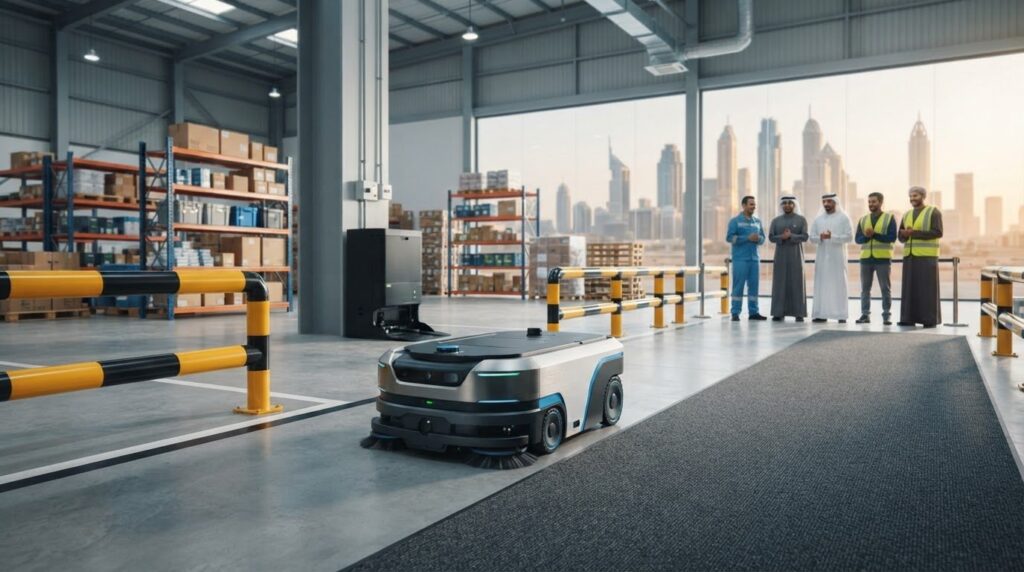
The main difference is the operating context. A household unit is intended for domestic rooms and routines, while a commercial system must be assessed against the facility’s cleaning area, route complexity, traffic, and schedule. Offices may have furniture and shared walkways; retail spaces may have changing aisle activity; operational sites may include access restrictions or work zones. These conditions define what buyers need to evaluate, rather than guaranteeing any particular system capacity or performance.
Facility routines matter, too. A route through a quiet office may be unsuitable during busy hours. An open area may offer clearer paths, but still needs planned access and oversight. Compare the system’s intended use with the actual environment, not with assumptions based on household machines.
When should a facility consider autonomous vacuuming?
Consider autonomous vacuuming for repeatable tasks, such as collecting dust and light debris along defined routes, especially where large floor areas need regular attention. Start by listing the areas to clean, when they are accessible, how foot traffic changes during the day, and which spaces need manual detail or a different cleaning method. This gives you a clear basis for deciding whether autonomous operation can complement existing routines.
For a wider view of cleaning automation, see Autonomous Cleaning Robots: The Definitive 2026 Guide to Industrial Hygiene Automation. EdNex Automation supplies and integrates cleaning robots for commercial and industrial operations across the UAE, helping connect cleaning-robot evaluation with facility workflows and broader automation requirements.
Which Autonomous Vacuum Capabilities Should Buyers Compare?
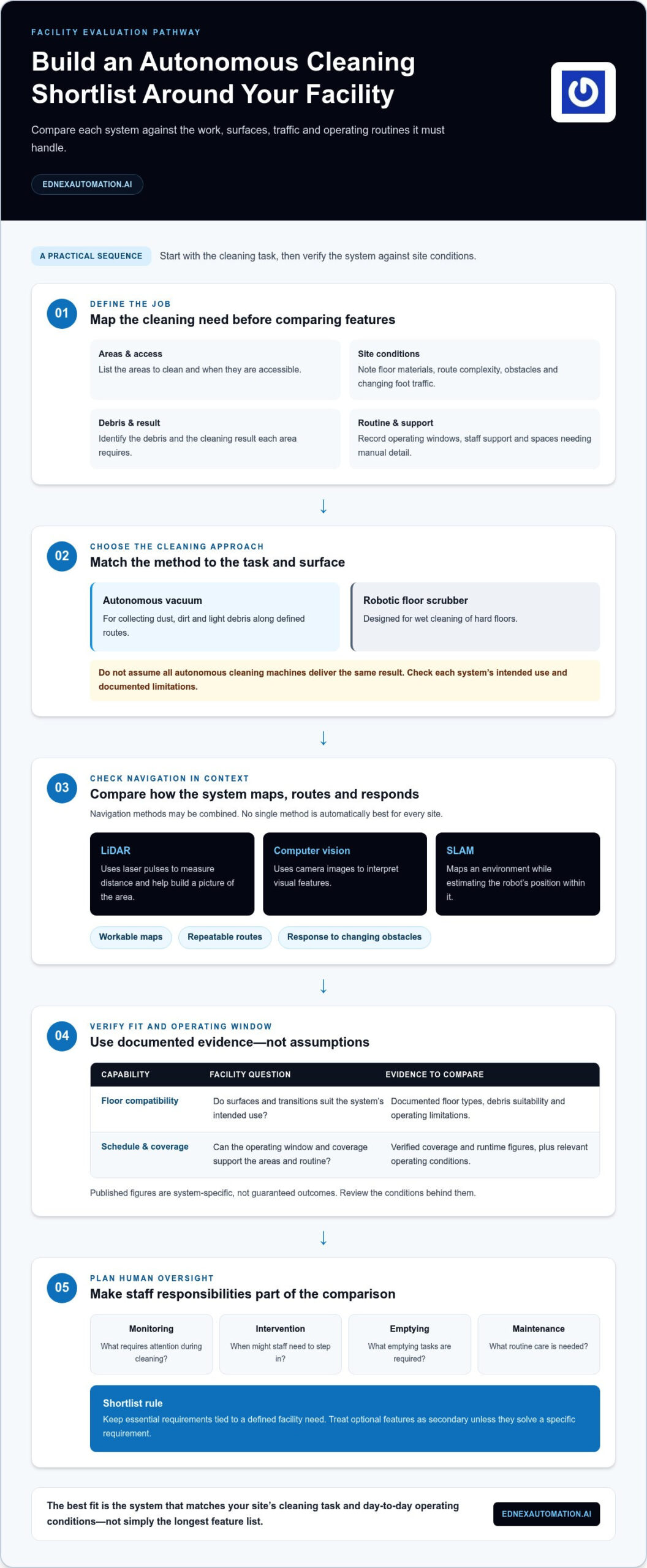
Compare systems against the work they must perform and the conditions they’ll encounter. Separate essential requirements, such as suitable floor coverage and safe movement through routine traffic, from optional features that don’t address a defined need. Write down the requirements first, then review each system’s documentation and, where appropriate, assess it in the facility.
| Capability | What to assess | Evidence to compare |
|---|---|---|
| Navigation | Can it follow intended routes and respond to people, equipment, and temporary obstacles? | Mapping method, route-planning functions, and documented obstacle response |
| Floor compatibility | Do the surfaces and transitions match the system’s intended use? | Documented floor types, debris suitability, and operating limitations |
| Schedule and coverage | Can its operating window and coverage support the areas and routine you’ve defined? | Verified coverage and runtime figures, plus relevant operating conditions |
| Human oversight | What tasks require staff attention during and between cleaning runs? | Instructions for monitoring, intervention, emptying, and routine maintenance |
How do navigation systems affect autonomous vacuum performance?
Navigation determines how a robot interprets its surroundings and moves through them. LiDAR measures distance using laser pulses to help build a picture of the area; computer vision uses camera images to interpret visual features; and SLAM, or simultaneous localization and mapping, lets a robot map an environment while estimating its position within it. Systems may combine these approaches, and no single method is automatically best for every site.
Focus on how the system performs in your environment: can it create or use a workable map, plan repeatable routes, and respond appropriately to changing obstacles? A clear route across a quiet floor presents a different challenge from one that crosses busy walkways or areas where equipment moves during a shift.
Which cleaning and operating specifications matter most?
Match documented cleaning capabilities to the surfaces and debris in your facility. Check how dust and debris are collected, what routine maintenance involves, and whether staff can access parts that need attention. Then compare stated coverage and runtime with your required areas and operating windows. Published figures are system-specific, not guaranteed outcomes. Review the conditions behind them in the product documentation and assess performance against the actual task.
Use that evidence to distinguish must-haves from enhancements. EdNex Automation’s robotics integration perspective connects equipment evaluation with facility workflows and broader automation requirements for commercial and industrial operations in the UAE.
Autonomous Vacuum vs. Robotic Floor Scrubber: Which Approach Fits?
Choose the cleaning method based on the result the floor needs, not on the robot’s autonomy alone. An autonomous vacuum collects dust, dirt, and light debris through suction. A robotic floor scrubber applies water and cleaning solution with brushes, then collects the dirty water. One facility may need regular dry debris removal; another may prioritize wet care for hard floors. Some sites may need both as part of a coordinated cleaning plan.
| Cleaning approach | Typical use case | Operational fit | Key trade-off |
|---|---|---|---|
| Autonomous vacuum | Routine collection of dust, dirt, and light debris | Consider it where dry cleaning is the main task and the floor type suits the system’s documented capabilities. | It doesn’t provide wet scrubbing for grime embedded on hard floors. |
| Robotic floor scrubber | Wet cleaning to remove grime from hard floors | Consider it where the cleaning plan calls for scrubbing and the site can support the machine’s water-handling needs. | Heavy debris may need to be removed first; otherwise, it can create sludge or clog the machine. |
When is an autonomous vacuum the better fit?
Vacuuming may be the better fit when dry debris is the priority, such as dust and light dirt along recurring routes. Assess whether the facility’s surfaces, traffic patterns, and cleaning schedule suit the system’s documented use. For example, a site with carpeted areas or hard floors may consider vacuuming, but compatibility should be verified for the specific system and surface. An autonomous vacuum isn’t a substitute for wet floor care when scrubbing is required.
When should buyers compare other robotic cleaning systems?
Compare other cleaning robots when the task involves removing grime from hard floors, applying cleaning solution, or recovering wastewater. A vacuum-only approach won’t provide those functions. Conversely, using a scrubber when dry debris collection is the main need may add a wet-cleaning process the task doesn’t call for. Match the equipment to the required result and the site workflow.
For more detail on wet floor care, read Why Your Facility Needs a Robotic Floor Scrubber. If route navigation is also part of the decision, Autonomous Mobile Robots: The Definitive Guide to Industrial Autonomy in 2026 offers relevant context. Treat coverage and cleaning-performance claims as system-specific, and evaluate them against the facility’s surfaces, debris, and operating conditions.
How to Evaluate Facility Readiness Before Deploying an Autonomous Vacuum
A structured readiness review connects the cleaning task to site conditions and the people who will support daily operation. Before choosing a system, document what needs cleaning, how the facility functions, and how a pilot will be assessed. This helps avoid selecting equipment that can perform a task but doesn’t fit the wider workflow.
- Define the task. Specify the areas to clean, the type of debris, the required routine, and the work that will remain manual.
- Survey the site. Map cleaning zones, routes, entrances, access restrictions, floor materials and transitions, fixed obstacles, and areas where layouts change.
- Check operating constraints. Note busy periods, shift patterns, restricted hours, shared routes, and activities that could affect access or safe movement.
- Assign responsibilities. Identify who prepares areas, monitors operation, handles routine maintenance and charging, and responds when the robot needs attention.
- Plan a pilot. Choose a representative cleaning task, set an evaluation period, and agree on measurable acceptance criteria before the trial begins.
What should a facility survey document?
Capture the conditions the system will encounter, not just a floor plan. Record surface materials, transitions between zones, furniture or equipment that may move, access points, cleaning boundaries, and traffic patterns at different times. Note temporary obstructions and spaces that must remain clear. Don’t assume a route is suitable based on appearance alone; compare site details with the selected system’s documented requirements.
The survey should also identify the practical support setup. Mark where the robot can be charged, who is responsible for routine care, and how staff will report a blocked route, incomplete task, or other interruption. Clear ownership helps keep daily operation consistent.
How can a pilot test operational fit?
Use the pilot to evaluate a defined task under representative site conditions. Set criteria in advance, such as whether assigned zones are completed, routes remain consistent, staff interventions are manageable, and maintenance fits existing routines. Record exceptions and their causes, including traffic, access changes, or obstacles. Compare results with the facility’s baseline cleaning needs, but don’t assume savings or productivity gains without project-specific evidence.
Use the findings to refine routes, responsibilities, and integration planning before wider deployment. To connect facility requirements with a broader robotics evaluation, explore EdNex Automation’s robotics solutions.
How EdNex Automation Can Support Autonomous Cleaning Evaluation
Selecting cleaning equipment is only one part of an automation decision. The system also needs to fit the facility’s layout, cleaning priorities, staff routines, and existing processes. EdNex Automation supplies and integrates robotic solutions for commercial and industrial operations across the UAE, including cleaning robots and specialized outdoor cleaning automation. This wider robotics perspective connects equipment evaluation with the way a site operates.
What does an integration-led evaluation cover?
An integration-led evaluation starts with the intended cleaning outcome, then considers the operating environment around it. For example, a facility may need recurring dry-floor cleaning in shared areas while keeping routes clear for staff and other equipment. The evaluation can account for cleaning zones, access patterns, operating hours, charging and maintenance responsibilities, and how the system fits alongside existing workflows.
This approach keeps the decision grounded in operational needs rather than isolated features. It also helps distinguish a cleaning task that suits an autonomous vacuum from one that calls for a different robotic cleaning method. Define integration priorities around the facility’s actual processes, without assuming particular system interfaces, deployment timelines, or performance outcomes.
What are the next steps for a facility buyer?
Prepare a concise evaluation brief before making a decision. Include:
- Cleaning task: Identify target areas, floor-care priorities, and work that will remain manual.
- Site conditions: Record floor types, route changes, access limits, obstacles, and traffic patterns.
- Comparison criteria: Set essential requirements for navigation, cleaning suitability, operating schedule, and staff oversight.
- Pilot measures: Define how task completion, route consistency, interventions, and maintenance needs will be assessed.
These details give decision-makers a clear basis for discussing cleaning automation and its fit with wider facility operations. Explore how autonomous cleaning robots can fit within a broader robotics strategy, or discuss autonomous cleaning requirements with EdNex Automation to evaluate your commercial or industrial needs.
Turn Facility Requirements Into a Confident Shortlist
The right autonomous vacuum is the one that fits your facility’s cleaning task, surfaces, traffic patterns, and operating routines. Compare documented navigation and cleaning capabilities with those needs, then assess whether vacuuming or robotic scrubbing better matches the required floor-care result.
Before deployment, map routes and access constraints, assign staff responsibilities, and define pilot measures for task completion, interventions, and maintenance. This gives your team a practical basis for evaluating fit without relying on headline specifications or unverified performance promises.
EdNex Automation supplies and integrates robotics for commercial and industrial sectors across the UAE, with a portfolio that includes cleaning robots and outdoor cleaning automation. Explore how robotics can support your facility’s wider operational requirements. Explore EdNex Automation’s robotics solutions and take the next step toward a considered cleaning automation plan.
With clear requirements and a measured evaluation, your team can make a more informed decision.
Frequently Asked Questions
What is an autonomous vacuum?
An autonomous vacuum is a robotic cleaning system that navigates an assigned area and performs vacuuming tasks with limited routine direction. Its suitability for a commercial facility depends on the layout, floor surfaces, debris, operating schedule, and level of human oversight required. Compare documented system capabilities with actual site conditions instead of relying on a single headline specification to predict whether cleaning needs will be met.
Is an autonomous vacuum suitable for commercial facilities?
An autonomous vacuum can suit a commercial facility when the cleaning tasks are repeatable, the floors match the system’s documented capabilities, and routes are navigable. Suitability also depends on traffic, obstacles, access restrictions, and operating hours. A site assessment can reveal potential constraints, while a structured pilot helps evaluate route completion, staff intervention, and cleaning quality under representative conditions before wider deployment.
How does an autonomous vacuum navigate a facility?
Navigation varies by system. LiDAR measures distances to help map surroundings, computer vision interprets camera images, and SLAM combines mapping with estimating the robot’s position. These technologies can support route planning and obstacle response, but their effectiveness depends on implementation and site conditions. Review the system’s documentation, then observe how it handles the facility’s layout, changing obstacles, and routine traffic during a site assessment or pilot.
Can an autonomous vacuum replace manual cleaning?
No, not automatically. A robot may take on defined, repeatable vacuuming tasks, while staff continue work requiring judgment, detailed attention, or a response to unexpected conditions. The right arrangement depends on cleaning standards, the facility environment, and verified system capabilities. Before changing staffing or cleaning procedures, assess how automated tasks fit existing workflows and clarify who will monitor operation, handle maintenance, and address interruptions.
What is the difference between an autonomous vacuum and a robotic floor scrubber?
An autonomous vacuum collects dry dust, dirt, and light debris, while a robotic floor scrubber is designed for wet cleaning of hard floors using water, cleaning solution, and brushes. The better fit depends on the surface, debris, and desired cleaning result. A scrubber may need heavy debris removed beforehand to avoid sludge or clogging. Compare each system’s documented functions with the task your facility needs done.
How much space can an autonomous vacuum clean?
There isn’t one coverage figure that applies to every autonomous vacuum. Achievable coverage depends on the system, route design, floor conditions, operating schedule, and level of human intervention. Review documented coverage information alongside a map of the areas to be cleaned, and note the conditions behind any published figures. A pilot in representative operating conditions can help assess route completion and cleaning quality for your facility.
What should I evaluate before deploying an autonomous vacuum?
Start by documenting the cleaning task, floor types, routes, obstacles, access needs, and operating hours. Identify who will manage charging, routine maintenance, monitoring, and escalation when a task is interrupted. Then compare the system’s verified specifications with these requirements and define measurable pilot criteria, such as task completion and intervention frequency. This process helps assess operational fit before planning a broader deployment.