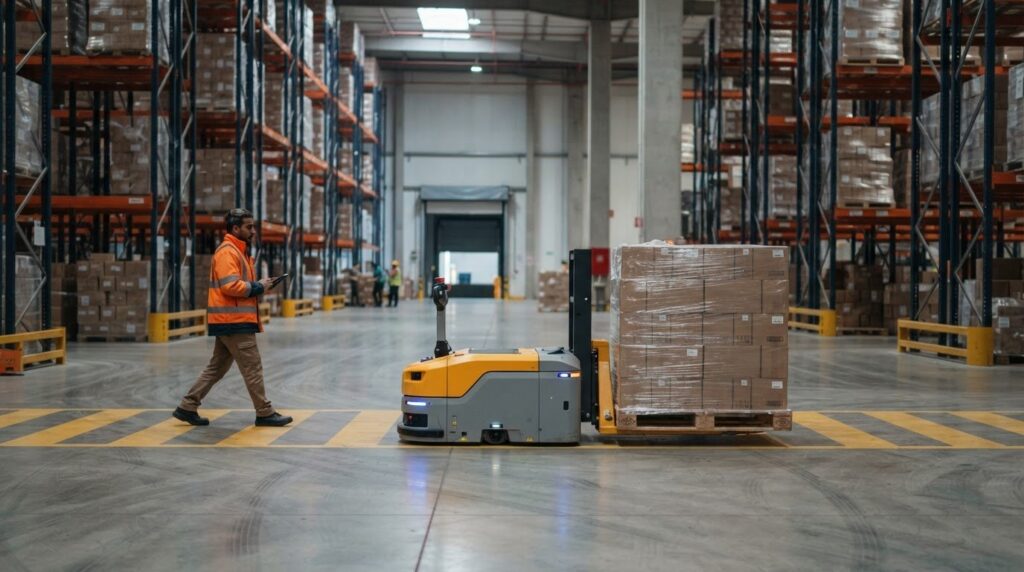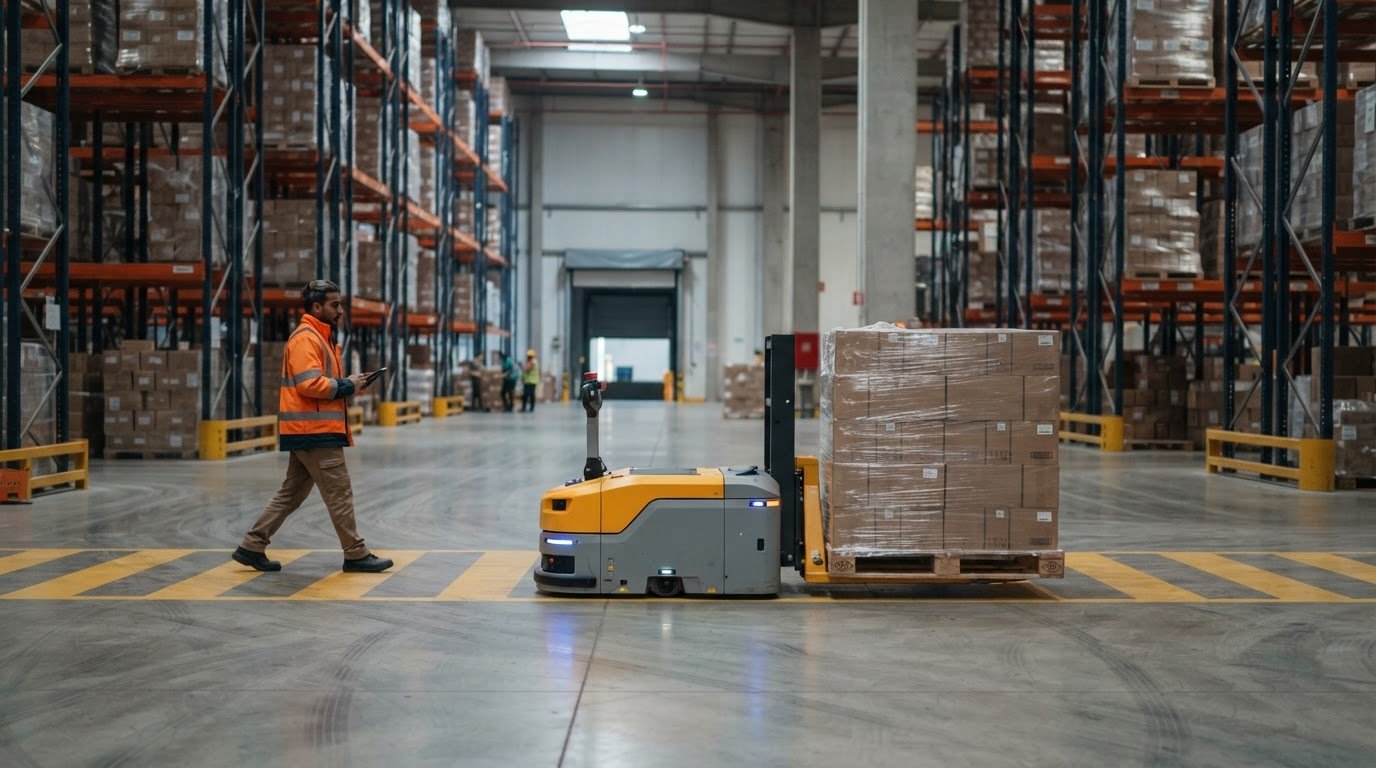
Warehouse automation in the UAE isn’t a single-robot decision. Robotic solutions for GCC warehouses can combine autonomous mobile robots (AMRs), automated guided vehicles (AGVs), and AI-enabled robots, each suited to different movement, handling, and decision-making tasks. The right mix depends on the facility’s workflows and operating environment.
Choosing automation can feel complex when warehouse and manufacturing demands differ across sites. The decision becomes clearer when each technology is matched to a specific operational need, from moving goods along repeatable routes to supporting more flexible intralogistics.
This article explains how AMRs, AGVs, and AI-enabled robots fit UAE and wider GCC operations, where robotics is used, and which market trends are shaping adoption. It also outlines what to assess when planning an implementation, so you can compare options before deciding how automation should support your facility.
Key Takeaways
- Match mobile robot types to the movement patterns and flexibility demands of each warehouse workflow.
- Assess how regional robotics providers and integration capabilities can shape an automation project’s fit.
- Use GCC market trends to understand the direction of smart manufacturing and plan technology adoption around operational needs.
- Explore how robotics applications differ across logistics, manufacturing, and other sectors, then identify where EdNex Automation’s offerings may support your operation.
Autonomous Mobile Robots and Automated Guided Vehicles
AMRs and AGVs automate material movement, while the best fit depends on route stability and workflow. GCC warehouses can combine mobile robots with storage systems and software automation.
AMRs navigate changing routes using sensors and onboard navigation, while AGVs follow predefined paths. AMRs suit workflows that change; AGVs can handle repeatable transfers. Cost and performance depend on facility layout, task volume, integration needs, and operating conditions, not just robot type.
Automated storage and retrieval systems (ASRS) coordinate storage and retrieval by linking inventory locations with warehouse workflows. Robotic process automation (RPA) is software, not a physical robot; it can handle rules-based work such as invoice processing and customer onboarding. Together, these tools can connect digital processes with the physical movement of goods.
Saudi Arabia is a major logistics automation hub alongside the UAE, and logistics automation is expanding into Oman, Qatar, Kuwait, and Bahrain. For example, an operation can use mobile robots to transfer goods between receiving, storage, and dispatch zones, while warehouse software coordinates inventory tasks.
GCC countries have their own robotics regulations, safety standards, and import requirements. Compliance and safety reviews should account for the destination country and intended installation, rather than assuming one regional requirement applies to every deployment—a process often supported by international trade and IOR specialists like Global4PL when clearing advanced equipment across borders.
Robot Selection and Deployment
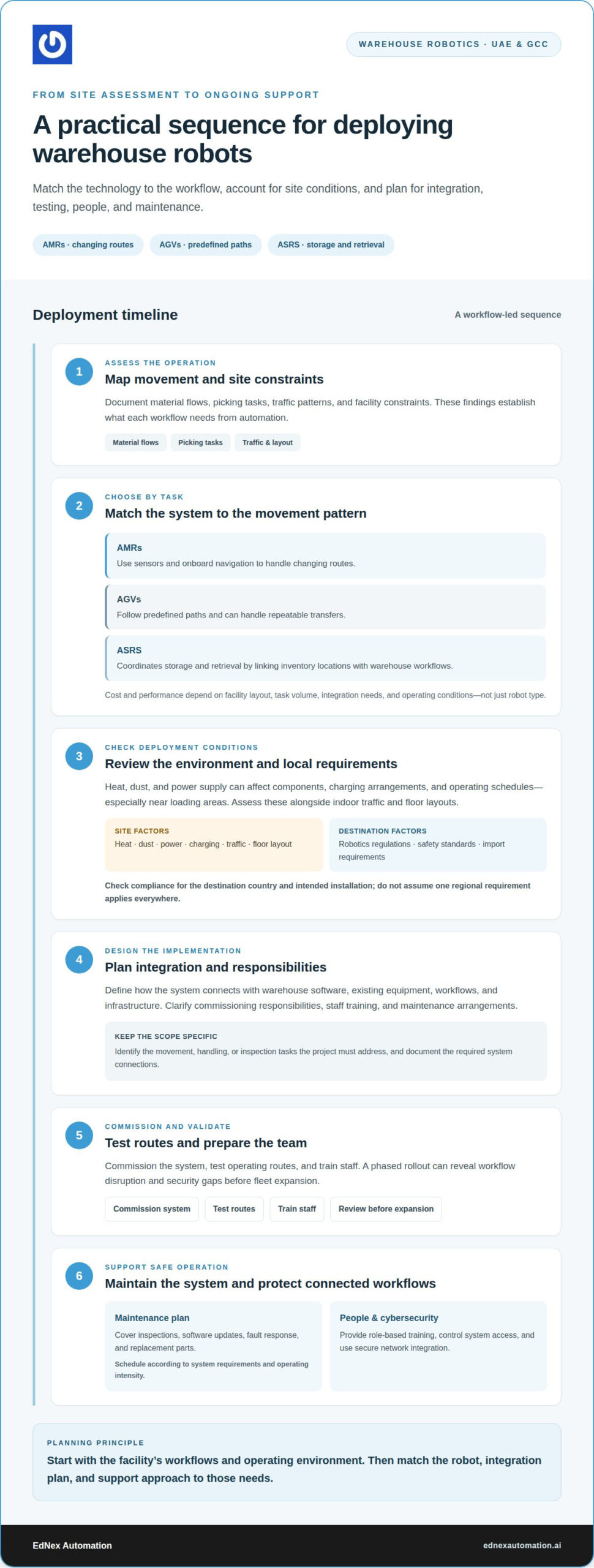
Before recommending a system, a provider maps material flows, picking tasks, traffic patterns, and facility constraints. These findings help determine whether AMRs, AGVs, or ASRS fit each workflow. The provider then plans integration, commissions the system, tests operating routes, and trains staff. Maintenance planning covers inspections, software updates, fault response, and replacement parts, with schedules shaped by system requirements and operating intensity.
GCC Deployment Conditions and Risks
Heat, dust, and power supply can affect components, charging arrangements, and operating schedules, especially near loading areas. Providers assess these factors alongside indoor traffic and floor layouts. Workforce and cybersecurity risks also need attention: staff require role-based training, and connected systems need controlled access and secure network integration. A phased rollout can expose workflow disruption and security gaps before fleet expansion.
Robotics companies operating in the sector
Robotics companies serving the UAE and wider GCC often specialise in different parts of an automation project. Equipment manufacturers develop robotic platforms, while systems integrators connect them with warehouse software, workflows, and infrastructure. Implementation partners coordinate site planning and commissioning. For a national operation, assess how a provider can adapt its approach to different facilities instead of assuming one system fits every site.
Innovation depends on more than selecting equipment. A capable provider translates operational requirements into a system design, coordinates commissioning, and supports staff training and technical integration. Regional expertise in programming, integrating, and optimising autonomous fleets matters to Gulf logistics. It helps align robotic operations with changing inventory flows, existing systems, and each facility’s practical needs. Select robotic solutions for GCC warehouses around these requirements.
- Define the system scope: Identify the material movement, handling, or inspection tasks the project must address.
- Map integration needs: Document how the proposed system will connect with warehouse software and existing equipment.
- Plan implementation: Set commissioning responsibilities, staff training, and maintenance arrangements.
- Assess regional support: Clarify how technical support and fleet optimisation will serve the operation across its sites.
Regional experience matters when operations span several GCC markets. Logistics automation is expanding into Oman, Qatar, Kuwait, and Bahrain, alongside established hubs in Saudi Arabia and the UAE. Robotic solutions for GCC businesses operating across borders need to account for different facilities, workflows, and implementation requirements. A coordinated plan can create consistency while addressing each site’s operating conditions.
Saudi Arabia’s Warehousing & Logistics Expo took place in September 2026, reflecting attention to logistics technology in the region. For buyers, a useful next step is to assess providers against a defined project scope: system functions, integration plan, deployment responsibilities, and ongoing support. This creates a practical basis for evaluating how robotic solutions for GCC manufacturers and logistics operators fit their specific operational priorities, without relying on broad claims about innovation or performance.
GCC smart manufacturing robotics market size
The GCC smart manufacturing robotics market is moving from isolated automation projects toward integrated production systems. Market analysis uses 2024 as its base year, covers 2019 to 2024, and forecasts market size for 2025 to 2030. This timeline helps businesses distinguish established adoption from expected expansion across the region.
The forecast points to double-digit robotics market growth by 2030. That direction matters to UAE manufacturers because investment decisions must account for future production needs, not only current tasks. In the Emirates, assess whether automation can connect material handling, production, inspection, and inventory workflows as operations evolve.
Market expansion does not mean every facility needs the same technology. A warehouse with repeated transfers may prioritise mobile transport, while a production line may need robots for repetitive handling. Start an assessment by mapping bottlenecks, then match each task to a system and weigh operational needs against integration requirements.
For planning, separate market momentum from project economics. Regional growth signals a widening role for robotics, but an individual deployment depends on facility layout, task complexity, existing equipment, software integration, and support requirements. A phased plan can identify the workflows with the clearest operational case before extending automation elsewhere.
How much do industrial, service, and warehouse robots cost in the GCC? Pricing depends on the project and is provided after a quote request. Key cost factors include robot type, fleet size, integration scope, site conditions, commissioning, and ongoing maintenance.
A practical market takeaway is to treat 2025 to 2030 as a planning horizon, not a reason to automate without a defined need. UAE businesses can use the 2024 baseline and projected double-digit growth by 2030 to frame investment priorities, then evaluate each project against measurable workflow requirements.
Which industries in the GCC are adopting robotics, and for what applications?
Across the GCC, robotics supports logistics, manufacturing, hospitality, retail, aviation, and business services. Applications range from moving goods and assisting passengers to automating repetitive digital tasks. In the UAE, a warehouse, hotel, airport, and bank each need systems suited to their distinct workflows and service environments.
Logistics automation is expanding across the UAE and Saudi Arabia, and into Oman, Qatar, Kuwait, and Bahrain. In warehouses, robots can support material movement and fulfilment; manufacturing applications focus on production tasks. Start by identifying a specific operational bottleneck, such as transferring stock between storage and dispatch, then match automation to that task.
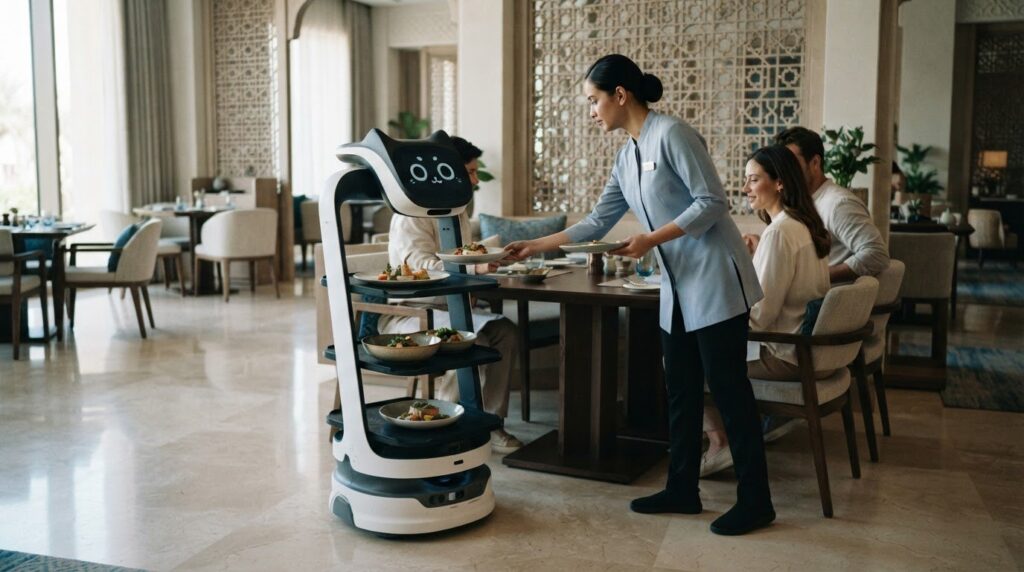
Hospitality and retail use robots for customer-facing support. Hotels in the GCC use robots for room-service delivery and guest escorting. Smart malls across the region use robotic systems to help visitors find stores, navigate, learn about offers, and provide feedback. These applications combine autonomous movement with visitor services in busy commercial spaces.
Airports apply robotics and AI to passenger assistance. Hamad International Airport, Dubai International Airport, and King Khalid Airport use tools that include boarding-pass checkers, passenger guides, language-translation robots, and sanitisation robots. These applications address distinct points in the passenger journey, from wayfinding to hygiene support, in complex transport environments.
Banking, telecom, insurance, and human resources use robotic process automation for repetitive, rules-based work. Examples include customer onboarding, KYC verification, data entry, CRM updates, invoice processing, approvals, form validation, and ID checks. Unlike a mobile robot, RPA automates digital processes rather than moving physical goods.
For UAE businesses, frame an automation project around its operational setting and intended task. Warehouse movement differs from hotel guest assistance or airport passenger guidance. Defining the workflow, users, and desired operational outcome helps identify an appropriate system and gives implementation teams a clearer basis for planning.
EdNex Automation
EdNex Automation helps UAE businesses match robotics to warehouse and commercial workflows. Its offerings include collaborative robots (cobots), autonomous mobile robots (AMRs), cleaning robots, and delivery robots for different operational needs across industrial and commercial environments.
Consider these systems when repetitive movement, cleaning, or delivery tasks form part of a wider automation plan. The right fit depends on the work, site layout, and how the robot must operate alongside existing processes. EdNex Automation can help you explore robotic solutions suited to your operation.
Contact EdNex Automation to discuss your robotics requirements.
Turn Automation Priorities Into a Practical Plan
Start by defining what a successful automation project needs to change in your operation. Identify the workflow causing the greatest friction, then clarify how a robotic system should work alongside employees, equipment, and existing processes. This gives your implementation plan a clear purpose and a basis for evaluating progress.
Planning robotic solutions for GCC operations means choosing technologies for specific tasks rather than pursuing automation for its own sake. EdNex Automation offers collaborative robots (cobots), autonomous mobile robots (AMRs), and cleaning robots for a range of commercial and industrial requirements. The right starting point depends on your facility, workflow, and operational priorities.
Bring your requirements into a focused discussion, whether you’re exploring a new deployment or refining an automation roadmap. A clearly defined goal can help turn emerging robotics capabilities into a considered operational decision.
Contact EdNex Automation to discuss your requirements and take the next step with confidence.
Frequently Asked Questions
What robotic solutions are available for businesses in the GCC?
Businesses can use industrial robots, collaborative robots, autonomous mobile robots, automated storage and retrieval systems, cleaning robots, delivery robots, inspection robots, and surveillance robots. The right choice depends on the task: a manufacturer might automate repetitive assembly, while a distribution centre could use mobile robots to move goods. Software-based robotic process automation handles digital tasks, not physical movement.
Who are the leading robotics suppliers and integrators in the GCC?
Supplier fit depends on the system and integration work required, not on a single ranking across the GCC. EdNex Automation supplies and integrates robotics and industrial automation systems for commercial and industrial customers in the UAE. Its offerings include cobots, AMRs, cleaning and delivery robots, as well as PLC and SCADA integration and ASRS. These capabilities support different project needs, from physical automation to connected industrial infrastructure.
What are the robotics market size and growth forecasts for GCC countries?
The GCC smart manufacturing robotics market analysis uses 2024 as its base year, reviews 2019-2024, and forecasts market size for 2025-2030. The robotics market is projected to grow at a double-digit rate by 2030. These figures describe regional market direction, not guaranteed growth for each country or individual project. For UAE planning, use the forecast horizon to consider future production needs and automation priorities.
How do robotics solutions compare with automation alternatives in cost and performance?
Cost and performance depend on facility layout, task volume, integration needs, and operating conditions, not just robot type. AMRs suit changing workflows, while AGVs can handle repeatable transfers.