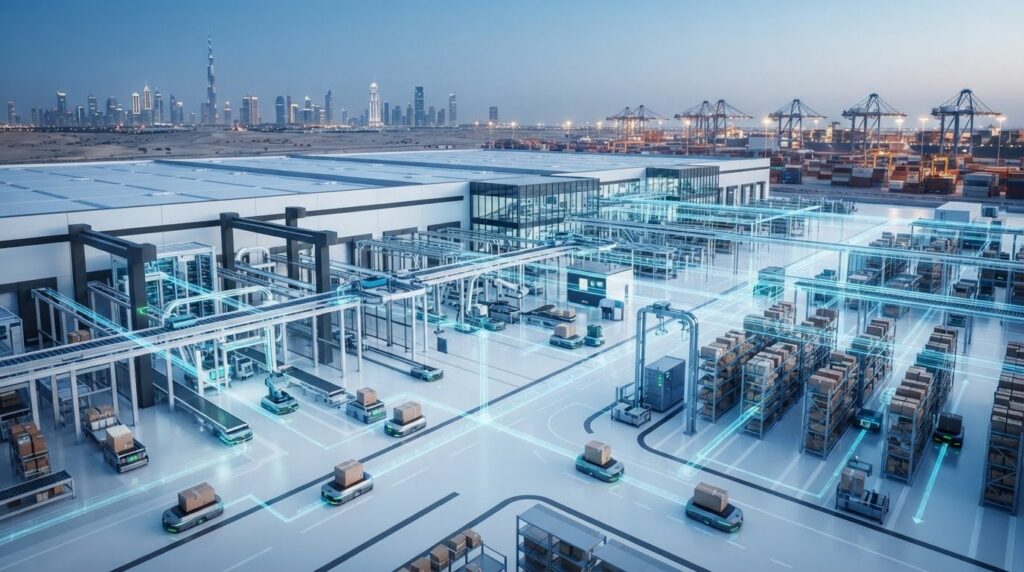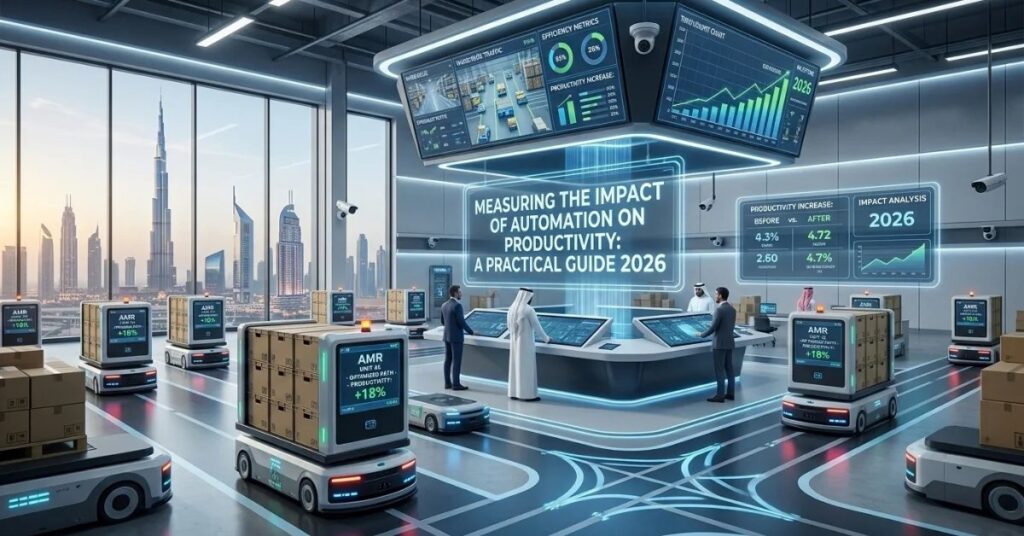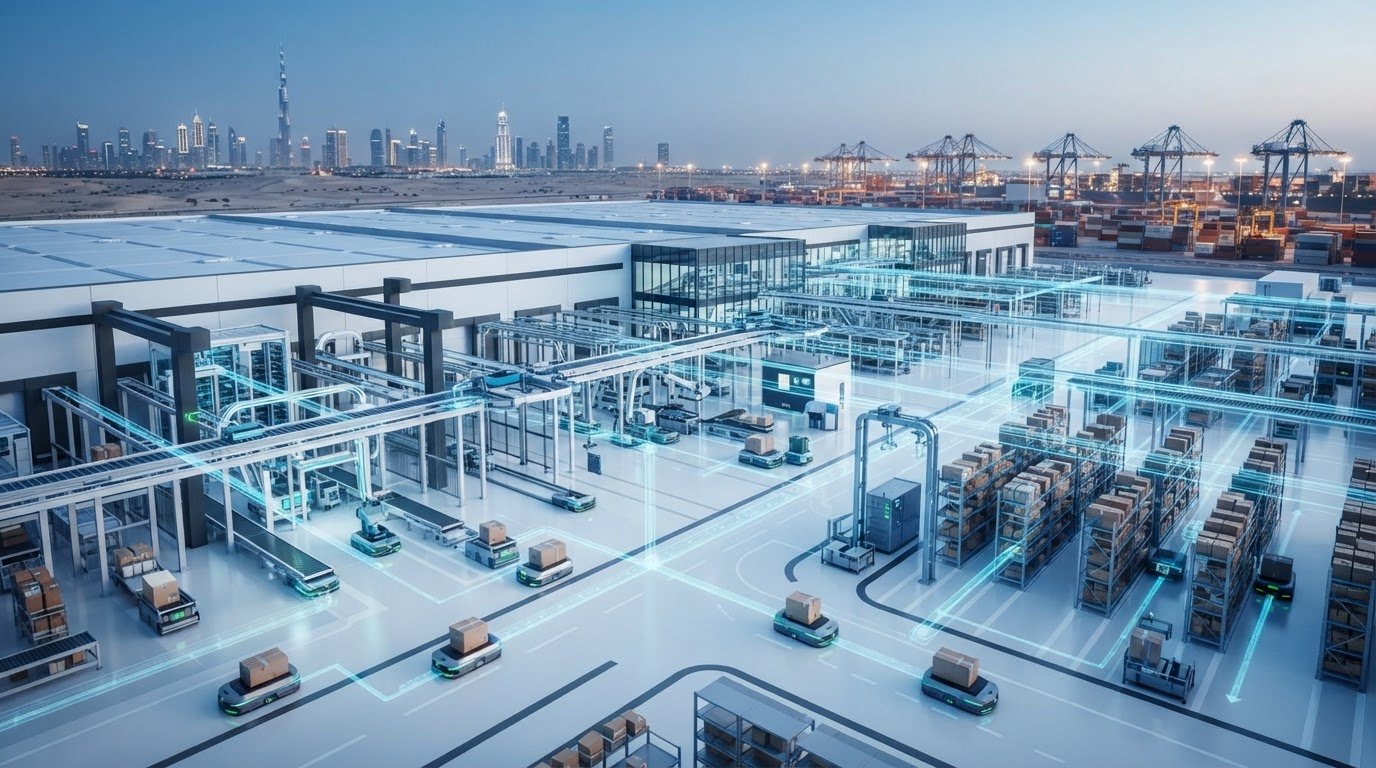
What if the biggest logistics advantage in the Middle East isn’t a faster robot, but a better-connected operation? The future of logistics in the Middle East will depend on how effectively businesses connect automation with the warehouses, transport networks and control systems they already use. For operators across the UAE, resilience matters alongside speed as trade patterns shift and supply chains face disruption.
It’s reasonable to ask which technologies are ready to deliver practical value and whether new systems can integrate without adding complexity. Automation isn’t a single purchase: autonomous mobile robots can move goods, automated storage and retrieval systems can manage inventory, and PLC and SCADA integration can connect equipment with operational control. The right mix depends on the work, the facility and the systems already in place.
This article explores the forces and technologies likely to shape logistics from 2026 onward, focusing on connected automation rather than isolated deployments. It looks at how trade dynamics affect warehouse and transport decisions, where emerging technologies can fit together, and what practical steps can help prepare an operation without overcommitting.
Key Takeaways
- Assess how trade connectivity, e-commerce demand and supply-chain pressures affect your operation before choosing a technology.
- Match automation to specific workflows and facility conditions, then confirm how new equipment will interface with existing systems.
- Weigh the potential benefits of autonomous equipment against integration, safety and operational constraints.
- Set baseline measures for throughput, accuracy, safety and downtime to guide decisions and evaluate progress.
- Consider how the future of logistics in the Middle East could develop, from targeted automation to more coordinated networks, and identify what each path requires.
Why the Future of Logistics in the Middle East Is Being Reshaped
Logistics transformation is the coordinated evolution of transport, warehousing and fulfilment, not simply the introduction of new equipment. It can involve changing trade routes, adding storage capacity, improving information flow and redesigning how goods move from arrival to dispatch. The future of logistics in the Middle East will depend on how well these elements respond together to shifting trade patterns, customer expectations and operational risks.
Economic diversification and large-scale infrastructure programmes are reshaping regional priorities. The broader context of economic diversification in the Middle East helps explain why logistics is increasingly important across sectors beyond oil and gas. But the region isn’t one uniform operating environment: infrastructure, trade links, customer demand and sector requirements differ between markets. A fulfilment network serving fast-moving consumer goods, for example, may face different inventory and delivery pressures from one supporting industrial or energy supply chains.
Which regional forces are changing logistics priorities?
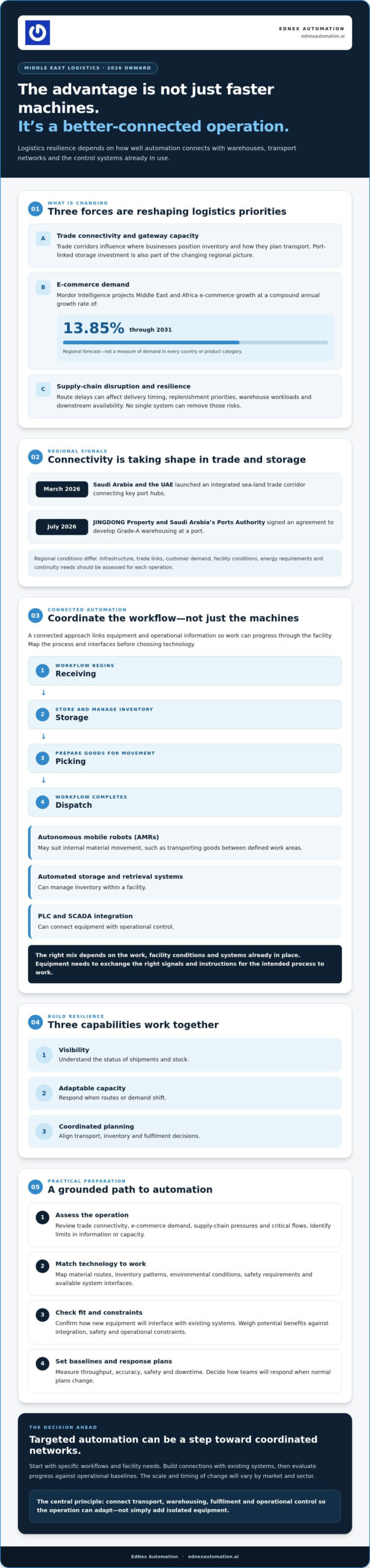
Trade corridors and gateway capacity influence where businesses position inventory and how they plan transport. In March 2026, Saudi Arabia and the UAE launched an integrated sea-land trade corridor connecting key port hubs, illustrating efforts to expand route options. In July 2026, JINGDONG Property and Saudi Arabia’s Ports Authority signed an agreement to develop Grade-A warehousing at a port, reflecting continued investment in port-linked storage.
Demand is changing too, though not uniformly. Mordor Intelligence projects Middle East and Africa e-commerce growth at a 13.85% compound annual growth rate through 2031. That regional forecast points to increasing pressure for responsive fulfilment, but it shouldn’t be treated as a measure of demand in every country or product category. Cross-border operators also need to coordinate shipment information and inventory plans across routes and partners. Assess facility conditions, energy requirements and continuity needs for each operation instead of assuming they are the same across the region.
What does a more resilient logistics network require?
Resilience relies on complementary capabilities: visibility into shipments and stock, adaptable capacity when routes or demand shift, and coordinated planning across transport, inventory and fulfilment. A delay at a gateway can affect more than delivery timing. It may also change replenishment priorities, warehouse workloads and the availability of goods downstream. Recent regional disruptions and changes to cargo insurance coverage in certain areas reinforce the need to understand route dependencies. No single system can remove those risks.
For UAE operators, a practical starting point is to map critical flows, identify where information or capacity is limited, and decide how teams will respond when normal plans change. Regional logistics is being reshaped by stronger trade connectivity, evolving fulfilment demand and the need to absorb disruption. Investment and corridor development provide evidence of change, while the scale and timing of future operational shifts will vary by market and sector.
How Automation Technologies Could Connect Middle East Logistics Operations
Connected logistics automation coordinates the movement, storage, sensing and control of goods across a facility. Rather than treating each machine as a standalone upgrade, it links equipment and operational information so work can progress through the workflow, from receiving and storage to picking and dispatch. This systems-level approach is central to the future of logistics in the Middle East, where facilities differ in layout, operating conditions and existing technology.
Start technology selection with the task. A site assessment can map material routes, inventory patterns, environmental conditions, safety requirements and available system interfaces. A solution suited to predictable pallet movements may not fit mixed loads or frequently changing workflows. Compatibility matters: equipment needs to exchange the right signals and instructions with other systems for the intended process to work.
Where can mobile robots and automated storage contribute?
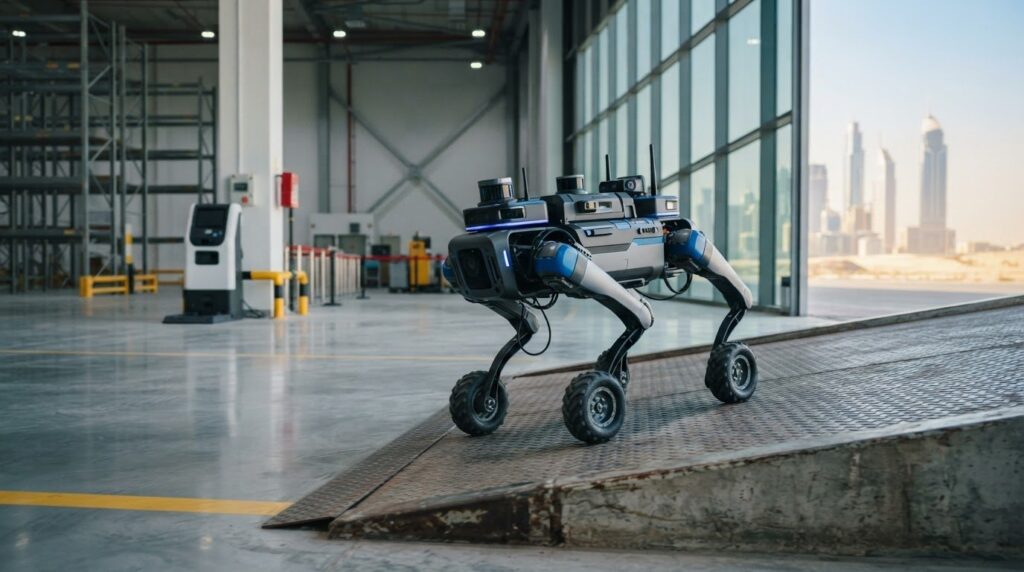
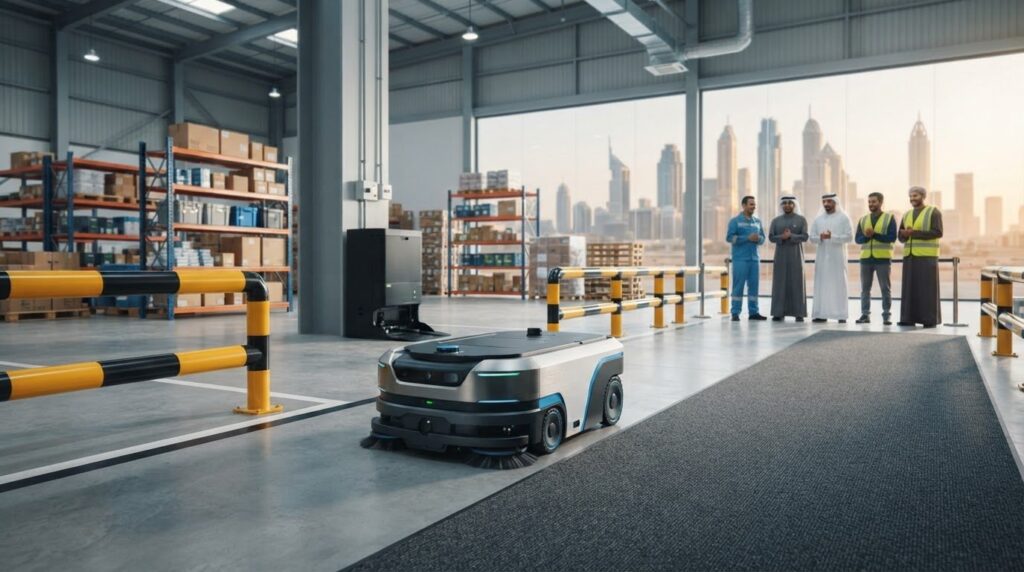
Autonomous mobile robots (AMRs) may be suitable for internal material movement, such as transporting goods between defined work areas. Their suitability depends on site conditions, traffic, routes and how tasks are assigned. For an overview of their capabilities and considerations, see this guide to autonomous mobile robots.
Automated storage and retrieval systems (ASRS) use automated infrastructure to store and retrieve inventory according to defined workflows. They may suit operations with established inventory rules and storage requirements, but the facility design and process fit need careful assessment. The ASRS guide explains the system category in more detail.
These technologies have different roles: AMRs move materials between points, while ASRS manages storage and retrieval. Combining them makes sense only when their tasks and interfaces match the operation’s actual flow.
Why do control systems and data interfaces matter?
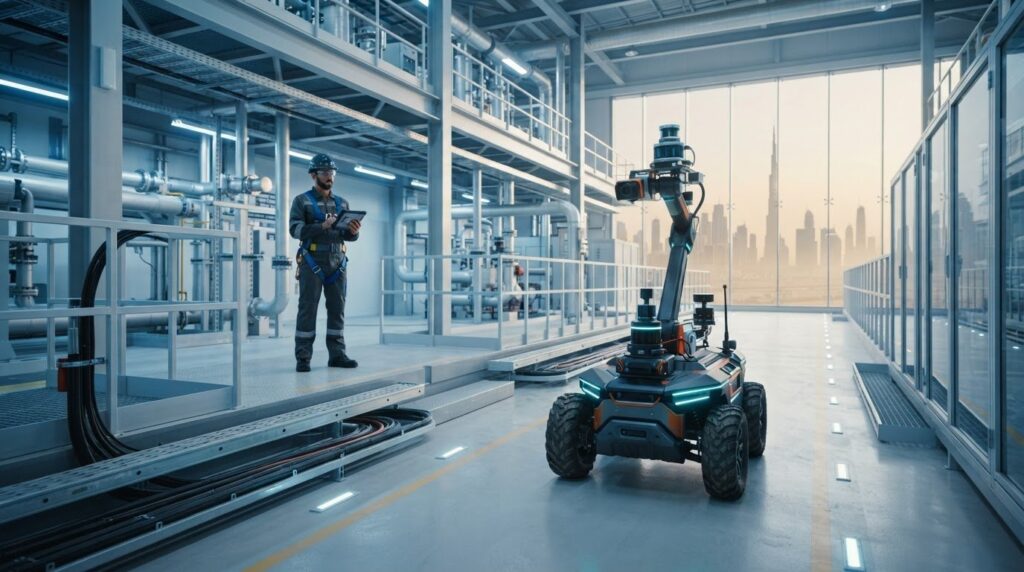
Programmable logic controllers (PLCs) manage machine-level logic and equipment signals, while supervisory control and data acquisition (SCADA) systems support monitoring and supervisory control across industrial processes. Their configuration and scope vary by operation. Connecting control systems with automation equipment can coordinate signals, task sequences and operational visibility, provided the interfaces, data definitions and exception handling are designed deliberately. Explore the PLC and SCADA integration guide for further technical context.
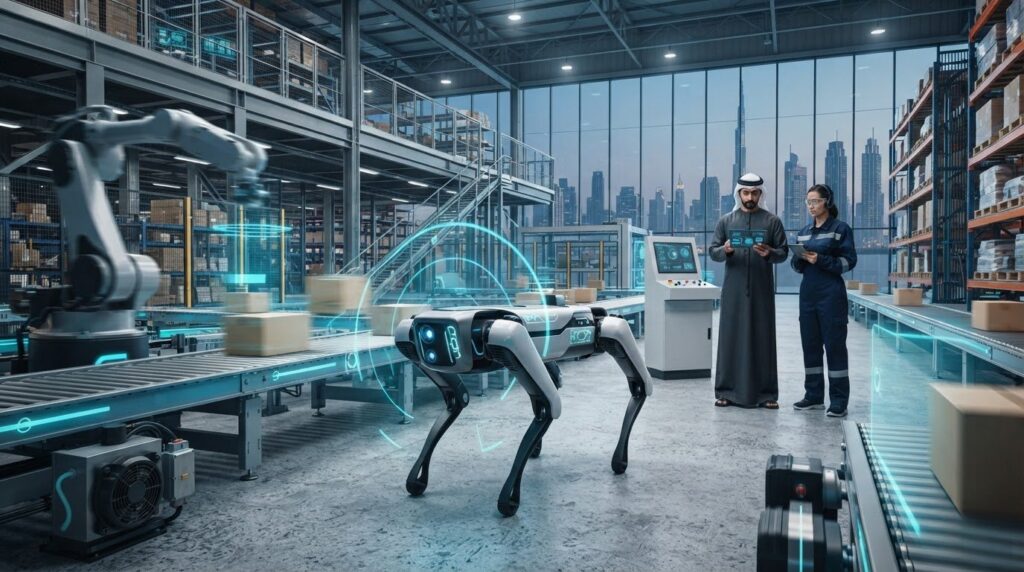
End-to-end automation depends on integration: mobile robots, ASRS, sensors, PLCs and SCADA need compatible data and signals, consistent workflow rules, and a way to handle exceptions. Without these, individual components may operate without supporting the wider process. For UAE businesses assessing how robotics and control systems could fit existing operations, EdNex Automation’s industrial automation capabilities provide a starting point for technical discussions.
What Could Slow the Future of Logistics in the Middle East?
Buying autonomous equipment doesn’t, by itself, create a modern logistics operation. A robot may perform its assigned task effectively yet fail to improve the wider process if inventory records are unreliable, handoffs aren’t defined or connected systems can’t exchange instructions. The future of logistics in the Middle East depends not only on technology’s potential, but also on whether an operation can integrate, govern and maintain it.
Automation can support more consistent material handling and improve visibility into selected processes, but those outcomes aren’t guaranteed. Deployment may involve interface work, process redesign, safety checks and workforce preparation. Teams need to understand how responsibilities and exception handling may change, with training suited to their roles and equipment. Data quality matters too: inaccurate item, location or task information can undermine automated decisions instead of correcting the underlying process.
How do integration and operational readiness affect adoption?
Legacy systems may use different data formats or lack clear interfaces, while inconsistent process data can make it difficult to turn existing work into reliable machine instructions. Before choosing equipment, map the workflow from start to finish. Record each handoff, the information needed at that point, and the systems or people involved. Then identify required interfaces and check whether the data is complete enough to support the intended process.
Safety and cybersecurity need project-specific review. Assess how equipment will interact with people, other machines and site procedures, then validate safeguards and failure responses with qualified experts. Review network access, data exchange and system permissions with the relevant technical and security teams. These checks should reflect the actual facility and deployment, not generic assumptions about a technology.
What should decision-makers verify before treating a trend as proven?
Separate evidence by source and context. A pilot demonstrates performance under its test conditions; a vendor claim describes a proposed capability; independently verified operational evidence can provide a stronger basis for comparison. None should automatically be assumed to apply to another facility.
- Check the comparison: What workflow, operating conditions and time period were assessed?
- Examine the boundary: Do the results include integration, exceptions and human work, or only the equipment’s task?
- Confirm the evidence: Can the outcome be independently reviewed and measured against a relevant baseline?
Market forecasts can help frame possible directions, but they’re scenarios, not confirmed outcomes or procurement instructions. Use them to inform questions, then base decisions on facility-specific needs, validated evidence and the operating conditions the system must handle.
How to Prepare a Logistics Operation for the Next Wave of Automation
Start with the operational need, not a shortlist of machines. A clear objective might be to reduce repeated manual transfers, improve inventory accuracy in a defined process or make a particular handoff easier to monitor. Then assess the work, establish a baseline and check whether the facility and existing systems can support a change. This sequence helps UAE businesses connect automation decisions to measurable operational priorities.
Which questions should a logistics team answer first?
Map the target process from beginning to end. Record material flows, bottlenecks, exceptions, handoffs and the information each step depends on. Bring operational, technical, safety and facilities stakeholders together to confirm site conditions, connectivity, equipment interfaces and relevant safety requirements. Define success measures before deployment, using the operation’s own baseline rather than assumed industry targets.
Choose measures that reflect the objective. Depending on the process, these might include:
- Throughput: How much work is completed over a defined period?
- Accuracy: How often are inventory records or process outcomes correct?
- Safety: Which relevant incidents, hazards or near misses should be monitored?
- Downtime: How much interruption affects the process, and how is it recorded?
Not every measure applies to every project. Assign an accountable owner, document how each measure will be collected and agree on how exceptions will be handled. A useful automation pilot is measurable, controlled and tied to a specific operational need.
How can an organisation scale without losing control?
Keep the first deployment bounded to a clearly defined workflow, area or task. This limits the dependencies under review and gives the team a practical way to compare results with the original baseline. Before expanding, examine what the evidence shows, where performance differed from expectations, and whether process or system-interface changes are needed.
People and operating procedures need to keep pace with the technology. Plan staff training, maintenance responsibilities and escalation routes alongside technical deployment, so teams know who responds to faults and process exceptions. A phased integration can reveal unresolved dependencies before they affect a broader operation. It also gives stakeholders opportunities to validate each stage and adjust plans based on observed evidence.
For the future of logistics in the Middle East, preparation is a strategic capability: it helps organisations adopt useful automation while keeping operational control. If you’re assessing robotics, storage or control-system integration for a commercial or industrial operation, EdNex Automation’s automation capabilities can inform your evaluation.
The Future of Logistics in the Middle East: From Trend to Connected System
The next stage of logistics automation won’t follow one template. Some operations may automate a single repetitive task; others may connect several processes within a facility, while broader coordination across sites and transport networks remains a longer-term possibility. The right path depends on operational needs, integration capacity and the readiness of existing processes, not on choosing the most advanced scenario available.
These scenarios differ in both capability and prerequisites:
- Incremental automation: Automates a defined task with limited changes to surrounding processes. It may require fewer interfaces, but still needs clear ownership, safe operating procedures and a way to assess results.
- Connected facilities: Coordinates movement, storage and control across multiple workflows. This requires compatible data exchange, planned system interfaces and teams responsible for the end-to-end process.
- Broader network coordination: Connects information and planning across facilities or transport partners. It calls for shared data practices, cross-organisation coordination and a clear approach to managing dependencies.
What might connected logistics look like in practice?
Consider this illustrative workflow, not a customer deployment: an ASRS retrieves a requested item, an autonomous mobile robot moves it to a dispatch area, and a supervisory system provides visibility into task status. For the sequence to work, systems need to exchange accurate task and status data, a process owner must define what happens when a step fails, and teams must coordinate safety around people and equipment. The connected system lies in how those relationships are designed, not just in the machines.
System integration aligns robotics, storage infrastructure and industrial control. It establishes how instructions, signals and exceptions move between components while keeping the operational workflow in view. EdNex Automation’s relevant capabilities include AMRs for internal movement, ASRS for automated storage and retrieval, and PLC and SCADA integration for industrial control and monitoring. Their suitability depends on the facility, workflow and required interfaces.
How can businesses explore the right automation path?
Start by identifying the process constraint: where goods wait, move repeatedly or require clearer operational visibility. Then assess the workflow, data, facility conditions and safety requirements before comparing equipment categories. This keeps selection tied to an operational need and helps clarify whether a focused change or a more connected approach is appropriate.
The future of logistics in the Middle East will be shaped by deliberate decisions about how systems work together. UAE businesses considering a next step can review EdNex Automation solutions to explore relevant automation capabilities.
Build Logistics Readiness One Connected Step at a Time
The future of logistics in the Middle East won’t be shaped by automation alone, but by how well technology fits operational needs and connects workflows. Trade pressures and changing fulfilment expectations make resilience essential, while integration, data quality, safety and workforce preparation affect whether new systems can support day-to-day operations.
Start with a clear process objective, map the workflow and establish relevant baseline measures before selecting equipment. Then evaluate a bounded pilot against those measures and expand only when the evidence and operational readiness support it. This measured approach helps businesses pursue useful change without treating every emerging trend as a procurement priority.
For commercial and industrial organisations across the UAE, EdNex Automation offers autonomous mobile robots (AMRs), automated storage and retrieval systems (ASRS), and PLC and SCADA integration. These capabilities can be assessed in terms of how material movement, storage and control systems need to work together.
Explore EdNex Automation solutions to discuss potential options for your operation. With clear objectives and deliberate integration, your next step can be practical and forward-looking.
Frequently Asked Questions
What is the future of logistics in the Middle East?
The future of logistics in the Middle East is likely to involve more connected, data-informed and automated operations, with the pace varying by country, sector and facility. Trade links, fulfilment expectations and resilience priorities may influence investment choices. Mobile robots, automated storage and integrated control systems can support specific workflows, but they aren’t standalone solutions. Treat forecasts as scenarios, and verify current regional evidence before using it to guide operational decisions.
How will automation change logistics in the Middle East?
Automation can support repetitive material movement, storage and monitoring tasks while helping teams coordinate workflows. Its effect depends on process design, system integration, facility conditions and workforce readiness. For example, an autonomous mobile robot may be considered for internal transport, while automated storage could suit defined inventory workflows. Assess each option against a specific operational need, then use a controlled pilot to measure results before considering wider deployment.
Will autonomous mobile robots become common in Middle East warehouses?
Autonomous mobile robots may suit warehouses that need flexible internal material movement, but they won’t fit every facility or task. Layout, routes, safety requirements, connectivity and system integration all affect suitability. Before piloting, map material flows and handoffs, identify operational constraints, and define how performance will be measured. Adoption levels and regional forecasts can change, so check current, reliable sources rather than assuming a particular technology is already widespread.
What challenges could affect logistics automation in the Middle East?
Integration, process data quality, safety validation and workforce preparation can all affect implementation. Existing systems may not exchange information easily, while inconsistent inventory or task data can complicate automated workflows. Facility conditions and operating requirements also shape the solution. These challenges don’t make automation unsuitable, but they make readiness essential. Map the process and interfaces before selecting equipment, and treat generic savings or adoption claims as unverified until supported by relevant evidence.
How can a logistics company prepare for future technology?
Prepare by documenting material flows, bottlenecks, exceptions and operational priorities before comparing equipment. Establish relevant baseline measures, such as throughput, accuracy, safety or downtime, and confirm facility and system-interface requirements with qualified stakeholders. Then select a contained pilot with clear ownership and evaluation criteria. Include staff training, maintenance planning and escalation procedures. Review results against the original measures before expanding, so decisions reflect observed performance rather than assumptions.
What role can AMRs, ASRS and PLC/SCADA systems play together?
AMRs can move materials within a facility, while automated storage and retrieval systems (ASRS) handle defined storage and retrieval workflows. Programmable logic controllers (PLCs) support equipment control, and supervisory control and data acquisition (SCADA) systems support monitoring, depending on system design. Their combined value depends on fit and reliable data exchange. Qualified technical stakeholders should assess workflows, interfaces, control requirements and safety coordination before implementation.
Is logistics automation suitable for every warehouse?
No, a single automation solution won’t suit every warehouse. Suitability depends on task repetition, layout, throughput requirements, safety conditions, inventory characteristics and existing systems. A manual process may remain appropriate if automation doesn’t address a defined operational need. Start with a process assessment, compare options against clear requirements, and use a pilot to test assumptions in the actual operating environment before committing to broader change.
How should businesses assess logistics technology forecasts for 2026 and beyond?
Use forecasts as directional scenarios, not guaranteed outcomes. Check when the research was published, which geography and sectors it covers, and how its conclusions were reached. Distinguish observed deployments from vendor projections, and verify policy or infrastructure developments through current, authoritative sources. Finally, assess whether the evidence applies to your workflows, facility and operating constraints. A useful forecast informs questions and planning without removing uncertainty from the decision.