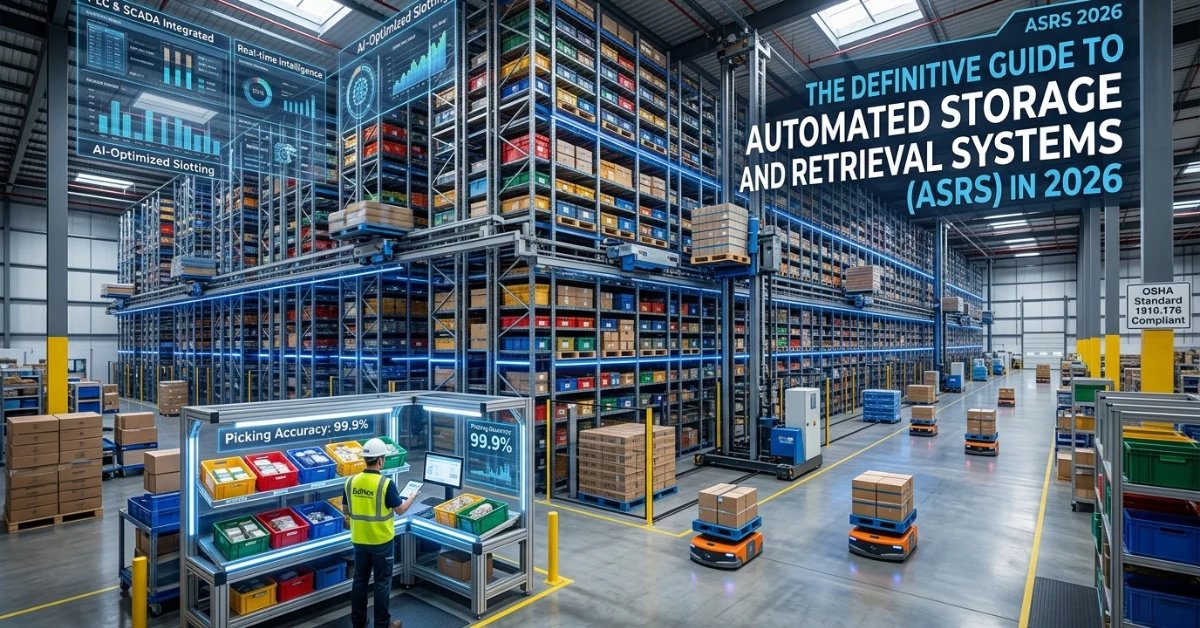
In 2026, the distinction between global industry leaders and stagnant enterprises is no longer defined by product volume, but by the sophisticated intelligence of their underlying infrastructure. Deploying automated storage and retrieval systems has transitioned from an elective upgrade for mega-warehouses into the essential backbone for national industrial resilience.
You likely recognize that escalating labor costs and a restricted warehouse footprint are no longer simple operational hurdles; they’re direct threats to your long-term viability. Leveraging our technical expertise, this guide reveals how ASRS technology transforms these physical constraints into a strategic competitive advantage, allowing you to maximize vertical storage while securing a definitive 99.9% picking accuracy. We’ll explore the critical integration of PLC and SCADA systems, analyze current OSHA safety standards like 1910.176 for secure storage, and examine how modular automation drives operational throughput in a high-density environment.
Key Takeaways
- Transitioning from manual person-to-goods methods to integrated computer-controlled precision ensures your facility meets the high-performance benchmarks required for modern industrial competition.
- Evaluating the functional differences between unit-load and micro-load systems enables the selection of an architecture that optimizes your specific throughput and density requirements.
- Comparing high-density cube storage with high-speed shuttle systems provides the intellectual framework necessary to choose a scalable solution that adapts to fluctuating market demands.
- Identifying key operational signals, such as rising labor costs and footprint limitations, justifies the strategic adoption of automated storage and retrieval systems for sustained ROI.
- Leveraging PLC and SCADA integration transforms traditional storage into a sophisticated data node, delivering the real-time operational intelligence needed for a truly smart factory.
What is an Automated Storage and Retrieval System (ASRS)?
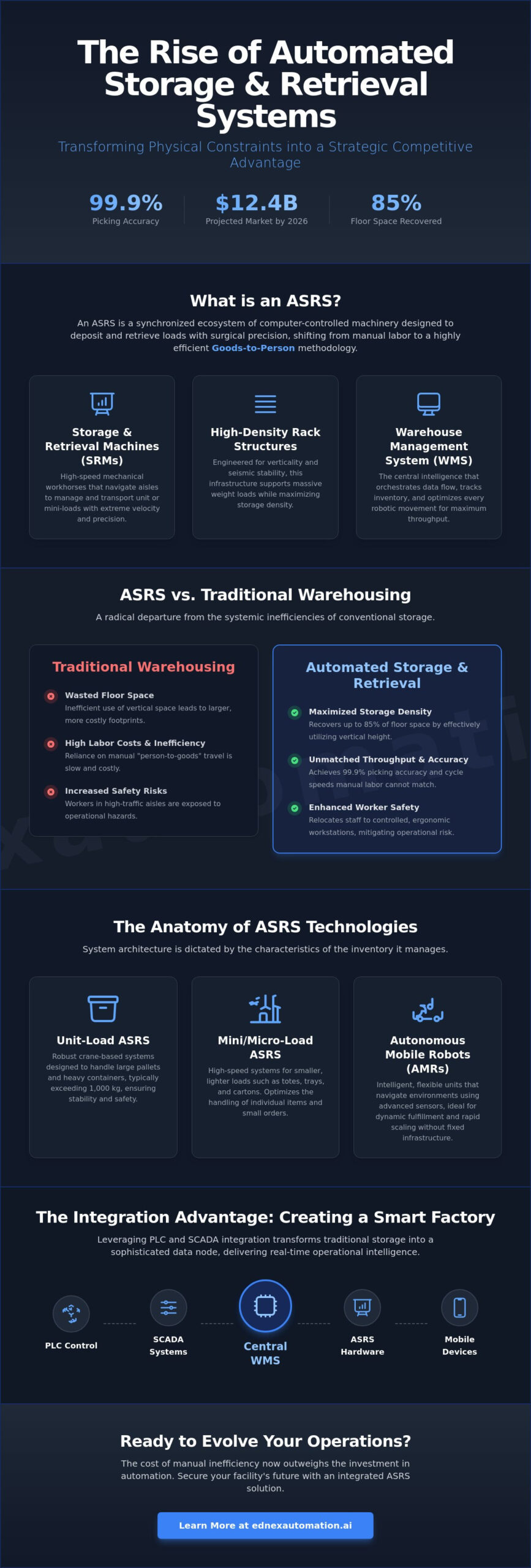
An Automated Storage and Retrieval System (ASRS) represents the pinnacle of modern material handling, functioning as a synchronized ecosystem of computer-controlled machinery designed to deposit and retrieve loads with surgical precision. Moving beyond the limitations of manual labor, these systems orchestrate the movement of inventory through a goods-to-person methodology. This paradigm shift eliminates the time-intensive travel required in traditional picking; instead, it delivers items directly to ergonomic workstations. By 2026, the global market for automated storage and retrieval systems is projected to reach up to $12.4 billion, signaling a definitive transition where automation becomes the baseline for industrial survival rather than a luxury for the elite.
The Core Components of a Modern ASRS
Establishing a robust ASRS requires the seamless integration of three primary pillars that work in total autonomy. Storage and Retrieval Machines (SRMs) act as the high-speed mechanical workhorses, navigating aisles with extreme velocity to manage unit or mini-loads. These machines interface with rack structures engineered for high-density verticality and seismic stability, ensuring the infrastructure supports massive weight loads while maintaining structural integrity. Finally, the Warehouse Management System (WMS) acts as the central intelligence, orchestrating data flow and inventory tracking to ensure every robotic movement is optimized for maximum throughput.
ASRS vs. Traditional Warehousing: A Strategic Shift
Transitioning to automated workflows offers a radical departure from the systemic inefficiencies of conventional storage. Utilizing vertical height effectively, an ASRS can recover up to 85% of previously wasted floor space, allowing facilities to expand capacity without increasing their physical footprint. This evolution also fundamentally redefines labor safety by relocating workers from hazardous, high-traffic aisles to controlled stations. Organizations can mitigate operational risk while simultaneously boosting throughput, as automation achieves cycle speeds that manual teams can’t match. This shift ensures high-volume order fulfillment remains consistent, avoiding the fatigue-induced errors typical of legacy operations.
In the current economic climate, 2026 marks the point where the cost of manual inefficiency finally outweighs the investment in automated storage and retrieval systems. National logistics networks now require the speed and density that only these integrated systems can provide to remain competitive in a landscape dominated by rapid e-commerce demands. By centralizing control through advanced software, businesses don’t just store items; they create a responsive, data-driven environment capable of scaling alongside their growth ambitions.
The Anatomy of ASRS: Exploring the Diverse Technologies
Navigating the complex ecosystem of automated storage and retrieval systems requires a deep understanding of how load characteristics and SKU velocity dictate system architecture. Engineers categorize these technologies primarily by the weight and dimensions of the inventory they manage, spanning from massive industrial pallets to individual components. Unit-load ASRS serves as the definitive standard for pallet-level automation within industrial environments. By aligning specific machinery with operational demands, leading industry suppliers enable facilities to achieve unprecedented levels of autonomy and precision.
Modern retrieval architectures have evolved beyond static cranes to include the strategic deployment of autonomous mobile robots. These intelligent units provide the flexibility needed to bridge the gap between high-density storage and dynamic fulfillment zones. Unlike traditional fixed-path systems, AMRs navigate environments using advanced sensors, allowing for rapid scaling during peak demand periods without the need for intrusive infrastructure modifications. This integration of mobile intelligence ensures that your facility remains agile as market requirements shift.
Unit-Load and Mini-Load Systems
Unit-load systems utilize robust crane-based mechanisms to handle large pallets and heavy containers, ensuring stability and safety for loads exceeding 1,000 kilograms. These workhorses are frequently deployed as manufacturing buffers or for finished goods storage in heavy industrial sectors. Conversely, mini-load systems are optimized for smaller totes and cases, delivering the high-speed throughput required for rapid case-picking operations. Both architectures provide the reliability necessary to maintain continuous production cycles while minimizing the risk of inventory damage.
Vertical and Horizontal Carousels
Maximizing storage density in constrained environments often involves the deployment of Vertical Lift Modules (VLMs) or horizontal carousels. VLMs function effectively as automated filing cabinets, utilizing a central elevator to retrieve trays of small parts and deliver them to an ergonomic picking window. In contrast, horizontal carousels rotate entire bins to the operator, favoring high-frequency picking for items with consistent dimensions. While VLMs prioritize vertical space, horizontal systems offer a smaller vertical footprint and are often easier to integrate into existing low-ceiling facilities. Selecting the optimal configuration requires a careful analysis of your specific operational throughput; our team provides the intellectual framework necessary to evaluate these automated storage solutions for long-term viability.
Selecting the appropriate technology depends heavily on the velocity of your inventory. Fast-moving SKUs typically require the high-frequency access provided by shuttle-based micro-load systems, while slower, bulkier items are better suited for unit-load crane configurations. This methodical approach ensures that the investment aligns with the specific functional needs of the facility, preventing over-engineering while securing the capacity for future growth.
Shuttle vs. Cube Storage: Selecting the Right Architecture
Choosing the optimal architecture for automated storage and retrieval systems requires a granular analysis of how your facility balances storage density against throughput velocity. While both shuttle and cube storage represent the cutting edge of warehouse modernization, they operate under fundamentally different mechanical philosophies. Scalability in shuttle systems often involves adding more autonomous units to a fixed rack structure, whereas cube storage allows for the expansion of the entire storage block. Understanding these nuances ensures that your investment provides a long-term strategic advantage rather than a temporary fix for capacity issues.
The Power of Shuttle-Based Systems
Implementing ASRS shuttle technology significantly enhances fulfillment speed by utilizing independent vehicles that navigate deep-lane storage configurations. These systems excel in high-volume retail distribution and e-commerce environments where rapid access to diverse SKUs is paramount. Multi-shuttle architectures provide inherent redundancy; because each level operates independently, the system eliminates single points of failure that can cripple traditional crane-based systems. This distributed intelligence maintains high uptime, ensuring that maintenance on one unit doesn’t halt the entire facility’s output.
Robotic Cube Storage Explained
Robotic cube storage offers the highest possible density by utilizing a ‘no-aisle’ concept, stacking bins in a solid, monolithic block. Top-running robots navigate a grid above the inventory, using intelligent algorithms to dig and retrieve specific bins for delivery to picking ports. This architecture is ideal for facilities with extreme space constraints, though it presents specific limitations regarding SKU height and weight. Unlike shuttle systems, the retrieval speed in cube storage can be impacted by the depth of the bin within the stack, making it better suited for ultra-high-density environments with smaller, uniform items.
Evaluating the total cost of ownership involves looking past the initial installation to maintenance requirements and system uptime expectations. According to research from Georgia Tech, the operational efficiency of retrieval systems depends heavily on the synchronization of hardware and control software. Shuttle systems typically offer easier access for routine servicing, while cube storage requires specialized maintenance of the top-grid infrastructure. By selecting the architecture that aligns with your SKU profile and throughput targets, you secure a resilient foundation for 2026 and beyond.
10 Signs Your Facility is Ready for ASRS Implementation
Justifying the ASRS cost estimate requires a visionary shift in perspective, moving from immediate capital expenditure to long-term operational viability. In the context of the UAE’s Operation 300bn initiative, adopting automated storage and retrieval systems is no longer a localized choice but a necessary evolution for national industrial excellence. Identifying these transition points early prevents catastrophic bottlenecks that can stall growth. A facility reaching its maximum physical capacity serves as the primary driver for achieving a definitive ASRS ROI.
By automating your storage infrastructure, you contribute to a more sustainable industrial ecosystem, reducing energy waste through optimized machinery movement and minimized lighting requirements in storage zones. These systems provide the intellectual framework necessary to scale operations without the proportional increase in overhead typical of legacy environments. Recognizing the following signs ensures your organization remains a grounded, reliable technical partner in an increasingly autonomous global market.
Operational Red Flags: Labor and Accuracy
Experiencing high turnover or persistent labor scarcity within your regional industrial sector indicates a critical need for robotic intervention. Frequent picking errors don’t just lead to costly returns; they inflict lasting brand damage in a market that demands absolute perfection. When manual pickers spend excessive time traveling between aisles, your overall facility throughput suffers, creating an artificial ceiling on your revenue potential. Transitioning to automated storage and retrieval systems eliminates these human variables, securing a consistent 99.9% picking accuracy that manual workflows simply cannot sustain. This shift allows your workforce to move from repetitive, low-value tasks to high-level system oversight and strategic management.
Space and Growth Constraints
Running out of horizontal real estate often forces a strategic decision to utilize vertical volume. Managing a growing number of SKUs within a manual framework leads to inventory chaos and tracking inaccuracies that cripple fulfillment speeds. Modern delivery expectations require 24/7 operations, a feat that’s physically and financially unsustainable without the precision of automated machinery. If your facility is struggling to manage SKU expansion or if safety incidents are rising in congested aisles, it’s a clear signal that your current infrastructure has reached its limit. Deploying a high-density ASRS allows you to reclaim up to 85% of your floor space, providing the capacity needed for future expansion without the need for costly new construction. To begin your journey toward a fully optimized warehouse, consult with our technical team to evaluate your facility’s specific automation readiness.
The Future of ASRS: Integration with PLC, SCADA, and AI
Modern industrial evolution has transformed automated storage and retrieval systems from isolated hardware installations into intelligent, data-generating nodes within the smart factory ecosystem. Moving beyond simple mechanical storage, these systems now serve as a primary source of operational intelligence, providing the granular data necessary for end-to-end supply chain visibility. Achieving this level of sophistication requires specialized PLC and SCADA integration services to ensure that every robotic movement is synchronized with broader production goals. By treating ASRS as a central nervous system rather than a siloed tool, organizations can achieve a state of continuous optimization that adapts to real-time market fluctuations.
Integrating Artificial Intelligence into the retrieval architecture allows facilities to transition from reactive to predictive operations. Utilizing advanced machine learning algorithms, the system analyzes historical order patterns to reorganize bin slotting autonomously, placing high-velocity items in the most accessible positions before a peak period begins. This predictive capability minimizes travel time and maximizes throughput, ensuring that the physical infrastructure remains as agile as the software governing it. EdNex Automation acts as the critical bridge in this process, connecting global technological breakthroughs with the specific economic and logistical needs of the regional industrial landscape.
The Integrated Automation Ecosystem
Establishing a seamless material flow requires connecting the ASRS directly to production lines through complex PLC logic, ensuring that raw materials and finished goods move without human intervention. SCADA systems enhance this connectivity by providing a ‘single pane of glass’ for facility-wide monitoring, allowing operators to visualize system health and inventory status in real-time. As these networks become more interconnected, maintaining cybersecurity and operational resilience becomes a primary technical requirement. Our approach focuses on building robust, protected architectures that safeguard industrial data while delivering the transparency needed for high-level decision-making.
Strategic Implementation with EdNex
Deploying such advanced technology demands a rigorous, consultative approach to ASRS design and implementation, ensuring that the chosen hardware aligns perfectly with functional business outcomes. We specialize in bespoke integration for specialized environments, such as developing high-performance ASRS for cold storage, where machinery must maintain absolute reliability in extreme thermal conditions. This commitment to technical excellence extends beyond the initial setup; we provide the intellectual framework and long-term operational support necessary to ensure your automation investment remains a source of competitive advantage. By partnering with a systematic organizer who understands the gravity of industrial transformation, you secure a future-ready facility capable of leading the next generation of global logistics.
Securing Industrial Dominance Through Intelligent Automation
Transitioning to automated storage and retrieval systems represents a permanent shift toward a higher standard of operational precision and long-term business viability. By consolidating high-density storage with advanced PLC and SCADA integration, your facility achieves the real-time visibility required to thrive in an increasingly volatile landscape. You’ve explored how selecting the appropriate architecture, whether shuttle-based or cube storage, serves as the catalyst for achieving 99.9% picking accuracy while maximizing your vertical footprint.
As a specialized division of the EdNex group, we provide the technical framework and national coverage necessary to connect global innovation with UAE industrial sectors. We provide the expert PLC and SCADA integration required for a truly autonomous environment, ensuring your infrastructure is resilient and scalable. Partner with EdNex Automation for your strategic ASRS implementation to ensure your organization remains at the cutting edge of modern logistics. It’s time to transform your warehouse density into a definitive competitive advantage.
Frequently Asked Questions
What is an Automated Storage and Retrieval System (ASRS)?
An automated storage and retrieval system is a sophisticated ecosystem of computer-controlled machinery designed to deposit and retrieve loads with surgical precision. These systems utilize a combination of storage racks, retrieval machines, and intelligent software to transform manual person-to-goods workflows into high-speed goods-to-person operations. By automating the movement of inventory, facilities achieve significant improvements in storage density and operational throughput without expanding their physical footprint.
How much does an ASRS system cost to implement in 2026?
The investment required for implementation depends heavily on the specific technology selected, such as unit-load cranes or high-speed shuttle systems, and the total volume of SKUs managed. Factors including vertical height, load weight, and throughput requirements dictate the final technical specification. While initial capital expenditure is a serious consideration, industry professionals suggest evaluating these costs against long-term reductions in labor overhead and the reclaimed value of warehouse floor space.
Can ASRS be integrated into an existing warehouse facility?
Integrating automated storage and retrieval systems into brownfield facilities is entirely feasible using modular architectures that adapt to existing structural constraints. Modern systems, particularly vertical lift modules and autonomous mobile robots, are designed for bespoke integration within current footprints. This approach allows organizations to modernize their infrastructure incrementally, avoiding the need for new construction while securing the benefits of high-density vertical storage and improved inventory tracking.
What is the typical ROI period for an ASRS investment?
Return on investment typically materializes within a three to five-year period, though this timeline varies based on regional labor costs and operational intensity. The primary drivers for ROI include the elimination of manual picking errors, reduced inventory shrinkage, and the ability to operate 24/7 without proportional increases in staffing. By achieving a definitive 99.9% picking accuracy, facilities mitigate the hidden costs of returns and brand damage, accelerating the path to long-term profitability.
How does ASRS improve warehouse safety and ergonomics?
Automation enhances facility safety by relocating personnel from high-traffic, hazardous storage aisles to ergonomically designed picking stations. These stations deliver items at an optimal height, reducing the physical strain associated with bending, reaching, and heavy lifting. By minimizing the interaction between human workers and heavy machinery like forklifts, the system creates a controlled environment that adheres to strict industrial standards for secure storage and material handling.
Is ASRS suitable for cold storage or pharmaceutical environments?
High-density automated systems are exceptionally well-suited for cold storage and pharmaceutical environments where precise temperature control and strict inventory rotation are critical. Automated machinery operates reliably in sub-zero temperatures that would be challenging for manual labor, ensuring product integrity throughout the retrieval cycle. These systems facilitate the stringent tracking and tracing requirements necessary for pharmaceutical compliance, providing a secure, climate-controlled intellectual framework for sensitive inventory management.
What happens to the system during a power outage or technical failure?
Modern architectures incorporate robust redundancy features and uninterruptible power supplies to ensure operational resilience during technical disruptions. In the event of a power failure, automated brakes secure all moving components in place to prevent load shifts or inventory damage. Technical failures are mitigated through multi-shuttle designs where independent units continue to operate, ensuring that a single point of failure doesn’t halt the entire facility’s throughput.
Does ASRS require a specific type of Warehouse Management System (WMS)?
Successful implementation necessitates a WMS capable of seamless real-time integration with PLC and SCADA control layers. While many modern cloud-based platforms support these connections, the software must be able to handle high-frequency data exchanges for precise inventory tracking. This integrated automation ecosystem ensures that every robotic movement is synchronized with broader supply chain goals, providing the transparency required for data-driven facility management in a smart factory context.