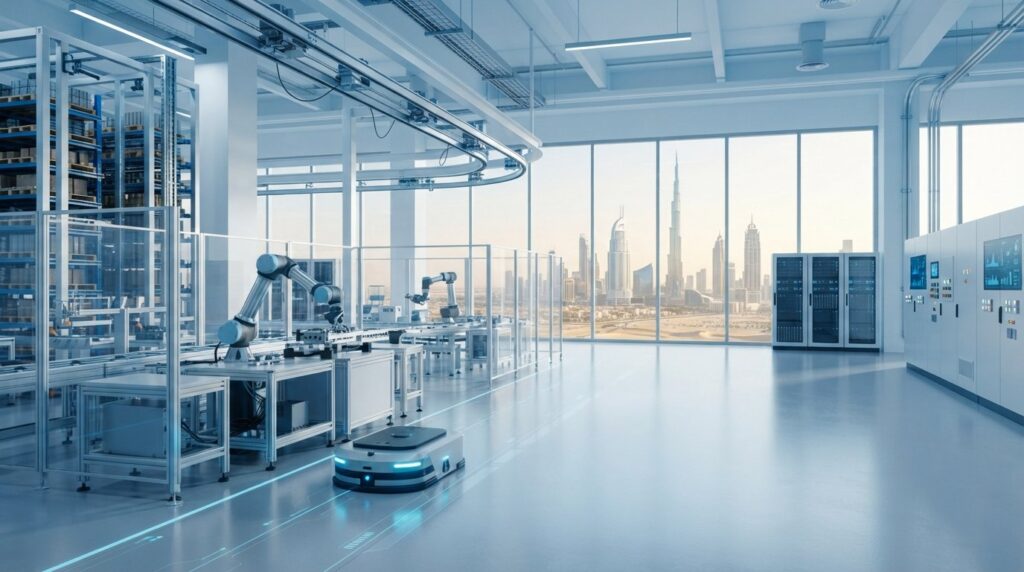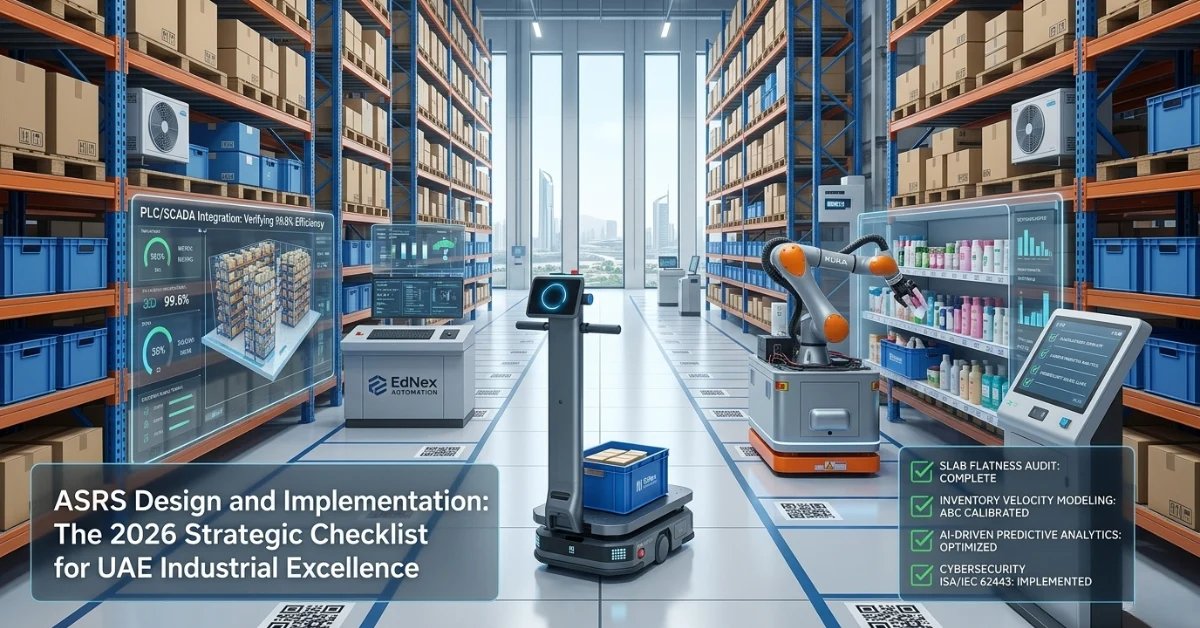
What if your warehouse footprint isn’t actually the constraint, but rather a symptom of outdated horizontal storage logic? Operating within the high-value industrial zones of the UAE requires a shift toward vertical density and intelligent autonomy. You likely recognize that inefficient space utilization and rising labor turnover are eroding your margins. Successfully executing ASRS design and implementation requires more than just hardware; it demands a systematic integration of robotics with your existing PLC and SCADA infrastructure to ensure seamless operational flow.
We understand that the technical debt of legacy systems makes modernization feel like a high-risk gamble. This article promises to demystify that process by providing a comprehensive technical checklist for your 2026 warehouse transformation. Aligning with the UAE’s Dh1 billion National Industrial Resilience Fund, we’ll explore the critical phases of deployment, including digital twin modeling, AI-driven predictive analytics, and the essential ISA/IEC 62443 cybersecurity protocols required to protect your automated assets. By mastering these architectural requirements, you can secure your competitive position in the global logistics corridor.
Key Takeaways
- Align your warehouse strategy with the UAE’s Industry 4.0 mandates to solve chronic labor turnover and space utilization challenges in high-cost industrial zones.
- Execute a precise ASRS design and implementation by analyzing facility constraints such as slab flatness and inventory profiles before committing to hardware.
- Compare the technical capabilities of Unit-Load and Mini-Load systems against high-speed shuttle technology to optimize your specific retrieval workflows.
- Follow a structured lifecycle from detailed engineering to commissioning to ensure your automation deployment remains on schedule and within technical specifications.
- Integrate advanced hardware with sophisticated SCADA and PLC systems to build a scalable, intelligent storage framework that supports long-term business viability.
The Strategic Imperative for ASRS in the 2026 UAE Industrial Landscape
Leveraging the UAE’s “Operation 300bn” initiative, regional manufacturing hubs are undergoing a radical transition toward Industry 4.0. This evolution positions the Automated Storage and Retrieval System (ASRS) as more than a utility; it’s the fundamental backbone of the modern “dark warehouse” vision. In high-cost industrial zones like JAFZA and Dubai South, the strategic focus has shifted from mere square footage to high-velocity throughput and absolute inventory precision. Achieving this level of excellence requires a meticulous approach to ASRS design and implementation, ensuring that automation isn’t just an add-on, but a core component of the national logistics strategy. By centralizing control through PLC and SCADA integration, businesses can orchestrate complex movements with minimal human intervention, effectively future-proofing their operations against regional labor scarcity.
Why Traditional Warehousing Fails Modern Throughput Demands
Manual picking and palletizing workflows are increasingly hitting a ceiling in high-velocity distribution centers. Identifying these bottlenecks reveals that human-centric operations struggle to maintain the sub-millimeter accuracy mandates required by 2026 supply chain standards. Transitioning from reactive storage to proactive retrieval eliminates the latency inherent in manual searching. By removing the variable of human error, facilities can achieve a steady, predictable flow that traditional methods simply can’t sustain. This shift is particularly critical for sectors handling high SKU counts, where the cost of a single mispick can ripple through the entire supply chain, causing significant financial and reputational damage.
Economic Drivers: ROI and Long-term Viability
Implementing a robust ASRS design and implementation strategy allows organizations to mitigate the rising costs of labor turnover and industrial land. While traditional storage models rely on horizontal expansion, automated storage and retrieval systems utilize vertical height to maximize density, directly impacting the bottom line through reduced OpEx. Calculating the true cost involves looking beyond the initial capital; you must weigh the ongoing expenses of manual labor against the efficiency of a robotic workforce. In the UAE’s competitive economic landscape, the ability to scale without proportional increases in headcount is a distinct competitive advantage.
Defining ASRS ROI requires a rigorous evaluation of the total cost of ownership, where the initial investment is offset by a multi-year reduction in operational overhead, error-related losses, and facility footprint requirements.
ASRS Design Checklist: Engineering the Physical and Digital Blueprint
Transitioning from conceptual strategy to technical execution requires a rigorous audit of the physical environment and digital ecosystem. In the context of ASRS design and implementation, the blueprint must account for extreme structural precision, as even minor deviations in slab flatness can compromise the stability of high-bay racking systems. Engineers must prioritize floor loading capacity to withstand concentrated point loads from vertical masts and heavy pallet loads. Beyond the floor, ceiling heights dictate the ultimate storage density, making it essential to map every cubic meter of available volume before finalizing hardware specifications.
Inventory profiling serves as the primary data driver for system selection. Analyzing SKU velocity through granular ABC classification ensures that high-turnover items are positioned for rapid retrieval, while weight distribution analysis prevents structural overstress. Throughput modeling must account for peak demand periods, calculating cycles per hour to ensure the system doesn’t become a bottleneck during high-volume shifts. These physical metrics must then sync with a robust software architecture, where the Warehouse Management System (WMS) and Warehouse Control System (WCS) integrate seamlessly with existing ERP frameworks to provide real-time visibility and autonomous decision-making.
Environmental and Facility Hardening
Designing for the UAE’s unique climate necessitates specialized engineering to address heat dissipation within high-density storage modules. High temperatures can degrade the performance of sensitive electronic components and robotic motors, requiring integrated cooling solutions or enhanced airflow within the racking structure. Structural integrity must also adhere to regional seismic codes, ensuring that high-bay installations remain stable under various stress conditions. Integrating these systems with fire suppression and HVAC infrastructure is not an afterthought; it’s a critical requirement for regulatory compliance and operational safety. For organizations seeking to navigate these technical complexities, consulting with specialists in bespoke industrial automation ensures that environmental risks are mitigated from the outset.
Inventory and Throughput Optimization
Finding the ideal balance between storage density and accessibility is a primary objective of the ASRS design and implementation process. Modular expansion capabilities should be embedded into the initial design, allowing for the addition of aisles or retrieval units as throughput requirements evolve. This foresight prevents the costly downtime associated with future facility overhauls. In ASRS retrieval modeling, the ‘Golden Zone’ refers to the optimal vertical and horizontal placement of high-velocity SKUs to minimize travel time and maximize the efficiency of robotic pickers. By optimizing this zone, facilities can significantly reduce cycle times and improve overall system responsiveness.
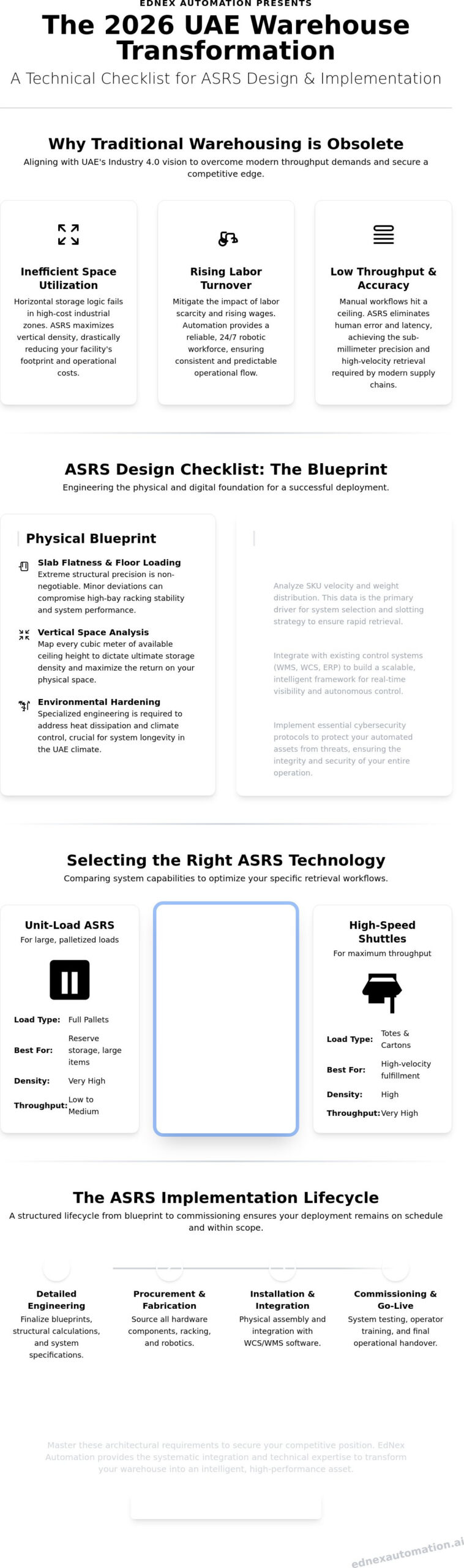
Selecting the Right ASRS Technology: A Comparative Framework
Navigating the diverse landscape of automated hardware requires a data-driven approach to ensure the selected system aligns with your specific operational profile. Selecting the appropriate technology is a critical pivot point in ASRS design and implementation that dictates long-term throughput capacity and operational agility. While Unit-Load systems are engineered for high-density, full-pallet storage in high-bay environments, Mini-Load systems provide the precision required for handling smaller totes and cases at high speeds. Organizations must evaluate these options against their SKU dimensions and weight distribution to avoid over-engineering or under-performing. For facilities prioritizing maximum density, cube-based storage offers a compact solution, though it often sacrifices the raw retrieval speed found in high-speed, multi-level shuttle configurations where concurrent movements are essential for peak demand.
Vertical Lift Modules (VLM) represent another specialized solution, specifically designed for high-density small parts handling within a minimal footprint. By utilizing a central elevator to deliver trays to an ergonomic picking station, VLMs eliminate the need for operators to navigate aisles, drastically reducing travel time and improving picking accuracy. Integrating these various technologies into a cohesive ecosystem requires a deep understanding of how each component interacts with your Warehouse Control System (WCS), ensuring that hardware selection supports the broader objective of autonomous industrial excellence.
Shuttle Systems vs. Crane-Based Retrieval
Evaluating the energy efficiency of modern ASRS shuttle technology reveals a clear advantage in high-throughput environments. Unlike traditional crane-based retrieval that moves a massive mast for every cycle, shuttle systems utilize lightweight, level-specific robots that consume significantly less power per pick. This decentralized architecture also provides superior system redundancy; if one shuttle requires maintenance, the remaining fleet continues to operate, preventing total aisle downtime. These systems are particularly effective in the pharmaceutical and e-commerce sectors, where order accuracy and rapid fulfillment are non-negotiable mandates.
Specialized Applications: Cold Storage and Hazardous Materials
Deploying ASRS for cold storage introduces unique design challenges that demand extreme temperature resilience and specialized engineering. Lubricants, sensors, and structural steel must be specifically rated for sub-zero environments to prevent brittle fractures or electronic component failure caused by condensation. In hazardous material environments, the ASRS design and implementation process must prioritize safety compliance through explosion-proof certifications and specialized fire suppression integration. Choosing materials that withstand these harsh conditions ensures the long-term viability of the automation investment, protecting both the physical facility and the high-value inventory within it from catastrophic operational risks.
The ASRS Implementation Lifecycle: From Blueprint to Commissioning
Orchestrating a successful ASRS design and implementation requires a disciplined, multi-phase lifecycle that mitigates technical risk while maximizing long-term throughput. This transition begins with Phase 1, where conceptual design and feasibility studies validate the system’s alignment with your facility’s specific SKU velocity and volumetric constraints. Moving into Phase 2, the focus shifts to detailed engineering and control system architecture, establishing the digital logic that will govern every robotic movement. It’s during this stage that the synchronization between physical hardware and intelligent software is finalized, ensuring the system can handle peak demand without latency.
Phase 3 involves the physical integration of the high-bay racking, retrieval masts, and shuttle units. This stage demands absolute structural precision to ensure that the autonomous components operate within sub-millimeter tolerances. The final stage, Phase 4, centers on software configuration and rigorous commissioning. By testing the handshakes between the Warehouse Management System and the underlying control layer, engineers transform inert steel into a proactive, autonomous organism. Organizations looking to streamline this complex journey should partner with experts in comprehensive ASRS deployment to ensure every phase adheres to global industrial standards.
Integrating the Control Layer: PLC and SCADA
Establishing a robust control layer is essential for ensuring seamless communication between your ASRS hardware and broader enterprise systems. Utilizing specialized PLC and SCADA integration services allows for deterministic control and real-time data visualization, which are critical for maintaining high-velocity operations. This integration provides diagnostic monitoring capabilities, allowing operators to identify and rectify potential bottlenecks before they impact throughput. Given the increasing connectivity of industrial networks, implementing advanced cybersecurity protocols is paramount to protect your automated warehouse from external threats and operational disruptions.
Testing, Commissioning, and Staff Training
Rigorous acceptance testing protocols represent the final barrier between installation and full-scale production. Factory Acceptance Testing (FAT) and Site Acceptance Testing (SAT) must be executed with precision to verify retrieval accuracy and system stability under load. Beyond the technical hardware, a successful ASRS design and implementation relies on effective change management. Transitioning the workforce from manual picking to robotic collaboration requires structured training programs that focus on system orchestration rather than manual labor. Establishing a schedule for predictive maintenance and post-implementation support ensures the system remains resilient, protecting your investment for the duration of its operational lifecycle.
Future-Proofing Your Logistics with EdNex Automation
Positioning your organization at the forefront of the UAE’s industrial evolution requires a partner who delivers the intellectual framework for transformation rather than just the hardware. EdNex Automation provides bespoke solutions that align with the specific regulatory and environmental mandates of the region, ensuring your ASRS design and implementation is resilient against the unique challenges of high-velocity desert logistics. By offering full-spectrum integration that spans from robust physical hardware to sophisticated SCADA and PLC control layers, we eliminate the fragmentation that often plagues large-scale automation projects. Our approach ensures that every component of your automated storage and retrieval system functions as a singular, intelligent organism, capable of scaling in lockstep with the UAE’s ambitious “Operation 300bn” objectives.
Utilizing advanced artificial intelligence and machine learning, our systems don’t just react to current orders; they proactively optimize warehouse workflows through predictive inventory placement. These autonomous capabilities allow facilities to anticipate demand surges and reconfigure storage density in real-time, effectively mitigating the risks of throughput bottlenecks. To ensure long-term business viability, we provide detailed consulting on the ASRS cost estimate, allowing operations leaders to align their capital expenditure with verified ROI projections and the financing opportunities provided by the Emirates Development Bank.
A Partner in Industrial Digital Transformation
Our commitment to excellence is reflected in our adherence to global standards and official certifications, which serve as a marker of legitimacy in a rapidly evolving market. EdNex acts as a strategic bridge, connecting global technological breakthroughs with the specific economic needs of regional manufacturing hubs. By maintaining alliances with world-leading robotics entities, we ensure your facility benefits from the latest innovations in autonomous retrieval and deterministic control. Starting your transformation with EdNex means moving beyond incremental improvements toward a fully autonomous, future-ready industrial environment.
Next Steps for Operations Leaders
Securing your competitive advantage in the 2026 landscape begins with a rigorous assessment of your current infrastructure. Operations leaders should prioritize a comprehensive facility audit to determine automation readiness and identify the specific technical requirements for a phased implementation roadmap. This structured approach ensures that the transition to robotics is controlled, deliberate, and safe. To begin developing your architectural blueprint for excellence, Consult with EdNex Automation on your ASRS strategy and discover how our integrated expertise can redefine your operational efficiency.
Securing Your Industrial Legacy in the Autonomous Era
Mastering the complexities of ASRS design and implementation is no longer a luxury but a strategic necessity for organizations aiming to thrive within the UAE’s rapidly evolving industrial landscape. By prioritizing vertical density and absolute structural precision, you effectively mitigate the constraints of rising land costs while maximizing operational throughput. Integrating these physical assets with a sophisticated digital control layer ensures your facility remains agile, resilient, and capable of meeting the sub-millimeter accuracy mandates of 2026 supply chain standards.
Partnering with Industry 4.0 certified integrators who possess specialized PLC and SCADA expertise allows you to bridge the gap between global technological breakthroughs and regional operational needs. EdNex Automation provides the intellectual framework and nationwide UAE support and maintenance required to sustain high-velocity excellence across your entire lifecycle. It’s time to transition from traditional storage models toward a proactive, autonomous future that guarantees long-term business viability. Scale your warehouse efficiency with EdNex ASRS solutions and lead the charge in regional industrial transformation.
Industrial Automation: Frequently Asked Questions
What is the typical timeline for ASRS design and implementation?
A standard lifecycle spans 9 to 18 months from the initial conceptual blueprint to final commissioning. This duration accounts for the rigorous engineering phases, procurement of specialized robotic components, and the precise on-site calibration required to ensure sub-millimeter retrieval accuracy in high-velocity environments.
How much floor space can I really save with an ASRS system?
Implementing high-density automated storage can reduce your footprint by up to 85% when compared to conventional horizontal racking models. By utilizing the full vertical height of a facility, organizations can significantly increase SKU density without the need for horizontal expansion in high-cost industrial zones like JAFZA.
Can ASRS be integrated into an existing warehouse facility?
Brownfield integration is entirely possible provided the existing slab meets specific flatness and load-bearing requirements. A comprehensive structural audit is necessary to ensure the facility can support the concentrated point loads of vertical masts and high-bay racking systems without compromising structural integrity.
What are the maintenance requirements for high-density automated storage?
Annual maintenance costs typically range from 5% to 10% of the initial system purchase price. This investment covers predictive diagnostics, sensor calibration, and mechanical servicing to prevent unplanned downtime, ensuring the system remains resilient throughout its operational lifecycle.
Is ASRS compatible with cold storage or cleanroom environments?
Specialized ASRS design and implementation protocols allow for seamless operation in sub-zero temperatures and ISO-certified cleanrooms. These systems utilize temperature-rated lubricants and stainless steel components to prevent material fatigue and ensure absolute compliance with pharmaceutical or food safety standards.
How does ASRS integrate with existing ERP and WMS software?
Integration occurs through a dedicated Warehouse Control System (WCS) that acts as the intelligent bridge between physical hardware and enterprise-level logic. This layer ensures real-time data synchronization, allowing your ERP to orchestrate complex inventory movements with absolute visibility across the supply chain.
What is the expected ROI period for a mid-scale ASRS project in the UAE?
Most mid-scale industrial projects in the region achieve full return on investment within 3 to 5 years. This calculation accounts for reduced operational expenditure, minimized labor turnover, and the optimization of high-value industrial real estate near major logistics hubs like Al Maktoum International Airport.
Do I need to upgrade my PLC and SCADA systems before installing ASRS?
Upgrading isn’t always mandatory, but ensuring your existing infrastructure supports modern communication protocols is vital for successful ASRS design and implementation. Seamless integration with your control layer allows for the deterministic logic and diagnostic monitoring necessary for achieving autonomous warehouse excellence. For a comprehensive overview of how these systems work together, the definitive guide to automated storage and retrieval systems provides an in-depth technical reference for operations leaders planning their 2026 infrastructure upgrades.