What if your warehouse footprint could deliver triple the throughput without adding a single square meter of expensive industrial land? As the UAE warehouse automation market accelerates toward a projected value of USD 521.5 million by 2030, industrial leaders are recognizing that traditional storage methods can no longer sustain the demands of high-SKU picking. You’ve likely felt the pressure of rising land costs and the scarcity of specialized labor in demanding environments. It’s a common challenge that requires a shift from simple labor replacement to radical space optimization through intelligent machinery.
By exploring the capabilities of ASRS shuttle technology, you’ll discover how these high-velocity robotic engines transform warehouse density and throughput compared to traditional automation systems. Delivering a sophisticated blend of autonomy and intelligence, these systems provide the intellectual framework necessary for long-term business viability. This article provides a strategic comparison of shuttle-based solutions; we examine their integration with PLC and SCADA systems and their role in meeting the rigorous safety standards set by the Dubai Civil Defence and other regional authorities to ensure your facility remains at the cutting edge of the 2026 industrial landscape.
Key Takeaways
- Understand how independent robotic shuttles eliminate single points of failure while achieving throughput rates exceeding 1,000 transactions per hour.
- Identify the fundamental operational shifts between static racking and dynamic ASRS shuttle technology to maximize cube utilization in high-density environments.
- Evaluate the strategic advantages of multi-level shuttle systems over traditional stacker cranes for high-frequency e-commerce and FMCG logistics.
- Discover why shuttle automation is a critical requirement for UAE-based cold storage and pharmaceutical facilities facing rising land constraints.
- Learn how bespoke PLC and SCADA integration ensures your automated storage system operates as a unified, intelligent engine rather than isolated hardware.
What is ASRS Shuttle Technology? Defining the Modern Warehouse Engine
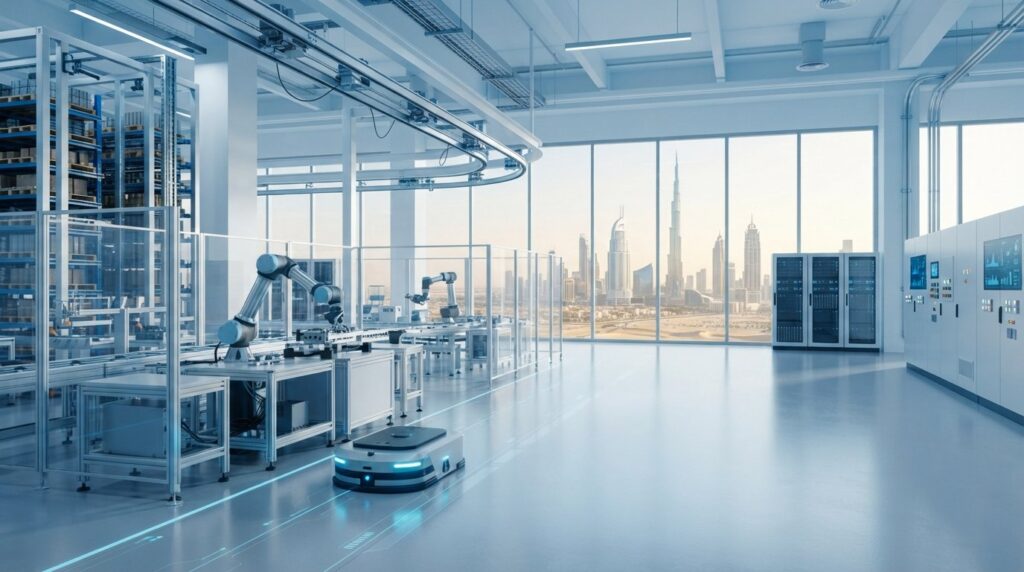
Developing a competitive advantage in the 2026 logistics landscape requires a fundamental shift in how facility managers perceive storage density. Understanding What is ASRS Shuttle Technology? begins with recognizing the transition from static, human-operated racking to dynamic, robotic environments. Unlike traditional systems that rely on wide aisles for forklift access, ASRS shuttle technology utilizes a dense matrix of rails where autonomous vehicles retrieve goods with surgical precision. This transition from “person-to-goods” to “goods-to-person” workflows is no longer a luxury; it’s a strategic necessity for UAE firms aiming to optimize throughput within limited footprints. As the regional market for warehouse automation targets a USD 521.5 million valuation by 2030, the shift toward shuttle autonomy reflects a broader national commitment to industrial modernization and efficiency.
The core philosophy of this technology centers on decoupling horizontal movement from vertical movement. In a standard warehouse, a single operator or crane handles both tasks, creating a bottleneck during peak periods. Shuttle systems solve this by deploying multiple independent units that operate simultaneously across different levels. This orchestration allows for a massive increase in transaction frequency, making it the ideal solution for high-SKU picking environments where speed is the primary KPI. By removing the human element from the retrieval path, businesses don’t just save on labor; they eliminate the safety risks and inaccuracies inherent in manual picking.
Key Components of a Shuttle ASRS Architecture
Building a high-performance system relies on the integration of several precision-engineered elements that work in total synchronization. These components provide the structural and mechanical foundation for the entire operation.
- Robotic shuttle vehicles: Serving as the autonomous workhorses of the facility, these units navigate individual levels of the racking to retrieve or deposit inventory without human intervention.
- Vertical lifts and hoists: Linking the horizontal storage lanes to the warehouse floor, these lifts enable multi-level high-density movement and ensure that goods reach the picking station at the exact moment they’re needed.
- Racking infrastructure: Utilizing precision-engineered steel, the racking serves as both the storage medium and the navigational track for the shuttles, requiring exacting tolerances to support high-speed robotic travel.
The Role of WMS and WCS in Shuttle Orchestration
Coordinating dozens of independent shuttles requires a sophisticated hierarchy of digital control. The Warehouse Management System (WMS) operates as the strategic layer, managing inventory levels and assigning storage logic based on demand forecasting. Acting as the real-time robotic conductor, the Warehouse Control System (WCS) orchestrates the physical movement of every vehicle. Ensuring sub-second latency in command execution is vital for high-throughput environments where every second counts. By leveraging expert PLC and SCADA integration, operators can bridge the gap between high-level management software and the physical machinery, creating a unified ecosystem that prioritizes safety and operational reliability. This intelligent control framework is what transforms a collection of hardware into a high-velocity robotic engine capable of meeting the rigorous demands of the modern UAE industrial sector.
The Mechanics of High-Velocity Shuttle Systems
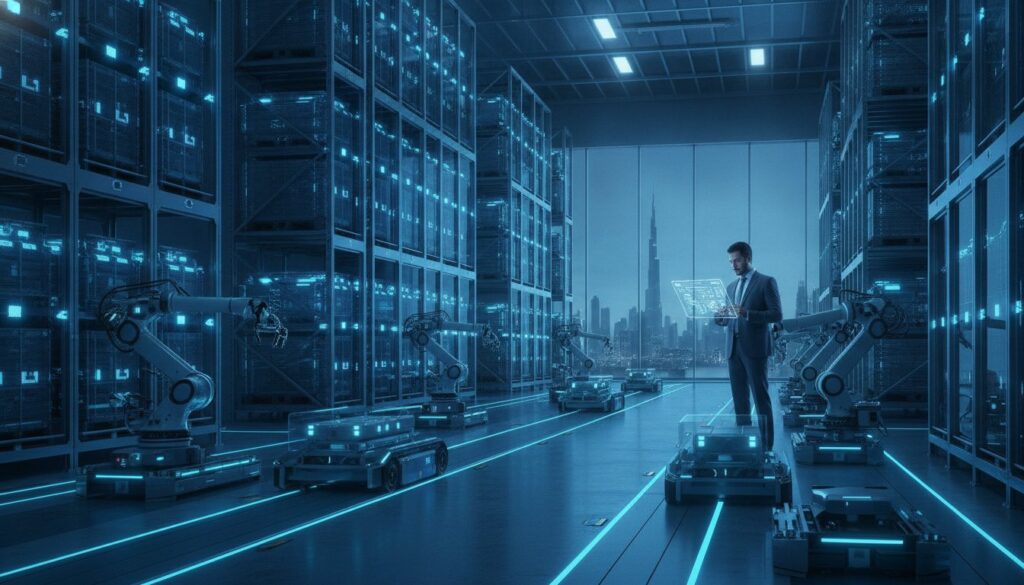
Achieving peak operational efficiency requires a departure from sequential processing toward a model of total simultaneity. The mechanical brilliance of ASRS shuttle technology lies in its ability to deploy dozens of independent robotic units within a single racking structure, allowing multiple tasks to occur on different levels at the same time. This parallel processing capability eliminates the bottlenecks associated with traditional single-crane systems that can only handle one load at a time. In optimized configurations, these high-velocity engines surpass 1,000 transactions per hour, providing the throughput necessary to handle the volatile demand cycles of the 2026 market. According to the leading industry definition of ASRS, these systems represent the pinnacle of high-density, high-speed material handling for modern industrial applications.
Scalability is another core advantage of the shuttle architecture that provides long-term business viability. Unlike static systems that require a total overhaul to increase capacity, a shuttle grid allows for modular expansion. You can introduce additional robotic units to an existing grid to boost throughput without expanding the physical footprint of the warehouse. This capability is particularly vital in the UAE, where industrial land costs continue to rise and space utilization is a primary KPI. Modern shuttles also prioritize energy efficiency through the use of low-mass materials and regenerative braking systems that capture energy during deceleration. For organizations looking to modernize their infrastructure, exploring bespoke ASRS integration is the first step toward a more sustainable and scalable operation.
Two-Way vs. Four-Way Shuttle Technology
Selecting the right mechanical configuration depends heavily on your specific SKU profile and volume requirements. Two-way shuttles move along a single axis, making them the preferred choice for high-density, deep-lane pallet storage where volume takes precedence over selectivity. In contrast, four-way shuttles navigate both the X and Y axes, providing access to every storage position on a level. This increased mobility offers maximum selectivity, which is essential for facilities managing a high variety of SKUs with frequent picking requirements. Choosing between these configurations is a strategic decision that dictates the long-term flexibility of your automation investment.
Simultaneous Retrieval and Buffering Logic
Intelligent control systems allow shuttles to manage peak-hour surges through advanced buffering logic. Instead of retrieving items only when an order is finalized, the system can pre-position high-demand inventory in buffer zones near the dispatch area. This proactive movement ensures that the final picking process remains uninterrupted even during extreme demand spikes. Sequencing is the critical link between storage and dispatch that ensures items arrive at the packing station in the precise order required for shipping. By automating this logic, facilities reduce idle time at the dispatch dock and ensure that outbound logistics remain as efficient as the storage environment itself.
Comparison: Shuttle ASRS vs. Stacker Cranes and Mini-Load
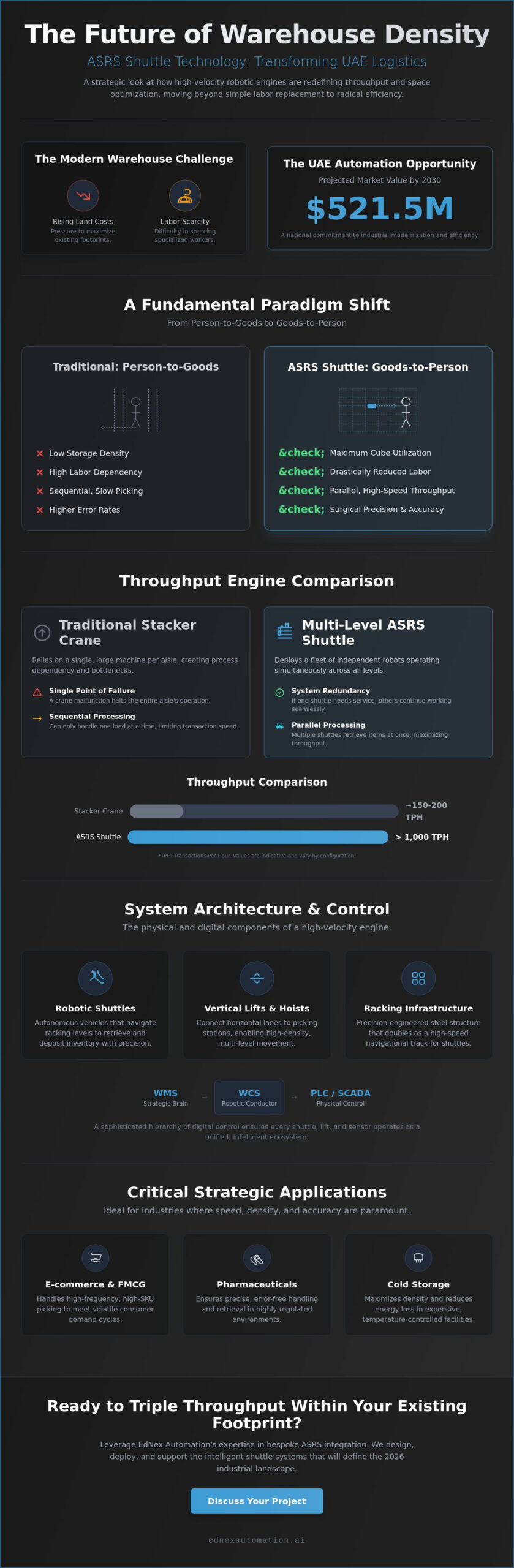
Selecting the optimal automated storage and retrieval system requires a meticulous evaluation of risk mitigation and operational uptime. While stacker cranes have long served as the industry standard for bulk storage, they introduce a critical “single point of failure” where a mechanical issue with one crane paralyzes an entire aisle. In contrast, ASRS shuttle technology utilizes a fleet of independent robotic units that operate across a shared matrix. If one shuttle requires maintenance, the remaining fleet continues to operate, ensuring that facility-wide halts are a thing of the past. This modular approach to reliability is a cornerstone of modern industrial strategy, providing the intellectual framework necessary for high-stakes logistics operations.
Beyond risk mitigation, the throughput density of shuttle systems makes them the dominant choice for high-frequency e-commerce and FMCG sectors. Traditional cranes are heavy, high-mass machines that require significant energy and time to accelerate and decelerate. Shuttles are lightweight and nimble, allowing for much higher cycles per hour in environments where rapid order fulfillment is a primary KPI. Stacker cranes still hold the advantage in extreme vertical applications exceeding 30 meters; however, for the majority of high-velocity distribution centers, the agility and redundancy of a shuttle-based architecture are superior.
Performance Benchmarks: Speed and Throughput
Performance benchmarks reveal a stark contrast in agility between these competing architectures. Shuttles achieve significantly higher cycles per hour because they decouple horizontal and vertical movements, allowing for simultaneous retrieval across multiple levels. In a national logistics context where order lead times are measured in minutes, the superior acceleration rates of lightweight shuttles provide a tangible competitive edge. This speed directly impacts the bottom line by reducing the time goods spend in the “storage” phase and accelerating their transition to “dispatch.”
Footprint and Volumetric Efficiency
Maximizing vertical cube utilization is a non-negotiable requirement in land-constrained industrial zones throughout the UAE. ASRS shuttle technology eliminates the need for wide aisles required by forklifts or the heavy structural support needed for massive crane systems. By tightening the storage matrix, these systems provide a transformative 85% density increase compared to traditional racking environments. This volumetric efficiency allows businesses to store more inventory within the same footprint, directly offsetting the impact of rising land costs while enhancing overall warehouse capacity. For organizations aiming to remain competitive, this shift represents a necessary evolution in industrial infrastructure.
Strategic Implementation: When to Invest in Shuttle Automation
Determining the precise moment to transition from manual operations to high-density automation requires a meticulous analysis of labor volatility and facility throughput. For many UAE enterprises, the trigger point arrives when the rising cost of manual picking and the risk of fulfillment errors begin to erode profit margins. Investing in ASRS shuttle technology provides a hedge against these variables, offering a predictable and scalable operational cost structure. To build a robust financial case, stakeholders must look beyond the initial purchase price and calculate a comprehensive ASRS cost estimate that accounts for total cost of ownership over a ten-year horizon. This forward-looking approach ensures that your organization meets national industrial goals while maintaining a competitive edge in a tightening labor market.
The decision to automate is often driven by the need for consistency in specialized environments where human labor is either too costly or too risky to maintain. As UAE industries pivot toward more sophisticated logistics models, the reliance on autonomous systems becomes the intellectual framework for growth. By removing the limitations of manual sorting, businesses can focus on higher-level strategic planning and market expansion. A successful transition depends on rigorous ASRS design and implementation planning that integrates digital twin modeling, cybersecurity protocols, and phased deployment strategies aligned with your facility’s existing infrastructure. This systematic organizer of inventory brings order and efficiency to complex environments through controlled and deliberate innovation.
ASRS for Cold Storage and Harsh Environments
Maintaining integrity in the food and pharmaceutical supply chains presents unique challenges in the Middle East, where ambient temperatures often exceed 40°C. Traditional manual picking in refrigerated environments is inefficient and poses significant health and safety risks for personnel. Utilizing ASRS for cold storage allows facilities to operate in temperatures as low as -30°C without human intervention. These robotic systems significantly reduce heat gain by minimizing the warehouse volume that requires cooling and eliminating the need for frequent door openings. By centralizing operations within a high-density shuttle matrix, businesses can achieve a significant reduction in energy consumption compared to conventional cold storage layouts.
ROI Calculation and Long-Term Viability
Achieving a rapid return on investment depends on the integration of several cost-saving factors, including reduced land requirements and lower energy overheads. The move toward a “Dark Warehouse” model enables fully autonomous 24/7 operations, maximizing the utilization of your capital assets without the constraints of shift patterns. While the initial CAPEX is higher than manual racking, the long-term viability of shuttle fleets is secured by their modular maintenance lifecycles. Individual shuttles can be serviced or replaced without halting the entire system, ensuring continuous uptime in high-duty environments. To evaluate how these systems can transform your specific facility, you should consult with an automation specialist to map out a bespoke implementation strategy. This transition ensures your infrastructure remains resilient against future economic shifts.
EdNex Automation: Bespoke ASRS Integration for UAE Industry
EdNex serves as a visionary integrator that transcends simple hardware provision to deliver comprehensive, intelligent control systems. By bridging the gap between global ASRS shuttle technology and the specific operational requirements of the UAE industrial sector, we provide the intellectual framework necessary for high-stakes transformation. Our approach focuses on the delivery of high-level solutions that integrate seamlessly with existing infrastructure, ensuring that your transition to Industry 4.0 is both controlled and deliberate. As a grounded technical partner, we understand that the success of an automated facility depends on the underlying logic of its control architecture rather than just the physical machinery.
Recognizing the critical role of sub-second latency and system reliability, we prioritize bespoke PLC and SCADA integration services as the core of our ASRS offering. This specialized expertise ensures that your automated storage and retrieval system operates as a unified engine, capable of responding to real-time demand shifts without manual intervention. Our status as a regional bridge-builder allows us to connect global technological breakthroughs with local industrial needs, providing a level of national support that ensures long-term business viability. We don’t just sell tools; we provide the systematic organization required to bring order and efficiency to complex industrial environments.
The EdNex Integration Framework
Our framework utilizes custom PLC logic designed specifically for specialized robotic movement and safety protocols. By developing bespoke code that governs the precise acceleration and deceleration of ASRS shuttle technology, we mitigate mechanical wear and maximize system longevity. Real-time data visualization via SCADA provides warehouse-wide monitoring, allowing facility managers to identify and resolve bottlenecks before they impact throughput. We also ensure total interoperability between ASRS, Autonomous Mobile Robots (AMRs), and existing conveyor systems to create a truly autonomous ecosystem that thrives in the 2026 logistics landscape.
Partnering for Success in Industry 4.0
Transitioning to a fully automated environment requires more than a technical checklist; it demands a partner who manages the full lifecycle from design to commissioning. EdNex provides comprehensive training and local support for UAE facility teams, ensuring that your staff possesses the technical expertise to manage advanced robotic systems effectively. This commitment to operational excellence frames our services as a necessary evolution for any organization wishing to remain competitive in an increasingly automated world. To begin your journey toward radical space optimization and throughput, consult with EdNex for your ASRS transformation and secure your facility’s place at the cutting edge of industrial innovation.
Securing Your Industrial Future with Intelligent Automation
Transitioning to a high-velocity robotic engine isn’t merely a storage upgrade; it’s a necessary evolution for organizations wishing to remain competitive in the 2026 industrial landscape. We’ve explored how ASRS shuttle technology provides a modular, redundant, and highly scalable alternative to traditional stacker cranes, offering the throughput density required for modern e-commerce and cold storage environments. By prioritizing intelligent orchestration over simple hardware acquisition, you ensure that your facility operates with the precision and reliability demanded by the UAE’s national logistics goals.
EdNex Automation stands as your grounded technical partner, providing the intellectual framework and specialized PLC/SCADA integration expertise necessary for seamless implementation. Our commitment to national UAE coverage and support ensures that your investment delivers long-term business viability and operational excellence. It’s time to move beyond manual constraints and embrace a future where autonomy drives growth. Schedule a Strategic ASRS Consultation with EdNex Automation today to begin your facility’s transformation. Your path to radical efficiency starts with a single, deliberate step toward visionary leadership.
Frequently Asked Questions
How does ASRS shuttle technology differ from traditional AGVs?
ASRS shuttle technology differs from traditional AGVs by operating exclusively within a fixed, high-density racking matrix rather than navigating the open warehouse floor. While AGVs provide flexible horizontal transport between disparate zones, shuttle systems prioritize vertical cube utilization and high-velocity retrieval within a structured robotic grid.
What is the typical ROI period for a shuttle-based ASRS in the UAE?
Determining the ROI period in the UAE requires factoring in local land costs and labor shift patterns, with most enterprises seeing a return within 3 to 5 years. This timeframe is often accelerated in high-throughput environments where 24/7 operations maximize the utilization of the robotic fleet and minimize the cost per transaction.
Can shuttle ASRS systems be integrated into existing warehouse structures?
Integrating these systems into existing warehouses is feasible provided the floor slab capacity and vertical clearance meet the structural requirements for a high-density matrix. Engineers must evaluate the load-bearing specifications of the current facility to ensure the precision-engineered rails remain stable under high-speed robotic travel and heavy load cycles.
How do shuttle systems handle different pallet or tote sizes?
Handling varied inventory is achieved through the use of telescopic forks or adjustable gripping mechanisms that accommodate different pallet and tote dimensions. This flexibility allows a single system to manage a diverse SKU profile, ensuring that your automation investment remains versatile as your product lines and market demands evolve.
What happens if a single shuttle robot fails during operation?
Failing robotic units don’t paralyze the entire operation because the modular nature of the fleet allows other shuttles to continue their tasks independently. A failed unit is typically moved to a maintenance bay at the end of its level, ensuring that the rest of the aisle remains productive and order fulfillment stays on schedule.
Are shuttle ASRS systems suitable for cold storage environments?
Operating in extreme cold is a primary capability of specialized ASRS shuttle technology models designed to function reliably at temperatures as low as -30°C. These systems are essential for UAE food and pharma logistics, where they reduce energy loss by maintaining a compact, high-density footprint that requires significantly less refrigeration volume.
How does SCADA integration improve ASRS performance?
SCADA integration improves performance by providing a real-time intellectual framework for monitoring every movement within the storage matrix. This visibility allows for sub-second command execution and predictive diagnostics, ensuring that small mechanical variances are addressed before they can impact warehouse-wide throughput or safety.
What are the maintenance requirements for a high-velocity shuttle fleet?
Maintenance for a high-velocity fleet involves scheduled inspections of the navigational rails, power contacts, and optical sensors to ensure peak precision. Because the units are modular, technicians can perform repairs on individual shuttles without halting the entire system, which maintains the high uptime necessary for modern industrial environments.