
Recognizing that the traditional air-gap is now a dangerous illusion, industrial leaders must acknowledge that isolated networks no longer exist in an era of cloud-integrated analytics. You’ve likely experienced the friction of merging legacy hardware with modern intelligence while fearing that a single cyber-physical breach could result in millions of AED in lost production. Maintaining operational resilience requires a shift from passive defense to a proactive, zero-trust framework that secures every sensor and controller in your facility.
Mastering SCADA security best practices is the foundational requirement for any organization aiming to survive the complexities of Industry 4.0. This article delivers a strategic checklist designed to harden your PLC and SCADA integration against modern threats, including the critical vulnerabilities identified in ScadaBR and FUXA software earlier in 2026. You’ll gain a clear roadmap for achieving compliance with the UAE Information Assurance Standards and the National Cyber Accreditation Programme; this ensures your infrastructure remains both secure and competitive in a high-stakes regional market.
Key Takeaways
- Transitioning from obsolete air-gap models toward zero-trust architectures allows for the secure integration of cloud-based analytics within hyper-connected Industry 4.0 environments.
- Implementing the Purdue Model for network segmentation ensures that SCADA security best practices are applied to isolate critical control functions from corporate IT vulnerabilities.
- Adopting a risk-based patch management strategy, including virtual patching via Intrusion Prevention Systems, mitigates the threat of remote code execution on legacy industrial hardware.
- Aligning operational protocols with the UAE Information Assurance Standards (IAS) facilitates National Cyber Accreditation while safeguarding Critical Information Infrastructure from evolving regional threats.
- Integrating security during the initial PLC and SCADA deployment phase establishes a resilient foundation for the autonomous operation of advanced robotics and automated storage systems.
The Evolution of SCADA Vulnerabilities in 2026
Defining SCADA security in the context of hyper-connected Industry 4.0 environments requires a fundamental shift from perimeter defense to deep-rooted system integrity. As industrial facilities in the UAE transition toward fully autonomous operations, the boundary between the plant floor and the corporate cloud has effectively vanished. This transformation brings unparalleled efficiency, yet it also exposes critical infrastructure to risks that were once contained by physical isolation. Maintaining a robust industrial control system (ICS) cybersecurity posture is now the only way to safeguard against sophisticated actors who view industrial controllers as soft targets for high-impact disruption.
Traditional IT security measures frequently fail when applied to real-time industrial controls because they don’t account for the unique latency and availability requirements of the factory floor. While an IT department might prioritize data encryption, an OT engineer knows that a millisecond of lag or an unexpected reboot of a PLC can lead to catastrophic hardware failure or safety hazards. The stakes involve more than just data breaches; they encompass significant financial loss, physical damage to specialized machinery, and potential threats to national infrastructure. Implementing SCADA security best practices ensures that modernization efforts don’t come at the cost of operational safety.
The Death of the Air Gap
Integrating Autonomous Mobile Robots (AMRs) and remote diagnostic platforms has rendered the concept of the “air-gapped” network obsolete. Relying on security through obscurity is a dangerous strategy in 2026, as every connected sensor and mobile unit expands the potential entry points for malicious code. By connecting legacy hardware to cloud-based analytics for predictive maintenance, organizations have inadvertently created pathways that bypass traditional firewalls. The modern industrial attack surface is a dynamic, multi-layered mesh of edge devices, cloud interfaces, and interconnected logic controllers that requires constant, intelligent monitoring.
Emerging Threats to Industrial Control Systems
Threat actors are now leveraging AI-driven automated vulnerability scanning to identify weaknesses in industrial software with unprecedented speed. This was evidenced by the critical vulnerabilities identified in ScadaBR and FUXA software in early 2026, which allowed for unauthenticated remote code execution. Ransomware-as-a-Service (RaaS) models have also evolved to specifically target manufacturing supply chains, aiming to extort industrial leaders by threatening prolonged production downtime. With Iranian-affiliated actors compromising at least 75 PLC devices globally as of April 2026, the focus on regional energy and water utilities has intensified. Adopting SCADA security best practices is a necessary evolution for any organization wishing to remain competitive and secure in this volatile landscape.
Network Architecture: Building a Secure Industrial Foundation
Establishing a resilient industrial foundation begins with a rigorous adherence to structural segmentation. By adopting the Purdue Model, engineers create a hierarchical defense that prevents a breach in the corporate office from escalating into a full-scale shutdown of the production line. This model separates enterprise functions from the sensitive plant-floor operations, ensuring that mission-critical controllers remain shielded. Implementing SCADA security best practices within this architecture ensures that every data packet is verified before it reaches a high-value asset. Ensuring compliance with the UAE’s National Cyber Accreditation Programme (NCAP) requires this level of architectural precision to protect regional critical infrastructure.
Moving toward a Zero Trust Architecture represents the next phase of industrial evolution. In this framework, no user or device is trusted by default, regardless of their location on the network. Utilizing Demilitarized Zones (DMZs) creates a controlled buffer that facilitates data exchange without allowing direct communication between corporate IT and the mission-critical OT layer. This is particularly vital for securing remote access for third-party vendors and system integrators who require entry for diagnostics. Partnering with experts for PLC and SCADA Integration allows for the seamless deployment of these advanced security frameworks while maintaining peak operational efficiency.
Micro-Segmentation and VLAN Strategies
Isolating PLC traffic from HMI and historian data streams prevents the lateral movement of threats within the production network. Utilizing firewalls specifically engineered for industrial protocols like Modbus, DNP3, and OPC UA provides deep packet inspection capabilities that standard IT firewalls lack. These specialized tools can identify and block malicious commands that might otherwise appear as legitimate traffic to an unoptimized system. This granular control is essential for protecting complex ecosystems that utilize AMRs and collaborative robots alongside legacy hardware.
Encryption and Secure Communication
Hardening communication between field devices and the SCADA master station requires the implementation of robust encryption protocols. Utilizing TLS/SSL for web-based HMI interfaces protects against data interception and spoofing attacks. Requiring VPNs with multi-factor authentication for all remote maintenance activities is among the SCADA security essentials that safeguard against unauthorized access. These measures are critical in 2026 as industrial leaders phase out insecure SMS-based authentication in favor of biometric and app-based verification. Adopting SCADA security best practices ensures that even as systems become more connected, the underlying logic remains impenetrable.
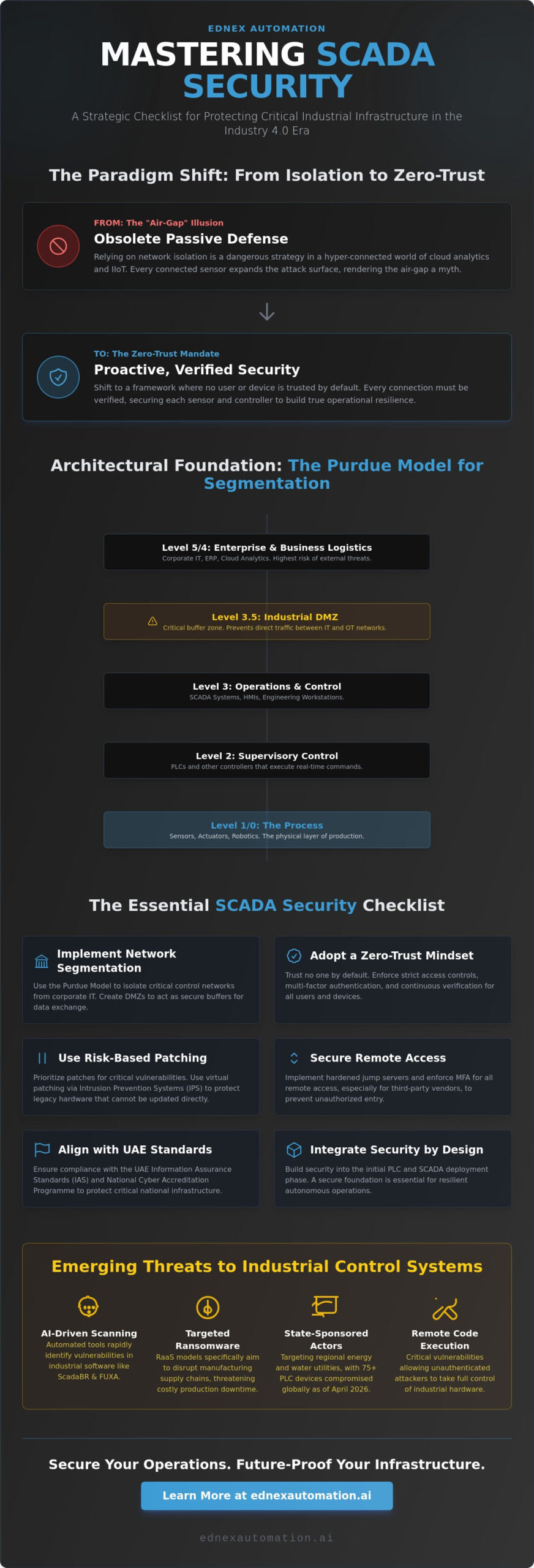
The Essential SCADA Security Best Practices Checklist
Implementing SCADA security best practices demands a methodical approach that prioritizes visibility and control over every component within the industrial ecosystem. Achieving this level of precision starts with a comprehensive asset inventory; you must document every PLC, RTU, and IED to ensure no “shadow” hardware exists on your network. Once visibility is established, engineers should immediately disable all unused ports and services on industrial hardware. This simple yet effective step significantly reduces the potential attack surface by closing doors that don’t need to be open. It’s the first line of defense in a world where automated vulnerability scanning is constant.
Enforcing a policy of least-privilege access for all operator and engineering workstations ensures that a compromised account can’t move laterally or execute unauthorized changes. This administrative control should be paired with real-time logging and centralized security monitoring through a SIEM platform. By aggregating data from the entire facility, you can detect anomalies in seconds rather than days. Finally, performing regular offline backups of all SCADA configurations and PLC logic provides a critical safety net against ransomware. These backups must be stored in a secure, non-networked environment to guarantee recovery after a catastrophic event, protecting your long-term business viability.
Identity and Access Management (IAM)
Modernizing your approach to identity means eliminating shared passwords across operator shifts. It’s a common but dangerous practice that obscures accountability during a security incident. Integrating SCADA access with centralized corporate identity providers, where operationally safe, allows for more robust oversight and faster de-provisioning of departing staff. Implementing Role-Based Access Control (RBAC) ensures that while an operator can monitor a process, only authorized engineers can modify the underlying logic. This distinction is vital for maintaining the integrity of your PLC and SCADA Integration and preventing accidental misconfigurations.
Device Hardening and Physical Security
Effective SCADA security best practices extend beyond the digital realm and into the physical environment. Locking cabinets that house network switches and PLCs prevents unauthorized physical tampering or the introduction of malware via portable drives. Disabling USB ports on all industrial workstations further mitigates this risk by removing the physical vector for infection. Before applying any updates to critical infrastructure, engineers must verify firmware integrity using cryptographic signatures to prevent the installation of malicious code. This systematic approach brings order and safety to complex environments through controlled and deliberate innovation.
Operational Resilience: Patching and Personnel Training
Developing a risk-based patch management cycle is essential for maintaining operational integrity without compromising uptime. Unlike IT environments where reboots are routine, industrial systems require a surgical approach to updates. Implementing SCADA security best practices involves prioritizing patches based on their impact on safety and production continuity. For systems that cannot be taken offline, “Virtual Patching” through an Intrusion Prevention System (IPS) provides a critical shield. This technology identifies and blocks exploit attempts at the network level, providing a necessary layer of protection until a scheduled maintenance window allows for a permanent fix.
Technology alone cannot guarantee resilience; building a culture of cybersecurity awareness among plant floor personnel is equally vital. Employees must understand that their actions, such as plugging in an unauthorized device or ignoring a system alert, have direct physical consequences. Conducting regular tabletop exercises allows teams to practice incident response scenarios in a controlled environment. These simulations help define clear roles and responsibilities, ensuring that when a suspected breach occurs, the response is methodical rather than chaotic. To ensure your workforce and systems are prepared for the next generation of threats, explore our specialized solutions for PLC and SCADA Integration.
The Challenge of Legacy Patching
Many facilities in the UAE still operate with end-of-life (EOL) software that no longer receives official security updates. In these cases, compensating controls such as enhanced network isolation and strict application whitelisting become the primary defense. Leaving unpatched HMIs exposed in a 24/7 production environment creates a persistent backdoor that threat actors can exploit to gain remote code execution and halt entire assembly lines. These legacy systems require PLC and SCADA integration services tailored with bespoke strategies to remain viable in a modern threat landscape. Resolving the underlying logic vulnerabilities in these environments often demands specialized PLC programming services Dubai facilities can rely on to migrate legacy code and eliminate the inefficiencies that create persistent security gaps.
Incident Response and Disaster Recovery
Effective disaster recovery hinges on maintaining “cold” backups that are kept entirely separate from the network. This air-gapped storage protects critical configuration files from ransomware that might spread through online backup systems. Organizations must also define their Recovery Time Objectives (RTO) and Recovery Point Objectives (RPO) with precision. In a SCADA environment, the RTO determines how quickly you can restore production, while the RPO defines the maximum tolerable data loss from the moment of failure. Adhering to SCADA security best practices ensures that these metrics are integrated into the core of your operational strategy, safeguarding your facility’s long-term business viability.
Strategic SCADA Integration: Future-Proofing UAE Assets
Designing for resilience requires that security be baked into the initial PLC and SCADA integration phase rather than treated as an elective add-on. By establishing a secure-by-design architecture, industrial leaders ensure that their digital transformation remains sustainable under the scrutiny of the UAE Information Assurance Standards (IAS). Transitioning toward this level of maturity involves more than just software; it requires a systematic organizer who can bridge the gap between global technological breakthroughs and regional industrial needs. Adhering to SCADA security best practices during the deployment of critical information infrastructure is the only way to achieve National Cyber Accreditation Programme (NCAP) status and maintain a competitive edge in 2026.
Professional system integrators play a vital role in navigating the complex convergence of OT and IT, ensuring that modernization does not introduce unintended vulnerabilities. While equipment vendors may focus solely on functionality, a strategic partner provides the intellectual framework necessary to protect high-value assets from sophisticated threats. This comprehensive approach aligns your facility with international standards like ISA/IEC 62443 while grounding those aspirations in the specific economic and regulatory context of the United Arab Emirates. Organizations seeking to unify legacy machinery with modern cloud intelligence should evaluate professional PLC and SCADA integration services that address both cybersecurity requirements and the transition to interoperable automation standards.
Holistic Automation and Security
Integrating SCADA data with Manufacturing Execution Systems (MES) provides secure, high-level production insights that drive efficiency across the entire value chain. This connectivity allows for the safe deployment of Autonomous Mobile Robots (AMRs) and collaborative robots, as a hardened control layer prevents unauthorized actors from interfering with autonomous physical movements. For a deeper understanding of how these components interact within a modern facility, consult our guide on PLC vs SCADA systems UAE to establish the correct architectural context for your facility.
The EdNex Advantage in Secure Integration
Leveraging specialized expertise in SCADA system integration UAE, EdNex Automation provides a comprehensive methodology that secures the industrial ecosystem from PLC programming to network deployment. We act as a reliable technical partner, delivering start-to-finish expertise that covers everything from Automated Storage and Retrieval Systems (ASRS) to surveillance robots. Our commitment to SCADA security best practices ensures that your investment in modern automation is protected by a robust and certified defense. Secure your industrial future and ensure long-term business viability by scheduling a professional EdNex automation audit today.
Securing the Future of UAE Industrial Intelligence
Maintaining operational resilience in 2026 requires more than simple perimeter defense; it demands a fundamental commitment to architectural integrity and proactive risk management. By transitioning from obsolete air-gaps to a structured Zero Trust framework, your organization can safely harness the power of cloud-integrated analytics and autonomous robotics. Adhering to these SCADA security best practices ensures your facility remains compliant with the UAE Information Assurance Standards while safeguarding against unauthenticated remote code execution and regional cyber threats.
As an industry pioneer with official alliances with global technology leaders, EdNex Automation provides the intellectual framework and specialized expertise needed for a successful Industry 4.0 transformation. Our comprehensive PLC and SCADA integration services ensure that safety, efficiency, and intelligence are seamlessly woven into your facility’s DNA. This evolution isn’t just a defensive measure but a necessary step for long-term business viability in an increasingly connected landscape.
Request a Strategic SCADA Security and Integration Audit to begin your journey toward a more secure and resilient industrial future. Your facility’s transformation into a secure, autonomous ecosystem starts with a single, deliberate step toward modernization.
Frequently Asked Questions
What is the most common entry point for SCADA cyberattacks?
The most frequent entry point for SCADA cyberattacks is unsecured remote access and phishing targeting the bridge between IT and OT networks. While legacy vulnerabilities remain a concern, modern breaches often exploit the expanded attack surface created by remote diagnostics and third-party vendor connections. Maintaining a zero-trust framework ensures that these external entry points don’t become gateways to your mission-critical controllers.
Can I use standard IT antivirus software on my SCADA workstations?
Standard IT antivirus software is generally unsuitable for SCADA workstations because its signature-based scanning can introduce unacceptable latency or trigger false-positive system reboots. Industrial control systems require specialized endpoint protection that prioritizes process availability and real-time performance. Utilizing OT-specific security solutions prevents the operational disruptions that often occur when standard IT tools interfere with sensitive PLC communication.
How often should we perform security audits on our industrial control systems?
Organizations managing critical infrastructure in the UAE should conduct comprehensive security audits at least annually or following any major system integration. Regular assessments ensure ongoing compliance with the National Cyber Accreditation Programme (NCAP) and help identify emerging vulnerabilities in the local threat landscape. These audits provide the intellectual framework necessary to adapt your defense strategy to the evolving capabilities of modern threat actors.
Is multi-factor authentication (MFA) practical for plant floor operators?
Multi-factor authentication is highly practical for the plant floor when implemented through app-based tokens or biometrics rather than disruptive SMS-based methods. These secure protocols prevent unauthorized access without hindering the rapid operational rhythm required by shift operators. Implementing SCADA security best practices in 2026 involves moving away from shared passwords and toward these individualized, high-integrity authentication methods for all operator workstations.
What is the Purdue Model and why is it relevant to SCADA security?
The Purdue Model is a hierarchical framework for industrial control system segmentation that separates enterprise IT from the sensitive plant-floor OT layer. It’s relevant because it provides the structural blueprint for network isolation, effectively containing breaches within a single network level. Adhering to this model is a foundational requirement for any facility aiming to protect its logic controllers and human-machine interfaces from external cyber threats.
How does SCADA security impact the deployment of collaborative robots (cobots)?
SCADA security directly impacts the deployment of collaborative robots by ensuring the integrity of the logic commands that govern their physical movements. A hardened control system prevents malicious actors from overriding safety parameters, ensuring that cobots can operate safely alongside human personnel in a shared environment. This secure integration is essential for maintaining the physical safety and operational reliability of your autonomous industrial ecosystem.
What should be our first step if we suspect a SCADA system breach?
The first step during a suspected breach is to activate your pre-defined incident response plan and isolate affected network segments rather than simply shutting down the entire process. This controlled containment prevents the lateral spread of malware while allowing for a methodical investigation of the compromised PLC or HMI. Immediate isolation protects the rest of the facility while your technical team works to restore system integrity.
Does upgrading to Industry 4.0 necessarily increase my security risk?
Upgrading to Industry 4.0 expands the industrial attack surface through increased connectivity, but it doesn’t necessarily increase overall risk when security is integrated from the start. Modern systems utilize advanced SCADA security best practices like encryption and zero-trust architectures, which provide superior protection compared to the “security through obscurity” of legacy hardware. Strategic integration ensures that your facility remains both highly connected and exceptionally secure.