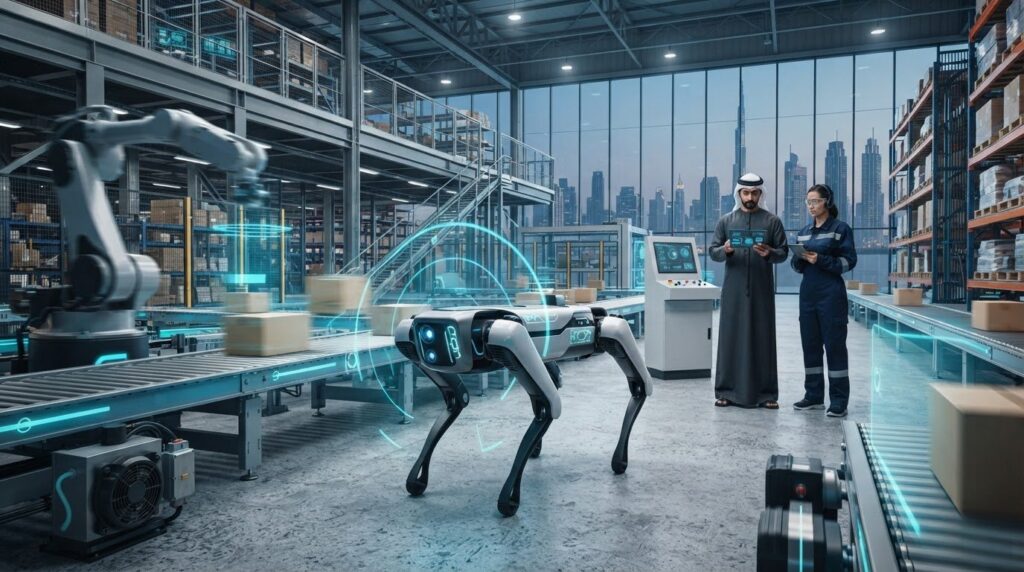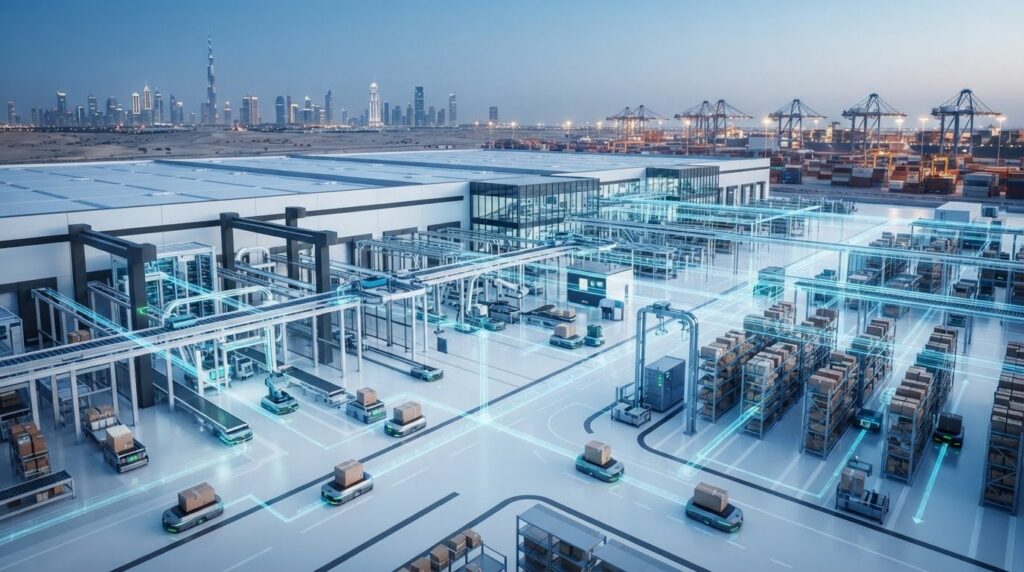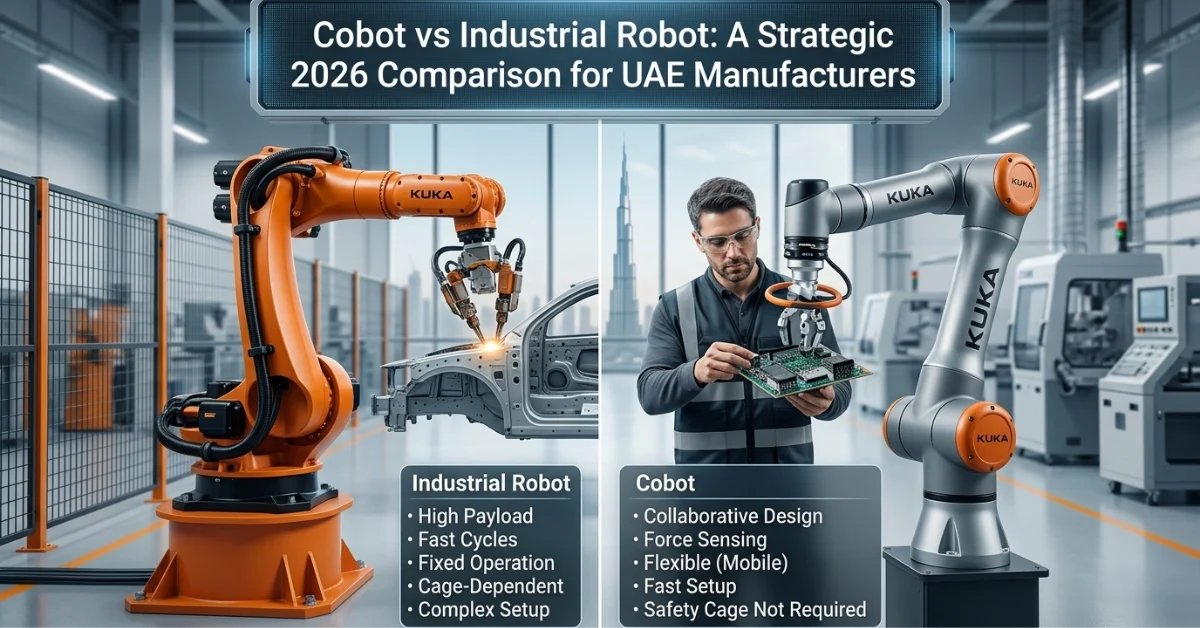
What if the most expensive mistake in your 2026 automation strategy isn’t choosing the wrong machine, but selecting an incompatible integration footprint? As the UAE targets a 50% automation rate for workflows through self-executing AI systems, the debate of cobot vs industrial robot has shifted from simple cycle times to complex architectural flexibility. You likely recognize that high labor costs in specialized sectors demand a transition toward autonomous systems, yet the technical friction of PLC integration often stalls progress.
This strategic analysis provides the intellectual framework you need to navigate this high-stakes decision while ensuring safety compliance with the latest DIFC AI ethics regulations. We’ll examine why a collaborative system, typically costing between $40,000 and $150,000, might offer superior ROI for agile tasks compared to the $400,000+ investment required for heavy-duty industrial cells. By reviewing payload capabilities and the impact of the recent $200 million Lianhe Sowell investment in the region, you’ll gain the clarity required to build a future-ready manufacturing infrastructure that delivers excellence across the GCC.
Key Takeaways
- Evaluate the fundamental shift in the cobot vs industrial robot debate by distinguishing between high-flexibility collaborative tools and high-velocity autonomous throughput engines.
- Master the technical specifications of payload and reach to ensure your robotic architecture supports everything from 3kg precision tasks to 1000kg+ heavy-duty operations.
- Optimize your shop-floor footprint by analyzing the strategic trade-offs between safety-caged industrial cells and the space-saving, open-floor layouts of collaborative systems.
- Streamline your digital transformation through advanced PLC and SCADA integration, turning your robotic assets into critical IoT nodes for predictive maintenance.
- Align your automation roadmap with the UAE’s national industrial digitalization goals to build a future-ready manufacturing infrastructure that maximizes long-term ROI.
Defining the 2026 Automation Landscape: Cobots and Industrial Robots
The 2026 industrial landscape in the UAE is undergoing a profound transformation as manufacturers pivot toward high-tech, autonomous infrastructures. Driven by the new AI and robotics framework introduced in May 2026, the distinction in the cobot vs industrial robot debate has become a cornerstone of strategic facility planning. We’re no longer seeing robots as isolated mechanical arms; they’re now sophisticated IoT nodes that form the backbone of a future-ready enterprise. This evolution is accelerated by massive regional investments, such as the $200 million commitment by Lianhe Sowell International Group to establish specialized robotics headquarters within the Emirates. While traditional systems focus on raw power, modern collaborative tools emphasize agility and human-machine synergy. The integration footprint is the total physical and digital space required for deployment.
The Core Purpose of Cobots
Collaborative robots, or cobots, represent a shift toward human-centric automation where safety and flexibility take precedence over sheer velocity. Understanding what a cobot is involves looking at their inherent design for proximity, featuring lightweight construction and sensitive force-torque sensors that allow them to work alongside personnel without safety cages. These next-gen tools excel in low-to-medium volume environments where high variability is the norm. Their intuitive hand-guiding features and AI-powered interfaces mean your team can reassign tasks in minutes. Beyond the factory floor, we’re seeing these systems thrive in laboratories and commercial kitchens, proving their worth as transformative assets for diverse GCC enterprises that require frequent task reassignment.
The Role of Traditional 6-Axis Industrial Robots
Traditional 6-axis industrial robots remain the undisputed engines of high-speed, autonomous throughput. Engineered for maximum duty cycles and capable of handling payloads exceeding 1,000kg, these machines are optimized for sub-millimeter precision at velocities no human-centric tool can match. They’re permanent, high-volume installations designed for standardized production lines where cycle times are measured in fractions of a second. While they require a larger physical integration footprint due to necessary safety partitioning, their ability to streamline massive output makes them indispensable for the UAE’s growing industrial headquarters. Integrating these giants into a wider PLC and SCADA framework ensures that every movement contributes to a data-driven, optimized manufacturing cycle that aligns with the Dubai Economic Agenda D33.
Cobot vs Industrial Robot: A Technical Comparison
Selecting the right robotic architecture requires a rigorous analysis of mechanical specifications and control logic. While the previous section established the visionary landscape of UAE’s Industry 4.0, the technical divergence in the cobot vs industrial robot debate centers on payload, precision, and the speed of deployment. We’re seeing a clear divide where collaborative systems offer agility for high-mix production, whereas traditional industrial units provide the raw power and sub-millimeter repeatability required for high-volume manufacturing. Precision remains the primary differentiator. Traditional 6-axis robots are engineered with high-rigidity castings that minimize deflection during high-speed maneuvers, making them the superior choice for applications requiring extreme micro-tolerances.
Payload and Reach Dynamics
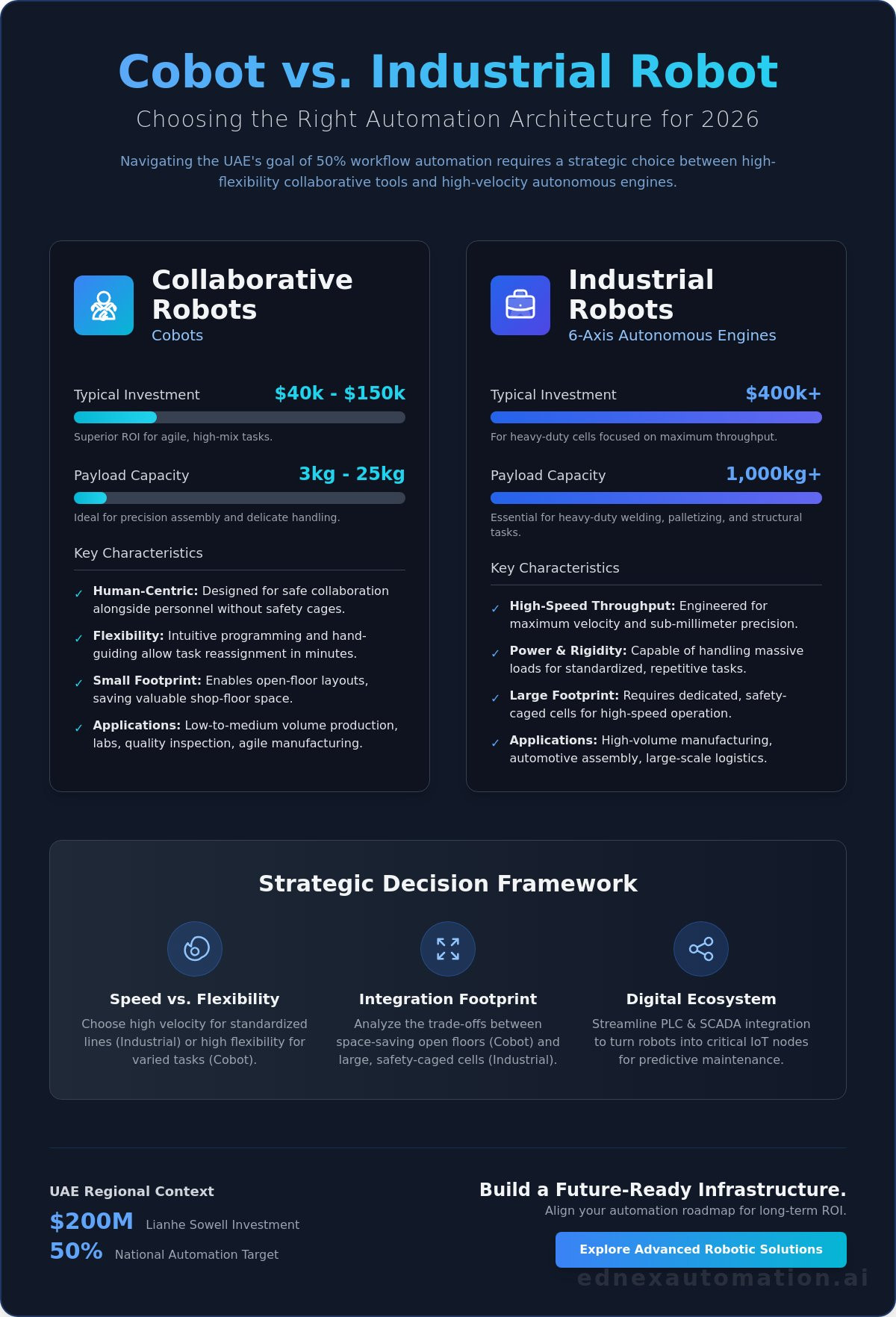
Structural limits define the operational boundaries of any robotic system. Cobots typically operate within a payload range of 3kg to 25kg, though 2026 industrial-grade models are pushing these boundaries toward higher capacities. Attempting to over-spec a cobot for heavy-duty tasks often leads to diminishing returns, as the safety-limited joint speeds must be reduced to manage the increased momentum. In contrast, traditional industrial giants easily handle 1,000kg+ loads, making them indispensable for large-scale palletizing or heavy structural welding. Exploring advanced robotics solutions can help you determine the specific payload-to-reach ratio required to optimize your facility’s throughput without compromising on structural integrity.
Programming and User Interface
Workforce transformation is a pillar of the UAE’s national AI strategy, and the user interface plays a critical role in this transition. Cobots utilize no-code or low-code environments, often allowing operators to program paths through intuitive hand-guiding or tablet-based drag-and-drop software. This rapid deployment model is a “plug-and-play” solution that reduces the need for specialized robotic engineers on-site. Traditional units, however, rely on advanced scripting and proprietary languages to squeeze every millisecond out of a cycle. These systems require a more complex engineered cell, involving significant PLC integration and safety fencing. Adhering to international robot safety standards is essential when designing these high-velocity cells, ensuring that your autonomous throughput engines operate within strict regulatory frameworks while maximizing your capital investment.
Installation speed also varies significantly between the two architectures. A collaborative robot can often be deployed and operational within a single shift, whereas a fully integrated industrial system may require weeks of commissioning. This difference is reflected in the total investment, with fully deployed cobot systems ranging from $40,000 to $150,000, while traditional high-speed cells often exceed $400,000. Your choice depends on whether your facility prioritizes the flexibility of rapid reassignment or the relentless efficiency of standardized, high-volume production. To build a rigorous financial defense for either path, leveraging a cobot ROI calculator can transform capital anxiety into a structured roadmap that satisfies every stakeholder.
Speed, Safety, and Space: Strategic Trade-offs
The decision-making process for a cobot vs industrial robot frequently centers on the physical footprint; yet, the most critical trade-off is often invisible: operational velocity. While collaborative systems eliminate the need for bulky safety cages in specific scenarios, they introduce a “speed tax” that can impact your total throughput. If your production line requires relentless, high-speed output, the “collaborative” nature of a cobot becomes a bottleneck because its sensors are programmed to reduce speed or stop entirely when a human enters its proximity. ISO 10218 safety standard is the global benchmark for robotic interaction.
One common industry misconception is the “Safe Tooling” myth. Many facility managers assume that choosing a collaborative arm automatically removes the need for fencing. However, if a cobot is equipped with a sharp end-effector, a high-heat welding torch, or is handling hazardous chemicals, the system is no longer safe for human proximity. In these cases, the integration footprint expands to include safety barriers, neutralizing one of the cobot’s primary space-saving advantages. You must evaluate the entire application, not just the robot arm, to determine your actual space requirements. Following a structured cobot implementation guide ensures that these application-level risk factors are systematically addressed before deployment, preventing costly redesigns after installation.
The Reality of Collaborative Speed
In high-intensity manufacturing, cycle time is the ultimate metric. A traditional industrial robot maintains a constant, high-velocity Units Per Hour (UPH) regardless of nearby activity because it’s physically isolated. Cobots, conversely, operate under “Power and Force Limiting” (PFL) protocols. When a human is detected, the robot’s momentum must stay below thresholds that could cause injury upon impact. This results in a variable UPH that fluctuates based on floor traffic. Recent data on the rising cobot market share suggests that while these units are popular, they’re often best utilized in “hybrid zones.” These zones use advanced area scanners to allow an industrial robot to operate at full speed when the area is clear, only slowing down to collaborative speeds when a technician approaches for maintenance or part loading.
Safety Infrastructure and Risk Assessment
As the UAE implements its new 2026 AI and robotics framework, conducting a comprehensive risk assessment has become a regulatory necessity rather than a suggestion. Modern plants are moving away from simple physical barriers toward intelligent safety infrastructures that include:
- Light Curtains: Optical barriers that trigger an emergency stop if a beam is broken.
- Area Scanners: Laser-based sensors that define “warning” and “stop” zones around the robotic cell.
- Force-Torque Sensing: Integrated joint sensors that allow cobots to detect contact and react within milliseconds.
For UAE manufacturers aiming for the 50% workflow automation goal, these technologies allow for a more condensed floor plan. By integrating these sensors directly into your PLC and SCADA architecture, you can create a responsive environment where safety and speed aren’t mutually exclusive, but are instead dynamically managed by the system’s digital twin.
Integration Complexity: Control Systems and Infrastructure
The true complexity of the cobot vs industrial robot decision lies beneath the surface in the control architecture. While physical specifications are vital, your facility’s digital readiness determines the ultimate speed of ROI. Cobots are frequently marketed as plug-and-play solutions, often running on standard single-phase 220V power. This makes them ideal for rapid deployment in existing UAE facilities where upgrading electrical infrastructure isn’t feasible or cost-effective. Traditional industrial robots require robust three-phase power and a more permanent “integration footprint” that involves hardwired safety interlocks and dedicated control cabinets. Selecting the right path requires understanding how these assets communicate with your broader ecosystem, particularly when deploying collaborative robots UAE manufacturers can trust for long-term scalability.
PLC and SCADA Compatibility
High-tech manufacturing relies on perfect synchronization between the robotic arm and the wider plant floor. It’s not enough for a robot to move in isolation; it must communicate seamlessly with conveyors, sensors, and vision systems through a unified control layer. We utilize open protocols such as OPC UA and MQTT to ensure your robots act as intelligent IoT nodes rather than isolated machines. This connectivity allows for real-time data harvesting, enabling centralized monitoring via SCADA systems that act as the digital brain of your facility. In the 2026 landscape, this digital integration is what separates a “Future-Ready Enterprise” from a legacy factory. If you’re looking to bridge the gap between hardware and high-level control, our PLC and SCADA integration services provide the necessary framework for total system transparency.
Maintenance and Long-term Reliability
A strategic comparison must account for the Total Cost of Ownership (TCO) over a standard 10-year lifecycle. Collaborative robots generally offer lower annual maintenance costs, which typically range from $2,000 to $8,000 as of early 2026 based on usage intensity. Traditional industrial units, while requiring more frequent mechanical servicing due to higher velocities, often provide superior long-term durability in 24/7 high-duty cycle environments. Regional technical support is a critical factor for UAE manufacturers. Access to local spare parts and authorized service teams prevents minor faults from becoming catastrophic production halts. Additionally, the Industry 4.0 era demands rigorous attention to firmware updates and cybersecurity. Ensuring your robotic assets are shielded from digital vulnerabilities is as important as their physical safety, making the choice of a reliable technical partner essential for sustained operational excellence.
The Future-Ready Decision: Selecting Your Robotic Architecture
Finalizing your automation architecture requires more than a simple budget check; it demands a rigorous alignment with the UAE’s National AI Strategy 2031 and the Dubai Economic Agenda D33. As the national AI market is forecasted to reach $221.38 billion by 2034, the cobot vs industrial robot decision becomes the foundation of your facility’s long-term scalability. You aren’t just purchasing hardware. You’re designing a systematic framework that must adapt to a 45.90% compound annual growth rate in regional technological adoption. Selecting the wrong architecture today creates technical debt that can stall your transition to a fully autonomous throughput engine tomorrow.
Strategic Selection Framework
Choosing the optimal robotic system depends on the specific intersection of production volume and task variability. Collaborative robots are the superior choice for assembly, precision testing, and human-assist tasks where the workspace is shared and the product mix changes frequently. Their lightweight design and intuitive interfaces allow for rapid reassignment, making them ideal for agile manufacturing environments. Conversely, traditional industrial robots are the necessary choice for heavy-duty palletizing, high-speed sorting, and spot welding. These machines thrive in high-volume, low-mix environments where relentless cycle times are the primary metric for success. Many forward-thinking UAE manufacturers are now adopting a hybrid approach, utilizing industrial robots for the “heavy lifting” while deploying cobots for intricate end-of-line quality inspections.
- Production Volume: Choose industrial robots for standardized, 24/7 high-speed cycles.
- Task Variability: Opt for cobots if your production line requires weekly or daily reconfigurations.
- Payload Requirements: Industrial units lead for loads exceeding 25kg; cobots excel in precision handling of smaller components.
- Human Proximity: Cobots eliminate the need for physical barriers in low-risk applications, optimizing floor space.
Partnering for Excellence
Shaping the future of robotics in the GCC requires a partner who understands the gravity of industrial transformation. At EdNex Automation, we act as a Technological Architect, providing the intellectual framework necessary to implement complex autonomous systems. As an authorized partner for global robotic leaders, we offer end-to-end expertise that bridges the gap between global innovation and local industrial needs. We don’t just sell machines; we deliver comprehensive systems that include tailored PLC and SCADA integration, ensuring your chosen architecture is fully compatible with your existing infrastructure.
Delivering excellence in the Industry 4.0 era means ensuring your facility is prepared for the next decade of evolution. Whether you are integrating high-speed industrial cells or flexible collaborative workstations, our team provides the customized integration services required to achieve maximized ROI and seamless shop-floor synchronization. To ensure your investment aligns with the latest 2026 regulatory frameworks and technical standards, Contact EdNex Automation for a comprehensive robotics feasibility study and take the first step toward building a truly future-ready enterprise.
Architecting Your Future-Ready Manufacturing Infrastructure
The strategic choice of a cobot vs industrial robot serves as the definitive foundation for your facility’s long-term viability within the UAE’s rapidly evolving industrial landscape. Success isn’t defined by hardware alone; it’s driven by the seamless integration of PLC and SCADA systems that transform isolated machines into intelligent, data-harvesting IoT nodes. Whether you prioritize the agile, human-centric flexibility of a collaborative system or the relentless, high-velocity throughput of a traditional 6-axis engine, your architecture must remain scalable and compliant with the latest 2026 regional safety standards.
Shaping the future of GCC manufacturing requires a partner who understands the gravity of technological transformation. As an Authorized Partner with global robotics leaders, EdNex Automation delivers end-to-end robotics expertise from initial design to final deployment. We specialize in complex Industry 4.0 infrastructures, ensuring your automation strategy isn’t just a current purchase, but a necessary evolution for the coming decade. Consult with our Technological Architects to design your future-ready robotic cell and secure your place at the cutting edge of innovation. Your journey toward a fully optimized, autonomous enterprise begins with a single, strategic decision.
Frequently Asked Questions
Do cobots really not need safety guarding?
Safety guarding requirements depend entirely on the risk assessment of the specific application. While the robot arm itself is collaborative, using a sharp tool or handling hazardous materials necessitates physical barriers or advanced area scanners to comply with ISO 10218 standards. You must evaluate the entire integration footprint to ensure personnel safety in shared workspaces. It’s the application, not just the robot, that determines the final safety architecture.
Can industrial robots be programmed as easily as cobots in 2026?
Cobots maintain a significant advantage in rapid deployment through no-code interfaces and hand-guiding features. Traditional industrial units are becoming more accessible through AI-powered software; yet, they still require specialized engineering for complex scripting and high-speed synchronization. The choice depends on whether you prioritize the plug-and-play agility of a cobot or the relentless precision of a traditional throughput engine that requires expert-level configuration.
What is the typical ROI for a cobot vs an industrial robot in the UAE?
ROI timelines vary based on production volume and the complexity of the cobot vs industrial robot installation. A collaborative system, with a total deployment cost between $40,000 and $150,000, often yields faster returns for high-mix, low-volume tasks. Industrial cells requiring investments of $400,000+ deliver superior long-term value in high-velocity, 24/7 operations where maximized throughput is the primary driver of facility profitability. Applying a structured cobot ROI calculator framework can help you quantify the total cost of ownership and project the typical 12 to 18-month payback period with the precision needed to secure board-level approval.
Can a cobot handle heavy-duty welding or painting?
Industrial robots are engineered for heavy-duty welding and large-scale painting where high payloads and sub-millimeter repeatability are critical. While 2026 industrial-grade cobots are expanding into light welding and precision coating, they lack the structural rigidity required for massive structural work. For high-intensity, standardized production, the traditional 6-axis machine remains the industry standard for durability and speed in demanding environments.
How does PLC integration affect the choice between a cobot and an industrial robot?
PLC integration acts as the digital backbone for both architectures, but it’s more complex for traditional industrial units. These systems require hardwired safety interlocks and sophisticated handshaking with factory-wide SCADA systems. Cobots often utilize simpler, fieldbus-ready connections, making them easier to integrate into existing lines without extensive infrastructure overhauls. Your choice should align with your facility’s current digital maturity and control logic requirements.
What happens if a human bumps into a collaborative robot?
Collaborative robots utilize Power and Force Limiting (PFL) sensors to detect contact and initiate a stop within milliseconds. This reaction prevents injury by staying below the pressure thresholds defined by global safety benchmarks. In contrast, a traditional industrial robot lacks these internal sensors and will continue its path with full force, which is why physical isolation or sophisticated area scanners are mandatory for these high-velocity machines.
Are industrial robots more expensive to maintain than cobots?
Annual maintenance for a collaborative robot typically ranges from $2,000 to $8,000 as of 2026. Traditional industrial robots incur higher costs due to the complexity of their mechanical joints and the high-duty cycles they endure. While industrial machines are more expensive to service, their robust construction often provides a longer operational lifespan in harsh environments where lightweight collaborative joints might suffer premature wear over a ten-year lifecycle.
Which robot type is better for small to medium enterprises (SMEs)?
Cobots are generally better suited for SMEs because of their lower initial investment and superior flexibility. They don’t require permanent safety cages or extensive floor space, allowing smaller facilities to automate high-mix tasks with minimal disruption. As an SME grows, these units can be easily redeployed to different sections of the plant, providing a scalable entry point into the UAE’s national AI market.