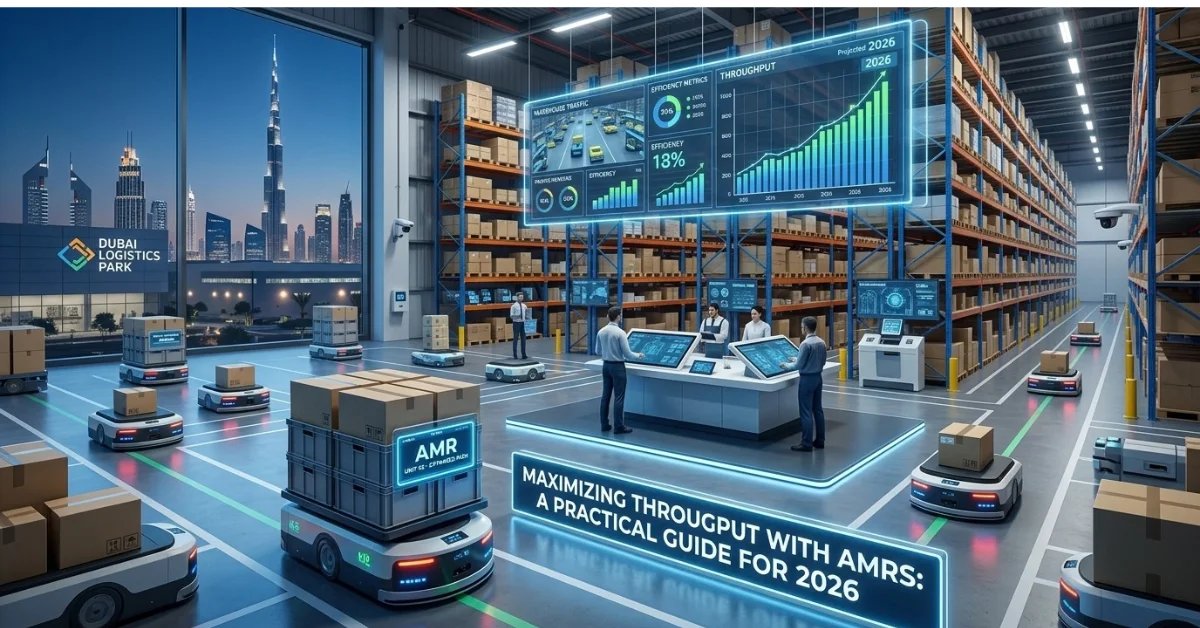
What if the fastest AMR in your fleet isn’t the one moving the most material? When production and warehouse demand shifts, robots can spend valuable time waiting, queuing, or travelling empty. That’s why maximizing throughput with AMRs depends on more than rated speed. Missions, handoffs, charging, traffic, and system integration all affect how efficiently materials move.
It’s natural to look at speed first, but a reliable baseline shows whether throughput is actually improving. This guide explains how to identify process constraints, measure completed missions and timely deliveries, and tune workflows for real operating conditions. It also covers fleet coordination and relevant integration needs, including where PLC and SCADA systems or ASRS may support material movement. Use these steps to build an evidence-based plan for improving AMR performance and scaling automation across your UAE operation without relying on speed alone.
Key Takeaways
- Define throughput by completed, correctly delivered material movements, not robot speed alone.
- Trace each material request from origin to destination to uncover where queues, handoffs, or delays restrict flow.
- Compare workflow changes such as task batching, route redesign, and fleet resizing against the constraint each is meant to address.
- For maximizing throughput with AMRs, establish a baseline and track a clear outcome before changing routes, missions, or fleet settings.
- Scale from workflows validated under representative demand, while checking whether charging, traffic, handoffs, and system integration can support added capacity.
What maximizing throughput with AMRs actually means
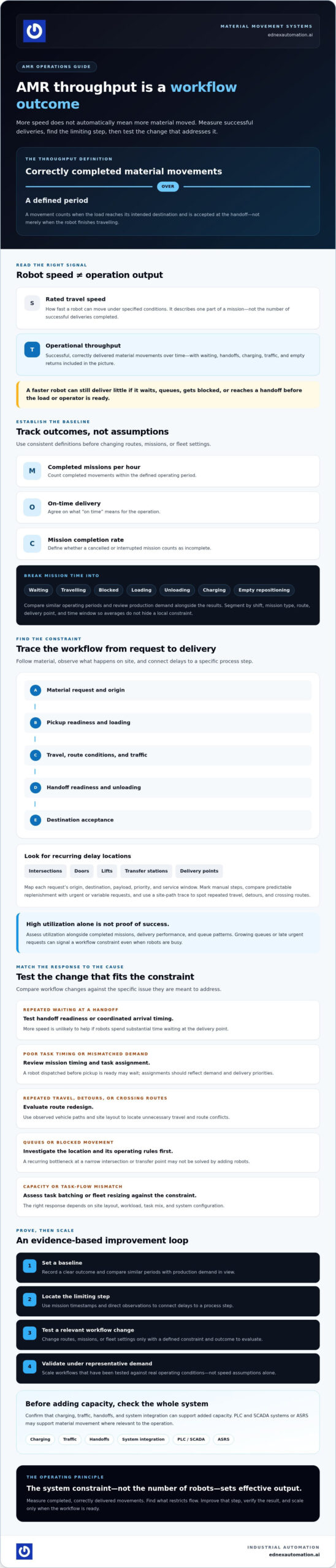
Throughput is the number of material movements an operation completes correctly within a defined period. In an AMR workflow, a movement is complete when the load reaches its intended destination and is accepted at the handoff, not merely when the robot finishes travelling. AMR throughput measures successful, correctly delivered movements over time; maximum travel speed measures how fast a robot can move under specified conditions.
An Autonomous Mobile Robot (AMR) can transport materials through a facility, but its output depends on the entire workflow. A robot may travel quickly and still deliver little if it waits for a task, queues at an intersection, gets blocked, or reaches a handoff point before anyone is ready. Charging, loading, unloading, and empty return trips also affect the number of useful movements completed.
Which throughput measures should an AMR operation track?
Start with completed missions per hour, then pair that measure with on-time delivery and mission completion rates. Define each metric consistently. For example, agree on what counts as “on time” and whether a cancelled or interrupted mission counts as incomplete. Establish a baseline before changing workflows, then segment results by shift, mission type, route, delivery point, and time window. This helps prevent averages from hiding a local constraint.
Break mission time into waiting, travelling, blocked, loading, unloading, and charging. This shows which time is spent moving and which contributes directly to delivery. Record production demand alongside these measures and compare similar operating periods. A quiet period and a peak-demand period may produce different results even when the layout and fleet remain unchanged.
Why faster AMRs don’t automatically increase output
Higher travel speed can shorten one leg of a route, but it won’t necessarily increase completed deliveries. If several robots arrive at a narrow intersection or handoff point at once, the queue may grow there instead. Poor task timing can have a similar effect: a robot dispatched before a pickup is ready may wait, while an empty return trip uses capacity without moving material.
If a baseline shows that robots spend substantial time waiting at one delivery point, increasing their speed is unlikely to address the constraint. Coordinating arrival times or improving handoff readiness may be a more relevant test. The right response depends on the site layout, workload, task mix, and system configuration. For maximizing throughput with AMRs, use operating measures to locate the limiting step before judging performance by a robot specification alone.
How to find the workflow constraints limiting AMR throughput
Use a repeatable diagnosis before changing fleet size or settings: map demand, observe routes, measure delays, identify the constraint, then test one change. This sequence helps distinguish a capacity problem from a workflow problem and gives each proposed improvement a clear operational purpose.
How to map AMR missions and material demand
Start with a process map for each material request, tracing it from origin through pickup, travel, handoff, and destination. Record pickup and delivery points, payload requirements, priorities, and service windows. Separate predictable, scheduled replenishment from urgent or variable requests. Then compare demand patterns with mission timing, fleet availability, and delivery priorities. This can reveal whether AMRs are dispatched too early, competing for the same route, or assigned work that doesn’t reflect actual demand.
Mark manual steps on the map as well. A load that isn’t ready, a transfer station awaiting an operator, or a destination that hasn’t been cleared can keep a robot occupied even after it reaches the right place. A spaghetti diagram, created by tracing vehicle paths across a site layout, can reveal repeated travel, detours, and crossing routes that are difficult to spot in a mission list alone.
How to interpret waiting, congestion, and utilization data
Classify mission time into productive travel, waiting, blocked time, and unproductive repositioning. Compare these categories across shifts and demand levels. If delays repeatedly cluster at an intersection, door, lift, or transfer station, investigate that location and its operating rules before assuming the fleet needs more robots. Review timestamps alongside direct observations so each delayed mission can be tied to a specific process step.
High utilization isn’t automatically a sign of success. A fleet that’s nearly always busy may still deliver late if queues are growing or urgent requests displace planned work. Assess utilization alongside completed missions, delivery performance, and queue patterns. The system constraint, not the number of robots, sets effective output.
Once the likely constraint is clear, test a focused change, such as adjusting mission timing or preparing a handoff differently. Keep other conditions as stable as possible and compare the result with the baseline for the same type of work and demand period. This helps show whether the change relieved the constraint or simply moved it elsewhere.
Because material flow depends on both robot tasks and connected automation, teams planning maximizing throughput with AMRs can also assess how AMRs fit with relevant systems such as PLC and SCADA integration or ASRS. AMR workflow integration capabilities may be useful to review when defining those requirements.
Which AMR throughput improvements deliver the strongest operational fit?
Choose an intervention based on the constraint identified in your baseline, not on the assumption that more robots or faster routes will solve every delay. Task sequencing and handoff changes can be tested within an existing workflow. Route redesign may require mapping or configuration updates, while traffic controls, fleet changes, and wider automation integration may involve software, hardware, or facility infrastructure. The table compares common options by their likely fit and the evidence to check.
| Intervention | Best-fit constraint | Operational risk | Validation measure |
|---|---|---|---|
| Task batching | Frequent small missions or avoidable empty returns | Urgent requests may wait behind grouped work | Completed deliveries, empty travel, and priority response times |
| Route redesign | Repeated detours or recurring congestion on a route | Delays may shift to another shared route or crossing | Travel time, queue duration, and on-time delivery by route |
| Traffic rules | Queues around intersections, doors, or transfer areas | Access or safety requirements may be affected | Blocked time, queue length, and route exceptions |
| Handoff changes | Robots waiting for loads, operators, or clear destinations | A faster transfer may move waiting to the next process step | Handoff time and mission completion rate |
| Fleet resizing | Sustained transport demand exceeds available fleet capacity | Added robots may increase congestion without relieving the constraint | Unserved demand, delivery performance, and queue patterns |
When to change routes, traffic rules, or task sequencing
Prioritize route changes when observation shows recurring detours or congestion taking up a significant share of mission time. Consider resequencing or batching when priority conflicts and frequent empty returns reduce useful capacity, while keeping a clear path for urgent work. Test traffic changes against site safety, access needs, and downstream processes. A local improvement is useful only if it doesn’t create a new bottleneck elsewhere.
When to adjust the fleet or integrate wider automation
Consider additional or different AMRs only after records show sustained unmet transport demand, rather than temporary peaks or delays caused by handoffs. If production signals need to trigger or coordinate transport tasks, assess whether PLC or SCADA integration fits the workflow. For foundational AMR concepts, see the autonomous mobile robots guide.
For maximizing throughput with AMRs, validate one intervention against a defined baseline before combining changes. Track the intended measure alongside exceptions, service delays, and any new queue locations. This makes trade-offs visible and helps determine whether the improvement belongs in the workflow, fleet configuration, or wider automation design.
How to test AMR changes and prove throughput improvement
A change is an improvement only if it increases useful output under comparable operating conditions without creating unacceptable safety or service issues. Before adjusting a route, mission rule, or fleet setting, set a baseline and choose one primary outcome, such as completed deliveries per shift or on-time mission rate. Define the measurement period and how exceptions will be recorded so the comparison remains meaningful.
How to run a controlled AMR throughput pilot
Document the workflow, mission rules, baseline period, and target measure before the pilot begins. Where practical, test one meaningful variable at a time, such as changing task sequencing on one route while keeping other settings stable. Set guardrails in advance for safe operation, delivery reliability, and service quality. Record blocked routes, interrupted missions, late handoffs, and other exceptions alongside the primary result.
Choose a bounded workflow that reflects representative demand, not an unusually quiet period. Compare similar shifts or demand periods, and note differences in staffing, product mix, production demand, and downtime. If a production signal triggers or prioritizes transport, include its behavior in the test. The PLC and SCADA integration guide provides more context for considering how production systems and material movement may interact.
How to decide whether a change is ready to scale
Look for repeatable results across representative operating periods rather than relying on a single favorable shift. Check the full workflow for delays that have moved elsewhere. A faster route may increase waiting at a handoff, charging point, storage area, or production interface. Keep the change only if the intended measure improves without weakening delivery reliability or creating new service or safety exceptions.
Before wider rollout, record what changed, who owns the workflow, which measures will be monitored, and how often they’ll be reviewed. Define rollback conditions, such as a recurring queue or a decline in the agreed service measures. This gives the team a controlled way to respond if operating conditions shift after deployment.
For teams focused on maximizing throughput with AMRs, evidence from a bounded pilot turns an operational hypothesis into a decision the wider site can evaluate. AMR integration requirements can be discussed with EdNex Automation when assessing AMR and related automation needs for your operation.
How to scale AMR throughput without scaling congestion
Scale from workflows that have performed reliably under representative demand. Before adding capacity, confirm that transport demand remains unmet over sustained operating periods and identify where constraints persist. More robots can add capacity, but without suitable routes, charging provision, traffic controls, and ready handoff points, they may add queues instead.
What an AMR operation should verify before adding capacity
Review fleet performance against demand, then check the physical and operational conditions a larger fleet would encounter. Confirm route access, charging arrangements, transfer-point capacity, and interfaces with production or warehouse systems. Verify that the proposed AMR capabilities and safety requirements suit the actual tasks and site conditions. Assess compatibility for the specific configuration rather than assuming it from a general specification.
Check interfaces at both ends of each mission. If storage equipment shapes pickup or delivery flow, review how those transfers would work with the wider system. The ASRS planning guide can help frame questions about storage interfaces and material movement.
How to plan the next improvement cycle with an integration partner
Bring a process map, baseline measures, representative mission examples, and known integration requirements to a planning discussion. Ask the partner to make assumptions explicit: which workflows are in scope, what responsibilities sit with each party, how changes will be validated, and who will monitor exceptions after implementation. Clear ownership for mission rules, issue handling, performance reviews, and process changes helps maintain control as operations evolve.
EdNex Automation supplies and integrates AMRs and industrial automation systems for commercial and industrial clients across the UAE. Depending on the workflow, its PLC and SCADA integration or ASRS capabilities may also be relevant to planning connected material movement. Check any proposed interfaces, fleet compatibility, and safety requirements against the site’s actual systems and operating conditions. Validate outcomes rather than assuming a throughput result.
To prepare the next improvement cycle, consolidate your site requirements and use AMR throughput planning with EdNex Automation as a starting point for evaluating AMR and wider automation integration needs. For maximizing throughput with AMRs, treat every expansion as a new operating hypothesis: scale what has been validated, assign clear ownership, then monitor whether performance holds without shifting delays elsewhere.
Build a Throughput Plan That Scales
Maximizing throughput with AMRs starts with measuring completed material movements, then finding the workflow constraint that limits them. Map where demand meets delays, choose an intervention that fits the cause, and test it against a clear baseline. Scale only after results hold under representative operating conditions and added capacity won’t shift queues to charging points, handoffs, or production interfaces.
For operations in the UAE, AMR performance is a material-flow and integration challenge, not simply a fleet-size decision. EdNex Automation supplies and integrates autonomous mobile robots, with PLC and SCADA integration and ASRS capabilities that may be relevant when connected systems or storage interfaces shape the workflow. Outcomes depend on site requirements and should be validated against operational data.
Discuss your AMR throughput requirements with EdNex Automation and explore an evidence-based path to improving material movement. With a clear baseline and a measured plan, your next automation decision can be practical and ready for what comes next.
Frequently Asked Questions
What is AMR throughput?
AMR throughput is the amount of material movement completed correctly within a defined period, such as missions per shift. A useful measure also checks whether each load reached the correct destination on time. Before comparing results, define the mission type, operating period, and workload. Raw mission counts alone can mislead if one period includes longer routes, heavier payloads, or more complex tasks than another.
How can I increase throughput with AMRs?
Start by measuring completed missions, delivery reliability, waiting, blocked time, charging, and empty travel. Map each request from pickup to delivery, then identify where delays accumulate. Test a targeted change, such as adjusting task sequencing or redesigning a route, and compare equivalent operating periods. Check whether the change creates queues elsewhere before scaling it. Maximizing throughput with AMRs means improving the complete workflow, not automatically adding robots.
Do faster AMRs always improve throughput?
No. Higher travel speed can improve output if travel time is the limiting factor, but it won’t resolve queues, poor task timing, slow handoffs, or unavailable charging. Faster movement may even shift congestion to shared routes or transfer points. Evaluate the complete mission cycle, including pickup, travel, handoff, and return, alongside site layout, workload, system configuration, and operating safety requirements before treating speed as the main improvement lever.
How do I know if my AMR fleet is the bottleneck?
Compare transport demand with mission completion and fleet availability across representative operating periods. Then examine how time is divided between productive travel, waiting, queues, charging, and repositioning. If robots remain consistently occupied while requests wait, fleet capacity may be constrained. However, scheduling, route, or handoff changes could still address the cause. Confirm that unmet demand persists after reviewing those workflow factors before concluding that the fleet itself is the bottleneck.
Should I add more AMRs to increase throughput?
Add AMRs only after confirming that transport demand consistently exceeds the capacity available for the required tasks. First assess congestion, task priorities, empty returns, charging, and handoff delays. Additional robots may help if fleet capacity is the demonstrated constraint and the site can support the added traffic and charging needs. Validate the decision with a bounded pilot, comparing relevant performance measures and safety conditions before expanding the fleet.
Can AMRs integrate with PLC, SCADA, or warehouse systems?
AMRs may be integrated with production or warehouse systems so transport tasks can respond to operational events, but the required interfaces depend on the equipment and control architecture. Define which system creates each task, what status information must return, and how exceptions are handled. EdNex Automation offers PLC and SCADA integration and ASRS capabilities. Verify system compatibility, cybersecurity considerations, and safety requirements with the responsible integrator before assuming an implementation approach or performance result.