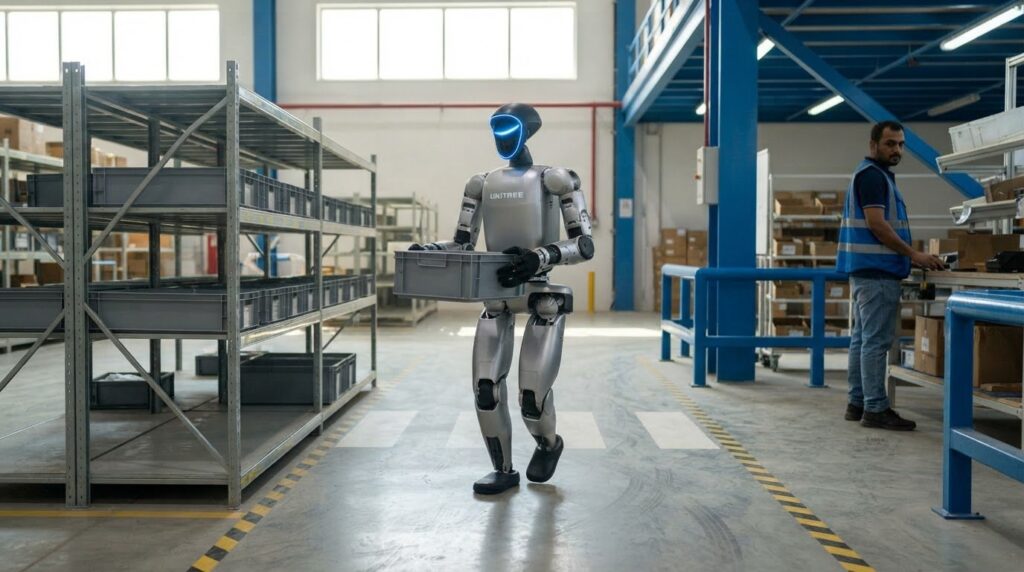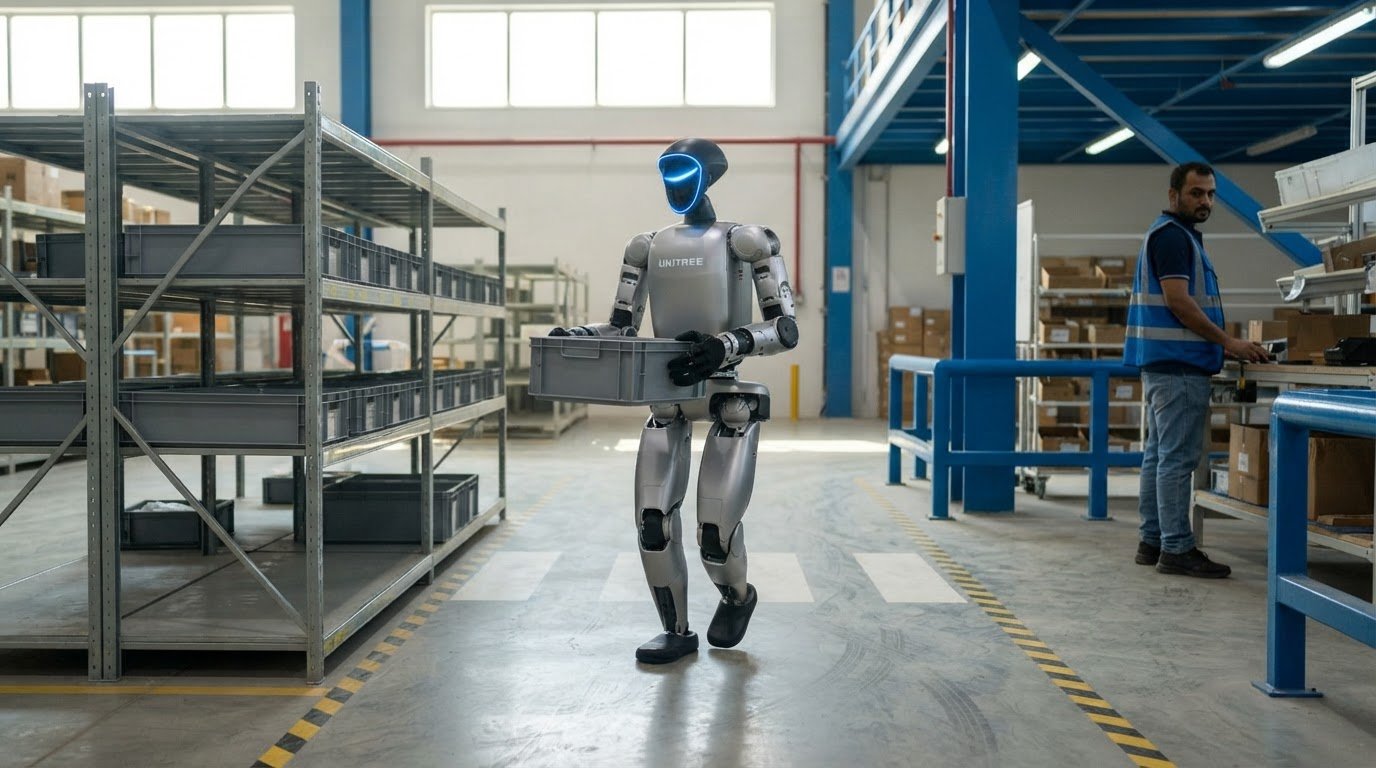
A two-hour runtime makes task design central to any business use of the Unitree G1 Humanoid Robot. It stands about 127 cm tall and measures 45 cm wide by 20 cm long, while its EDU model can use NVIDIA Jetson Orin computing modules delivering up to 100 to 157 TOPS of AI processing.
For UAE businesses, evaluating a humanoid robot means looking beyond its capabilities to practical fit: the tasks it can support, its operating time and the space it needs. This article explains potential business applications and outlines the G1’s battery, dimensions and optional computing hardware, alongside launch and pricing considerations for UAE procurement. It provides a grounded starting point for assessing whether the platform aligns with a business’s operational goals.
Key Takeaways
- Plan tasks and charging around the robot’s approximate two-hour battery runtime.
- Use its compact footprint and weight to assess workspace access and handling needs.
- Understand how optional EDU computing hardware can support more demanding AI workloads.
- Put launch and pricing details in context when evaluating a business purchase in the UAE.
Battery capacity and runtime
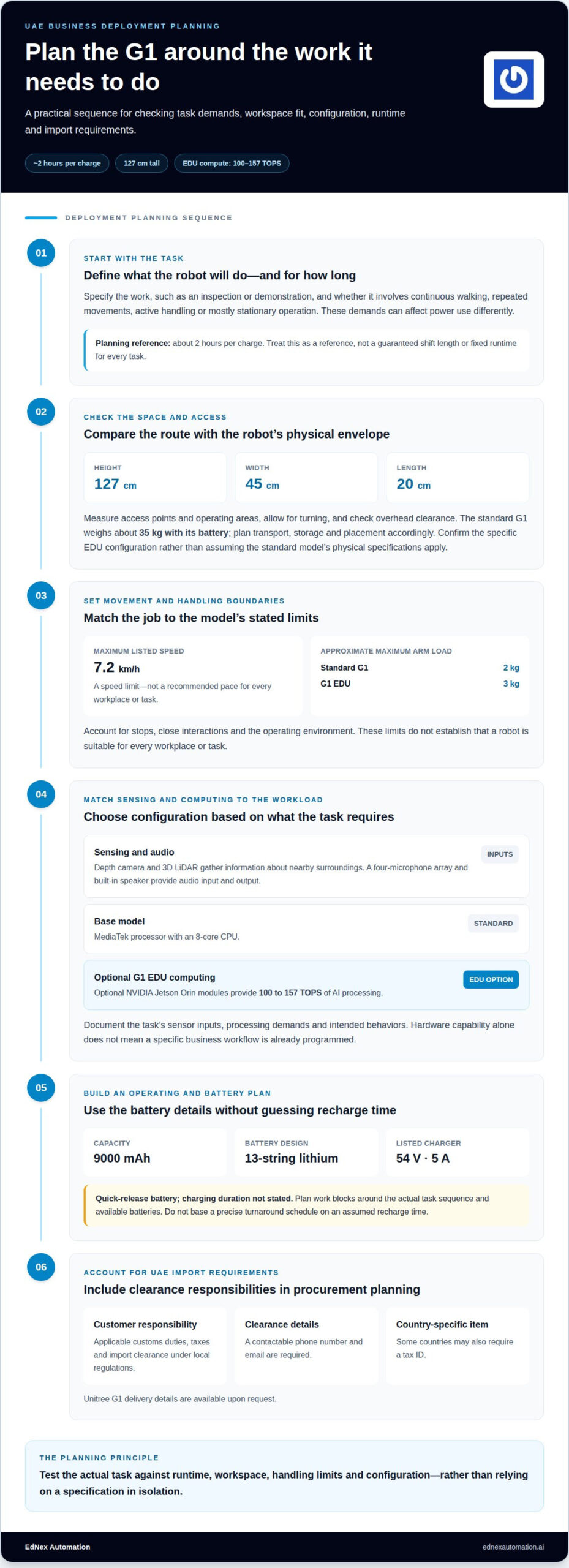
The Unitree G1 runs for about 2 hours per charge. Its quick-release battery has a capacity of 9000 mAh. The battery is a 13-string lithium design. For UAE businesses, this runtime makes task duration and charging access central to deployment planning.
Runtime changes with the work assigned. Continuous walking, repeated movements, and active handling can draw power differently from a stationary demonstration. Treat 2 hours as a planning reference, not a guaranteed shift length. For example, schedule a defined inspection or demonstration task, then include time for battery replacement or recharging.
The quick-release design supports battery changes between work periods. The listed charger is rated at 54 V and 5 A. The charging duration is not given here, so avoid building a precise turnaround schedule around an assumed recharge time. Instead, plan operating blocks around available batteries and the actual task sequence.
The listed maximum speed is 7.2 km/h. That figure describes a speed limit, not a recommended pace for every business environment. A route with frequent stops or close interaction needs a different task plan than a demonstration across open floor space. Match movement demands to the operating area and the job’s duration.
Unitree introduced its H1 humanoid robot in 2023. The G1’s approximate 2-hour runtime offers one concrete comparison point, but speed or endurance rankings against the H1 and other humanoid robots require comparable specifications.
For UAE imports, the customer is responsible for applicable customs duties, taxes, and import clearance under local regulations. Unitree G1 delivery details are available upon request. A contactable phone number and email are required for customs clearance; some countries may also require a tax ID.
Operational limits matter for safe task design. The standard G1 has an approximately 2 kg maximum arm load, while the EDU version reaches approximately 3 kg. Keep planned handling within the applicable model’s limit, and account for the 7.2 km/h maximum speed when defining movement tasks. These figures don’t establish suitability for every workplace or task.
G1 and G1 EDU dimensions and weight
The G1’s measurements help assess space, access, and handling requirements. Use its height, footprint, and battery-inclusive weight as practical planning inputs.
Height and Dimensions
The Unitree G1 stands approximately 127 cm tall, with a 45 cm width and 20 cm length. These dimensions describe the robot’s basic external envelope. They help teams assess whether it can fit through access points, move within designated areas, and occupy a suitable position for a task.
Measure the intended route and operating area against the robot’s dimensions. A narrow passage, for example, may restrict movement even if the listed width seems manageable. Allow space for turning and check overhead clearance against the robot’s full height. The EDU is a specific configuration, so don’t assume every configuration has the same physical dimensions.
Weight Specifications
The G1 weighs about 35 kg with its battery. That figure matters when planning transport, storage, and placement between work areas. It also gives operations teams a concrete reference for handling procedures and for assessing whether a route includes surfaces or transitions that affect movement.
For the G1 EDU, evaluate the weight of the specific configuration rather than treating the standard G1 figure as a confirmed EDU specification. Battery inclusion matters: the stated 35 kg includes the battery, so it represents the robot in that configuration, not a battery-free body. Record the chosen model and battery setup in deployment plans.
In UAE facilities, map the robot’s route from delivery point to work zone before assigning tasks. Compare the 127 cm height and 45 cm by 20 cm footprint with the intended space, then account for the approximately 35 kg battery-inclusive weight in handling plans. These checks help teams identify access and placement constraints before operational testing.
Optional computing hardware
The Unitree G1 Humanoid Robot combines sensing hardware with onboard computing. Its depth camera and 3D LiDAR gather information about nearby surroundings. These inputs can support spatially aware tasks, such as identifying obstacles or positioning the robot. The intended application and software setup determine how those inputs are used.
The G1 also includes a four-microphone array and built-in speaker. These components provide audio input and output alongside visual and spatial sensing. In a business demonstration, teams can assess how different sensor inputs relate to the task. A camera-led interaction, for example, may place different demands on the system than a workflow relying on LiDAR data.
Computing hardware varies by configuration. The base model uses a MediaTek processor and an 8-core CPU. The G1 EDU can be configured with optional NVIDIA Jetson Orin compute modules, providing 100 to 157 TOPS of AI processing. This distinction helps businesses evaluate computing capacity against the planned workload.
Sensors gather data, while computing hardware processes it. For an application that uses both depth-camera and LiDAR inputs, assess the required perception tasks alongside the processing configuration. A simpler demonstration using established behaviors may need a different setup. The Unitree G1 Humanoid Robot should therefore be evaluated against the actual task, not computing capacity alone.
The platform is described as using imitation and reinforcement learning, force-position hybrid control, and force-controlled dexterous hands. These capabilities relate to movement and manipulation, but they don’t mean a particular business workflow is already programmed. Define the behavior you need when assessing whether the software is suitable.
For UAE deployment planning, document the task’s sensor inputs, processing demands, and intended robot behaviors. Then assess whether the base computing configuration or optional EDU hardware better aligns with those requirements. This makes the Unitree G1 Humanoid Robot configuration discussion more concrete for business teams.
The optional single hand on the Unitree G1 EDU can have up to 7 degrees of freedom, a configuration detail to weigh when assessing manipulation needs.
G1 launch date and price
Unitree introduced its H1 humanoid robot in 2023. A 2024 pricing reference concerns the second iteration of Unitree’s humanoid robot. These dates provide context for the company’s humanoid-robot timeline, but they don’t establish a specific G1 launch date. For purchasing decisions, distinguish product milestones from a model’s current availability and configuration.
The 2024 reference is historical, not a current UAE business quote. A UAE buyer should assess the selected G1 configuration, optional hardware, and delivery arrangements before budgeting. The EDU’s optional NVIDIA Jetson Orin modules, for example, add a computing choice that affects the configuration being evaluated.
For procurement in the UAE, the price depends on the selected configuration, optional computing hardware, and delivery arrangements. Request a quote for the intended setup, since a base configuration and an EDU configuration with optional computing are different purchasing specifications.
Separate the robot’s purchase price from the total procurement budget. Shipping, applicable duties and taxes, and import clearance can affect the landed cost in the UAE. The customer is responsible for applicable duties, taxes, and clearance under local regulations. Include these costs in your calculation rather than treating a historical product reference as the full cost.
- Record whether the requirement is for the G1 or G1 EDU.
- List optional computing hardware needed for the planned workload.
- Include delivery and applicable import costs in the UAE budget.
These steps make price comparisons more meaningful: align the model and hardware first, then assess delivery and import costs. For a business evaluating humanoid robotics in the UAE, discuss a humanoid-robot project around its intended tasks and configuration.
This amount is useful only as context for that iteration; it does not identify a G1 launch date or establish the price of a G1 or G1 EDU configuration. A buyer comparing that reference with a current UAE quote should keep the model and configuration distinct, and should use the quote for the intended setup when assessing the purchase budget.
EdNex Automation: Humanoid robots
EdNex Automation offers humanoid robots for businesses assessing how advanced robotics could support operational tasks. After reviewing the G1’s runtime, dimensions, and computing options, define the work the robot needs to perform and the environment where it will operate. This helps frame whether a humanoid platform suits the requirement.
Another type of automation may suit some workflows better. EdNex Automation also offers collaborative robots (cobots), autonomous mobile robots (AMRs), and cleaning robots for different operational needs. Start by defining the task to identify the right direction for your UAE business.
Contact EdNex Automation to discuss your robotics requirements.
Turn a Robotics Evaluation Into a Clear Next Step
Choosing a humanoid platform is only one part of an automation strategy. Assess how the Unitree G1 Humanoid Robot would fit a defined business task, the environment where it must operate, and the outcomes your team needs. A focused evaluation helps separate tasks suited to humanoid robotics from workflows better served by another automation approach.
EdNex Automation also offers collaborative robots (cobots), autonomous mobile robots (AMRs), and cleaning robots. Each option serves different operational needs, so start with the task your business wants to address, not the technology alone. Outline the workflow, operating conditions, and intended result to guide a practical discussion about robotics in the UAE.
Ready to explore the next step? Contact EdNex Automation to discuss your business requirements and move forward with clarity.
Frequently Asked Questions
What battery life, speed, payload, and operating range does the G1 have?
The G1 runs for about 2 hours, reaches a listed maximum speed of 7.2 km/h, and has an approximately 2 kg maximum arm load. The G1 EDU’s maximum arm load is approximately 3 kg. Operating range depends on the assigned route and movement pattern, so plan around the task and available runtime rather than treating speed as a distance estimate.
How does the Unitree G1 compare with the Unitree H1 and other humanoid robots?
The G1’s approximate two-hour runtime is one comparison point, while Unitree introduced the H1 in 2023. Comparing endurance or speed rankings with the H1 and other humanoid robots requires comparable specifications.
Is the Unitree G1 available to buy in the UAE, and what is its local price?
UAE buyers can request delivery details and a quote for their chosen configuration. The price depends on the model, optional computing hardware, and delivery arrangements. The customer is responsible for applicable duties, taxes, and import clearance.
What AI, programming, and development tools does the Unitree G1 support?
The base G1 uses a MediaTek processor and an 8-core CPU; the EDU can use optional NVIDIA Jetson Orin modules providing 100 to 157 TOPS of AI processing. The platform is described as using imitation and reinforcement learning, but no specific programming or development tools are identified.
How can you order, set up, and operate a Unitree G1?
Request a quote for the G1 or EDU configuration, list any optional computing hardware, and request delivery details. For customs clearance, provide a contactable phone number and email; some countries may also require a tax ID. Plan tasks around the approximate two-hour runtime, workspace dimensions, and the model’s arm-load limit.