A lift can extend a restaurant robot’s route beyond one floor, but only if the lift, doors and access controls support the planned journey. PUDU BellaBot uses obstacle detection to navigate around people and objects in restaurant spaces, helping it move through changing service areas.
A delivery robot needs to do more than travel between tables: it has to fit the service flow and complete each handoff. This article explains how lift compatibility affects multi-floor operation, how obstacle detection supports navigation, and what to consider when planning routes in a UAE hospitality setting. It also covers how loading, delivery and return fit into a complete service cycle, so you can assess where automation may help and which site conditions matter.
Key Takeaways
- Plan multi-floor service around lift, door and access-control compatibility, then assess the full journey from loading through handoff and return.
- Learn how obstacle detection supports navigation in active restaurant spaces and why route conditions matter to day-to-day operation.
- Compare the robot’s dimensions, payload capacity, speed and battery life with the space, workload and service cycle it needs to handle.
- Identify which restaurant and hospitality settings are suited to delivery automation by considering route repetition, handoff points and operating flow.
Multi-floor route and lift compatibility
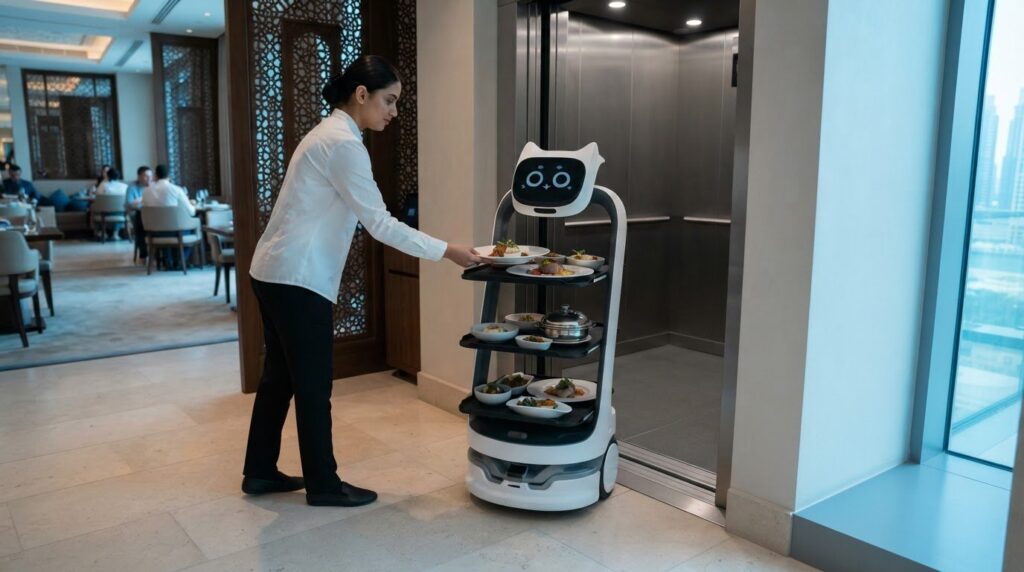
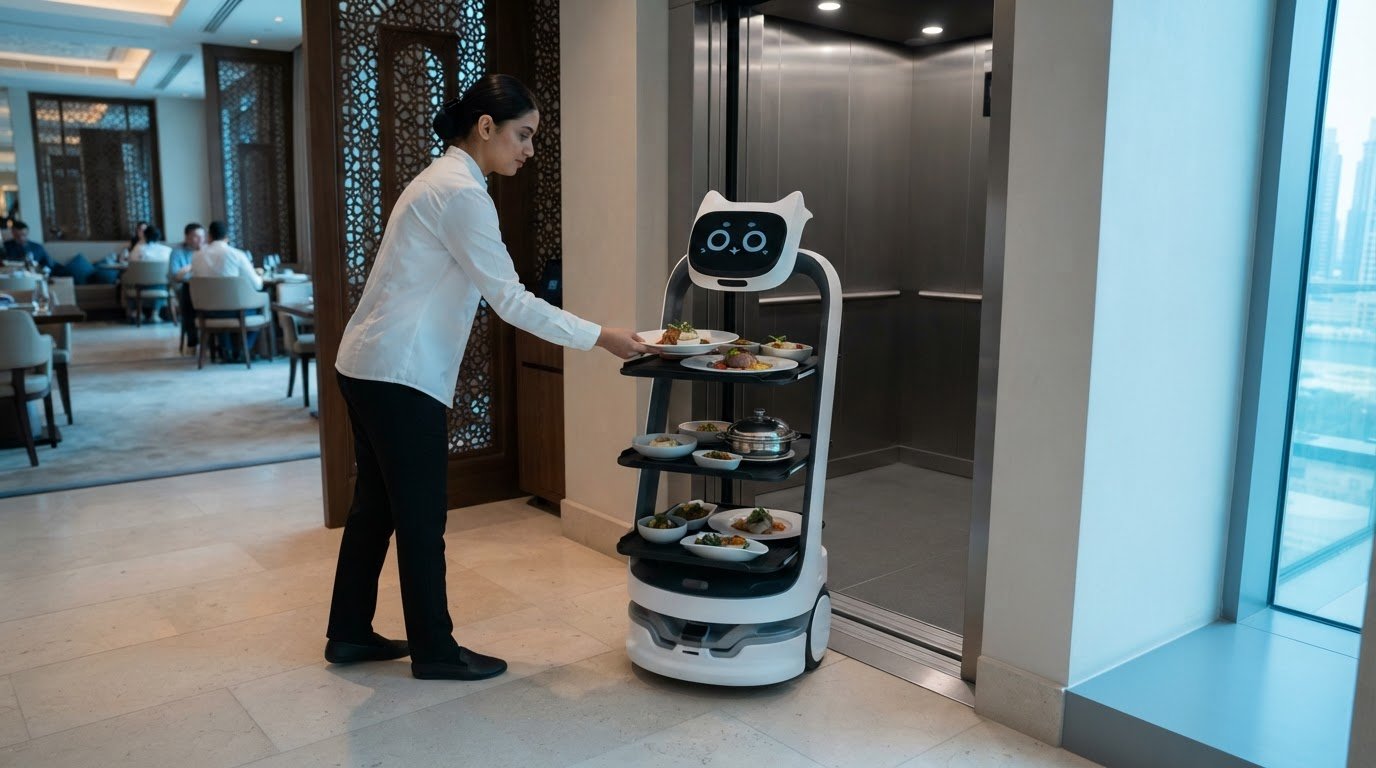
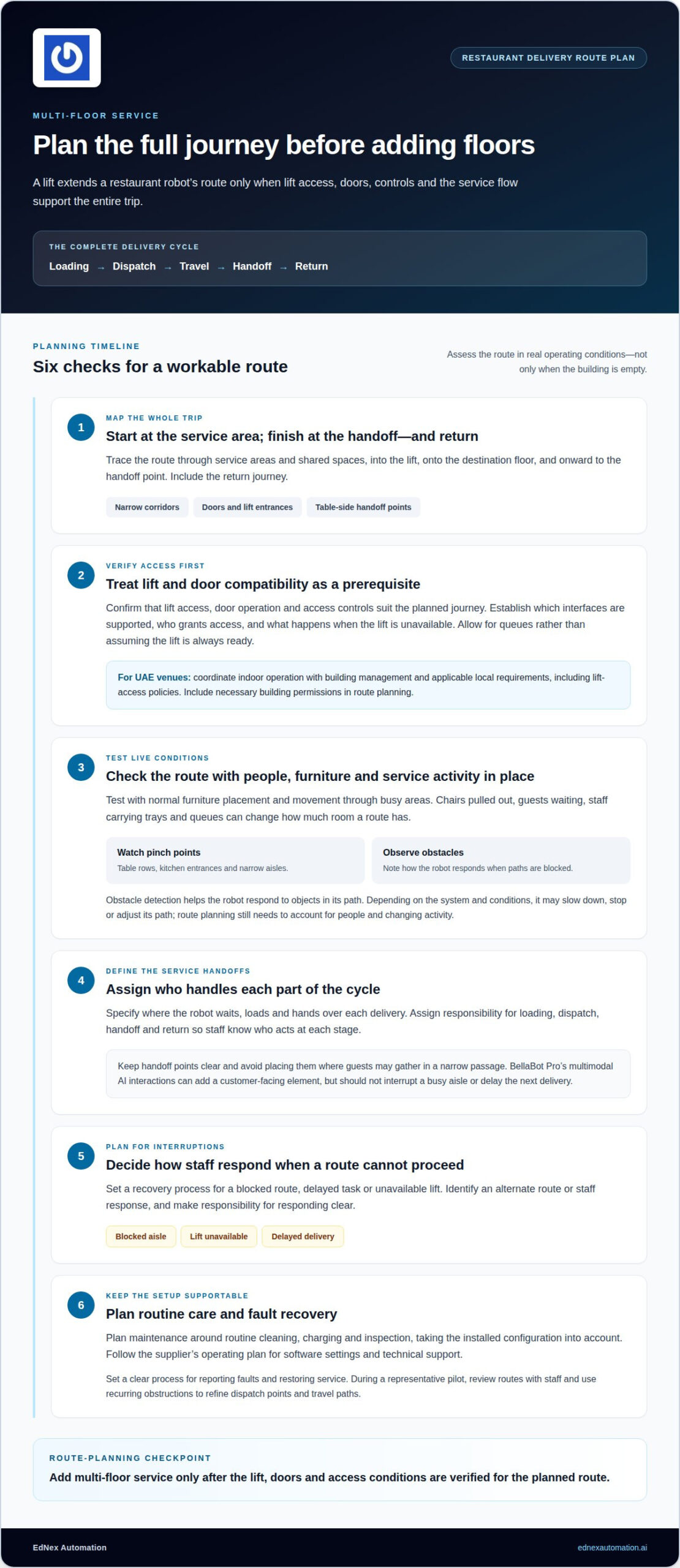
A multi-floor route involves more than reaching a lift. PUDU BellaBot must travel between service areas, enter the lift, reach the destination floor and continue to the handoff point. Every transition adds a site condition that can affect the full delivery cycle.
Before adding floors to a service route, map the journey through the restaurant and any shared spaces. Note narrow corridors, doors, lift entrances and table-side handoff points. Then test the route with furniture, people and access controls in place. An empty building may not reflect real service conditions.
- Confirm that lift access and door operation suit the planned route.
- Define where the robot waits, loads and hands over each delivery.
- Set a recovery process for a blocked route or delayed task.
Lift integration may require coordination between the robot, lift system and building access arrangements. Treat it as a defined integration task: establish which interfaces are supported, who grants access and what happens if the lift is unavailable. Allow for queues, too, rather than assuming the lift will always be ready.
For UAE venues, coordinate indoor robot operation with building management and applicable local requirements, including lift-access policies. Requirements depend on the site and its operating arrangements, so include the necessary building permissions in route planning.
Plan maintenance around routine cleaning, charging and inspection, as well as the installed configuration. Follow the supplier’s operating plan for software settings and technical support, and set a clear process for reporting faults and restoring service.
BellaBot Pro’s multimodal AI interactions add a customer-facing element to delivery. In a restaurant, they can make the robot’s presence more engaging, but the operating plan still needs to assign responsibility for loading, dispatch, handoff and return. Align guest interaction with the route so it doesn’t interrupt a busy aisle or delay the next delivery.
Before adding multi-floor service to the scope, confirm that the lift and doors are compatible with the planned route. Make this a prerequisite to route planning, rather than assuming access will work because the robot can travel between service areas on one floor. Verify the relevant access conditions before including the route.
Obstacle detection and navigation safety
Restaurant routes change as guests move chairs, staff carry trays and queues form. Obstacle detection helps a delivery robot respond to objects in its path, rather than treating a mapped route as permanently clear. It supports navigation, but route planning must still account for people and service activity.
PUDU SLAM navigation means simultaneous localization and mapping. A mobile robot uses this approach to build a map while estimating its position in the environment. In a restaurant, the map helps define routes between a dispatch point, dining areas and delivery locations. Furniture or layout changes can affect how those routes work in practice.
Pay particular attention to narrow restaurant aisles. A route between closely spaced tables may be clear during setup, then become constrained by pulled-out chairs or guests waiting to be seated. Test routes under typical service conditions, with normal furniture placement and movement through busy areas.
- Map pinch points, such as table rows and kitchen entrances.
- Identify where staff cross the robot’s route with trays.
- Observe how the robot responds when an aisle is temporarily blocked.
- Plan an alternate route or staff response for delayed deliveries.
Obstacle detection and route planning work together. Depending on its system and the conditions, a robot may slow down, stop or adjust its path when an obstacle appears. Keep handoff points clear and avoid placing them where guests would gather in a narrow passage. Assign responsibility for responding if a route becomes unusable.
During a representative pilot, review routes with staff and note recurring obstructions, including service carts or waiting guests. Use those observations to refine dispatch points and travel paths. For a site-specific assessment, consider robot navigation planning as part of an automation design discussion.
For restaurant delivery, assess loading and handoff as carefully as navigation. This connects the route plan to the points where each task begins and ends.
A complete restaurant delivery cycle covers loading, dispatch, travel, handoff and return. Assign responsibility at each stage and plan how to recover delayed tasks. Clear assignments help staff know who should act when a delivery is delayed or cannot proceed as planned. Reviewing the full sequence also helps teams account for obstacles before the robot leaves and after it arrives.
What are the BellaBot’s dimensions, payload capacity, speed, and battery life?
Dimensions, payload, speed and battery endurance all affect whether a delivery robot fits a restaurant’s service cycle. Use the technical specification for the exact BellaBot model being assessed. Avoid basing a route or workload on estimates: even a small difference in clearance or load can affect a delivery run.
To assess dimensions, compare the robot’s full footprint with the tightest points on its route. Measure doorways, turns, gaps between tables and approaches to lifts. A robot might fit through a corridor but struggle to turn beside a closely placed dining table. Account for guests and staff using the same space.
Payload capacity is the maximum load the robot can carry, not simply the number of dishes that fit on its trays. Weigh a typical delivery, including plates, bowls and drinks, and compare the total with the applicable model specification. Keep the load within the stated limit and distribute it securely across the available shelves.
Speed affects journey time, but the highest stated figure doesn’t determine service performance on its own. A route through a busy dining room includes turns, pauses and handoffs. Assess travel alongside loading and waiting, then consider how the robot’s operating pace fits the restaurant’s service flow.
Battery life affects how a shift is scheduled. Compare the specified operating endurance with the expected route pattern, including repeated trips, stops and charging intervals. A short delivery loop and a continuous multi-area service cycle place different demands on battery use. Build the schedule around actual operating conditions, not a headline runtime treated as a guaranteed shift length.
For a practical assessment, record four inputs: route clearances, typical delivery weight, journey pattern and planned charging windows. Compare each with the specifications for the exact BellaBot model. This gives restaurant operators a grounded basis for evaluating fit, capacity and service planning without relying on assumptions.
What types of restaurants and businesses are best suited to BellaBot?
Suitability depends on the delivery workflow, not the venue’s label. In the UAE, a restaurant with repeatable trips from a kitchen or service point to defined handoff areas may be a good candidate for automation. The route needs to be practical, the delivery task clear and staff responsibilities defined.
Hotel dining operations can assess service between a food preparation area and designated guest or staff handoff points. A multi-floor venue has additional dependencies, including lift access and coordination with building operations. A one-floor restaurant may have a simpler route, but crowded aisles and changing table layouts still affect daily performance.
Consider how these operating patterns fit:
- A food court stall can assess recurring orders moving from a preparation counter to a clear collection point.
- A hotel restaurant can map deliveries between kitchen areas and designated dining zones.
- A large dining venue can evaluate repeated trips where staff handoffs are consistent.
- A café can examine whether the route remains clear during customer queues and peak service.
Workflows with irregular destinations, frequent manual carrying or handoffs that change from task to task may be less suitable. For example, a venue where staff must constantly redirect each delivery may gain less from a fixed route. This doesn’t rule out automation; it shows why the task needs to be defined before assessing fit.
Measure operating value through a representative pilot and a baseline of current service. Include loading, servicing, staff interventions and recurring operating costs in the assessment. Time freed for other duties isn’t automatically a payroll saving, and there is no single payback period for every UAE site.
Start by documenting the delivery cycle: who loads, dispatches, receives and handles delayed tasks. Then assess whether the intended routes and handoffs suit the venue’s real operating pattern. Discuss restaurant delivery automation when evaluating how a robot could fit into that workflow.
EdNex Automation
EdNex Automation helps businesses across the UAE assess how robotics can fit their workflows, including restaurant delivery routes and indoor service tasks. Its portfolio includes delivery robots and autonomous mobile robots (AMRs), as well as collaborative robots and cleaning robots. For a hospitality team evaluating BellaBot, the next step is to match the intended delivery cycle with site conditions, handoff points and staff responsibilities.
This assessment can clarify where mobile automation fits within a broader operational setup and whether the planned tasks suit a delivery-robot workflow. It also gives decision-makers a practical basis for discussing routes, access and service requirements before defining an automation project.
Contact EdNex Automation to discuss your restaurant or hospitality automation requirements.
Design the next step in hospitality automation
Restaurant automation works best as part of a coordinated operating model, not as a standalone machine. Treat a PUDU BellaBot deployment as a way to connect delivery tasks with staff workflows, guest experience and the wider site environment. This systems-level view can help UAE hospitality teams plan automation that remains relevant as their operations evolve.
EdNex Automation’s broader capabilities include Collaborative Robots (Cobots), Autonomous Mobile Robots (AMRs) and cleaning robots. These solutions can support different operational needs across commercial environments, while a clear project scope keeps each automation task aligned with its intended role.
Bring your hospitality automation requirements into a focused discussion and identify a practical direction for your site. Contact EdNex Automation to discuss your next step. A carefully designed automation plan can create a stronger foundation for service innovation.