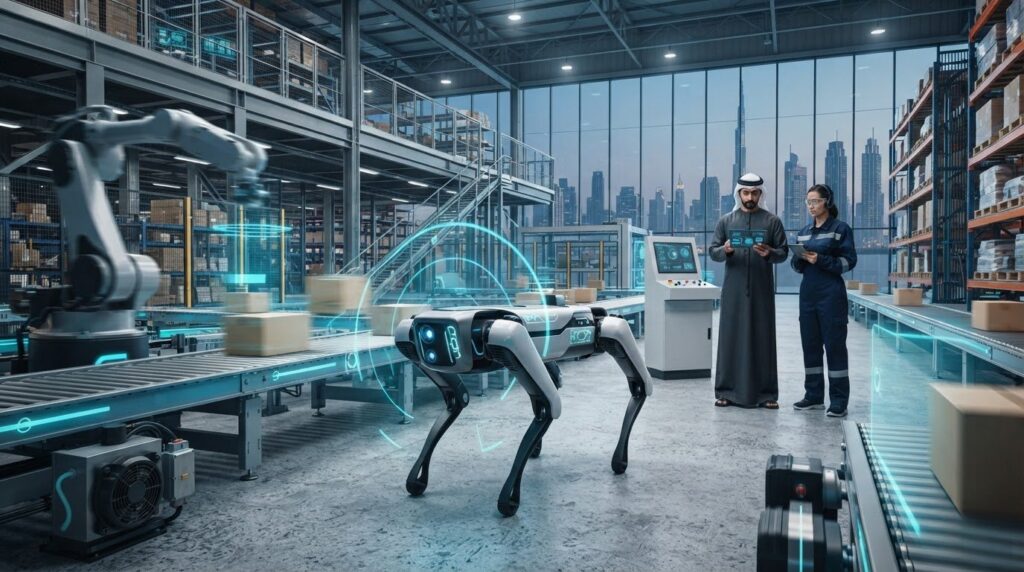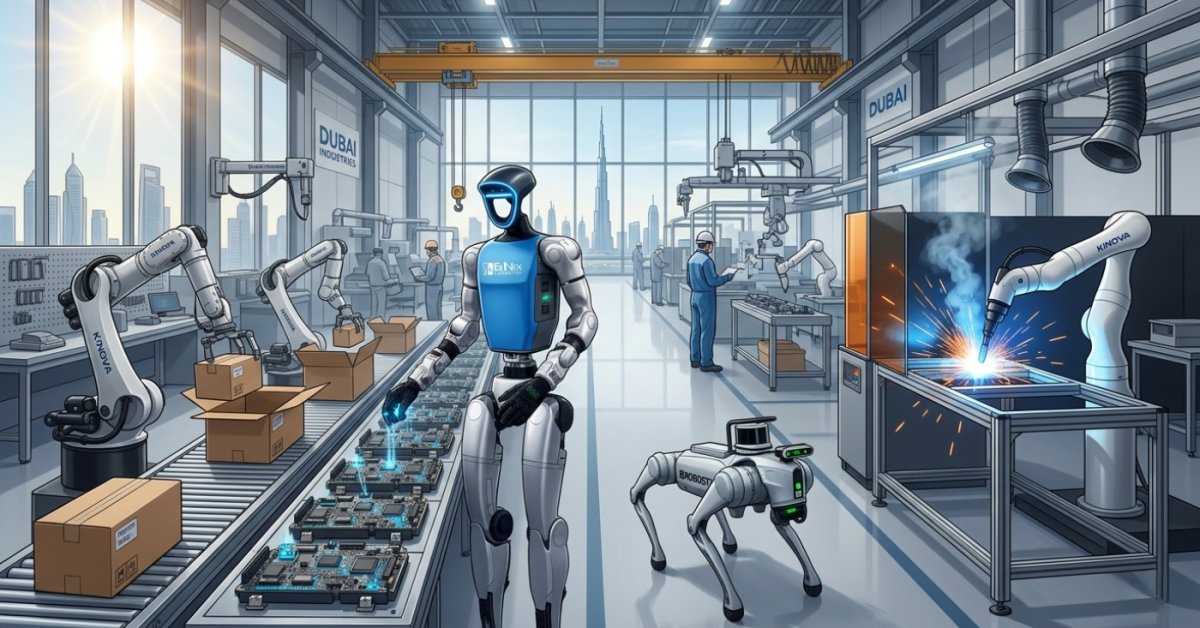
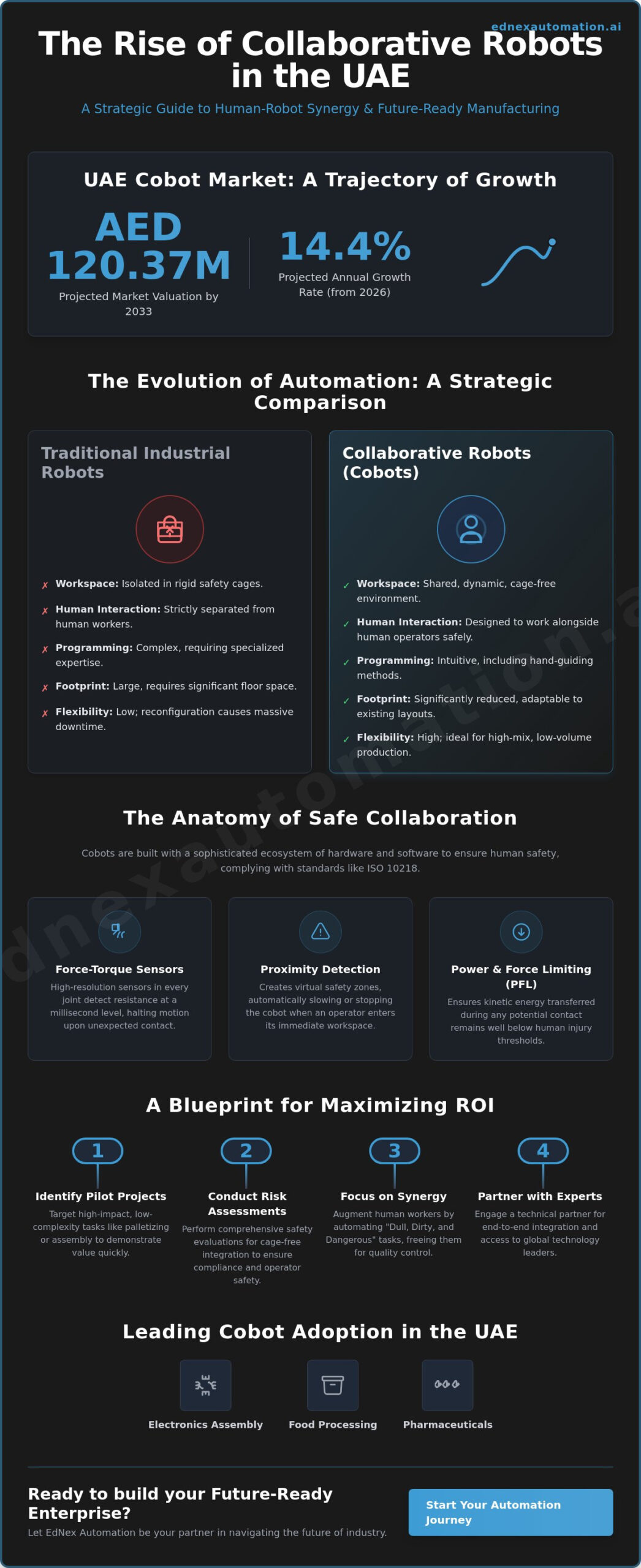
Did you know that the market for collaborative robots UAE is projected to reach a valuation of AED 120.37 million by 2033, fueled by a 14.4% annual growth rate starting in 2026? You likely recognize that rising labor costs and regional skill gaps are no longer just minor hurdles; they’re significant barriers to your operational efficiency. It’s natural to feel concerned about the technical complexity of integrating high-tech autonomy with your legacy infrastructure or meeting the strict national safety requirements for advanced industrial solutions.
At EdNex Automation, we’ll demonstrate how to navigate these complexities by shifting your focus toward the collaborative application model to ensure seamless human-robot synergy. This guide provides a strategic roadmap for evolving from manual processes to a future-ready enterprise through precise automation and international safety standards like ISO 10218. You’ll learn to identify a reliable technical partner capable of delivering end-to-end robotics expertise tailored to the unique demands of the UAE industrial sector.
Key Takeaways
- Learn how the transition from guarded industrial cells to collaborative workspaces is redefining human-centric manufacturing across the GCC industrial landscape.
- Understand the technical requirements for deploying collaborative robots UAE safely, focusing on force-torque sensors and proximity detection to ensure compliance with regional safety standards.
- Discover a structured blueprint for maximizing ROI by identifying high-impact pilot projects and conducting comprehensive risk assessments for cage-free integration.
- Evaluate the strategic advantages of cobots over traditional automation, including intuitive hand-guiding programming and a significantly reduced physical footprint.
- Gain insights into establishing a future-ready enterprise through end-to-end robotics integration and authorized partnerships with global technology leaders.
Defining Collaborative Robots in the UAE Industrial Landscape
The industrial landscape in the United Arab Emirates is undergoing a radical shift as we progress through 2026. Traditional manufacturing once relied on heavy industrial robots confined behind rigid safety cages. Today, the emergence of collaborative robots UAE has dismantled those barriers, replacing "guarded automation" with dynamic, shared workspaces. These AI-powered systems represent a fundamental departure from legacy robotics. While traditional machines operate in isolation, cobots are designed to function alongside human operators, utilizing advanced sensors to ensure safety and responsiveness. Shaping the future of regional manufacturing, these systems provide the intellectual framework for autonomous growth. For those seeking a foundational understanding, exploring What is a collaborative robot (cobot)? reveals how these systems have evolved from niche research projects into the primary interface of Industry 4.0.
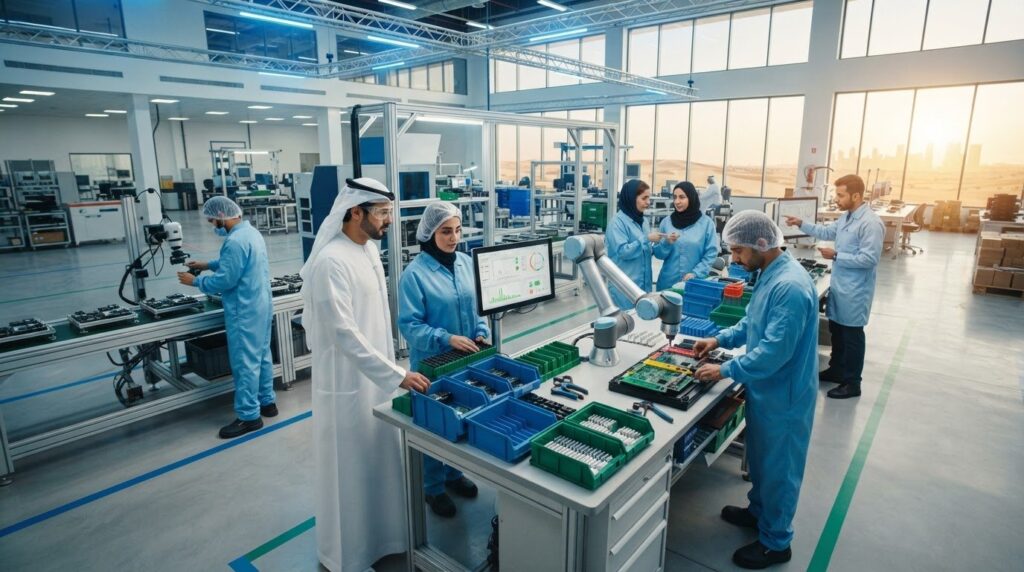
In the UAE, adoption is accelerating across sectors that demand high precision and hygiene. Electronics assembly, food processing, and pharmaceuticals are leading this transition. These industries require the flexibility that only collaborative systems provide, allowing facilities to pivot production lines quickly without the massive downtime associated with reconfiguring traditional caged cells. Delivering excellence through transformative automation, these robots serve as the cornerstone of the UAE’s Industry 4.0 evolution, where data-driven insights and physical labor converge.
The Core Philosophy: Human-Robot Collaboration
Modern automation isn’t about replacing the human element; it’s about augmenting it. We see cobots taking over the "Dull, Dirty, and Dangerous" tasks that often lead to workplace injuries or fatigue. By offloading repetitive palletizing or intricate assembly to a robotic arm, human workers can focus on quality control and process optimization. This is particularly vital in high-mix, low-volume production environments where adaptability is the only way to remain competitive. Cobots enhance workplace ergonomics, ensuring that your workforce remains healthy and productive while the machine handles the physical strain. It’s a partnership that maximizes the strengths of both biological and mechanical assets.
Cobots and the UAE National Industrial Strategy
The push for domestic production is a central pillar of the UAE’s economic vision. As of May 2026, the integration of collaborative robots UAE has reached a tipping point for regional manufacturing efficiency. By aligning with national goals for advanced automation, enterprises are reducing their reliance on external labor markets and volatile supply chains. The strategy emphasizes building a "Future-Ready Enterprise" that can compete globally through superior technological integration. This isn’t a distant prospect; it’s a current reality for businesses aiming to meet the rigorous standards of the local market while optimizing their operational costs in AED. As the UAE’s national robotics ambitions scale toward deploying 200,000 robots by 2032, enterprises exploring the full spectrum of robotic solutions should also evaluate humanoid robots for sale UAE enterprises can deploy today alongside collaborative systems. Our role as a technological architect is to bridge the gap between these global breakthroughs and local industrial needs.

The Technical Anatomy: How Cobots Enable Safe Interaction
Developing a safe collaborative environment requires more than just a slow-moving robotic arm; it involves a sophisticated ecosystem of hardware and software designed for instantaneous response. Next-gen collaborative robots UAE utilize high-resolution force-torque sensors integrated into every joint, allowing the system to detect resistance at a millisecond level. These sensor arrays work in tandem with proximity detection systems that create virtual safety zones around the machine. When an operator enters a predefined workspace, the robot automatically transitions into a reduced-speed mode or halts entirely, preventing physical contact before it occurs. This level of responsiveness is what differentiates a modern cobot from a traditional industrial machine.
End-of-Arm Tooling (EOAT) has also evolved into a modular platform for versatility. Whether your facility requires vacuum grippers for delicate pharmaceutical packaging or specialized vision sensors for electronics inspection, the interface remains intuitive. Power and force limiting (PFL) serves as the primary safety mechanism here, ensuring that even in the event of a technical glitch, the kinetic energy transferred during contact remains well below human injury thresholds. When planning your next phase of modernization, consulting with an expert in robotics integration ensures your technical foundation is sound and scalable.
Safety Protocols and ISO Standards
Compliance with international safety standards is the bedrock of any successful deployment in the UAE. Adhering to ISO 10218 and the specific guidance of ISO/TS 15066 ensures that your collaborative application meets global benchmarks for human-robot proximity. Collision detection systems are no longer secondary features; they’re core operational requirements. Every deployment must begin with a comprehensive risk assessment that evaluates the entire application, including the workpiece and the environment. This methodical approach to safety is what allows cage-free operations to thrive within the strict regulatory frameworks of the region.
Intelligent Vision and AI Integration
The integration of 3D vision and AI-powered adaptive learning is transforming how robots perceive their surroundings. Khalifa University’s research in autonomous robotic systems highlights how these technologies enable robots to perform complex pick-and-place tasks and real-time quality inspections with minimal human intervention. Adaptive motion control is a real-time algorithmic framework that enables robotic joints to modify their trajectory and velocity instantaneously based on unexpected environmental feedback. These systems don’t just follow a script; they learn from variations in the production line, optimizing their movements to increase throughput while maintaining a safe distance from human colleagues.
True Industry 4.0 maturity involves linking these collaborative units to your existing PLC and SCADA infrastructures. By creating a unified communication layer, data from the cobot’s sensors can be used to trigger actions in Automated Storage and Retrieval Systems (ASRS) or update centralized inventory logs in real-time. This connectivity ensures that your robotic assets aren’t isolated tools but are fully integrated components of a "Future-Ready Enterprise."
Strategic Comparison: Cobots vs. Traditional Industrial Automation
Choosing between traditional industrial robots and collaborative robots UAE requires a deep analysis of your facility’s spatial and operational constraints. Traditional 6-axis machines are the high-speed heavyweights of automation, excelling in high-volume environments like automotive assembly where heavy payloads are the norm. However, these systems demand significant floor space due to mandatory safety perimeter fencing and rigid mounting requirements. In contrast, the cage-free advantage of collaborative robots UAE allows for a compact footprint that integrates directly into existing manual production lines. This flexibility is a game-changer for manufacturers operating in high-density industrial zones where every square meter of floor space carries a premium in AED, often requiring strategic property management from firms like Chainex Real Estate to maximize site efficiency.
Programming complexity marks another major point of divergence. Traditional automation often requires specialized engineers to write complex code for every minor process adjustment. Collaborative systems utilize intuitive hand-guiding interfaces, allowing technicians to "teach" the robot new paths by simply moving the arm through the desired sequence. While traditional robots are still necessary for tasks requiring extreme velocity or payloads exceeding 25kg, the ability to redeploy a cobot across different plant sections within hours provides a level of agility that fixed automation cannot match. For a detailed breakdown of how these two automation paradigms compare across payload, integration complexity, and total cost of ownership, the cobot vs industrial robot strategic comparison for UAE manufacturers provides the architectural framework needed to make this high-stakes decision. Delivering excellence in a modern facility means knowing when to deploy the raw power of a 6-axis giant and when to utilize the surgical precision of a collaborative partner.
Total Cost of Ownership (TCO) Analysis
A true TCO analysis looks far beyond the initial purchase price. Traditional automation carries significant "hidden" costs, including the installation of safety cages, light curtains, and the ongoing salary of specialized programming staff. Cobots typically have a lower entry barrier because they don’t require expensive safety infrastructure. Long-term maintenance is also streamlined; the modular nature of collaborative systems means downtime is minimized. The redeployment value of a cobot is its strongest financial asset. As your production needs shift, you can move the asset to a new line rather than decommissioning an entire fixed cell, ensuring the investment remains productive for its entire lifecycle.
Decision Framework: Which System Fits Your Facility?
Identifying the "sweet spot" for collaborative automation involves evaluating your production volume against task complexity. If your facility handles high-mix, low-volume production, cobots offer the best ROI due to their rapid changeover capabilities. Space-constrained facilities in the UAE often find that collaborative systems are the only viable path to automation without expanding the physical building. Use this framework to guide your transition: prioritize traditional robots for repetitive, high-speed bulk work, and reserve collaborative applications for tasks that require human proximity, frequent adjustments, or intricate sensor-based feedback. For facilities ready to extend beyond cobots into bipedal automation, reviewing the available humanoid robots for sale in the UAE can help identify complementary solutions for logistics and service environments. This strategic balance is what defines a truly future-ready enterprise.
Maximizing ROI: A Blueprint for Cobot Implementation
Transitioning to a high-tech facility requires a methodical strategy that prioritizes immediate value while building toward long-term autonomy. Implementing collaborative robots UAE shouldn’t be a chaotic overhaul; it’s a structured evolution. The first step involves identifying high-impact pilot projects, such as end-of-line palletizing or precision pick-and-place, where the return on investment is most visible. Once a pilot is selected, conducting a rigorous safety and risk assessment is non-negotiable to ensure compliance with regional standards like DIFC Regulation 10. Integrating these units into your existing PLC and SCADA frameworks allows for real-time data monitoring, turning each robotic joint into a data point for operational intelligence.
Success also depends on the human element. Workforce training and fostering a culture of robotic adoption are essential to prevent friction during the transition. As your team becomes proficient with the initial cell, you can begin scaling toward a fully autonomous production line. This modular approach minimizes risk and allows for capital expenditure to be spread across multiple phases, ensuring each step is validated by measurable performance gains. Shaping the future of your facility requires this level of disciplined planning.
Calculating the Real ROI of Collaborative Systems
True profitability is measured by more than just replacing a manual station. We look at throughput increases, significant error reduction, and the optimization of labor costs by shifting staff to high-value supervisory roles. Minimizing unplanned downtime through predictive maintenance and robotic reliability directly preserves UAE manufacturing margins by preventing costly production halts in high-output facilities. By analyzing these metrics in AED, enterprises can see a clear path to recouping their investment within 12 to 18 months, depending on the application’s complexity. To build a rigorous financial defense for your automation investment, using a cobot ROI calculator provides the structured framework needed to quantify total cost of ownership and secure board-level approval with precise data.
The Role of System Integrators
While marketing often suggests "plug-and-play" simplicity, the reality of industrial automation demands expert integration to achieve peak performance. A professional system integrator ensures that your collaborative robots UAE communicate flawlessly with other assets, such as Automated Storage and Retrieval Systems (ASRS) or delivery robots. This technical synergy is what creates a cohesive ecosystem rather than a collection of isolated machines. To begin your transformation with a partner who understands the gravity of industrial excellence, consult with our automation architects to design your implementation roadmap. We provide the intellectual framework and authorized support necessary to keep your systems optimized and future-ready.
EdNex Automation: Your Partner for End-to-End Robotics Integration
EdNex Automation functions as a Technological Architect for the UAE’s industrial sector, providing the intellectual framework required to navigate the complexities of Industry 4.0. We don’t just sell machines; we design the systems that allow them to thrive. As an authorized partner with global leaders in robotics, we ensure that every deployment of collaborative robots UAE adheres to the strictest international safety and performance standards. This status acts as a stamp of legitimacy, guaranteeing that our clients receive best-in-class technology backed by regional expertise. We act as a bridge-builder, connecting global technological breakthroughs with the unique industrial demands of the GCC.
Our brand persona is built on Expert Reliability, suggesting a methodical approach to controlled innovation. We operate as a systematizer, bringing order and efficiency to complex manufacturing environments through tailored integration infrastructures. By focusing on the transformative power of technology, we help businesses solve high-level industrial challenges while optimizing their operational costs in AED. Our goal is to ensure that your transition to automation is seamless, safe, and results-oriented.
Our End-to-End Robotics Expertise
Delivering excellence in automation requires a holistic view of the production floor. We provide customized solution design based on your facility’s specific constraints, ensuring that every robotic joint and sensor array is positioned for maximum throughput. Our expertise extends to the technical integration of PLC and SCADA systems, which creates a unified control architecture for your entire enterprise. This connectivity is vital when linking collaborative robots UAE to other critical assets like Automated Storage and Retrieval Systems (ASRS) or autonomous mobile robots. We handle everything from the initial conceptual design to ongoing maintenance and firmware optimization, ensuring 24/7 reliability for your high-output production lines.
Building a Future-Ready Enterprise
The move toward a Future-Ready Enterprise is not a luxury but a necessary evolution for businesses aiming to remain competitive in 2026 and beyond. EdNex Automation is committed to safety, efficiency, and the kind of transformative automation that turns legacy factories into smart facilities. We understand the gravity of industrial transformation and provide the steady, hierarchical guidance needed to manage it. Our solutions are designed to scale, allowing you to start with a single collaborative cell and expand into a fully autonomous ecosystem. To take the first step in your modernization journey, consult with our robotics experts to optimize your facility and secure your place at the cutting edge of the regional market.
Architecting Your Industrial Future with Collaborative Automation
The widespread adoption of collaborative robots UAE is no longer a speculative trend; it’s a core requirement for any enterprise seeking to optimize margins and address regional labor shortages in 2026. By transitioning from restrictive guarded cells to dynamic, shared workspaces, your facility gains the agility needed to handle high-mix production while maintaining strict compliance with DIFC Regulation 10. Success in this new era requires more than just hardware. It demands a unified control architecture where robotic joints communicate seamlessly with PLC, SCADA, and ASRS systems to create a truly data-driven ecosystem.
As a Technological Architect and authorized partner of global robotics leaders, EdNex Automation provides the intellectual framework necessary to bridge the gap between breakthrough technology and local industrial needs. Our specialized expertise in GCC industrial transformation ensures that your automation roadmap is both scalable and results-oriented. Don’t let legacy constraints hinder your growth in an increasingly autonomous market. Design your future-ready facility with EdNex Automation’s end-to-end robotics expertise. The path to a smarter, more efficient production floor starts with a commitment to controlled innovation. Your evolution into a best-in-class enterprise is within reach.
Frequently Asked Questions
What are the primary benefits of using collaborative robots in UAE factories?
Collaborative robots UAE offer substantial improvements in throughput and precision while directly addressing the regional skill gap and rising labor costs. These systems allow facilities to automate repetitive tasks without the spatial constraints of traditional safety cages; this is particularly valuable in high-density industrial zones. By optimizing operational expenses in AED, manufacturers can pivot their workforce toward high-value supervisory roles, ensuring long-term resilience in a competitive market.
Are collaborative robots safe enough to work next to human employees without cages?
Cobots are engineered for cage-free interaction through sophisticated power and force limiting (PFL) mechanisms and high-resolution sensor arrays. Adhering to international safety standards like ISO 10218 and ISO/TS 15066 ensures that the system reacts instantaneously to human presence. Sensors integrated into every robotic joint detect resistance at a millisecond level, halting motion immediately to prevent injury and maintaining a secure, collaborative environment.
How long does it typically take to see a return on investment (ROI) for a cobot?
Most enterprises achieve a full return on investment within 12 to 18 months of initial deployment. This timeline is driven by measurable increases in production speed and a significant reduction in material waste or assembly errors. Because these systems don’t require expensive safety infrastructure or dedicated programming staff, the initial capital expenditure remains manageable for businesses looking to modernize their operations in the GCC.
Can collaborative robots be integrated with my existing PLC and SCADA systems?
Technical integration with existing PLC and SCADA infrastructures is a fundamental component of a future-ready deployment strategy. Linking collaborative robots UAE to a unified control layer allows for real-time data monitoring and predictive maintenance alerts. This synergy ensures that robotic assets function as integrated nodes within your broader Industry 4.0 ecosystem rather than operating as isolated tools on the factory floor.
What industries in the UAE are most suited for collaborative robot adoption?
Sectors requiring high precision and stringent hygiene, such as electronics assembly, food processing, and pharmaceuticals, are the primary adopters of this technology. These industries benefit from the high-mix, low-volume flexibility that collaborative systems provide. As of 2026, we see an increasing trend in logistics where cobots work alongside Automated Storage and Retrieval Systems (ASRS) to streamline order fulfillment and palletizing operations.
Do I need a specialized robotics engineer to program a collaborative robot?
Specialized engineering degrees aren’t required because modern collaborative systems utilize intuitive hand-guiding and block-based programming interfaces. Your existing shop-floor technicians can "teach" the robot new paths by physically moving the arm through the required motions. This ease of use reduces the costs of specialized staffing and allows for rapid redeployment across different plant sections as your production needs shift.
What is the maximum payload and reach typical for modern cobots in 2026?
Modern collaborative robots in 2026 typically handle payloads up to 25kg with a reach extending to 1,750mm. While these specifications cover the majority of assembly and palletizing tasks, the focus has shifted toward "collaborative applications." This means the safety and capability are determined by the entire system, including the end-of-arm tooling and the specific workpiece, rather than just the robotic arm’s raw power.
How does EdNex Automation support the implementation of collaborative robots?
EdNex Automation acts as a Technological Architect, providing end-to-end robotics expertise from conceptual design to ongoing technical support. As an authorized partner of global robotics leaders, we deliver best-in-class systems tailored to the specific regulatory and economic landscape of the UAE. We bridge the gap between breakthrough global technology and your facility’s practical need for safety, efficiency, and long-term scalability.