While the global collaborative robot market is projected to reach $2.75 billion in 2026, many industrial leaders remain paralyzed by the perceived gap between high-tech potential and fiscal reality. You understand that a successful automation strategy requires more than just deploying advanced machinery; it demands a rigorous financial defense that satisfies every stakeholder. Utilizing a sophisticated cobot ROI calculator allows your organization to bridge this gap, transforming capital anxiety into a structured roadmap for scalable growth.
Mastering these metrics ensures you can justify the investment by looking beyond simple labor savings to the broader impact on operational resilience. We’ll explore how to quantify the total cost of ownership, including often-overlooked maintenance and integration requirements, while securing board-level approval through precise data. This strategic framework provides a clear path toward the typical 12 to 18-month payback period, ensuring your transition to collaborative systems is both technologically superior and financially sound. By analyzing the 30% productivity boost seen in modern assembly lines, you can move from uncertainty to a definitive break-even timeline for your industrial transformation.
Key Takeaways
- Establish a visionary framework that positions collaborative robotics as a driver of operational scalability rather than a simple labor-saving metric.
- Deploy a professional cobot ROI calculator to navigate the complexities of total cost of ownership, ensuring every hardware and software variable is accurately accounted for.
- Quantify the indirect financial gains of modern automation, such as the optimization of factory floor space and the mitigation of risks inherent in manual production lines.
- Discover how the “flexibility premium” enables your facility to pivot rapidly between product lines, opening new revenue streams through high-margin, low-volume custom orders.
- Accelerate your industrial transformation by implementing bespoke integration strategies and technical training programs that ensure immediate operational efficiency and long-term viability.
The Strategic Framework of Cobot ROI in Modern Industry
In the current era of industrial digital transformation, return on investment (ROI) has evolved from a simple accounting metric into a blueprint for long-term survival. Traditional fixed automation often requires massive infrastructure changes and rigid production cycles, creating a financial profile characterized by high risk and low adaptability. Conversely, the collaborative robot (cobot) introduces a paradigm shift in fiscal planning. These systems prioritize flexibility and rapid deployment, allowing manufacturers to respond to market shifts with unprecedented agility. By employing a comprehensive cobot ROI calculator, decision-makers can visualize how these modular systems outperform legacy equipment through reduced integration complexity and lower secondary costs.
This strategic approach aligns directly with national productivity targets, such as the ambitious industrialization goals within the UAE’s Operation 300bn initiative. Transitioning from short-term cost recovery to long-term value creation requires a deep understanding of how automation secures a competitive edge. Rather than simply replacing manual tasks, these intelligent systems serve as the foundation for a data-driven enterprise that scales efficiently. It’s a move toward a future where technology and human expertise coexist to maximize throughput.
Automation as a Catalyst for Operational Resilience
As a core component of Industry 4.0, operational resilience is defined as the systemic capacity of an industrial organization to maintain consistent performance and absorb environmental disruptions through intelligent automation. Achieving this resilience involves reducing dependency on volatile labor markets where talent shortages can halt production. Collaborative systems provide a steady, high-precision output that remains unaffected by external economic pressures. This consistency ensures business continuity during shifts in regional industrial demand, allowing facilities to maintain throughput even when manual resources are scarce. It isn’t just about speed; it’s about reliability in an unpredictable market.
The Shift from CapEx to Strategic Asset Management
Modern financial officers are increasingly viewing robotics as modular assets rather than static capital expenditures. Because cobots can be redeployed across various tasks, from palletizing to quality inspection, their utility extends far beyond a single project lifecycle. The lower integration costs associated with these systems significantly accelerate the payback timeline, often delivering results within months rather than years. Successfully integrating collaborative robots UAE into your 5-year financial plan requires a shift toward strategic asset management. This methodology treats every robotic unit as a versatile tool capable of evolving alongside your production needs. Using a data-backed cobot ROI calculator ensures that your investment remains optimized as your industrial footprint expands.
Direct vs. Indirect ROI: Decoding the Variables
Analyzing the financial viability of automation requires a departure from simplistic wage-replacement models. While traditional manual production lines appear cost-effective on a balance sheet, they harbor significant hidden expenses in recruitment, onboarding, and repetitive training cycles. A robust cobot ROI calculator must account for the value of reclaimed floor space. Since collaborative units often operate without the massive safety cages required by fixed robotics, facilities can optimize their layout to increase revenue per square meter. This reclaimed real estate allows for additional production lines or expanded inventory storage, directly impacting the organization’s scalability without expanding the physical footprint.
Precision is a major driver of indirect ROI that many stakeholders overlook during initial assessments. Human fatigue inevitably leads to material waste and scrap; however, robotic units maintain sub-millimeter accuracy throughout every shift. This reduction in raw material loss and the elimination of rework cycles directly pads the bottom line. The ROI Calculation Methodology utilized by industry leaders emphasizes that these quality gains often outweigh direct labor savings over the system’s lifecycle. By minimizing errors, you’re not just saving money; you’re protecting your brand’s reputation for quality.
Hard Savings: Labor and Throughput
Calculating hourly rate parity is only the starting point for a serious investment analysis. Robotic units provide a 24/7 operational capacity that bypasses overtime premiums and shift-change downtime, ensuring that production targets are met regardless of labor availability. Based on verified 2025 industrial data, these systems can boost productivity by up to 30% in assembly applications. This consistency eliminates the unpredictable peaks and valleys of manual throughput, providing a predictable baseline for financial forecasting. When you factor in that most applications achieve a return on investment within 12 to 18 months, the argument for immediate deployment becomes undeniable.
Soft Savings: Safety, Quality, and Retention
Safety and retention are critical pillars for long-term business viability. By automating “dull, dirty, and dangerous” tasks, organizations significantly reduce insurance premiums and liability risks associated with repetitive strain injuries. Employees stay longer when they’re moved from grueling manual labor to higher-value roles as robot supervisors, which slashes the high costs of constant turnover. It’s a strategic move that fosters a more engaged and technically skilled workforce. If you’re ready to modernize your facility and secure these competitive advantages, exploring advanced robotic solutions is the logical next step in your industrial evolution.
The ROI Calculation Methodology: A 5-Step Guide
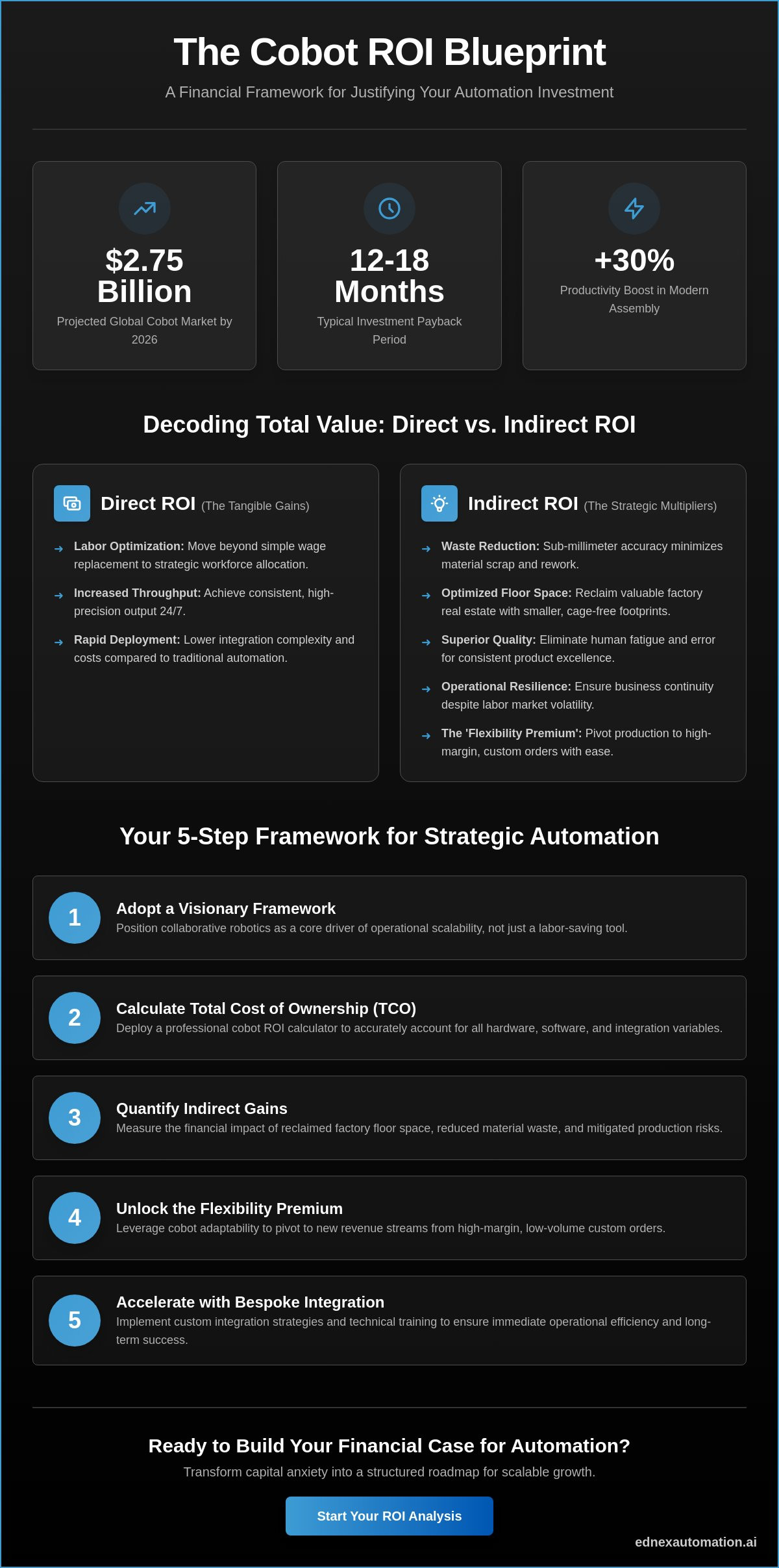
Developing a precise fiscal roadmap requires a systematic deconstruction of operational variables. While many organizations focus solely on the acquisition price, a comprehensive cobot ROI calculator incorporates the entirety of the system’s lifecycle. This methodology moves beyond surface-level estimation to provide a data-backed justification for board-level approval. By following a structured five-step process, you can determine the exact month of break-even while accounting for both immediate throughput increases and long-term waste reduction. Accurate financial modeling transforms a technological upgrade into a calculated business evolution.
Step 1: Auditing the Current Manual Baseline
Establishing an accurate financial baseline serves as the indispensable foundation upon which all subsequent ROI projections are built. This audit must encompass the total cost of manual labor, including fringe benefits, liability insurance, and the specific facility overhead allocated to the production line. Additionally, analyzing the average cost of rework and scrap in your current process reveals the hidden financial leakage that automation is designed to plug. Precise data at this stage prevents the common error of underestimating the true cost of human-centric production, ensuring your starting point reflects reality.
Step 2: Factoring in Total System Integration
Moving from baseline to implementation requires a rigorous assessment of the Total Cost of Ownership (TCO). Beyond the initial sticker price of the robotic arm, stakeholders must factor in the cost of end-of-arm tooling such as grippers, vision sensors, and bespoke programming tailored to the application. When evaluating cobot vs industrial robot deployments, it’s evident that collaborative systems offer significantly lower integration costs due to their intuitive interfaces and reduced safety infrastructure. However, you still need to account for internal training time and the initial production downtime during the commissioning phase to ensure a realistic payback timeline. Following a structured cobot implementation guide aligned with the latest ISO 10218:2025 safety standards ensures that your TCO assessment remains comprehensive and your deployment timeline stays on track.
Step 3: Projecting Multi-Year Financial Performance
Projecting multi-year financial performance involves calculating the Net Present Value (NPV) and the Internal Rate of Return (IRR) over a standard five-year lifecycle. This sophisticated analysis ensures the investment remains viable even as market conditions evolve. Incorporating annual maintenance costs, which typically range from $2,000 to $8,000 based on 2026 industrial benchmarks, is essential for maintaining operational integrity. Finally, by factoring in projected throughput gains and the reduction of material waste, you can determine the precise month of break-even. This completes the final stages of the cobot ROI calculator methodology, providing a clear vision of the long-term value created by your automation investment.
Beyond the Break-Even Point: Scaling for Future Growth
Achieving the initial break-even point is merely the first milestone in a long-term strategy of industrial modernization. Once the system has paid for itself, typically within 12 to 18 months, the focus shifts toward the “flexibility premium” that collaborative systems provide. By utilizing a cobot ROI calculator to simulate diverse production scenarios, manufacturers can model the financial impact of rapid product changeovers. This capability allows organizations to pivot toward smaller, high-margin custom orders that were previously cost-prohibitive. It’s about transforming a production line from a rigid cost center into an agile engine of revenue growth.
Future-proofing the facility against labor shortages and wage inflation is an essential component of this scaling phase. As regional economic conditions evolve, having a fleet of modular robotic assets ensures that your output remains consistent regardless of external workforce volatility. Every robotic unit serves as a node in the Industrial IoT (IIoT) ecosystem, generating valuable data as an asset. Analyzing these metrics through PLC and SCADA integration allows for predictive maintenance, which further reduces long-term maintenance costs that typically range from $2,000 to $8,000 annually according to 2026 industrial benchmarks. This data-driven approach ensures that your investment continues to yield dividends long after the initial capital recovery.
Agility as a Competitive Advantage
Maintaining a competitive edge in a global market requires a significant reduction in time-to-market for seasonal or high-demand items. Collaborative systems excel here, allowing organizations to launch new product lines with significantly higher speed than traditional fixed automation. The value of redeploying robots to different sections of the plant as needed ensures that your capital investment remains productive across various project lifecycles. This modularity allows for a systematic expansion of capabilities, ensuring the facility remains responsive to shifting consumer trends without requiring massive new capital expenditures. It’s a strategic framework that prioritizes long-term adaptability over static output.
The Role of Human-Robot Collaboration
Optimizing the long-term ROI of the human workforce involves elevating operators from repetitive manual tasks to strategic supervisory roles. This creates a synergistic environment where robots handle high-precision execution while humans manage logic and process optimization. Ensuring your workforce is technically prepared for the transition to Industry 4.0 is a critical investment in your organization’s viability. If you’re ready to scale your operations and implement a future-proof automation strategy, explore our range of collaborative robots to begin your transformation.
Maximizing Your Automation Investment with EdNex Automation
Integrating collaborative systems requires more than just hardware acquisition; it demands a partner who understands the technical nuances of deployment. EdNex Automation delivers bespoke integration services specifically engineered to minimize initial downtime while ensuring your new robotic assets are productive from the first shift. By providing start-to-finish expertise, from initial feasibility studies to comprehensive post-deployment support, we ensure your industrial transformation remains fiscally optimized. Our engineers align every robotic solution with regional industrial standards and certifications, guaranteeing that your facility meets the rigorous requirements of the modern global market. This comprehensive service model transforms a complex technological acquisition into a controlled and deliberate evolution of your production capabilities.
Rapid internal adoption is secured through our technical training programs, which empower your existing workforce to manage and optimize these advanced systems. EdNex Automation focuses on bridging the gap between global technological breakthroughs and regional industrial needs, ensuring your team is prepared for the intricacies of Industry 4.0. By prioritizing technical literacy alongside hardware deployment, we help you build a resilient operational framework that maintains high-level performance over the long term. This systematic approach ensures your investment delivers the transformative power necessary to solve your most complex industrial challenges.
Why a Strategic Partner is Essential for ROI
Navigating the transition to automated systems without expert guidance often leads to common pitfalls in robotic selection that can rapidly drain financial resources. Choosing a partner who understands the nuances of various payloads and reach capacities ensures you invest in the specific technology required for your application rather than over-specifying and inflating costs. Ensuring seamless PLC and SCADA integration is fundamental for achieving data-driven ROI, as it allows for real-time monitoring of robotic performance and throughput. By leveraging the status of EdNex Automation as a certified regional leader, your organization gains access to an intellectual framework that prioritizes long-term business viability over simple equipment acquisition. We don’t just sell tools; we architect the systems that define the future of your production environment.
Your Next Steps Toward Industrial Excellence
Initiating your journey toward a modernized, high-efficiency facility begins with a rigorous assessment of your current operational landscape. Requesting a comprehensive feasibility study allows our team to identify the specific processes where collaborative robotics will yield the highest return. Consulting with our engineers provides the opportunity to refine your cobot ROI calculator projections with technical accuracy, ensuring your board-level presentations are backed by verifiable data. This methodical approach to innovation brings order and efficiency to complex environments, positioning your brand at the cutting edge of the industrial sector. Contact EdNex Automation to begin your transformation today and secure your place in the evolving global economy through the power of intelligent, autonomous systems.
Securing Your Position in the Future of Industrial Automation
Transitioning to collaborative systems represents more than a technical upgrade; it’s a fundamental shift toward operational excellence. By utilizing a cobot ROI calculator, you’ve established the financial clarity required to move from theoretical potential to measurable industrial impact. This strategic framework has demonstrated that true value lies in the synergy between robotic precision and human ingenuity, allowing your facility to achieve the rapid payback periods discussed while scaling for future demand. You’re now equipped to justify the total cost of ownership and identify the indirect benefits that drive long-term profitability.
As Certified Industry 4.0 Integrators with a proven track record in UAE manufacturing, EdNex Automation provides the comprehensive regional technical support necessary for a seamless transition. We’re ready to help you validate your projections and secure your organization’s long-term viability through systematic, controlled innovation. Request a Professional Cobot ROI Assessment to begin your transformation today. The evolution of your production line is the essential step for any organization wishing to remain competitive in the future.
Frequently Asked Questions
How long does it typically take to see ROI on a collaborative robot?
Most industrial applications achieve a return on investment within 12 to 18 months after deployment. This timeline is significantly accelerated by the 30% productivity increase typically observed in assembly line tasks. By utilizing a cobot ROI calculator, you can visualize how rapid deployment minimizes the duration between initial capital expenditure and positive cash flow.
What are the hidden costs associated with cobot implementation?
Hidden costs often include end-of-arm tooling, vision sensors, and the technical hours required for bespoke programming. While the robot arm itself represents a significant portion of the initial price, integrating it into a complex PLC and SCADA environment requires a budget for specialized software and internal training. Accounting for these variables ensures your total cost of ownership remains transparent and realistic.
Can cobots really reduce my insurance premiums and safety costs?
Reducing insurance premiums is a direct outcome of improving ergonomic safety and mitigating liability for repetitive strain injuries. Since collaborative systems adhere to ISO 10218 and ISO/TS 15066 standards, they allow for a safer floor environment where humans and machines work in close proximity. This reduction in workplace accidents translates to lower long-term liability costs and more favorable terms from insurance providers.
How does cobot ROI compare to traditional industrial robots?
Collaborative systems offer a faster ROI compared to traditional industrial robots because they require significantly less safety infrastructure and integration time. Their modular nature allows for quick setup without the massive safety cages that consume valuable floor space. This flexibility reduces the time-to-market for new production lines, providing a more agile financial profile than legacy fixed automation systems.
Is a cobot ROI calculator accurate for small-scale manufacturing?
A cobot ROI calculator is highly accurate for small-scale operations as it quantifies the impact of automation on low-volume, high-mix production environments. For smaller manufacturers, the ability to automate repetitive tasks with a minimal physical footprint provides a scalable roadmap for growth. It helps identify the precise point where robotic output becomes more cost-effective than manual labor at current production volumes.
What happens to the ROI if I need to redeploy the cobot to a different task?
Redeploying a robotic unit to a different task enhances the long-term value of the asset by extending its utility beyond a single project lifecycle. Because these systems are inherently modular, the cost to reconfigure them for a new application is significantly lower than purchasing specialized new equipment. This adaptability ensures that your capital investment continues to generate high-level solutions as your production needs evolve over time.
How do electricity and maintenance costs factor into the ROI calculation?
Annual maintenance typically ranges from $2,000 to $8,000, covering essential inspections, calibration, and lubrication to ensure operational integrity. While electricity consumption is a recurring expense, it represents a minor fraction of the savings generated by consistent, 24/7 robotic output. Including these operational expenditures in your financial model provides a comprehensive and professional view of the system’s impact on the bottom line.
Does the UAE government offer incentives for industrial automation?
The UAE government actively encourages industrial automation through strategic initiatives like Operation 300bn, which aims to increase the industrial sector’s contribution to the national GDP. Manufacturers should investigate regional programs and official certifications that support the adoption of Industry 4.0 technologies and intelligent systems. These frameworks are designed to accelerate the digital transformation of regional industries, making advanced automation a viable path for competitive growth.