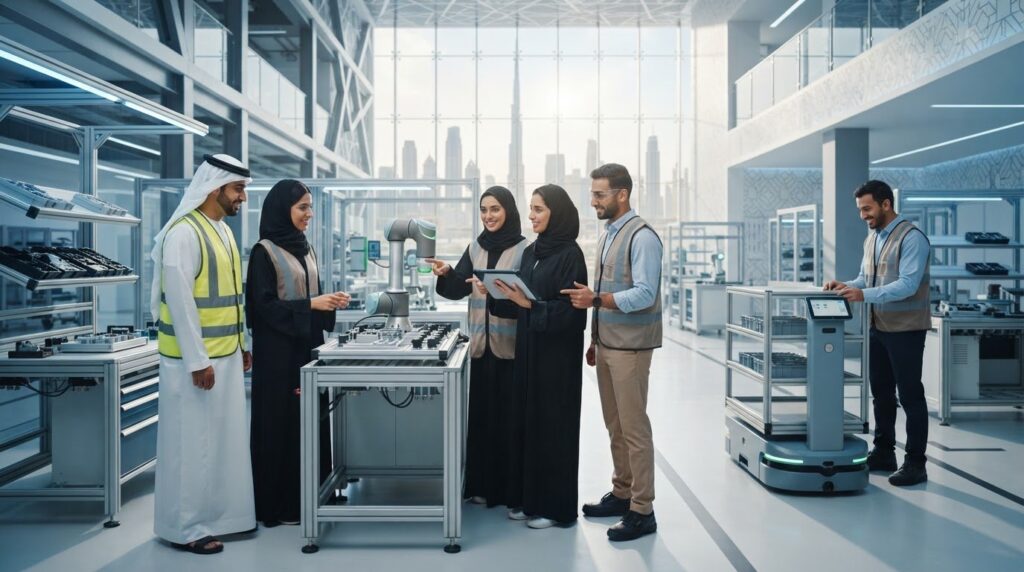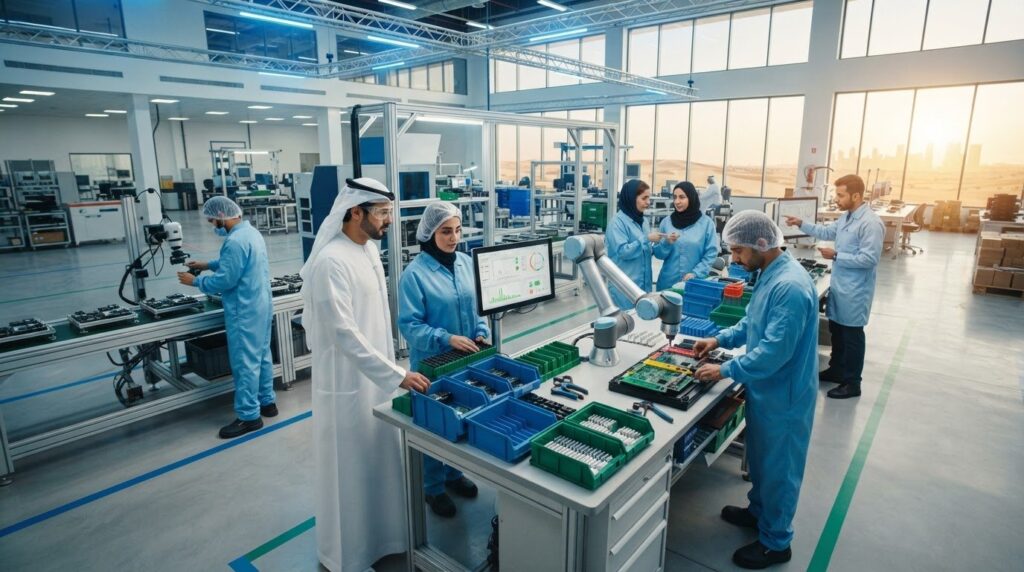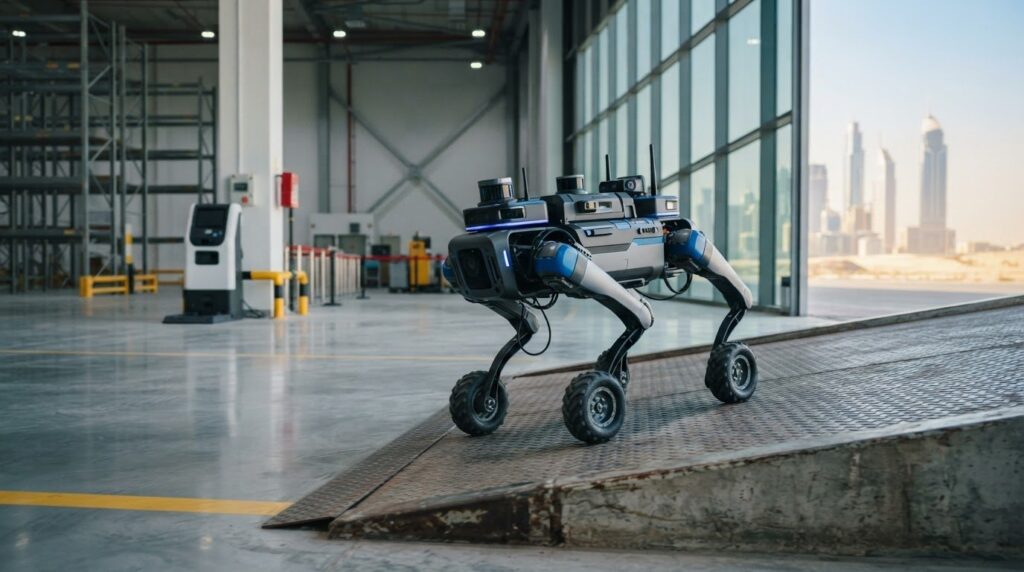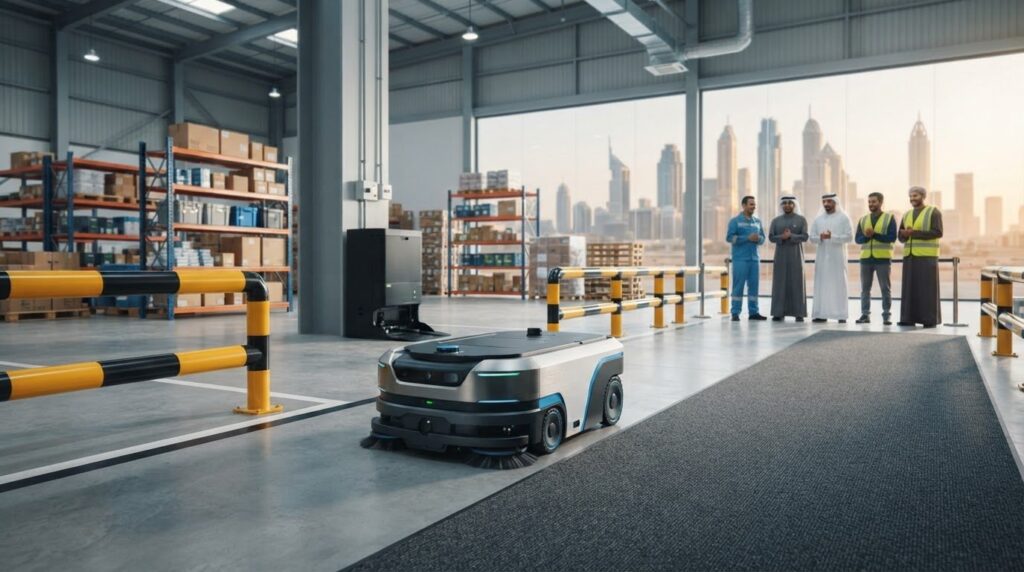
What if automation made work more human, not less? Understanding how automation improves employee morale starts with more than asking whether tasks get done faster. The key is whether technology takes on selected repetitive or physically demanding work while preserving meaningful human control.
Employees may have understandable questions about what automation means for their roles, job security, and privacy. When a new system arrives without clear communication or staff input, it can add uncertainty and pressure. When routine tasks are automated thoughtfully, employees may have more time for problem-solving, collaboration, and work that draws on their expertise.
This guide explains the conditions that can help automation support wellbeing, the risks leaders should address, and practical ways to involve employees during implementation. It also covers how to assess workforce experience alongside operational outcomes, so morale isn’t reduced to a productivity figure. For organizations in the UAE considering robotics or industrial automation, the principle is straightforward: design systems around people as well as processes.
Key Takeaways
- Learn how automation improves employee morale when it reshapes work around task relief, safety, autonomy, and skill development.
- Separate morale from productivity, and assess employee confidence, motivation, and satisfaction as distinct outcomes.
- Identify how unclear role changes or limited human oversight can create pressure, then address concerns through employee involvement and transparent communication.
- Use a structured rollout: map tasks, involve employees, pilot the system, provide training, and review feedback over time.
- Compare cobots, AMRs, and cleaning robots by the tasks they may support, then align the technology with real workforce needs.
How automation improves employee morale: the workplace conditions that matter
Automation can change the feel of a working day, but installing a system doesn’t automatically improve employees’ experience. The impact depends on which tasks change, how responsibilities are redesigned, and whether employees have a voice in the process. To understand how automation improves employee morale, separate workforce experience from operational performance.
What does employee morale mean at work?
Employee morale is the level of confidence, motivation, and satisfaction people feel in relation to their work and workplace. It is distinct from productivity, which measures output or efficiency. Engagement describes employees’ involvement and commitment, while job satisfaction concerns how they evaluate their work and conditions. Retention is an employment outcome, and a short-term mood can shift from day to day. These concepts can affect one another, but none is a direct substitute for morale. For more context on a related concept, see this overview of job satisfaction.
The same technology can affect different roles in different ways. An autonomous mobile robot handling routine material movement may reduce a physical burden for one team. Another team may need to coordinate routes, resolve exceptions, or learn new processes. Employees’ confidence in leadership, perceptions of job security, workload, training, and opportunities to raise concerns all influence whether the change feels supportive or unsettling.
Why do repetitive tasks affect how work feels?
Repetitive work isn’t inherently negative. Some employees value predictable routines, and tasks vary in effort and meaning. However, recurring activities such as moving materials, cleaning large areas, or entering routine data can limit task variety and consume attention. When these duties leave little room for problem-solving, customer service, or skilled work, employees may feel their capabilities are underused.
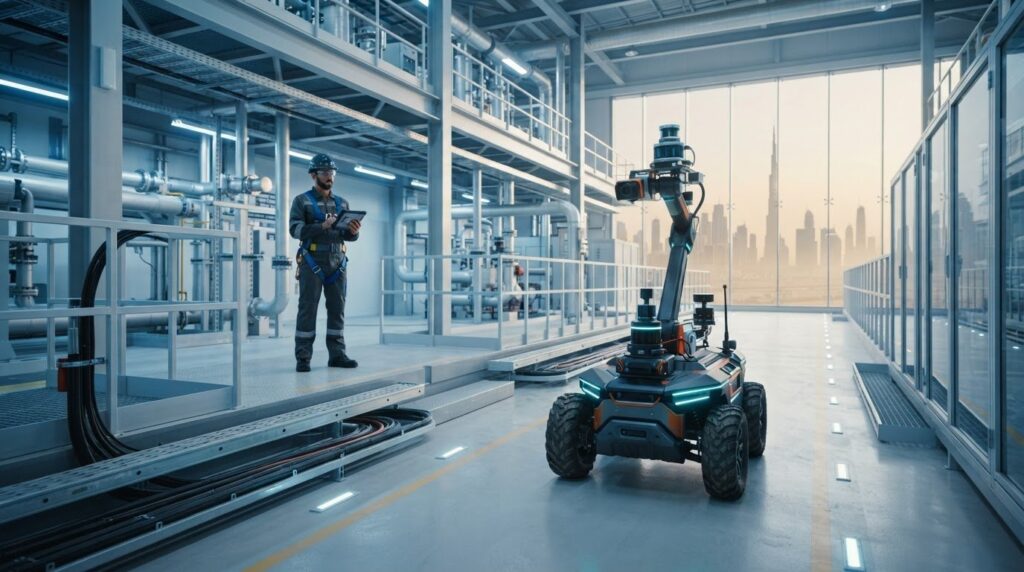
Well-planned automation can take on selected routine or physically demanding tasks, creating an opportunity to redesign roles around work that calls for human judgment, communication, and expertise. A cleaning robot, for example, may support routine floor cleaning while employees focus on other duties. A collaborative robot may assist with repetitive handling tasks, and an AMR may move materials along established workflows. These are examples of possible task changes, not guaranteed improvements to morale.
What happens to the time and capacity automation creates matters. If employees are simply expected to do more, workload may rise rather than morale. If leaders explain the purpose, address job-security concerns, provide relevant training, and involve workers in decisions about redesigned tasks, the change is more likely to feel deliberate and fair. Automation supports morale when it removes friction while preserving meaningful human control.
Four ways automation can improve employee morale when work is redesigned well
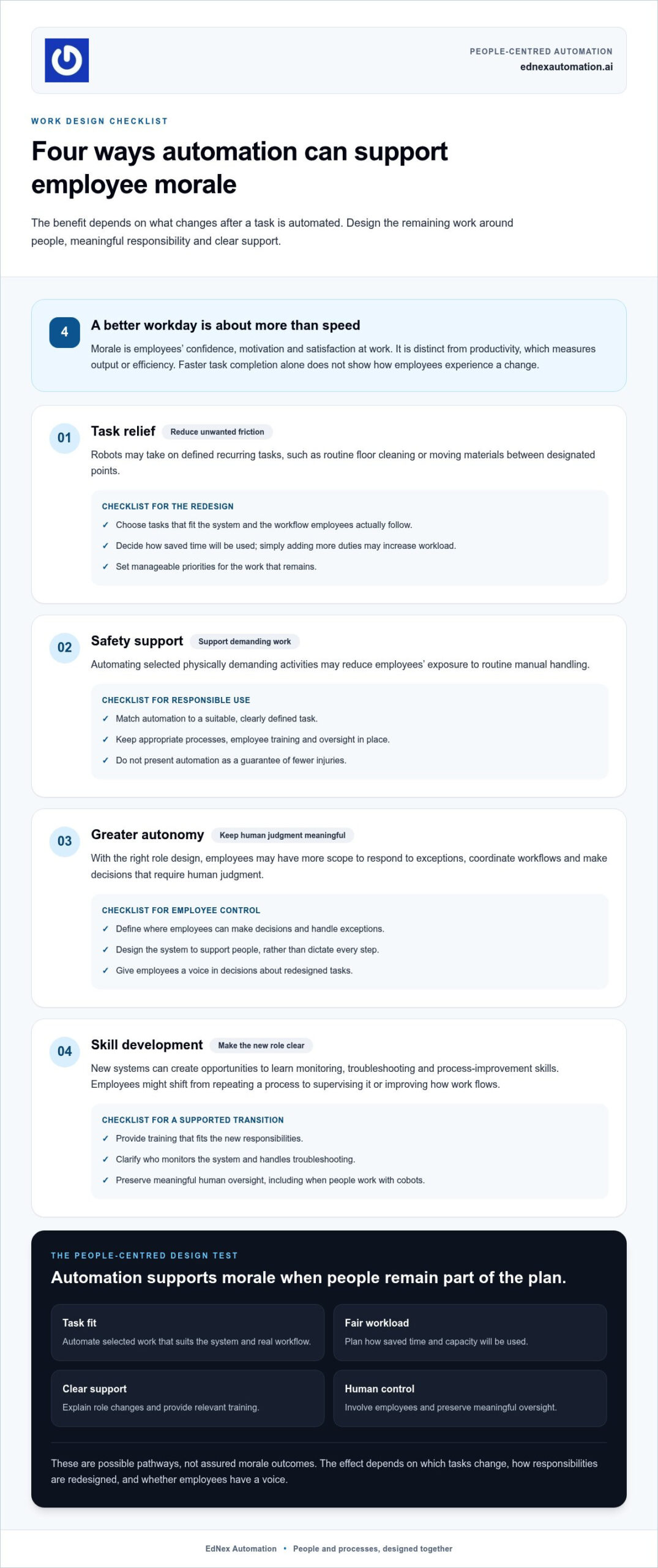
Automation can support morale in ways that go beyond faster task completion. It can change how employees use their attention, how much control they have over their work, and whether they can build useful skills. Automation is most likely to support morale when it reduces unwanted friction and gives employees a clear, trained, and meaningful role in the work that remains.
- Task relief: Cleaning robots or autonomous mobile robots (AMRs) may take on defined, recurring tasks such as routine floor cleaning or material movement. The benefit depends on what happens to the time saved. A manageable workload and clearer priorities are more supportive than simply adding more duties.
- Safety support: Automating selected physically demanding activities may reduce employees’ exposure to routine manual handling. It shouldn’t be presented as a guarantee of fewer injuries. Teams still need appropriate processes, training, and oversight.
- Greater autonomy: Employees may have more scope to respond to exceptions, coordinate workflows, or make decisions that require human judgment. This is more likely when the system supports people rather than dictating every step.
- Skill development: New systems can create opportunities to learn monitoring, troubleshooting, and process-improvement skills. Training and clear responsibilities help employees understand how their roles may develop.
Can automation reduce repetitive or physically demanding work?
It can when the task is suitable and the system fits the workflow employees actually follow. A cleaning robot may handle defined cleaning routes, while an AMR may move materials between designated points. These examples show how technology can support specific tasks, not guarantee a particular workload or injury outcome. Explore the autonomous cleaning robots guide for more on this category.
Can automation make work more skilled and engaging?
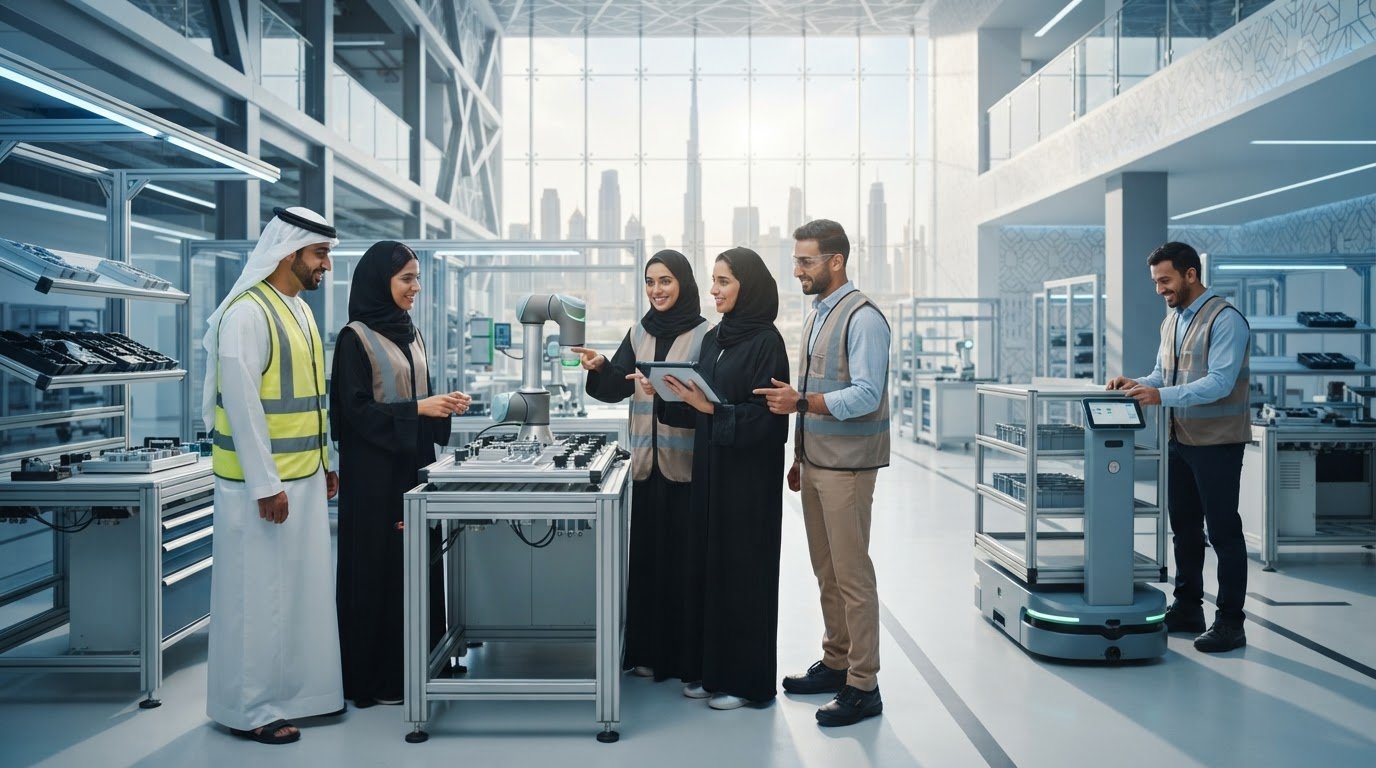
Potentially. Employees might shift from repeating a process to supervising it, handling exceptions, or improving how work flows. Collaborative robots, or cobots, are designed for human-robot collaboration. They still require defined responsibilities, relevant training, and meaningful human oversight. Read the collaborative robots guide for further context.
These are possible pathways, not assured morale outcomes. How automation improves employee morale depends on what follows the task change: whether workloads remain reasonable, employees can influence implementation, and leaders explain how roles may evolve. Organizations exploring robotics can consider how industrial and commercial automation fits specific tasks and workforce needs.
Does automation hurt employee morale? Addressing job-loss and control concerns
It can, especially when employees learn about a major change only after decisions have been made. Automation changes tasks and workflows. Whether that leads to different responsibilities, fewer roles, or new work depends on the task, process design, and deployment context. Neither universal job replacement nor guaranteed job creation is a sound assumption. Employees need a clear explanation of what may change in their roles before implementation begins.
Will automation replace employees or change their roles?
Start by examining the work. A system designed to move materials along a defined route affects different responsibilities from one used for inspection or process control. Map which tasks may be automated, which still require human judgment, and what skills employees may need. Discuss possible role changes early, invite questions, and explain what is known and what remains undecided. Clear, timely communication can reduce avoidable uncertainty without promising a particular employment outcome.
Assess potential benefits and risks together:
- Potential gain: Less time on repetitive tasks may create capacity for skilled work, problem-solving, or service.
- Potential risk: If duties shift without adequate training or workload review, employees may face greater pressure or feel unprepared.
- Potential gain: Automation can support consistent processes and help teams focus on exceptions that require human judgment.
- Potential risk: Unclear monitoring or accountability can make employees feel watched, blamed, or unable to influence decisions.
How can autonomy and trust be protected?
Define who makes decisions, who reviews system outputs, and when a person should intervene. Employees should understand what operational information a system collects, why it is collected, who can access it, and how it will be used. Monitoring that is unexplained or appears unrelated to the work can weaken trust. A clear purpose and accountable oversight make the system easier to understand.
Give staff a straightforward way to report workload, safety, and usability concerns, and explain how those reports will be reviewed. Then act on recurring issues. If a system increases the pace beyond what teams can reasonably sustain, or creates frequent exceptions with no clear owner, treat that as a process-design problem rather than an individual failure.
Ultimately, how automation improves employee morale depends on whether people experience the change as useful, fair, and understandable. Human-centred planning pairs technical capability with transparent role discussions, training, clear decision rights, and ongoing feedback. Organizations assessing robotics and industrial control can explore automation integration options in relation to specific tasks and workforce needs.
How to introduce automation without damaging morale
A controlled rollout gives employees a chance to shape how automation fits their work and gives leaders evidence to refine the process. Treat implementation as a sequence of decisions, not a one-time equipment launch. Start with the tasks and people affected, then test, train, measure, and adapt.
What should leaders do before and during a pilot?
Map the workflow to identify repetitive tasks that may suit automation and points where human judgment must remain central. Invite affected employees to review the proposed workflow, flag practical risks, and help test the system. Their day-to-day knowledge can reveal issues a process diagram may miss. Before the pilot begins, explain its purpose, scope, responsibilities, and how employees can raise concerns.
Use the pilot to learn, not simply to validate a technical decision. Provide role-specific training before employees are expected to work with the system, including how to handle exceptions and where to escalate problems. Review feedback regularly and adjust the workflow if responsibilities become unclear, workloads rise, or the technology doesn’t fit operational realities. Set clear boundaries for the pilot and a defined point to review results.
How can a company measure morale after automation?
A pre-automation baseline gives leaders a reference point for understanding how employee experience changes after deployment. Before rollout, gather confidential feedback on confidence, motivation, satisfaction, perceived workload, task variety, and concerns about role changes. Repeat the same questions at planned intervals after the pilot begins. Add interviews or team discussions to understand why responses may have shifted.
Compare workforce experience with relevant operational indicators, such as task completion, exception handling, or process delays. Keep the measures distinct: improved throughput doesn’t prove morale has improved, and a change in survey responses doesn’t explain its cause on its own. Consider other factors, including staffing changes, workload, management decisions, or wider organizational shifts. Report patterns transparently, protect confidentiality, and explain what actions will follow from the findings.
- Map: Document tasks, handoffs, human decisions, and possible pressure points.
- Involve: Include employees in workflow design, testing, and risk identification.
- Train: Prepare people for new responsibilities and exception handling.
- Review: Compare baseline and follow-up feedback with operational measures, then adapt the process.
Measuring how automation improves employee morale requires listening as carefully as tracking system performance. The robotics and automation integration options can be considered against the specific workflow and workforce needs.
Choosing people-centred automation: practical next steps for organizations
Choose automation by starting with the work and the people who do it, not with the technology alone. Identify tasks that are repetitive, physically demanding, or difficult to coordinate. Then determine where automation could help without removing necessary human judgment. Clear responsibilities, employee input, appropriate training, and accountable oversight help teams understand how workflows may change. They also give leaders a practical basis for assessing whether the system is working as intended.
Which automation examples may support different teams?
Match the system to the task. Collaborative robots, or cobots, may support shared workflows where people and robots perform complementary activities. Autonomous mobile robots (AMRs) may move materials along designated routes, while cleaning robots may handle defined routine cleaning tasks. Each application needs a workflow assessment so staff understand their responsibilities and how to handle exceptions. For more on AMR applications, see the autonomous mobile robots guide.
These examples show how automation can support particular tasks; they don’t guarantee a specific workforce outcome. How automation improves employee morale depends on how well the chosen system fits the work, how roles are shaped around it, and whether employees have a clear way to share feedback as implementation progresses.
What should a people-centred automation plan include?
A practical plan makes employee experience part of implementation, not an afterthought. Include affected employees in workflow discussions and testing, clarify which decisions remain with staff, and provide role-specific training before responsibilities change. Establish an ongoing route for reporting usability, workload, or safety concerns, then review those reports alongside operational measures. This helps leaders spot friction early and adjust the process rather than assuming that improved system performance means the transition is working for everyone.
For connected industrial processes, PLC and SCADA integration can form part of the automation design. Consider how operational controls connect with the human workflow, including who monitors system status and who responds when a process needs attention. EdNex Automation supplies and integrates robotics and industrial control systems for commercial and industrial applications, with task requirements and workforce needs central to planning.
Start with one well-defined workflow, involve the employees who know it best, and use what you learn to guide the next decision.
Build a more people-centred approach to automation
Automation can improve day-to-day work when it addresses real task needs and employees have clear roles, training, and a meaningful voice in implementation. The central lesson in how automation improves employee morale is that technology alone doesn’t determine the outcome. Thoughtful role design, human oversight, and ongoing feedback help organizations assess workforce experience alongside operational performance.
For organizations in the UAE, a practical starting point is a specific workflow, not a promise of transformation. EdNex Automation provides robotics and integration for commercial and industrial sectors, with collaborative robots, autonomous mobile robots, and cleaning robots among its offerings. Each can support different tasks, depending on operational needs and how work is designed around the system.
Review EdNex Automation’s robotics and integration solutions in relation to your organization’s workflows.
Frequently Asked Questions
Can automation improve employee morale?
Yes, automation can support employee morale when it reduces unwanted repetition, improves work conditions, or gives employees more opportunity to do meaningful tasks. How automation improves employee morale depends on implementation: involve affected workers, provide relevant training, and build trust through clear communication. Measure employee feedback alongside operational changes, since faster processes alone don’t show whether people feel more confident, motivated, or satisfied at work.
Does automation always improve employee satisfaction?
No, automation doesn’t automatically improve satisfaction or morale. Poor communication, reduced autonomy, unclear responsibilities, or heavier workloads can make employees’ experience worse, even if operations become more efficient. Before deployment, clarify which tasks may change, involve affected employees in planning, and provide role-specific training. After implementation, review feedback and adjust the workflow instead of assuming productivity gains translate into a better working experience.
Will automation take away employees’ jobs?
Automation may change tasks and responsibilities, but its effect on roles depends on the process and how the technology is deployed. Automating one task doesn’t, by itself, establish what will happen to an entire job. Avoid universal predictions about job losses or job creation. Leaders should explain which workflows may change, discuss responsibilities transparently, and identify training needs early so employees can understand what the transition could mean for their work.
How can managers introduce automation without upsetting employees?
Managers can reduce uncertainty by explaining why automation is being considered and involving employees in workflow design before decisions are finalized. Pilot the system carefully, offer training suited to each role, and clarify who remains accountable for decisions and exceptions. Consultation shouldn’t stop after an announcement. Provide a clear route for concerns, then review employee feedback during the pilot and make changes where workload, usability, or role clarity needs attention.
What types of workplace tasks can robots automate?
Robots may support defined, repeatable tasks such as moving materials, cleaning floors, inspection activities, or structured handling. Autonomous mobile robots (AMRs) can support material movement, cleaning robots can support routine cleaning, and cobots can be used in human-robot collaborative workflows. Suitability depends on the environment, task, and process design. These systems may support employees with specific activities; that doesn’t mean an entire role is necessarily automated.
How do you measure the effect of automation on employee morale?
Establish a baseline before deployment, then compare employee feedback over time. Use confidential surveys or interviews to understand morale, workload, task experience, and concerns, alongside relevant operational measures. Review patterns and consider other changes, such as staffing or workload shifts, that could also affect responses. Productivity, time saved, or output can describe operational results, but they aren’t direct measures of employee wellbeing.
Can collaborative robots make work safer and more engaging?
Collaborative robots can support workflows designed for people and robots to work together, but safety and engagement depend on the task, environment, and way the system is integrated. Assess the work carefully, define responsibilities and human oversight, and provide suitable training and safeguards. Invite employee feedback during testing and after deployment. Cobots may change how a task is performed, but they don’t guarantee safer or more engaging work. To discuss robotics and integration for your workflow, visit EdNex Automation.