Even an advanced inspection system may need a person to make the final call. In human vs robot inspection in manufacturing, robots excel at repeatable checks, consistent data capture and routine movement, while people bring contextual judgment and adaptability when defects are unfamiliar. The right approach depends on the task, the environment and how teams will use the findings.
Automation can improve consistency and reduce repetitive work, especially when production demands are high. But inspection quality depends on more than speed: sensor capability, part variation, access, safety and the need to interpret unusual findings all matter.
This article compares people and robots across accuracy, repeatability, collaboration, mobility and challenging manufacturing environments. It explains where each approach works well, why human oversight remains important and how a combined inspection model can link measurements to practical quality and maintenance decisions in UAE facilities.
Key Takeaways
- Match inspection technology to the task: repeated, measurable checks suit automation, while unusual findings call for human interpretation.
- Assess mobile platforms by their sensors, reach, operating endurance, environmental tolerance, data handling and maintenance needs.
- Design collaboration so robots gather repeatable measurements and people interpret results and guide quality or maintenance decisions.
- In demanding environments, consider what a robot can inspect safely and consistently, along with the sensing and navigation the task requires.
- Evaluate humanoid inspection in real factory conditions, focusing on task fit, measurement reliability and how findings connect to manufacturing systems.
Ground-based mobile inspection robots in manufacturing
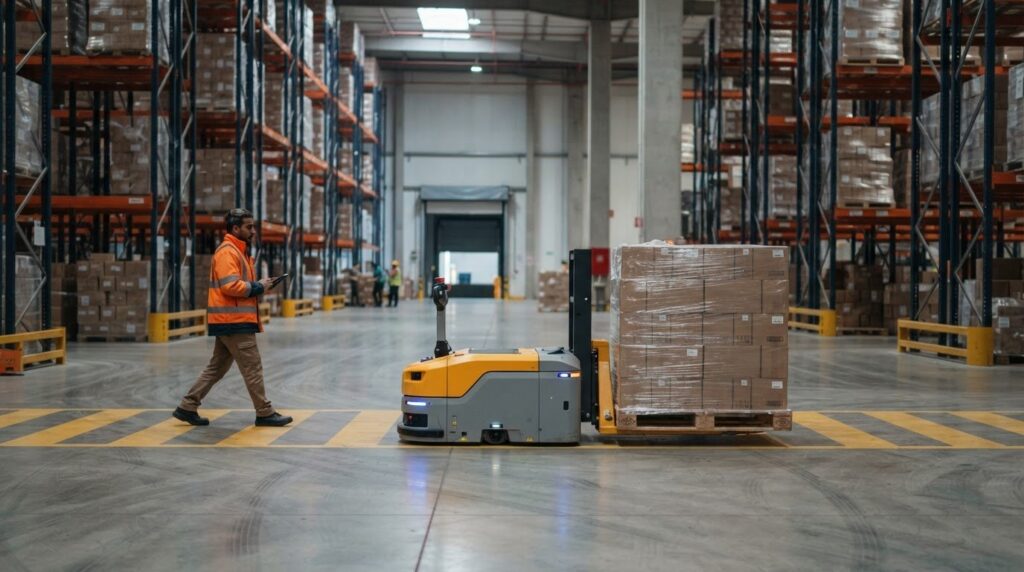
Ground-based inspection robots bring sensors to parts, equipment and work areas, rather than limiting checks to a fixed inspection cell. Their value depends on matching the robot’s route, sensors and measurement task to the production environment.
Mobile Robot Inspection
A mobile inspection robot moves between factory locations while carrying inspection sensors. It can check parts with different sizes and geometries, monitor equipment condition or verify safety systems along a repeatable route. For example, cameras can capture surface conditions, while thermal imaging can highlight abnormal heat. Consistent routes also produce comparable records for tracking changes over time.
Standards and Regulations
Standards and regulations set the relevant quality, safety and measurement controls for an automated inspection setup. In the UAE, identify applicable requirements by reviewing product acceptance criteria, machine safety, measurement traceability and data handling for the specific process. No single standard necessarily covers every factory, product or inspection method. Mapping these requirements helps ensure results are technically reliable and usable in the facility’s quality process.
Inspection Costs and Returns
Robotic inspection costs include the platform, sensors, integration, maintenance and data handling. Manual inspection costs include staff time and the resources needed to reach inspection points. Compare both approaches against inspection frequency, route complexity, downtime exposure and the cost of missed defects. Actual ROI depends on the task, usage, reliability and the expenses the system offsets.
Offline voice interaction lets an operator give a robot spoken instructions without a continuous cloud connection. A practical setup might use a limited local command vocabulary, such as “inspect station,” “pause” or “return to base,” and confirm each command on the robot interface. Factory noise, accents, ambiguous wording and varied phrasing can still cause recognition errors, so clear commands and visible status feedback support reliable operation.
API-based inspection connects robot measurements with quality, maintenance, or risk-management programs. For example, an inspection result can be routed to a manufacturing control system, where a detected deviation prompts review of machining or assembly settings. Integrating inspection with Industry 4.0 systems can support real-time decisions and automated responses. Structure records with the asset, inspection location, sensor reading, and timestamp so teams can interpret trends and act on exceptions.
Human-robot collaboration
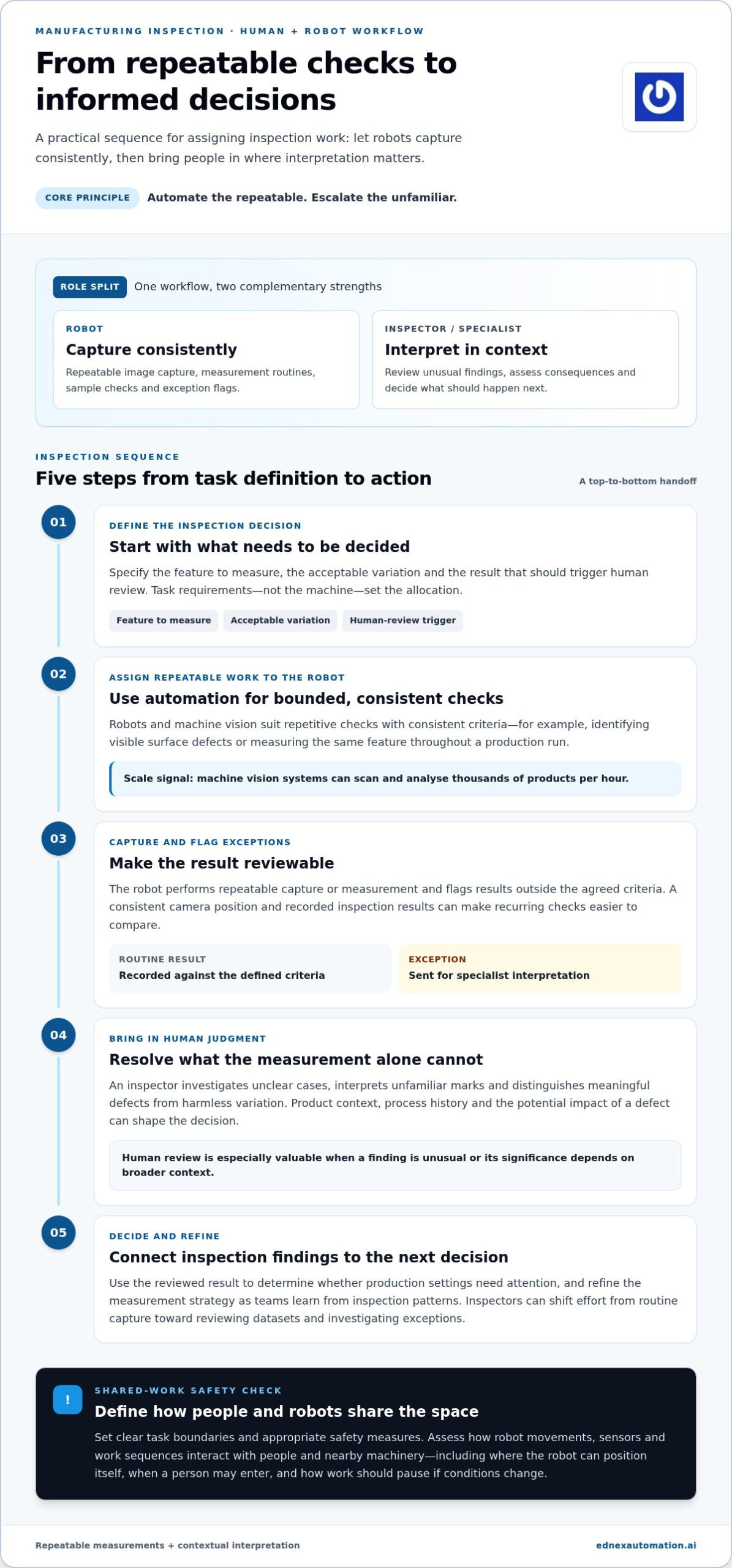
In a manufacturing inspection cell, robots can collect repeatable measurements while people interpret exceptions and decide what to do next. This division combines consistent data capture with human judgment.
Human-Robot Visual Inspection
Human-robot visual inspection combines robotic image capture or measurement with a specialist’s review. For example, a robot can position a camera consistently throughout a production run, flag visible surface anomalies and record each result. An inspector can then assess unusual marks in context and distinguish a meaningful defect from harmless variation.
Robots can also perform measurement routines, hold sensors, run sample checks or capture inspection data. A metrology specialist can focus on interpreting patterns and refining the measurement strategy instead of repeating routine checks. This workflow is useful when the same visual task recurs, but decisions may still depend on product context, process history or the potential impact of a defect.
Shared work requires a defined operating space, clear task boundaries and appropriate safety measures. Before a robot operates near staff, assess how its movements, sensors and work sequence interact with people and nearby machinery. This helps establish where the robot can position itself, when a person may enter and how work should pause if conditions change.
Allocating Inspection Tasks
Robots and machine vision suit repetitive, bounded checks with consistent criteria, such as identifying visible surface defects or measuring the same feature throughout a production run. Machine vision systems can scan and analyse thousands of products per hour, while people are better placed to interpret unfamiliar findings and make decisions that require broader context.
Allocate tasks by starting with the inspection decision, not the machine. Define the feature to measure, acceptable variation and the result that triggers human review. A robot can perform repeatable capture and flag exceptions; an inspector can investigate unclear cases, assess consequences and decide whether production settings need attention.
This division also changes how teams use expertise. According to the OECD, introducing robots can change workers’ tasks without necessarily displacing employment in their occupations. In a factory, inspectors may shift from routine capture to reviewing richer datasets, investigating exceptions and refining inspection methods.
For a UAE facility planning shared inspection workflows, explore collaborative automation options as one way to assess where machines and specialists can work together effectively.
That shift can also involve humanoid robots when work calls for mobility or flexible handling. They can support visual checks, gauging, sample runs and data capture, although fixed vision systems may be preferable for some tasks. Humanoid robots can perform measurement routines or hold sensors, allowing specialists to focus on interpretation and strategy. The assistant was evaluated in simulated and real-world industrial visual-inspection use cases.
As automation expands, metrology professionals may increasingly supervise fleets of automated systems, interpret richer datasets, and refine measurement strategies at the system level. Human judgment remains important for interpreting inspection findings and making protection and maintenance decisions. In 2026, humanoid robots are described as useful for appropriate manufacturing tasks but not as drop-in replacements for an entire workforce. Their role is therefore to support defined inspection work while specialists retain responsibility for contextual decisions.
Accuracy, stability, and error compensation
Robotic inspection can improve repeatability, but accuracy depends on the complete measurement setup. The camera, lighting, robot position and inspection algorithm must work together. For example, a vision system checking a machined edge needs a clear view and consistent product positioning. A human vs robot inspection in manufacturing comparison should account for these setup conditions, not just the sensor’s stated capability.
Robotic inspection has limits when a defect is unfamiliar, ambiguous or outside the system’s programmed criteria. A person can consider context, compare an unusual mark with the surrounding component and decide whether it matters. A robot may flag the mark as an exception, but its output still needs interpretation. Mobile platforms also face metrology challenges involving kinematics, stability and error compensation. These limits matter when choosing between human and robot inspection, especially for variable parts.
Machine vision systems can scan and analyse thousands of products per hour. Robots can repeat a programmed check consistently, while inspection pace and judgments can vary between people because of fatigue or subjective perception. Speed alone does not establish better quality. The useful comparison is whether each approach meets the inspection criteria and captures results clearly enough to inform production decisions.
Machine vision uses high-resolution cameras and algorithms to identify small defects that may be difficult to see with the human eye. The research reports 92% defect detection accuracy for surface anomalies, corrosion, and leak indicators using AI vision. Treat that figure as a reported result for those inspection targets, not as a universal benchmark for every component, camera setup, or manufacturing line.
Measurement stability requires active control. Routine robotic calibration checks can reveal measurement-system drift early and help maintain confidence in recorded results. For example, if a camera gradually shifts relative to its fixture, repeated readings may become biased even when the software runs consistently. Calibration routines help detect such changes before teams rely on the results for process adjustments or product decisions.
In complex factory spaces, a mobile robot’s movement can affect measurement quality. Vibration, changing distance or an unstable position may alter a reading, so deployment should account for how the robot approaches each inspection point. Teams can compare robot measurements with established reference checks, review repeated readings and correct identified sources of error. This supports reliable automation without treating every detected anomaly as a confirmed defect.
Environmental constraints and hazardous atmospheres
Heat, dust, contamination, restricted access and hazardous gases can affect inspection in a UAE factory. A ground-based robot equipped with cameras, thermal imaging or gas sensors can collect information where routine human entry adds exposure. Choose a platform based on its sensor capability and suitability for conditions at the inspection point.
Robotic inspection has its own safety risks, including unexpected movement, collision and unreliable readings if sensors or equipment are unsuitable for the environment. Workers still need clear operating boundaries and fault-response procedures. During a substation fault, for example, sending a robot into the affected area first can give operators information before personnel enter.
Robots can reduce, but don’t eliminate, worker exposure. Robotic inspection has been associated with a 70% reduction in human entry hours in hazardous process areas, and routine robotic rounds with a 68% reduction in worker-hours inside IDLH-potential atmospheres. These figures describe reported applications; the practical impact depends on which inspection rounds the robot can perform and how much human follow-up remains.
Choose sensors according to the hazard being assessed. Thermal imaging can identify overheating equipment, while gas sensors can help detect leaks. In substations, robotic inspections can identify oil or SF₆ gas leaks and monitor equipment after faults, fires, flooding or severe weather. A robot’s readings can inform a response, but operators still need to interpret the findings and decide how to proceed.
Physical access also shapes the comparison. Specialised robots are designed to inspect inaccessible places such as pipes or fuel tanks, according to the International Labour Office. This can shift some checks away from direct human access, while cameras, payload, endurance, and environmental tolerance determine whether a particular platform can reach and examine the target. Inspection of a narrow pipe, for instance, calls for a different configuration than a mobile round across an open factory floor.
Robotic inspection changes workforce tasks as well as access. A qualified lineman can supervise a robot performing a high-exposure task from a safe distance, while retaining responsibility for interpreting results and deciding on maintenance. In manufacturing, staff may shift from routine rounds to exception review, equipment response and robot oversight. That transition needs clear handoffs: teams should know who reviews an alert, who authorizes entry and how normal inspection resumes after an equipment fault.
Humanoid robots for visual inspection
Humanoid robots can support visual checks in manufacturing areas designed around people. Their humanlike form can help them move through existing workspaces and interact with components or instruments arranged for human hands. For example, articulated wrists can position a camera or operate an inspection instrument at a workstation. This may be useful where repetitive checks are difficult to staff or physically tiring.
On an in-line production process, a humanoid robot can use vision-led checks to inspect products and flag exceptions. It can repeat a defined measurement routine, capture images and record findings for review. Its role is to identify deviations against task criteria, not to replace human judgment about unusual results. Inspectors can investigate flagged items and decide what the findings mean for product quality.
Humanoid platforms can also use articulated manipulators to position components or adjust fixtures designed for human hands. For instance, a robot might hold a sensor in a consistent position while measuring a part, then record the reading. This can help in workspaces with varied inspection points, but mobile platforms bring metrology challenges involving stability, kinematics and error compensation.
Inspection frequency is another potential advantage. One reported use case describes a threefold increase in inspection frequency when humanoid robots replace scheduled human walkthroughs. More frequent checks can provide additional observations between established rounds, giving teams more information about changes. Their value depends on linking readings to the relevant asset, process and quality records.
That connection matters. For measurements to inform factory operations, data must be contextualized, traceable and actionable within connected manufacturing and quality systems. A visual alert linked to the correct component and inspection location is more useful than an image without production context. Connected sensors can also feed analytics platforms, digital twins and dashboards that show product or process health.
Trial a deployment in a real factory before scaling. Select a bounded task, measure performance in the actual workspace and assess whether the robot can complete the visual routine reliably. Dynamic environments shared with workers require appropriate sensing, robust safety architectures and risk assessment. A humanoid robot suits specific tasks, not automatic replacement of an entire workforce.
To assess where humanoid visual inspection could fit your production workflow, discuss an industrial inspection project with EdNex Automation.
Every deployment should be assessed against the specific inspection task and the conditions of the actual workspace, rather than assumed to suit every production area. While manufacturing spaces built for people can accommodate humanoid robots without expensive facility rebuilding, this potential fit does not remove the need to demonstrate performance. Manufacturers are advised to prove robot reliability through real factory trials before scaling operations. Ultimately, frequency gains matter only when observations support defined quality goals and integrate smoothly with existing enterprise systems.
EdNex Automation: Collaborative Robots (Cobots)
EdNex Automation offers Collaborative Robots (Cobots) for industrial teams assessing where people and automation can work together. Consider this option when inspection includes repeatable machine tasks alongside human review, such as capturing routine measurements while specialists assess exceptions. The right division depends on the inspection process, the production environment, and how findings feed into quality decisions. For facilities considering mobile inspection workflows, Autonomous Mobile Robots (AMRs) are another relevant offering. A focused review of the task can help clarify which work should be automated and where human judgment remains central. Contact EdNex Automation to discuss your manufacturing inspection needs.
Turn Inspection Priorities Into a Practical Automation Plan
Treat human vs robot inspection in manufacturing as a design decision, not a contest between people and machines. Start by identifying an inspection outcome that matters to production, then define how the result will inform the next operational decision. This provides a clear basis for evaluating automation while keeping accountability and quality objectives in view.
For UAE manufacturers planning their next step, EdNex Automation supplies Collaborative Robots (Cobots), Autonomous Mobile Robots (AMRs) and Cleaning robots. The right solution depends on the work your facility needs to support and how it fits existing operations. A focused discussion with EdNex Automation can help define the use case and identify a suitable direction, without assuming every inspection task should be automated.
Contact EdNex Automation to discuss inspection and define a practical path forward for your manufacturing environment.
Frequently Asked Questions
How do human and robot inspection compare in manufacturing accuracy and defect detection?
Robots produce repeatable results for defects with clearly defined inspection criteria, while people can assess unfamiliar issues in context. For example, a camera may flag a finish variation on a component, and an inspector can decide whether it affects the part’s intended use. To compare performance, distinguish missed defects from false alarms and assess both against the same acceptance criteria. This reveals whether automation needs adjustment or human review.
How can manufacturers integrate robotic inspection with existing production lines and quality systems?
Start by defining how each inspection result will connect to a product record and the next production decision. For example, attach the result to a part or batch identifier, then route accepted items and exceptions through separate quality workflows. Map the robot’s signals to the production line’s existing status conventions, including what happens if inspection data is delayed or incomplete. This preserves traceability and prevents an unreadable result from being treated as a pass.
How do manufacturers validate and maintain robotic inspection systems?
Validate the system using representative parts, including known acceptable examples and defects that challenge its detection criteria. Repeat checks after changes to camera position, lighting, software or product presentation, then document whether results still meet quality requirements. During routine maintenance, inspect sensor surfaces, fixtures and cable connections, and review system logs for unexpected measurement shifts. These checks help distinguish a real process change from a change in inspection performance.
What are real-world examples of human-robot inspection in manufacturing?
One practical workflow pairs a vision station with an inspector: the system flags a surface mark, and the person decides whether to hold the item for review. In another, a mobile platform checks equipment indicators during scheduled rounds, while maintenance staff assess unusual readings. A clean-room workflow can combine sensor-based contamination monitoring with specialist review. These are examples of application patterns, not claims about a specific factory deployment.