At Dubai’s Museum of the Future, a robot dog moves using 17 joints and uses 360-degree perception to map terrain and avoid obstacles. That capability helps explain why Robot Dogs in the UAE are attracting interest for security and inspection tasks, where access and repeatable observation matter.
For organizations in Abu Dhabi and Dubai, hiring a robot dog is not simply about selecting a machine: the task, site conditions and required observations all shape the right fit. You’ll learn what robot dogs can contribute to security and inspection, what to consider when exploring hire options, and how these systems compare with other robotic solutions.
This guide explains how inspection and surveillance robots can support commercial and industrial operations, helping you assess whether a robot dog fits the work or another type of automation is a better match.
Key Takeaways
- Understand what to compare when assessing robot dog sales and hire options for security or inspection work.
- See which project requirements can shape the total cost, including delivery and import considerations.
- Learn how location and site conditions affect deployment planning across Dubai, Abu Dhabi and other emirates.
- Explore how EdNex Automation’s inspection and surveillance robot offerings may suit operational needs that a robot dog does not.
Which companies sell or rent robot dogs in the UAE?
The available UAE examples show robot dogs in public-facing deployments, but they don’t identify commercial sellers or rental operators. Dubai’s Museum of the Future features a robot dog with 17 joints and 360-degree perception for mapping terrain and avoiding obstacles. That example demonstrates a use case, not a supplier or hire option.
Dubai Police’s K9 administration is a separate reference. Its K9 dogs were involved in over 3,000 operations in 2023, and the administration took a major leap during the past four years. These are police dog operations, not evidence of robot dog sales or rentals. Keep the distinction clear when comparing market examples.
When evaluating a robot-dog supplier, define these points before comparing proposals:
- Commercial role: Determine whether the company sells the robot, rents it for a defined project, or provides both arrangements.
- Task fit: Match the proposed platform to a specific duty, such as perimeter observation or inspection in a difficult-to-access area.
- Deployment scope: Clarify what the arrangement covers, including delivery, setup, operator support and collection for a rental.
- Technical capability: Compare the sensors, movement and data outputs with the Museum of the Future example, rather than relying on appearance alone.
These steps distinguish a defined operating solution from a robot display or technology showcase. A public demonstration shows the robot in action, but a project proposal should specify its task and deployment scope. That distinction matters when assessing whether a robot dog fits a site’s security or inspection plan.
Apply the same checks to any proposed purchase or project deployment in the UAE. Get the operating arrangement in writing, including whether the robot is being purchased or supplied for a limited project. Compare the stated task, support and deployment scope before deciding. A prominent public demonstration alone does not establish what a commercial project includes.
Robot Dog Prices in UAE Including Delivery and Import
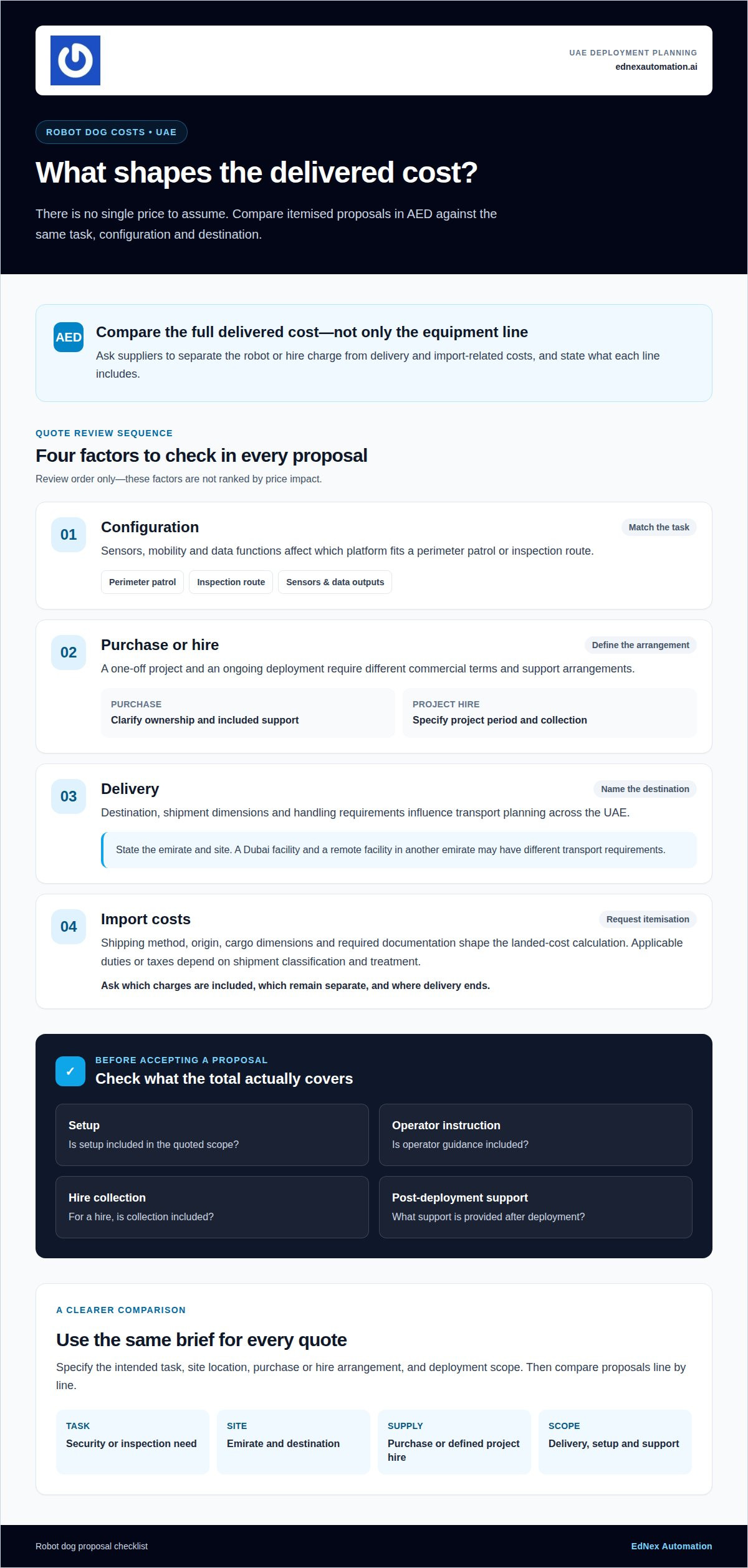
The cost of a robot dog depends on its intended task, configuration and supply arrangement. Purchase and project deployment have different cost structures, so compare proposals against the same security or inspection requirements. Request a quotation that explains the configuration and any delivery or import-related costs. Prices and terms should be assessed from the proposal rather than assumed.
For a useful comparison, request an itemised quotation in AED. Separate the robot or hire charge from delivery and import-related costs, then note what each line covers. A quote for a Dubai site, for example, may have different transport requirements from one serving a remote facility in another emirate.
- Configuration: Sensors, mobility and data functions affect which platform fits a perimeter patrol or inspection route.
- Purchase or hire: A one-off project and an ongoing deployment require different commercial terms and support arrangements.
- Delivery: Destination, shipment dimensions and handling requirements influence transport planning for Abu Dhabi, Dubai or another emirate.
- Import costs: Shipment details and customs classification can affect applicable charges. Ask for these costs to be itemised rather than folded into one total.
Before accepting a proposal, compare the complete delivered cost, not just the equipment line. Check whether setup, operator instruction, collection for a hire, and post-deployment support are included. For example, a lower equipment price may not represent the lower project cost if essential delivery or operational services appear separately.
Import planning also affects the final estimate. The shipping method, origin, cargo dimensions and required documentation shape the landed-cost calculation; applicable duties or taxes depend on the shipment’s classification and treatment. Ask the supplier to show which charges are included, which remain separate, and whether delivery ends at the site or another handover point. This gives procurement teams a clearer basis for comparing robot-dog proposals across the UAE.
Where can you buy or rent a robot dog in Dubai, Abu Dhabi, and other UAE emirates?
For a Dubai, Abu Dhabi, or other emirate deployment, start by identifying suppliers that quote robot-dog sales or project hire. A supplier’s location alone doesn’t show whether delivery reaches your site. Specify the emirate, site type, intended task, and whether you need a purchase or temporary hire. These details help define the right route to a usable proposal.
Use the same brief for each location. For example, a warehouse inspection in Abu Dhabi differs from a perimeter observation task in Dubai. The environment, access requirements, and operating schedule shape the requested configuration and delivery plan. For a site in Sharjah or Ras Al Khaimah, state the location clearly so transport and deployment arrangements address that destination.
Before choosing a sales or hire arrangement, establish these points in writing:
- Supply model: State whether you need ownership or a robot for a defined project period.
- Destination: Name the emirate and site, such as a Dubai facility or an Abu Dhabi industrial location.
- Task: Describe the route, inspection area, or security objective the robot must support.
- Deployment scope: Clarify delivery, setup, operator guidance, and collection for temporary hire.
Then compare proposals against the same task and destination. A purchase proposal for a Dubai site should make clear what delivery and operational support cover. A hire proposal for Fujairah should state the rental period and the arrangements for deploying and returning the equipment. This makes differences between offers easier to evaluate.
For locations beyond Dubai and Abu Dhabi, such as Ajman, Umm Al Quwain, or Fujairah, the named site remains central to planning. Include access conditions and the inspection or security objective in the initial brief. A clearly defined destination and task help determine whether purchase or hire better suits the project, and what deployment steps the supplier should include.
What are the UAE rules for importing, operating, and filming with robot dogs in public
Importing a robot dog, operating it at a site and filming with it are separate planning questions in the UAE. Product classification and declared purpose inform import processing. A public demonstration raises different considerations, including access, pedestrian movement and site operating conditions. Treat these as distinct stages rather than assuming that delivery automatically permits public use.
For import planning, prepare a clear description of the device, its intended function and shipment details. State whether it is intended for inspection, a security demonstration or another task. Keep product documents and shipping information together. The classification and shipment particulars guide import processing and help distinguish the robot dog from equipment with a different purpose.
Before operating in a public setting such as a Dubai event venue, build a site-specific plan covering:
- Location: Identify the exact public area and the party responsible for access.
- Movement: Map the robot’s route around people, entrances, and restricted areas.
- Supervision: Set out who controls movement and responds if the robot stops or changes course.
- Recording: Define what cameras capture, where footage is used, and how bystanders are handled.
Filming needs its own assessment. A camera mounted on a robot may capture people, private premises or restricted spaces, so a public setting should not be treated as blanket permission to record. A planned inspection route through a shared building, for example, differs from a controlled demonstration in a closed venue. Specify the recording purpose, camera direction and intended audience for the footage.
Keep the import description, site plan, and filming purpose aligned. If the robot arrives for a private inspection but later appears at a public event, that change affects the operating plan. A structured review of those three stages supports a more controlled deployment. Discuss an automation project when planning inspection operations that need a defined deployment approach.
EdNex Automation
EdNex Automation helps organizations across the UAE assess robotics and automation options against operational needs, including whether a robot dog is the right fit. Autonomous Mobile Robots (AMRs), for example, can support internal material movement, while inspection may call for a system suited to the specific site and task. The right choice depends on the required function, environment and fit with existing operations.
Turn to EdNex Automation when you’re defining an automation requirement and need to consider solutions such as AMRs, Collaborative Robots (Cobots), cleaning robots, or delivery robots. Share the task and operating context to start a focused discussion. Contact EdNex Automation to discuss your requirements.
Turn a technology assessment into an operational plan
Choosing whether to deploy Robot Dogs in the UAE is part of a broader automation decision. Start by defining the operational outcome: which tasks need to change, how the technology must work alongside people and how it can fit existing processes. This helps distinguish a focused robotic deployment from a wider modernization opportunity.
EdNex Automation also supplies Collaborative Robots (Cobots), Autonomous Mobile Robots (AMRs) and cleaning robots. Each serves different operational needs, so match the system to the task rather than adopting technology for its own sake. A clear project brief keeps the decision and implementation focused on practical objectives.
Move your assessment forward by outlining the site, task, and desired operational outcome. Discuss your automation priorities with EdNex Automation and take the next step toward a solution aligned with your operations.
Frequently Asked Questions
What robot dogs are available in the UAE and what can they do?
A public UAE example is the quadruped robot displayed at Dubai’s Museum of the Future. It moves using 17 joints and uses 360-degree perception to map terrain and avoid obstacles. These capabilities can support movement through complex surroundings and make the robot suitable for demonstrations or tasks involving site observation. Commercial purchase or hire options depend on suppliers and project arrangements.
What safety, privacy, and cybersecurity risks come with using robot dogs in the UAE?
Robot movement in public areas can affect pedestrian access, entrances and restricted areas. Plan the route, supervision and response if the robot stops or changes course. Cameras may capture people, private premises or restricted spaces, so define what is recorded and how the footage will be used.