The UAE national strategy for industry 4.0 advances transformation by connecting industrial digitalisation and technology adoption with stronger national industries. The UAE’s Fourth Industrial Revolution Strategy aims to establish the country as a leading global hub and open lab for 4IR applications. Its Industry 4.0 programme is a key pillar of Operation 300bn and aims to increase productivity in the UAE industrial sector by 30%.
For manufacturers, transformation is about more than installing new equipment: it also involves industrial data, organisational readiness and how technology fits into production. The 4th Industrial Revolution Readiness Index assesses the digital maturity of industrial facilities’ processes, technologies and organisation. This article explains how the UAE strategy approaches industrial data management, encourages advanced technology adoption and supports national industries, then connects those priorities to the wider shift towards Industry 4.0. You’ll see how the national direction relates to practical decisions about systems, workflows and long-term industrial competitiveness.
Key Takeaways
- Use the 4th Industrial Revolution Readiness Index to understand how a facility’s processes, technologies and organisation align with digital transformation priorities.
- Recognise that secure industrial data management is a foundation for connected systems, informed decisions and coordinated technology adoption.
- Explore how advanced technology initiatives and industrial support measures can strengthen productivity and the competitiveness of UAE industries.
- Connect national ambitions with practical operations by identifying where automation and intelligent systems can address specific industrial needs.
Digital transformation and industrial data management
The UAE national strategy for Industry 4.0 connects industrial digitalisation with the country’s wider Fourth Industrial Revolution ambitions. The UAE Industry 4.0 programme was launched as part of the Projects of the 50. The broader strategy aims to establish the UAE as a leading global hub and open lab for Fourth Industrial Revolution applications, including digitally enabled industries.
What is the UAE National Strategy for Industry 4.0, and when was it launched? The Industry 4.0 programme is an industrial transformation initiative within the UAE’s wider Fourth Industrial Revolution direction. It was launched as part of the Projects of the 50; the strategy also promotes connected, cyber-secured data infrastructure.
Compared with Saudi Arabia and other GCC countries, the UAE approach is distinguished by its industrial readiness assessment and stated focus on a cyber-secured big data environment. Compare national frameworks by how they assess factory processes, technology and organisation, rather than assuming they use identical measures.
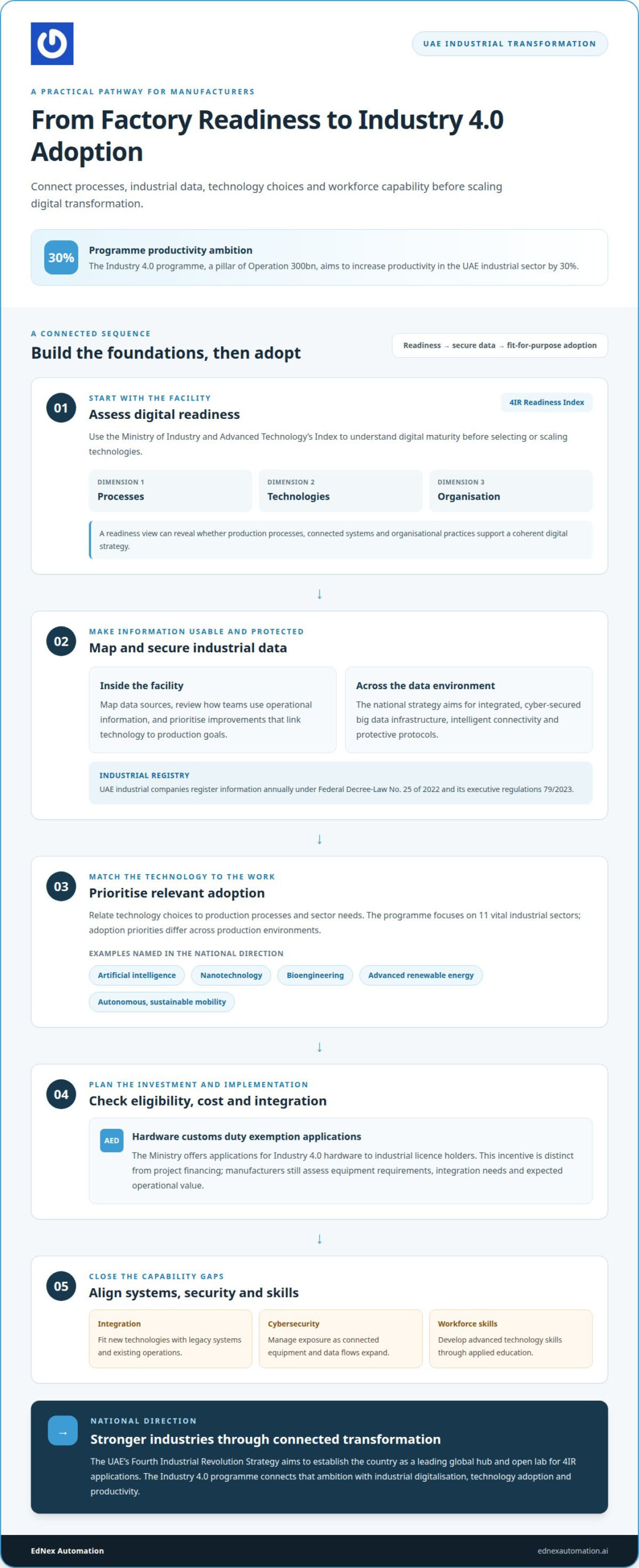
The UAE government sets the wider direction, while the Ministry of Industry and Advanced Technology leads industrial implementation through the Industry 4.0 programme. Established in July 2020, the Ministry uses the 4th Industrial Revolution Readiness Index to assess technology implementation in industrial facilities. The Index examines digital maturity across processes, technologies and organisation, giving manufacturing leaders a structured view of readiness.
For a factory, an industrial readiness assessment can show whether production processes, connected systems and organisational practices support a coherent digital strategy. Map data sources, review how teams use operational information, and prioritise improvements that link technology to production goals. Assessing digital maturity before selecting or scaling technologies is useful because process and organisational gaps can affect implementation.
Industrial data management also depends on secure connectivity and clear protocols. The UAE Fourth Industrial Revolution Strategy aims to develop an integrated, cyber-secured big data environment with intelligent connectivity and protective protocols. Separately, UAE industrial companies register information annually through the Industrial Registry under Federal Decree-Law No. 25 of 2022 and its executive regulations 79/2023. The strategy also proposes blockchain and other digital economy technologies for financial transactions and services, linking digital infrastructure with economic security.
Innovation and advanced technology adoption
The UAE’s Industry 4.0 approach links technology adoption with industrial competitiveness and national innovation priorities. Its measures combine an assessment framework, an industrial hardware incentive and wider investment in advanced skills.
Industrial Technology Adoption Incentives
An adoption incentive reduces a defined cost or barrier to putting industrial technology into use. The Ministry of Industry and Advanced Technology offers customs duty exemption applications for Industry 4.0 hardware to industrial licence holders.
For eligible manufacturers, this can affect the landed cost of qualifying hardware and inform implementation planning. It is distinct from project financing: companies still need to assess equipment requirements, integration needs and the expected operational value when building an investment case. The Ministry’s 4th Industrial Revolution Readiness Index also assesses technology implementation, helping connect readiness with adoption priorities.
Covered Technologies and Industrial Sectors
The programme’s industrial scope covers 11 vital sectors, while the wider strategy promotes technologies that can reshape production and services. Examples include artificial intelligence, nanotechnology, bioengineering, advanced renewable energy and autonomous, sustainable mobility.
Which technologies and industrial sectors does the UAE Industry 4.0 strategy cover? The Ministry’s strategy focuses on 11 vital industrial sectors, and the national direction includes advanced technologies such as AI, bioengineering and nanotechnology. This breadth matters because adoption priorities differ across production environments, so manufacturers can relate technology choices to their processes and sector needs.
Adoption Barriers and Workforce Skills Gaps
Adoption barriers are practical constraints that can slow implementation, including legacy-system integration, cybersecurity exposure and gaps in workers’ advanced technology skills. These issues matter because connected equipment makes secure data flows and capable teams increasingly important.
What barriers, cybersecurity risks, and workforce skills gaps affect Industry 4.0 adoption in the UAE? Facilities must manage the risks of connected systems, align new technologies with existing operations and develop the skills needed to use them. The UAE strategy addresses this capability challenge through applied education focused on advanced science, innovation and entrepreneurship, while its industrial data direction emphasises cyber-secured environments.
For facilities translating adoption priorities into operational systems, explore industrial automation solutions as one practical technology pathway.
Support for national industries and industrial competitiveness
The UAE government connects industrial transformation with stronger productivity and national economic priorities. Its Industry 4.0 programme supports that direction as a pillar of Operation 300bn.
Industrial Productivity
Industrial productivity measures how effectively a facility converts resources, time and effort into output. The UAE Industry 4.0 programme aims to increase productivity in the UAE industrial sector by 30%, giving manufacturers a clear national ambition to consider.
For a factory, national ambitions become operational when leaders identify constraints such as repetitive handling, process delays or limited visibility. They can assess which improvements match production needs and track whether changes affect throughput, quality or resource use. The goal is not technology for its own sake, but measurable improvement in industrial operations.
Industrial Competitiveness
Industrial competitiveness is a company’s ability to perform effectively and sustain its position in changing markets. Industry 4.0 can support this by improving how facilities organise production, use operational information and respond to demand.
The Ministry of Industry and Advanced Technology strategy includes six main objectives and 16 initiatives. Together, these establish a policy framework for strengthening national industry, rather than treating each technology investment as an isolated upgrade. For manufacturers, the connection matters: digital systems and process changes can contribute to competitiveness when they address a defined operational need.
Industrial licence holders may also achieve a higher ICV score through the UAE Industry 4.0 programme. This links industrial transformation with a national measure relevant to participating businesses. A manufacturer can consider how its technology roadmap, production priorities and local industrial contribution fit together, rather than evaluating equipment solely as a standalone purchase.
Competitive manufacturing connects investment decisions with operational outcomes. Map a production bottleneck, identify a process change to address it, and define performance measures before implementation. The national industrial revolution agenda provides direction, while each facility’s priorities determine how that direction can support productivity and market readiness.
Industry 4.0 transformation
Transformation matters when national priorities shape connected infrastructure, production, logistics and public services. The UAE Fourth Industrial Revolution Strategy aims to position the country as a global hub for Fourth Industrial Revolution applications and an open lab for their development.
The UAE Industry 4.0 programme was launched as part of Projects of the 50. Industry 4.0 is a key pillar of Operation 300bn. Make it in the Emirates also belongs in the national-industry conversation, but the initiative names should remain distinct: the programme’s stated launch was under Projects of the 50.
What are the strategy’s key initiatives, including Operation 300bn and Make it in the Emirates? The Industry 4.0 programme supports Operation 300bn as a key pillar, while Make it in the Emirates is another named national-industry initiative. Together, these names point readers toward industrial development, but they are not interchangeable programme titles.
The strategy’s transformation agenda extends beyond factory production. It aims to develop next-generation intelligent terminals and a sustainable logistics ecosystem, while future energy grids are intended to support decentralised generation, sustainable consumption and intelligent asset management. It also seeks to establish the UAE as a centre of excellence for 3D-printed and robotic construction.
These priorities connect industrial transformation with national infrastructure. Satellite data, for example, is intended to support planning for future cities. Robotics and autonomous vehicle technologies also feature in the strategy’s proposed development of defence industries. Each direction links advanced applications to a defined national purpose, rather than treating innovation as an isolated technology purchase.
What are notable UAE Industry 4.0 projects or manufacturing success stories? The strategy identifies project directions, including intelligent terminals, robotic construction and future energy grids, rather than specific factory success stories. For manufacturers, the practical takeaway is to connect a technology project with its intended operational or national purpose, then define how progress will be evaluated.
To explore how automation can support industrial transformation, review automation applications for industry.
EdNex Automation: Collaborative Robots (Cobots)
EdNex Automation offers Collaborative Robots (Cobots) for businesses assessing where robotic automation could support their operations. Cobots may be relevant when a manufacturer is evaluating tasks for human-robot collaboration as part of a broader Industry 4.0 roadmap. The right application depends on the process, work environment and the role the system needs to perform.
For other operational needs, EdNex Automation supplies and deploys autonomous mobile robots (AMRs), cleaning robots and delivery robots. These solutions support different automation needs across industrial and commercial settings, including mobile transport, cleaning and delivery. Define the task first to connect the technology choice with a specific operational requirement.
Contact EdNex Automation to discuss how collaborative robots could support your automation priorities.
Turn Industrial Ambition Into a Defined Next Move
The UAE national strategy for Industry 4.0 sets a direction, but each facility’s next move should start with a specific operational constraint. Choose one workflow where reliability, throughput or task allocation needs attention, then define what a useful change would look like in that setting. This focus keeps technology decisions connected to operational priorities rather than novelty.
Before expanding a project, map how the proposed system fits existing processes, staff responsibilities and information flows. A clear scope helps decision-makers compare implementation options and identify the questions a pilot should answer. It also helps teams apply lessons from one project to future transformation work.
For organizations assessing robotic automation, a focused discussion can connect the task and operating environment to a suitable direction. Discuss your automation priorities with EdNex Automation and take a deliberate step toward a more capable operation.
Frequently Asked Questions
What are the UAE Industry 4.0 strategy’s main goals and targets?
The programme aims to increase productivity in the UAE industrial sector by 30%, while the wider strategy seeks to position the UAE as a leading global hub for Fourth Industrial Revolution applications. For manufacturers, these ambitions translate into evaluating how technology can improve production and support long-term industrial competitiveness. The target is a national programme objective, not a guaranteed outcome for an individual facility.
What funding, incentives, or grants are available to UAE manufacturers adopting Industry 4.0 technologies?
A verified incentive is the customs duty exemption application offered by the Ministry of Industry and Advanced Technology for Industry 4.0 hardware, available to industrial licence holders. This is an exemption application, not a grant or a general financing offer. Manufacturers can factor it into hardware investment planning while assessing equipment needs, integration requirements and the operational case for adoption.
What support does the UAE Industry 4.0 programme provide to businesses, and how can companies participate?
The programme provides an industrial readiness assessment through the 4th Industrial Revolution Readiness Index and offers industrial licence holders a route to apply for customs duty exemptions on Industry 4.0 hardware. A company can begin by reviewing its processes, technology and organisation against transformation priorities, then identify relevant hardware and consider the application route. The programme can also help industrial licence holders achieve a higher ICV score.
How does the UAE measure progress toward its Industry 4.0 targets, including productivity and industrial GDP?
Progress is assessed through the 4th Industrial Revolution Readiness Index, which evaluates industrial facilities’ processes, technologies and organisation, and through the programme’s 30% industrial productivity target. These measures address different levels: readiness reflects facility-level digital maturity, while productivity is a sector-level ambition. Industrial GDP provides a broader economic lens, so it should be interpreted alongside facility readiness and productivity rather than as a direct measure of a factory’s technology adoption.
How does the UAE Industry 4.0 strategy compare with those of Saudi Arabia and other GCC countries?
The UAE approach is distinguished by its industrial readiness assessment and focus on a cyber-secured big data environment. Compare frameworks by how they assess factory processes, technology and organisation.