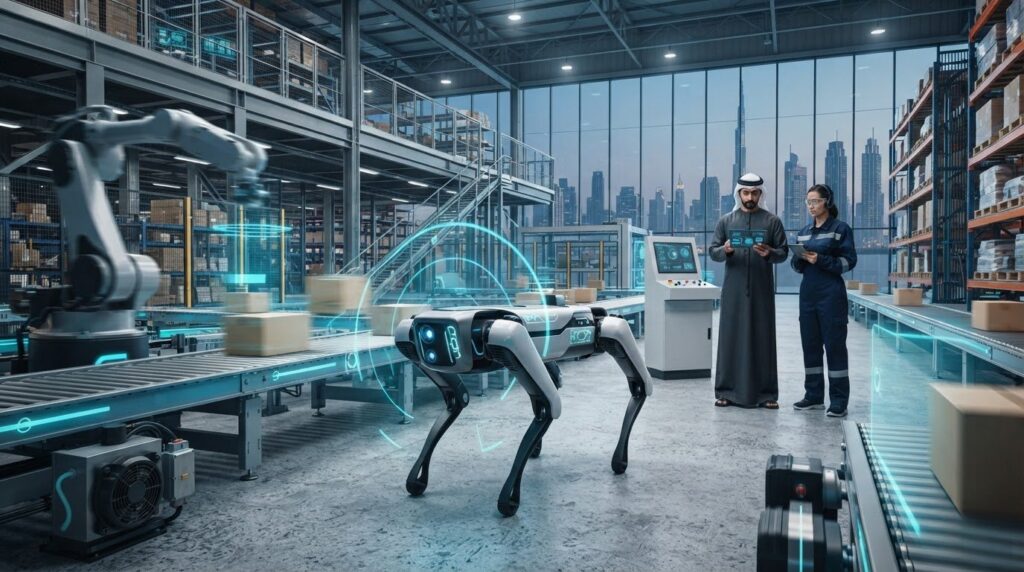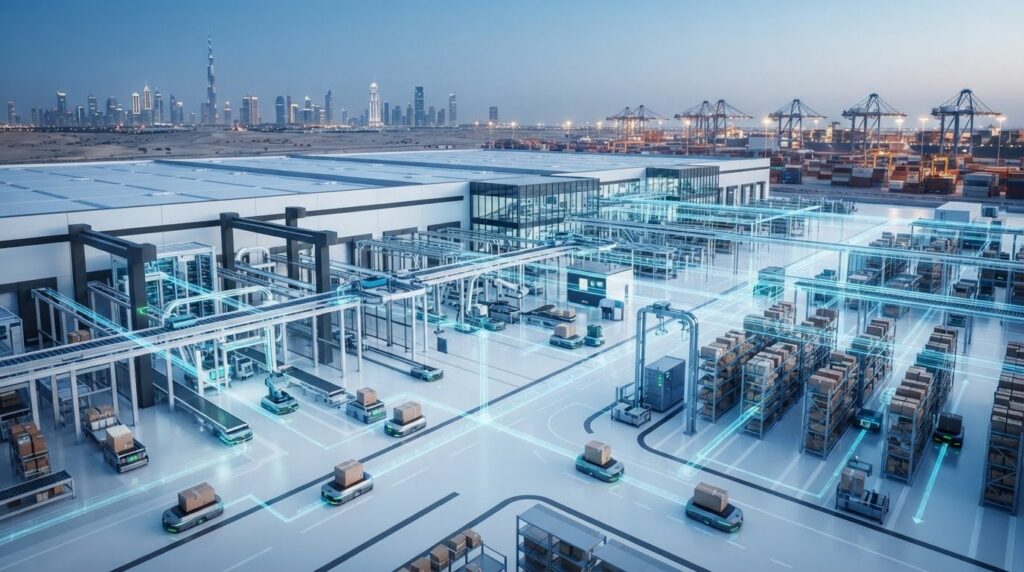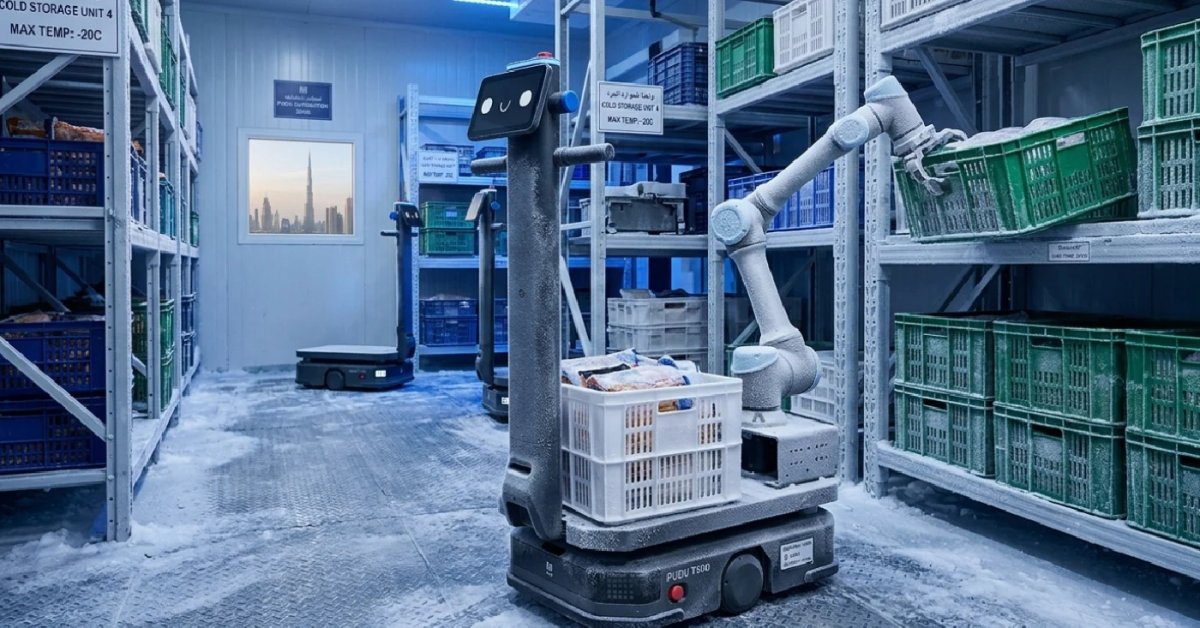
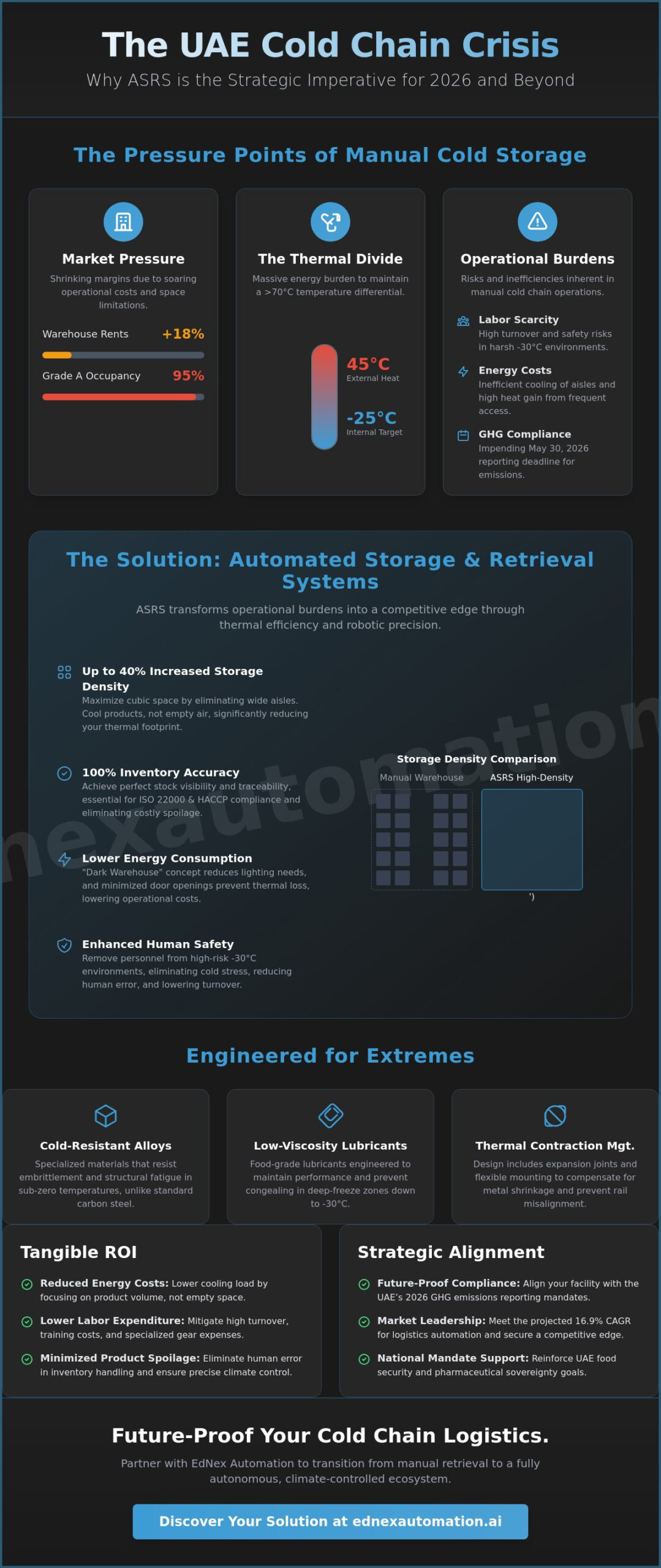
With warehouse rents across the UAE surging by 18% in the last year and Grade A occupancy hitting 95%, the margin for inefficient space utilization has vanished. Operating a cold chain in the UAE’s extreme climate is a relentless battle against thermal loss and labor scarcity in harsh -30°C environments. You’re likely feeling the pressure of rising energy costs and the critical May 30, 2026, GHG emissions reporting deadline. Implementing ASRS for cold storage isn’t just about moving pallets; it’s a strategic thermal management decision that transforms these operational burdens into a distinct competitive edge.
You’ll discover how high-density automated systems deliver 100% inventory accuracy while significantly lowering energy consumption through optimized volume cooling. We’ll explore the tangible ROI of robotic integration, compliance with the UAE’s stringent food safety standards, and how EdNex Automation provides the end-to-end robotics expertise needed to future-proof your logistics backbone. This guide breaks down the transition from manual retrieval to a fully autonomous, climate-controlled ecosystem that meets the rigorous demands of the UAE market.
Key Takeaways
- Understand why transitioning to ASRS for cold storage is a critical requirement for mitigating the operational risks of manual handling in extreme -30°C environments.
- Learn how to optimize your thermal footprint by increasing storage density by up to 40% and focusing cooling energy on products rather than empty aisle space.
- Explore the essential material science and technical requirements needed to ensure robotic reliability and longevity within the UAE’s demanding sub-zero facilities.
- Discover the strategic role of PLC and SCADA integration in creating a cohesive, real-time robotic ecosystem that ensures 100% inventory accuracy and operational resilience.
- Align your facility with the UAE’s 2026 GHG emissions reporting mandates by adopting energy-efficient automation that reduces your overall carbon footprint and operational costs.
Overcoming the Thermal Divide: Why Cold Storage ASRS is Essential in 2026
The UAE’s logistics sector, valued at approximately USD 23 billion in 2026, is undergoing a radical transformation driven by national food security mandates and pharmaceutical sovereignty. While external ambient temperatures in the GCC frequently exceed 45°C, the internal requirements for frozen storage remain fixed at -25°C or lower. This massive thermal divide creates an immense energy burden that traditional manual facilities can no longer sustain. Implementing an Automated Storage and Retrieval System (ASRS) allows operators to bridge this gap by creating a highly insulated, high-density environment. ASRS for cold storage is becoming the standard for enterprises that prioritize operational resilience over the outdated, reactive models of the past decade.
The UAE Cold Chain Landscape
In 2026, the UAE government’s classification of poultry and essential medicine as critical infrastructure has accelerated the need for automated precision. Traditional forklifts and manual picking methods struggle to meet the 16.9% CAGR projected for the logistics automation market through 2033. High-velocity throughput is now a requirement, not a luxury. Conventional equipment often experiences hydraulic sluggishness and rapid battery discharge in sub-zero zones, leading to frequent maintenance cycles. A future-ready enterprise utilizes automation to bypass these physical limitations, ensuring that cold chain integrity remains uncompromised regardless of external heatwaves or peak demand periods.
Labour Challenges in Harsh Environments
Operating in temperatures between -20°C and -30°C presents significant health and safety risks for human personnel. Cold stress, reduced cognitive function, and the physical limitations of wearing heavy specialized gear lead to high turnover rates and frequent human error. These errors often result in product spoilage or inventory inaccuracies that are costly in a market where Grade A warehouse occupancy averages 95%. By removing humans from the core storage zone, businesses can adopt the “Dark Warehouse” concept. This approach eliminates the need for human-centric lighting and high-velocity air exchange, which significantly reduces the heat gain associated with frequent door openings and internal activity.
Shifting from manual handling to ASRS for cold storage represents a move toward proactive automated throughput. Instead of reacting to labor shortages or equipment failure, managers can rely on robotic systems that maintain 100% inventory accuracy in pitch-black, sub-zero conditions. This precision is vital for complying with ISO 22000 and HACCP benchmarks, where real-time temperature monitoring and rapid retrieval are mandatory. By integrating these high-tech solutions, UAE firms secure their position as technological architects of a more resilient and efficient regional supply chain.
Engineering for Extremes: Technical Requirements for Sub-Zero Automation
Engineering for sub-zero environments requires a fundamental departure from standard industrial robotics. In a technical context, ASRS for cold storage refers to robotic systems specifically engineered with specialized materials to operate reliably in temperatures as low as -30°C. Standard carbon steel becomes brittle at these levels, leading to structural fatigue. We utilize cold-resistant alloys and low-viscosity, food-grade lubricants that won’t congeal or lose their lubricating properties in deep-freeze zones. Understanding the advantages of ASRS in the cold chain starts with recognizing that these systems are built from the ground up to handle extreme thermal stress; they account for the physical reality that metal shrinks as temperatures drop.
Thermal contraction management is a critical design pillar for UAE facilities. When a system transitions from the 45°C ambient heat of a Dubai summer to a -25°C frozen zone, the structural tolerances shift significantly. Our engineering approach utilizes expansion joints and flexible mounting configurations to prevent rail misalignment. By May 2026, AI-powered predictive maintenance has become a non-negotiable feature for high-density facilities. These next-gen systems monitor real-time sensor data to identify micro-vibrations or torque fluctuations, allowing operators to predict component failure before it disrupts the cold chain. This level of end-to-end robotics expertise ensures that your automation investment remains a reliable asset rather than a maintenance liability.
Specialized Hardware Components
Choosing between pallet shuttles and stacker cranes depends on your specific throughput requirements. While stacker cranes offer impressive vertical reach in high-bay warehouses, pallet shuttles leveraging advanced ASRS shuttle technology often provide superior density for deep-lane storage. Both systems require heated control cabinets to protect sensitive PLC electronics from condensation and frost. We utilize specialized cabling with Teflon or silicone jackets that remain flexible in the cold, preventing the cracking that often plagues standard electrical setups in frost-heavy environments.
Maintenance in the Cold
Maintaining a sub-zero system requires a strategic approach to accessibility. We design “warm-up zones” where robots can be periodically moved for service without breaking the facility’s primary cold seal. This prevents the formation of ice crystals on internal components during repair. Additionally, the use of digital twins allows us to simulate thermal stress on ASRS structures before physical deployment. This simulation identifies potential weak points in the racking or rail systems, ensuring the infrastructure can withstand the 2026 high-velocity logistics demands of the GCC region.
The ROI of Automation: Energy Efficiency and Operational Resilience
Achieving high-impact ROI in the UAE’s logistics sector requires more than just storing goods; it demands the radical optimization of every cubic meter of refrigerated space. With Grade A warehouse rents rising by 18% in Dubai over the past year, the financial burden of inefficient storage has reached a tipping point. Implementing ASRS for cold storage allows enterprises to increase storage density by up to 40% compared to traditional selective racking systems. This efficiency is quantified through calculating ROI for ASRS, focusing on square footage recovery and the drastic reduction of the ‘Air-to-Product’ ratio. By cooling products instead of the empty aisle space required for manual forklifts, operators can slash their refrigeration energy loads by approximately 30%. Before committing to a full deployment, developing a detailed ASRS cost estimate that accounts for throughput-per-square-meter efficiency is essential for building a defensible business case and securing board-level approval.
The transformation of labor costs is equally profound. Instead of deploying personnel into hazardous -30°C zones where productivity naturally drops, businesses can reallocate their workforce to high-value management and system oversight roles. This shift mitigates the costs of specialized cold-weather gear and reduces the risk of expensive product spoilage caused by human error during retrieval. Automated systems ensure that the ‘Dark Warehouse’ remains a closed thermal loop, minimizing the energy-intensive air exchange that occurs during frequent manual door openings.
Space Optimisation and Real Estate
High-bay warehouse designs are essential for the UAE’s future-ready enterprises. By building upwards rather than outwards, companies can significantly reduce their land acquisition costs and cooling footprint. Given that the average base construction cost for a climate-controlled or cold storage facility in Dubai ranges between AED 1,800 and AED 2,200+ per square meter, maximizing vertical space through deep-lane ASRS shuttle technology solutions or double-deep racking is a financial necessity. This approach ensures that every dirham spent on construction and cooling delivers maximum utility in a market where occupancy averages 95%.
Long-term Financial Sustainability
Long-term financial sustainability through ASRS for cold storage is anchored in the precision of automated inventory management. Systems that utilize ‘First-In-First-Out’ (FIFO) automation are vital for complying with the UAE’s strategic stockpile mandates, which require a six-month supply of essential goods. Automation eliminates the risk of expired stock and product loss, ensuring that high-velocity logistics operations remain profitable. This 24/7 operational capability provides a resilient backbone for the global supply chain, allowing UAE firms to maintain their status as regional leaders in logistics excellence.
Strategic Integration: Connecting ASRS with PLC and SCADA Ecosystems
Deploying high-performance hardware represents only half of a sophisticated automation strategy. True operational excellence in the GCC logistics sector stems from the seamless orchestration of physical assets through advanced control layers. At EdNex Automation, we advocate for end-to-end robotics expertise that transcends simple installation. By integrating ASRS for cold storage with Programmable Logic Controllers (PLC) and Supervisory Control and Data Acquisition (SCADA) systems, we transform isolated machines into a synchronized, intelligent ecosystem. This digital backbone ensures that every pallet movement is coordinated with real-time thermal conditions, preventing the mechanical bottlenecks that often plague poorly integrated facilities.
PLCs act as the central nervous system of the warehouse, managing the sub-millisecond coordination required for high-velocity robotic picking. When these controllers are linked to a SCADA interface, operators gain total visibility into both operational throughput and environmental stability. With the UAE’s mandatory GHG emissions reporting deadline of May 30, 2026, approaching, this level of data granularity is no longer optional. A well-integrated system allows you to track energy consumption per pallet move, directly feeding into corporate ESG reports and ERP systems for precise financial forecasting. To optimize your facility’s digital backbone, explore our PLC and SCADA integration services.
Unified Control Architectures
A “single pane of glass” approach is critical for maintaining cold chain resilience in extreme climates. By embedding temperature sensors directly into the ASRS control logic, the system can automatically adjust retrieval speeds or prioritize specific zones if a thermal fluctuation is detected. This proactive adjustment protects sensitive pharmaceutical or food stocks from spoilage. As industrial networks become more connected, our integration infrastructures prioritize robust cybersecurity protocols to protect your automated enterprise from external digital threats, ensuring 24/7 uptime in a competitive 2026 market.
Customising the Logic
Future-ready enterprises require tailored retrieval algorithms that account for more than just location. We customize control logic to manage “First-In-First-Out” (FIFO) protocols based on specific product shelf-lives, which is vital for managing the UAE’s strategic food stockpiles. Dynamic load balancing is also programmed into the system to prevent mechanical strain on components operating in -30°C zones, extending the lifespan of your ASRS for cold storage. SCADA systems function as the definitive supervisory layer that maintains cold chain integrity by aggregating real-time thermal data and robotic telemetry into a single actionable interface.
EdNex Automation: Your End-to-End Partner for Cold Chain Transformation
Shaping the future of robotics requires more than just high-spec machinery; it demands a partner who understands the gravity of industrial transformation and the technical nuances of sub-zero environments. EdNex Automation delivers excellence by bridging the gap between global technological breakthroughs and the specific logistics demands of the UAE. We provide a comprehensive framework that spans from initial technical feasibility to complex PLC and SCADA integration, ensuring that your investment in ASRS for cold storage is a strategic evolution toward becoming a future-ready enterprise. Our approach is fundamentally visionary, positioning your facility at the absolute cutting edge of innovation while maintaining the grounded reliability of a technical partner.
Delivering transformative automation in the GCC involves navigating a landscape where transport and storage sectors grew by 13.8% in late 2025. We act as a technological architect for your business, providing the intellectual framework necessary to implement autonomous systems that thrive where manual labor falters. By focusing on the transformative power of technology, we help UAE firms solve complex industrial challenges through controlled innovation and best-in-class engineering.
Why Choose EdNex?
As an authorized partner with global robotics leaders, we provide a stamp of legitimacy and quality that ensures access to next-gen hardware and specialized technical support. Our team possesses deep expertise in both advanced robotics and the underlying integration infrastructures that drive them. We don’t just sell machines. We provide a systematized approach to efficiency that includes:
- Authorized partner status with global leaders in ASRS and robotic technology.
- End-to-end robotics expertise, handling everything from the initial concept to final PLC coordination.
- A proven track record of delivering scalable, high-density storage solutions across the GCC region.
- Deep understanding of UAE-specific regulations, including Dubai Municipality food safety standards and 2026 GHG reporting mandates.
Getting Started with Cold Storage ASRS
The journey toward a fully autonomous facility begins with the EdNex consultation process, where our experts identify specific operational bottlenecks and calculate your potential ROI. We provide a tailored system design that accounts for every thermal variable, whether your facility manages pharmaceutical storage at -25°C or strategic food stockpiles. This methodical approach reassures our clients that their transition to ASRS for cold storage will be seamless, providing a resilient backbone for their logistics operations. Consult with our automation architects today to secure your position as a leader in the next generation of UAE logistics.
Architecting the Next Decade of Cold Chain Excellence
The transition toward fully automated cold chains is no longer a peripheral consideration for UAE enterprises. With warehouse occupancy at 95% and the May 30, 2026, emissions reporting deadline fast approaching, the pressure to optimize is undeniable. Implementing ASRS for cold storage provides the high-density architecture required to slash energy consumption by 30% while ensuring 100% inventory precision. This transformation moves your facility beyond manual limitations and into a realm of AI-powered operational resilience where every cubic meter is utilized with maximum efficiency. By adopting these technologies, you secure a resilient infrastructure capable of meeting the UAE’s strategic food and pharmaceutical security mandates.
EdNex Automation stands as your strategic bridge to this future. As an Authorized Partner with global robotics leaders, we combine specialized regional focus with deep expertise in PLC and SCADA integration to deliver comprehensive, Industry 4.0 systems. We don’t just supply hardware; we build the intellectual framework for a truly future-ready enterprise that thrives in the GCC’s unique industrial climate. Partner with EdNex Automation for end-to-end ASRS expertise to secure your competitive advantage in the evolving logistics landscape. Your facility’s evolution begins with a single, calculated step toward total automation.
Frequently Asked Questions
Can ASRS systems operate in -30°C environments without failure?
Yes, specialized robotic systems are engineered using cold-resistant alloys and low-viscosity lubricants to ensure reliable operation at temperatures as low as -30°C. Standard industrial equipment often fails due to brittle steel or congealed fluids; however, ASRS for cold storage utilizes heated control cabinets and specialized cabling to protect sensitive electronics. These systems are designed to account for thermal contraction, ensuring that rail alignments remain precise despite the extreme temperature gap between the UAE’s external heat and internal frozen zones.
How much space can I save by implementing ASRS in my cold storage facility?
Implementing automation allows you to increase storage density by up to 40% compared to traditional selective racking methods. By utilizing high-bay warehouse designs that reach vertical heights exceeding 30 meters, you can build up instead of out. This strategy minimizes the physical footprint and maximizes the utilization of every square meter of expensive real estate. In a market where Grade A warehouse occupancy averages 95%, this vertical optimization is essential for scaling operations without acquiring additional land.
What is the typical ROI period for an automated cold storage system in the UAE?
The typical ROI period for an automated system in the UAE logistics market ranges between three and five years. This calculation accounts for a 30% reduction in labor costs and significant energy savings from optimized cooling. With warehouse rents in Dubai rising by 18% in the last year, the payback period is accelerating as the cost of manual inefficiency grows. Delivering excellence through automation ensures that your facility remains profitable while meeting the UAE’s strategic stockpile mandates.
How does ASRS integration with SCADA improve cold chain safety?
SCADA integration provides real-time visibility into both robotic telemetry and thermal metrics, ensuring that any temperature fluctuation is identified before it causes product spoilage. By linking temperature sensors directly to the ASRS control logic, the system can automatically prioritize the retrieval of sensitive goods if cooling thresholds are breached. This creates a proactive safety net that ensures 100% compliance with ISO 22000 benchmarks. It’s a critical tool for maintaining the integrity of pharmaceutical and food supplies in the GCC.
Do I need to shut down my facility to install an ASRS system?
Complete facility shutdowns aren’t required if a phased implementation strategy is utilized during the retrofit. While greenfield projects allow for the most seamless integration, brownfield retrofits can be managed by isolating specific zones during the installation of racking and rail systems. This approach ensures that your existing cold chain operations continue to meet market demands while the new infrastructure is commissioned. Shaping the future of your logistics backbone doesn’t have to come at the cost of current productivity.
What maintenance is required for robotic systems in sub-zero temperatures?
Maintenance for sub-zero robotics requires “warm-up zones” where equipment is periodically moved to prevent ice crystal formation on internal components. AI-powered predictive maintenance tracks micro-vibrations and torque fluctuations to identify potential failures before they occur. This strategy eliminates the need for technicians to spend extended periods in hazardous -30°C environments, improving both safety and system uptime. By monitoring real-time data, operators can schedule service cycles that don’t disrupt the high-velocity throughput required in the 2026 market.
Is ASRS suitable for both palletized and small-load cold storage?
ASRS for cold storage is highly versatile and accommodates both heavy palletized goods and small-load totes. Pallet shuttles and stacker cranes manage bulk inventory; meanwhile, miniload systems or specialized AMRs handle smaller picking requirements for e-commerce or pharmaceutical applications. This flexibility allows UAE enterprises to tailor their automation strategy to their specific product mix and throughput requirements. It ensures that both high-volume poultry storage and low-volume, high-value medicine can be managed within a single, integrated infrastructure.
How does ASRS help in reducing energy consumption for cooling?
Automation reduces energy consumption by approximately 30% through the elimination of human-centric lighting and the reduction of frequent door openings. A “Dark Warehouse” configuration minimizes heat gain by keeping the cold zone sealed and focused on cooling products rather than empty aisle space. This efficiency is critical for meeting the UAE’s mandatory GHG emissions reporting deadline on May 30, 2026. By cooling a smaller, more dense volume, operators significantly lower their carbon footprint and operational costs simultaneously.