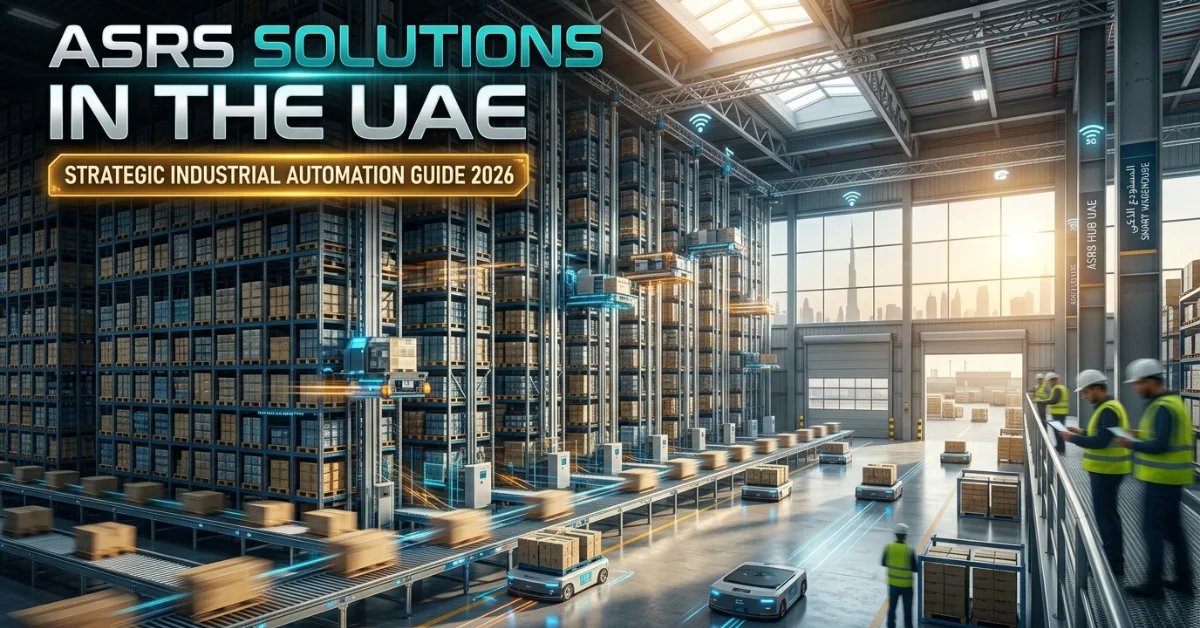
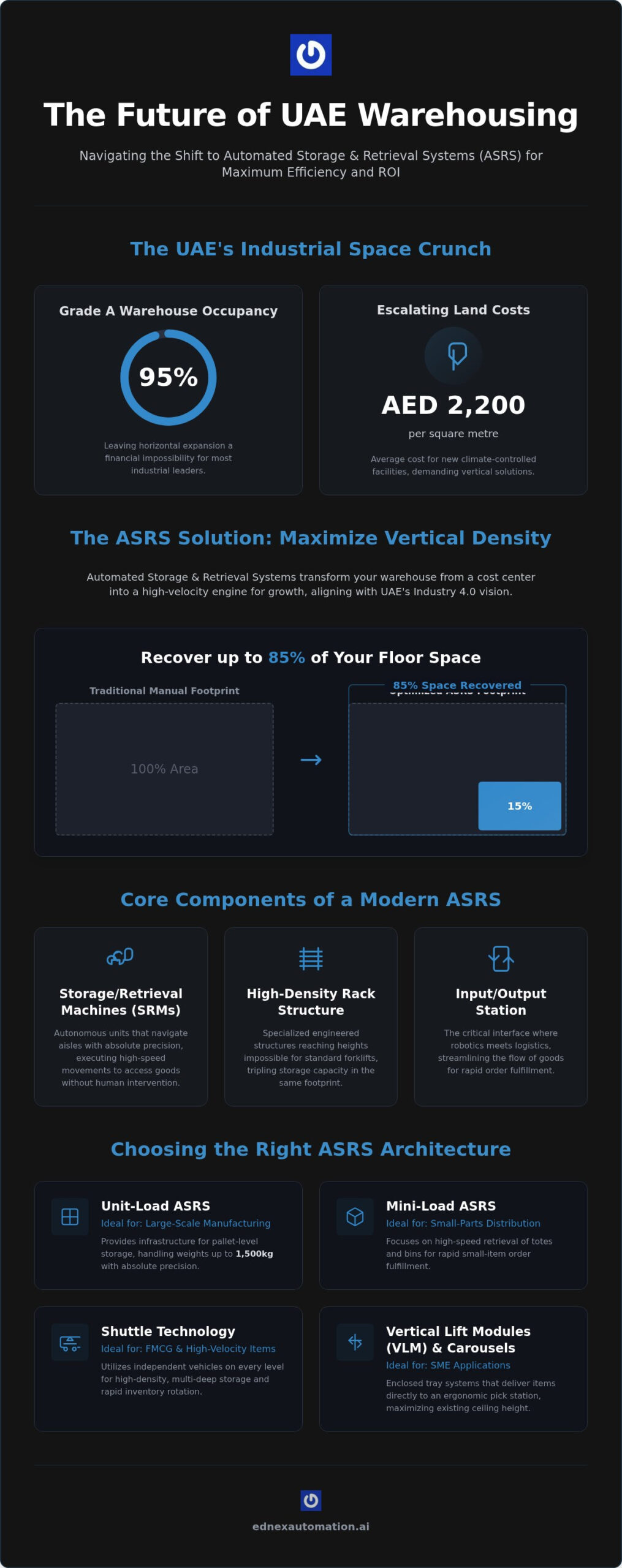
With Grade A warehouse occupancy across the UAE reaching a staggering 95 per cent, the traditional strategy of horizontal expansion has become a financial impossibility for most industrial leaders. You likely recognise that the escalating cost of industrial land, currently averaging up to AED 2,200 per square metre for climate-controlled facilities, necessitates the adoption of advanced ASRS solutions UAE to maximise vertical density. Relying on manual picking processes and fragmented legacy systems no longer suffices in a market where speed and precision define your competitive edge.
This strategic guide details how to integrate automated storage and retrieval systems with your existing PLC and SCADA infrastructure to achieve maximum throughput and ROI. We will explore the technical framework necessary to transition from inefficient manual workflows to a fully autonomous, data-driven environment that satisfies the latest 2026 national environmental mandates. By aligning your facility with Industry 4.0 standards, you can transform your warehouse from a simple storage site into a high-velocity engine of industrial growth, ensuring long-term viability in an increasingly automated regional economy.
Key Takeaways
- Evaluate how high-density robotic systems align with the UAE national strategy for industrial digitisation to future-proof your large-scale operations.
- Quantify the strategic ROI of vertical storage, which can recover up to 85% of floor space while drastically reducing long-term manual labour expenses.
- Select the optimal architecture by matching specific SKU profiles and payload requirements to unit-load or mini-load configurations for maximum throughput.
- Optimise system performance by leveraging expert PLC and SCADA integration to synchronise warehouse management and control systems for high-performance ASRS solutions UAE.
- Implement a comprehensive roadmap for automation success, bridging global technological innovation with regional industrial requirements through end-to-end technical support.
Navigating the Shift to Automated Storage and Retrieval Systems (ASRS) in the UAE
In the evolving industrial landscape of 2026, it’s vital to distinguish between administrative acronyms and transformative technology. While some regional search results link ASRS to recruitment services, for industrial leaders, Automated Storage and Retrieval Systems (ASRS) represent a high-density robotic framework designed for buffering, storing, and retrieving inventory on demand. These systems are central to the UAE National strategy for industrial digitisation, specifically supporting the “We the UAE 2031” vision to double GDP through non-oil exports and advanced manufacturing. By integrating these systems, you align your operations with a national mandate for technological sovereignty and operational excellence.
As Grade A warehouse occupancy across the country remains at a critical 95 per cent, verticality has become the primary solution for land-constrained industrial zones. Implementing ASRS solutions UAE allows organisations to move beyond traditional static racking. You’re no longer just managing physical space; you’re operating an intelligent, software-driven storage environment that treats every cubic centimetre as a high-velocity data point. This shift is essential for businesses facing the high construction costs of climate-controlled facilities, which now exceed AED 2,200 per square metre.
The Core Components of a Modern ASRS Environment
A sophisticated ASRS deployment relies on three integrated pillars to ensure operational continuity and high-speed throughput:
- Storage and Retrieval Machines (SRMs): These autonomous units navigate aisles with absolute precision, executing high-speed movements to access goods without human intervention or the limitations of manual equipment.
- The Rack Structure: High-density vertical loads require specialised engineering. These structures often reach heights impossible for standard forklifts, effectively doubling or tripling your storage capacity within the same footprint.
- The Input/Output Station: This is the critical interface where robotics meets logistics, often integrating with AMRs and specialized material handling systems from Quintec Conveyors to streamline the flow of goods to the dispatch bay for rapid order fulfilment.
Distinguishing ASRS Technology from Manual Warehousing
The transition to automation eliminates the inherent variability and error rates of human performance in high-velocity picking environments. In heavy industrial sectors, these systems significantly enhance safety protocols by removing personnel from high-traffic zones and reducing the risk of workplace hazards associated with manual handling. ASRS is an autonomous infrastructure that maximises cubic volume without increasing physical footprint. By adopting ASRS solutions UAE, businesses transition from reactive storage to proactive inventory management, ensuring they remain competitive in a market defined by rapid fulfillment and strict environmental compliance.
A Technical Breakdown of Modern ASRS Architectures
Identifying the correct architecture is the primary engineering challenge when designing a high-performance facility. You must align your ASRS solutions UAE with specific SKU profiles and payload requirements to prevent under-utilised capacity. It’s vital to ensure mechanical components aren’t strained by improper loading. For large-scale manufacturing, Unit-Load ASRS provides the necessary infrastructure for pallet-level storage, handling weights up to 1,500kg with absolute precision. Conversely, Mini-Load systems focus on high-speed retrieval of totes and bins, making them ideal for small-parts distribution. For the fast-moving consumer goods (FMCG) sector, shuttle technology has evolved into the standard for high-density, multi-deep storage. These systems utilise independent vehicles on every level to ensure that high-velocity items are always accessible, allowing for rapid inventory rotation that manual systems can’t match.
Vertical Lift Modules (VLM) and Carousels
Vertical Lift Modules (VLM) and Carousels are particularly effective for small-to-medium enterprise (SME) applications where maximising existing ceiling height is a priority. These systems act as enclosed cabinets of trays that deliver items directly to an ergonomically designed pick station. By adopting goods-to-person workflows, you drastically reduce the travel time for warehouse operatives, increasing picking accuracy to near 100 per cent. Integrating these modules with autonomous mobile robots creates a seamless end-to-end flow. This combination moves retrieved items from the storage core to the dispatch bay without manual intervention, ensuring that your workforce remains focused on high-value tasks rather than repetitive transit.
Micro-Fulfillment and the Rise of Urban Logistics
The rapid expansion of the UAE retail and quick-commerce sectors, projected to grow at a CAGR of 13.76 per cent through 2031, has necessitated the move toward micro-fulfillment. These systems are designed to fit into smaller, urban footprints closer to the end consumer, reducing last-mile delivery times. Modular ASRS designs offer the scalability required to grow alongside your business volume, allowing for the addition of more robots or storage bins as demand increases. Beyond throughput, automated systems provide a significant advantage in temperature-controlled environments. High-density storage reduces the total cubic volume that requires cooling, potentially lowering energy consumption by up to 30 per cent. This efficiency is critical for meeting the strict 2026 GHG emissions reporting standards while maintaining pharmaceutical or food-grade sovereignty. For organisations seeking to optimise these complex deployments, consulting with industrial automation experts ensures the selection of a system tailored to your specific operational constraints.
Evaluating Strategic ROI: Why ASRS is the Foundation of Industry 4.0
Measuring the financial viability of ASRS solutions UAE requires a shift from viewing automation as a capital expense to evaluating it as a long-term strategic asset. Calculating the Total Cost of Ownership (TCO) involves comparing the upfront investment against the compounding expenses of manual labour, recruitment, and the rising cost of industrial real estate. With Grade A warehouse space at a premium, recovering up to 85 per cent of floor space through vertical density provides an immediate and quantifiable return. This reclaimed area can be repurposed for production lines or additional inventory, effectively expanding your capacity without the need for expensive physical warehouse construction.
Beyond physical space, throughput gains represent a primary driver for ROI. Automated systems allow for a significant increase in hourly picking cycles, ensuring that high-demand orders are processed with a speed that manual teams can’t replicate. When combined with real-time Warehouse Management System (WMS) integration, facilities achieve 99.9 per cent inventory precision. This level of accuracy eliminates the hidden costs of mispicks, returns, and stockouts, creating a lean operational environment that’s essential for Industry 4.0 compliance.
ASRS for Cold Storage and Hazardous Environments
Extreme temperature zones, such as cold storage facilities operating as low as -30°C, present significant operational pains for human labour. ASRS solutions ensure consistency in performance, maintaining throughput in 24/7 industrial cycles where manual efficiency typically degrades due to environmental stress. By removing personnel from these hazardous or high-strain environments, you mitigate health and safety risks while ensuring a steady flow of goods. ASRS provides a predictable ROI by stabilising operational costs against fluctuating labour markets.
Future-Proofing via Modular Automation
The transition from static storage to automated storage and retrieval systems isn’t a one-time event but an ongoing evolution. Utilising open-architecture systems mitigates the risks of technological obsolescence, allowing for the seamless integration of future robotic upgrades. This modularity ensures your infrastructure remains relevant as UAE market demands shift. Aligning with national sustainability goals is equally critical; the high-density nature of these systems reduces the energy required for lighting and climate control, directly supporting compliance with the 2026 GHG emissions reporting standards.
Engineering the Integration: Aligning ASRS with PLC and SCADA Infrastructure
Successful deployment of ASRS solutions UAE relies on more than mechanical excellence; it requires a robust digital backbone that connects physical robotics to high-level enterprise software. Integrating these systems necessitates a hierarchical control architecture where the Warehouse Management System (WMS) handles business logic and order prioritisation, while the Warehouse Control System (WCS) dictates the specific movements of the hardware. Achieving seamless performance depends on leveraging expert PLC and SCADA integration services to ensure that every command is executed with millisecond precision. Without this alignment, even the most advanced cranes and shuttles will suffer from latency issues that degrade overall facility throughput.
Real-time data visualisation is the cornerstone of modern industrial oversight. By utilising SCADA dashboards, operators gain a comprehensive view of system health, energy consumption, and real-time retrieval rates. This transparency allows for the immediate identification of bottlenecks before they impact the supply chain. As warehouses become increasingly interconnected through Industry 4.0 protocols, cybersecurity for automated facilities has become a critical priority. Protecting the industrial network ensures that sensitive inventory data and operational controls remain shielded from external threats, maintaining the integrity of your national logistics infrastructure.
The Interplay Between ASRS and Industrial Control Systems
Programmable Logic Controllers (PLCs) act as the primary interface for the mechanical layer, managing the precise acceleration and positioning of storage and retrieval machines (SRMs). These controllers process inputs from thousands of sensors to ensure safe and accurate operation in high-density environments. When integrated with a SCADA system, this sensor data serves as a single source of truth for facility-wide oversight. Advanced deployments now utilise this data for predictive maintenance, identifying wear in motors or drive belts before a failure occurs; you can read more about the specialized power transmission components used in these systems. This proactive approach prevents costly system downtime, ensuring that your 24/7 industrial cycles remain uninterrupted.
The efficiency of an automated warehouse is defined by the speed at which data moves from the receiving dock to the storage rack. Integrating RFID and Automatic Identification and Data Capture (AIDC) technologies allows for the instantaneous tracking of goods as they enter the ASRS environment. Bespoke software integration is essential for managing complex, multi-vendor environments where different robotic components must communicate over a unified network. Ensuring low-latency communication between the control layer and robotic hardware is vital for maintaining the high-velocity picking cycles required in the 2026 market. For organisations ready to bridge the gap between legacy infrastructure and modern robotics, partnering with a specialized systems integrator is the most reliable path to achieving a future-proofed facility.
Strategic ASRS Implementation with EdNex Automation
Navigating the complexities of large-scale industrial transformation requires a partner who functions as a bridge between global technological breakthroughs and regional operational needs. EdNex Automation, a specialised division of the EdNex group founded in 2018, provides the intellectual and technical framework necessary to deploy advanced ASRS solutions UAE. We don’t merely supply machinery. Our team engineers comprehensive ecosystems that align with the national vision for a digitised, non-oil economy. By focusing on start-to-finish expertise, we ensure that your transition to an autonomous warehouse is controlled, deliberate, and fully integrated with your existing industrial fabric.
Our commitment to long-term reliability is backed by national technical support across the UAE, providing the assurance that your high-velocity operations remain functional and efficient. As the industrial landscape evolves toward 2026 standards, partnering with an integrator who understands the gravity of Industry 4.0 is essential. We facilitate this evolution by providing the software and hardware synchronisation required to maintain a competitive advantage in a market defined by rapid fulfilment and stringent environmental compliance. This systematic approach brings order and safety to complex environments through controlled innovation.
The EdNex Automation Integration Framework
Adopting a consultative design approach allows us to tailor ASRS deployments to the specific challenges of diverse sectors, including Oil & Gas, Retail, and Manufacturing. We manage the entire lifecycle of the project, from initial feasibility studies to full-scale PLC and SCADA integration. This end-to-end execution mitigates the risks associated with multi-vendor environments, ensuring that robotic hardware and control software function as a unified entity. Our status as an authorised partner for global robotics manufacturers, combined with official certifications, serves as a marker of technical legitimacy and excellence in the field of industrial automation.
Commencing Your Automation Journey
Initiating your facility’s transformation begins with a comprehensive audit to identify bottlenecks and define a clear automation roadmap. Leveraging EdNex expertise ensures that your infrastructure is prepared for the demands of Industry 4.0, from low-latency communication to advanced data analytics. By establishing a robust foundation today, you secure the long-term viability of your organisation in an increasingly automated regional economy. Consult with EdNex Automation experts to design your bespoke ASRS solution and take the first step toward a future-proofed, high-density industrial environment.
Architecting the Future of UAE Industrial Infrastructure
Transitioning to high-density automation is no longer a discretionary upgrade but a fundamental requirement for maintaining long-term business viability. By adopting advanced ASRS solutions UAE, you effectively decouple your operational capacity from the constraints of physical land and manual labour variability. We’ve explored how the strategic alignment of storage hardware with sophisticated PLC and SCADA layers creates a responsive, data-driven ecosystem that satisfies both throughput demands and national environmental mandates. This evolution transforms your facility into a future-proofed asset capable of navigating the complexities of the 2026 industrial landscape.
Achieving this level of operational excellence requires a partner with visionary Industry 4.0 leadership and comprehensive technical expertise. EdNex Automation provides the intellectual framework and national technical support necessary to ensure your systems remain reliable and efficient throughout their lifecycle. Our start-to-finish approach manages the intricate details of software synchronisation and hardware deployment, allowing you to focus on high-level strategic growth. Partner with EdNex Automation for your National ASRS deployment and lead the shift toward a more autonomous, efficient, and intelligent industrial future. Your journey toward total warehouse optimisation starts with a single, deliberate step into the next era of automation.
Frequently Asked Questions
What is the typical ROI period for an ASRS solution in the UAE?
Balancing ambitious innovation with grounded technical partnership, the ROI for ASRS solutions UAE typically manifests within a three-to-five-year window. This timeline is heavily influenced by the immediate recovery of up to 85 per cent of floor space and the mitigation of escalating industrial land costs. By stabilising operational expenses against fluctuating labour markets, these systems provide a predictable financial trajectory that justifies the initial capital allocation for large-scale industrial transformation.
Can ASRS be integrated into an existing warehouse without building a new facility?
Integrating advanced storage robotics into existing brownfield facilities is entirely feasible through bespoke engineering and modular design. Rather than necessitating new construction, these systems are frequently deployed within current footprints to maximise vertical density and cubic volume. This approach allows organisations to modernise their operations without the disruption of relocating, provided the existing floor slabs meet the structural requirements for high-density vertical loading and robotic precision.
How does ASRS technology handle different SKU sizes and pallet types?
Modern architectures are designed to accommodate a diverse spectrum of inventory profiles, from individual small parts to heavy palletised loads. Utilising specialised end-effectors and adjustable racking configurations, systems like Mini-Load or Unit-Load ASRS can manage varying SKU dimensions with absolute precision. This versatility ensures that your automation framework remains responsive to shifting inventory requirements, allowing for the seamless handling of both standard Euro-pallets and non-standard containers within a unified environment.
What happens to ASRS operations during a power outage or system failure?
Ensuring operational continuity during power fluctuations requires the integration of Uninterruptible Power Supplies (UPS) and industrial-grade backup generators. In the event of a system failure, advanced PLC and SCADA frameworks provide immediate diagnostic feedback to facilitate rapid troubleshooting. Most systems also feature manual override protocols or redundant robotic units, ensuring that critical inventory retrieval remains possible while the primary automation layer is restored to full operational status.
Is ASRS technology compatible with existing Warehouse Management Systems (WMS)?
Achieving seamless synchronisation between robotic hardware and existing Warehouse Management Systems is a standard component of professional integration. Utilising robust APIs and middleware, the Warehouse Control System acts as a bridge that translates business logic into mechanical execution. This high-level compatibility ensures that inventory data remains accurate across all enterprise platforms, facilitating the real-time tracking and high-velocity picking cycles essential for modern Industry 4.0 compliance.
What level of maintenance is required for high-density automated storage systems?
Maintaining peak performance in high-density environments necessitates a structured preventive maintenance schedule focused on mechanical drive components and sensor calibration. Leveraging the diagnostic capabilities of SCADA systems, operators can implement predictive maintenance strategies that identify potential wear before it results in unplanned downtime. While these systems require specialised technical oversight, the reduction in manual equipment wear and tear often results in lower long-term maintenance overhead compared to traditional forklift-based operations.
How does ASRS improve workplace safety in industrial environments?
Enhancing workplace safety is a primary benefit of transitioning to autonomous storage, as it effectively removes personnel from high-traffic zones and hazardous environments. By automating the movement of heavy loads at significant heights, these systems eliminate the risks associated with manual handling and forklift collisions. Integrated safety sensors and light curtains provide an additional layer of protection, ensuring that robotic movements are immediately halted if human intrusion is detected within the automated zone.
Can ASRS solutions be scaled as business requirements grow?
Designing for scalability is a core principle of modern industrial automation, allowing businesses to expand their storage capacity in alignment with market demand. Modular ASRS solutions UAE permit the addition of extra aisles, storage levels, or robotic units without requiring a complete system overhaul. This flexibility ensures that your initial investment remains viable as business requirements grow, providing a future-proofed solution that evolves alongside the nation’s rapidly expanding logistics and manufacturing sectors.