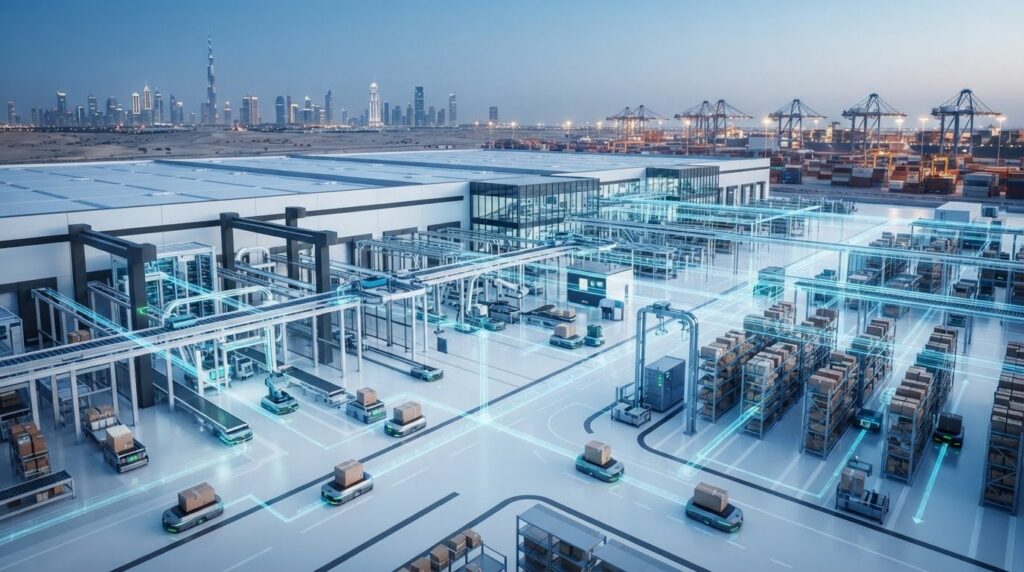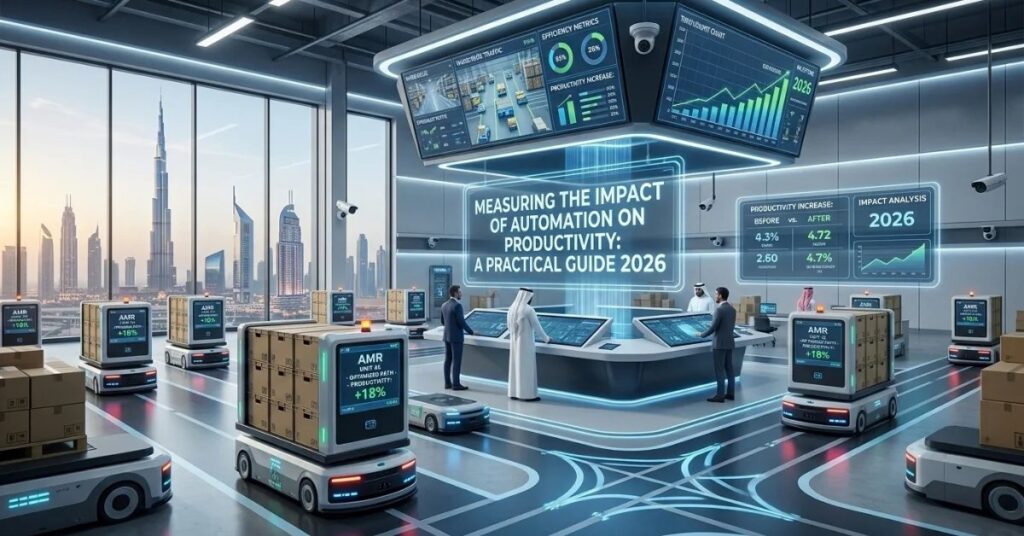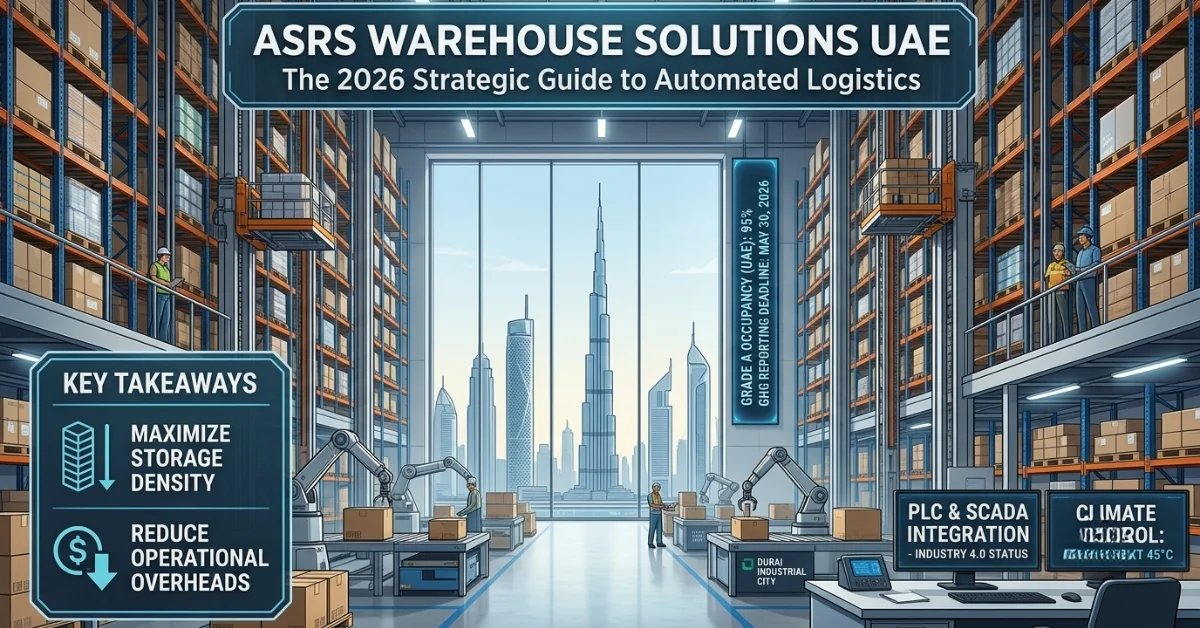
With Grade A warehouse occupancy across the UAE reaching 95% and rental rates in Dubai Industrial City surging by 32% over the last year, can your facility afford to leave its vertical space unutilized? You’re likely navigating the dual pressure of rising real estate costs and the urgent May 30, 2026, deadline for mandatory GHG emissions reporting. Managing these complex supply chain demands while relying on manual labor in extreme climates is no longer a sustainable strategy for long-term growth.
By deploying advanced ASRS warehouse solutions UAE, you’ll secure a significant competitive advantage through high-density optimization and seamless industrial integration. This guide provides a strategic roadmap for leveraging automated storage to maximize storage density and reduce operational overheads. We’ll explore how integrating sophisticated robotic hardware with PLC and SCADA systems creates a future-proofed Industry 4.0 facility that ensures business viability in an increasingly competitive regional market. From mitigating real estate risks to achieving autonomous efficiency, discover how these systems redefine the standards of modern logistics.
Key Takeaways
- Understand the critical role of automated storage in the UAE’s industrial digital transformation, enabling facilities to achieve maximum storage density in high-cost real estate markets.
- Learn to distinguish between unit-load and mini-load architectures to select the optimal ASRS warehouse solutions UAE for your specific pallet or bin-level requirements.
- Analyze the business case for automation by focusing on total cost of ownership and the strategic reallocation of labor to high-value industrial roles.
- Recognize the necessity of integrating ASRS with PLC and SCADA networks to create a unified, data-driven control architecture for your facility.
- Master a structured roadmap for implementation, starting with throughput modeling and concluding with bespoke technological integration for Industry 4.0 readiness.
Table of Contents
- What are ASRS Warehouse Solutions and Why are They Essential in the UAE?
- Primary ASRS Technologies: Selecting the Right Architecture
- The Business Case: ROI and Operational Benefits in the UAE
- Strategic Integration: Connecting ASRS with PLC and SCADA Networks
- Implementing ASRS with EdNex Automation: Your Industry 4.0 Roadmap
What are ASRS Warehouse Solutions and Why are They Essential in the UAE?
The evolution of logistics within the Emirates has reached a critical juncture where traditional storage methods can no longer sustain the velocity of regional growth. An Automated Storage and Retrieval System (ASRS) represents a sophisticated synergy of computer-controlled systems designed for the autonomous placement and retrieval of loads from defined storage locations. As the UAE accelerates its transition toward a high-tech manufacturing hub under the “Operation 300bn” initiative, these systems have moved from luxury acquisitions to essential infrastructure. Implementing ASRS warehouse solutions UAE provides the technical foundation required to support high-throughput environments while maintaining the precision demanded by modern global supply chains.
The architecture of a modern ASRS consists of three primary pillars: high-density storage structures, precision retrieval machines such as cranes or shuttles, and integrated software interfaces that orchestrate every movement. By 2026, several economic factors have converged to make this a pivotal year for automation. The mandatory GHG emissions reporting deadline of May 30, 2026, forces businesses to seek energy-efficient operational models, while the projected growth of the logistics market toward USD 31.41 billion necessitates a departure from manual, labor-intensive processes. These systems don’t just store goods; they manage data and energy with a level of intelligence that manual facilities can’t replicate.
The Strategic Importance of High-Density Storage
Rising industrial land premiums, specifically the 32% year-on-year rental growth seen in Dubai Industrial City, have made horizontal expansion financially unviable for many organizations. Maximizing vertical space allows operators to increase their pallet positions without increasing their facility’s physical footprint, effectively neutralizing the impact of high real estate costs. Defining ASRS as the intersection of robotics and structural engineering, these systems provide the skeletal framework for modern industrial intelligence. By utilizing the full clear height of a building, ASRS warehouse solutions UAE transform underused air space into productive, high-density assets.
ASRS vs. Conventional Racking: A Comparative Overview
When comparing automated cycles to manual picking, the differences in speed and throughput are stark. Automated systems operate with a consistent, tireless velocity that manual teams can’t maintain in the UAE’s extreme climate, ensuring that fulfillment deadlines are met regardless of external conditions. Accuracy remains a critical differentiator; by eliminating human error in the warehouse, ASRS ensures near-perfect inventory control and reduces the costs associated with mispicks. Safety benefits are equally compelling. By reducing or entirely eliminating forklift traffic in high-density zones, facilities significantly lower the risk of operator injury and racking damage, creating a controlled environment where safety and efficiency coexist through deliberate innovation.
Primary ASRS Technologies: Selecting the Right Architecture
Selecting the correct architecture for ASRS warehouse solutions UAE requires a deep understanding of payload dynamics and throughput velocity. As regional businesses navigate the booming market for warehouse automation, they must distinguish between systems designed for massive industrial pallets and those optimized for rapid-fire e-commerce fulfillment. The choice of hardware isn’t merely an equipment purchase; it’s a strategic decision that dictates your facility’s long-term operational ceiling. Before finalizing a design, engineers typically evaluate several critical factors:
- Payload Profile: Determining whether the system must handle 1,500kg pallets or 5kg totes.
- Throughput Requirements: Calculating the number of storage and retrieval cycles needed per hour.
- Building Constraints: Assessing clear height availability and floor slab load-bearing capacity.
- Future Scalability: Ensuring the system can expand as SKU counts or order volumes increase.
Unit-load systems serve as the heavy lifters of the industry, managing large pallets and substantial industrial components with absolute precision. Conversely, mini-load systems offer optimal solutions for bins, totes, and small parts, providing the agility needed for high-frequency picking operations. For sites constrained by narrow footprints or urban locations, Vertical Lift Modules (VLM) and carousel systems provide a dense storage alternative that prioritizes vertical height over floor area, effectively turning small rooms into high-capacity vaults.
Shuttle and Crane-Based Systems
Stacker cranes represent the traditional backbone of high-bay environments, operating with dedicated masts to reach heights exceeding 30 meters. Transitioning to more flexible layouts, 4-way pallet shuttles allow for multi-directional movement, effectively decoupling horizontal and vertical transport to eliminate single points of failure. Maintaining these heavy-duty retrieval machines requires a proactive approach, ensuring that mechanical components remain calibrated for continuous, high-speed cycles in demanding industrial environments.
The Evolution: AMR-Based Storage and Cube Storage
Modern facilities are increasingly integrating autonomous mobile robots with static racking to create hybrid environments that don’t require fixed, permanent infrastructure. Cube-based storage takes this a step further, achieving the highest possible density for e-commerce by eliminating aisles entirely and utilizing top-loading robotic grids. This model offers unparalleled scalability; you can increase throughput simply by adding more robots rather than expanding your physical footprint. It’s a modular approach that allows for incremental investment as demand grows, providing a safety net against market volatility. Identifying the ideal mix of these technologies is the first step toward a truly autonomous facility. If you’re ready to evaluate which architecture fits your specific operational goals, exploring integrated ASRS frameworks can help clarify your path forward.
The Business Case: ROI and Operational Benefits in the UAE
Evaluating the financial viability of ASRS warehouse solutions UAE requires a shift from viewing automation as a capital expenditure to recognizing it as a strategic asset for long-term value creation. Calculating the Total Cost of Ownership (TCO) involves analyzing the lifecycle of the machinery against the backdrop of escalating operational costs. While the initial investment in robotic infrastructure is higher than conventional racking, the reduction in human capital requirements and the elimination of manual handling errors create a rapid path to profitability. Facilities that transition to these systems often see a stabilization of overheads that manual operations, burdened by rising wages and recruitment challenges, simply cannot achieve.
Operational resilience is particularly critical in the UAE’s extreme climate, where maintaining high throughput in temperatures exceeding 40°C poses significant risks to human health and equipment longevity. Automated systems operate with consistent precision in environments that would otherwise require expensive, high-intensity climate control for human comfort. By transitioning to “dark warehouse” configurations in automated zones, businesses can significantly reduce energy consumption related to lighting and HVAC systems. This optimization directly supports the mandatory May 30, 2026, deadline for Scope 1 and Scope 2 GHG emissions reporting, positioning the facility as a leader in sustainable industrial practice.
Mitigating Labor and Real Estate Constraints
Addressing the regional labor shortage through robotic reliability ensures that facility throughput remains unaffected by fluctuations in the workforce. These systems allow management to reallocate human capital to higher-value technical roles, such as system supervision and data analysis, rather than repetitive physical tasks. By consolidating storage into a high-density vertical footprint, ASRS reduces the cost per pallet position over a 10-year horizon compared to the compounding expenses of traditional leased space and manual handling. This efficiency is vital given that Grade A warehouse occupancy in the UAE remains at a staggering 95%, leaving little room for those who fail to optimize their existing square footage.
Supply Chain Agility and Resilience
Managing seasonal peaks in demand without increasing headcount is a primary advantage of a scalable automated architecture. Real-time inventory visibility allows for just-in-time manufacturing protocols, reducing the need for excess safety stock that ties up working capital. Controlled robotic handling also minimizes product damage, which is a common byproduct of high-velocity manual picking. Utilizing ASRS warehouse solutions UAE transforms the warehouse from a static cost center into a dynamic, data-driven engine capable of adapting to the rapid growth of the projected USD 31.41 billion regional logistics market. Each movement is recorded and optimized, providing the intellectual framework necessary for continuous operational improvement.
Strategic Integration: Connecting ASRS with PLC and SCADA Networks
Orchestrating the movement of thousands of SKUs requires a control layer far more responsive than standard warehouse software. While the physical cranes and shuttles form the skeletal structure of ASRS warehouse solutions UAE, the integration of Programmable Logic Controllers (PLC) and Supervisory Control and Data Acquisition (SCADA) systems acts as the central nervous system. Leveraging professional PLC and SCADA integration services ensures that high-level commands from a Warehouse Management System (WMS) are translated into precise mechanical actions. This architectural bridge is what allows a facility to move from simple mechanized storage to a truly autonomous Industry 4.0 environment.
Ensuring data integrity across the automation stack is a non-negotiable requirement for modern logistics. As a WMS identifies an order, it communicates the coordinates to the industrial controllers, which then execute the retrieval cycle with absolute accuracy. In 2026, cybersecurity for automated warehouse networks has become a primary concern; protecting these communication protocols from external interference is essential for maintaining operational continuity. A secure, well-integrated stack doesn’t just move pallets. It provides a reliable data stream that informs every level of the organization, from the shop floor to the executive suite.
The Control Layer: PLCs and Real-Time Execution
Synchronizing conveyor speeds with retrieval machine cycles demands millisecond precision to avoid bottlenecks or mechanical collisions. PLCs handle this real-time execution, managing error handling and safety protocols within their logic to protect both the inventory and the infrastructure. Utilizing an open architecture for these controllers is a strategic move that facilitates future system expansions without requiring a total overhaul of the existing code. It’s about building a flexible foundation that can adapt as your throughput requirements evolve. For organizations seeking to unify their hardware and software layers, exploring bespoke industrial control integration is the next logical step toward total autonomy.
SCADA and Visualization for Warehouse Managers
Monitoring system health and throughput via SCADA dashboards provides managers with a granular view of facility performance in real time. This visualization layer transforms raw sensor data into actionable insights, allowing for predictive maintenance that identifies potential component failures before they cause unplanned downtime. Integrating ASRS data into broader Enterprise Resource Planning (ERP) systems creates a seamless flow of information, ensuring that procurement and sales teams have an accurate, live view of stock levels. By moving away from siloed data, ASRS warehouse solutions UAE become an integral part of the broader business intelligence ecosystem, driving efficiency through visibility and controlled innovation.
Implementing ASRS with EdNex Automation: Your Industry 4.0 Roadmap
Transitioning from manual logistics to a fully autonomous environment requires a systematic framework that prioritizes data integrity and operational continuity. EdNex Automation guides organizations through a rigorous four-stage implementation process designed to mitigate risk and ensure long-term ROI. By providing the intellectual framework necessary for large-scale transformation, we ensure that ASRS warehouse solutions UAE are not just installed, but strategically integrated into the core of your business operations.
- Step 1: Data-Driven Facility Analysis: Our engineers conduct exhaustive throughput modeling and SKU profiling to define the precise requirements of your future system.
- Step 2: Bespoke System Design: Utilizing the technical insights from our analysis, we select the optimal crane, shuttle, or cube-based architecture for your specific payload demands.
- Step 3: Seamless Integration: We manage the complex synchronization of hardware with your existing industrial infrastructure, ensuring the control layer communicates perfectly with your ERP.
- Step 4: Comprehensive Training: Concluding the deployment, we provide intensive technical training and lifecycle support to empower your team to manage the automated ecosystem.
Why EdNex for UAE Warehouse Automation?
Positioned as a specialized division of the EdNex group, we offer start-to-finish expertise that bridges the gap between structural engineering and automated storage and retrieval systems software integration. We don’t act as a simple equipment vendor; instead, we serve as a high-level consultant and technical partner dedicated to the UAE’s industrial evolution. Our commitment to the UAE National Strategy for Industry and Advanced Technology ensures that every project we undertake contributes to the nation’s standing as a global manufacturing hub. By combining local technical support with global technology alliances, we provide a level of reliability and expertise that is unmatched in the regional market.
This focus on intelligent management is a hallmark of the EdNex group, which also supports digital transformation in education through SchoolEduPulse, an advanced operating system for modern school administration.
Next Steps for Your Automation Journey
Initiating your transition requires a detailed feasibility study tailored to your specific facility constraints and throughput objectives. This initial assessment identifies the most effective ASRS warehouse solutions UAE for your site, whether you’re managing heavy industrial pallets or rapid-fire e-commerce totes. For organizations seeking a modular approach, leveraging our expertise in collaborative robots allows for the creation of hybrid picking zones that combine human agility with robotic consistency. Requesting a technical consultation today provides you with the roadmap needed to future-proof your facility and secure your place in the Industry 4.0 landscape.
Securing Industrial Resilience in the 2026 Logistics Landscape
Transitioning to automated logistics is no longer a choice but a necessity for organizations aiming to navigate the 95% occupancy squeeze and rising operational overheads. By integrating advanced ASRS warehouse solutions UAE, you’re investing in a controlled, data-driven environment that ensures 24/7 throughput despite the region’s extreme climate challenges. Success in this new era requires more than just high-density hardware; it demands a unified control architecture where PLC and SCADA systems communicate flawlessly with your broader industrial ecosystem.
As a Certified Industrial Automation Integrator and a specialized Industry 4.0 division, EdNex Automation provides the intellectual framework and technical precision required for this large-scale transformation. We bridge the gap between global technological breakthroughs and regional industrial needs, delivering comprehensive PLC/SCADA expertise from initial design through to long-term lifecycle support. Partner with EdNex Automation for high-performance ASRS solutions to secure your facility’s long-term viability and competitive edge. The future of UAE logistics is autonomous, and the time to build that foundation is now.
Frequently Asked Questions
What is the typical ROI period for an ASRS installation in the UAE?
The typical ROI period for an ASRS installation generally ranges from three to five years, though this timeline fluctuates based on specific labor costs and real estate valuations. By consolidating storage density and eliminating manual handling errors, facilities achieve rapid capital recovery through reduced operational overheads. Strategic implementation ensures that long-term savings in energy and land premiums outweigh the initial capital expenditure, providing a stable financial foundation for growth.
Can ASRS be integrated into an existing warehouse, or does it require a new build?
ASRS can be integrated into existing warehouses through brownfield retrofitting or designed into new greenfield builds to maximize vertical clear height. While new facilities allow for the extreme heights characteristic of high-bay racking, modern shuttle systems and vertical lift modules are frequently deployed in legacy sites to optimize current footprints. We conduct a thorough facility analysis to determine the most viable structural path for your specific industrial infrastructure.
How does an ASRS system handle power fluctuations or outages?
Automated systems handle power fluctuations through integrated Uninterruptible Power Supply (UPS) units and regenerative braking technologies that stabilize the electrical load during operation. In the event of a total outage, the control logic initiates a safe-stop protocol to prevent mechanical collisions or inventory damage. These protection layers ensure that the robotic hardware remains calibrated and ready for an immediate restart once the power supply is restored.
What is the difference between a Mini-Load ASRS and a Vertical Lift Module?
The primary difference lies in the retrieval mechanism and intended throughput velocity. A Mini-Load ASRS utilizes cranes or shuttles to manage bins and totes in high-density aisles, making it ideal for high-throughput fulfillment environments. Conversely, a Vertical Lift Module (VLM) is a self-contained tray system that brings items directly to an operator, serving as an optimal solution for space-constrained sites with lower cycle requirements.
Is ASRS suitable for cold storage facilities in the Middle East?
ASRS is exceptionally suitable for cold storage facilities because it eliminates the need for human personnel to work in sub-zero environments for extended periods. These systems facilitate dark warehouse operations, significantly reducing heat gain from lighting and open dock doors. By optimizing the refrigerated volume, ASRS warehouse solutions UAE help operators meet sustainability goals while maintaining strict temperature integrity for sensitive food or pharmaceutical inventory.
How much maintenance does an automated storage system require annually?
An automated storage system typically requires quarterly preventive maintenance inspections to ensure mechanical components and sensors remain within calibrated tolerances. Utilizing predictive maintenance via SCADA data allows for the identification of wear patterns before they lead to unplanned downtime. This structured approach ensures that the machinery maintains its high-velocity performance throughout its operational lifecycle with minimal disruption to your daily throughput requirements.
Does EdNex Automation provide the software needed to run the ASRS?
EdNex Automation provides the comprehensive software stack necessary to orchestrate the entire automation ecosystem, including WMS, PLC, and SCADA layers. Our expertise lies in the seamless integration of these platforms, ensuring that high-level inventory data translates into precise robotic movements. We don’t just provide tools; we deliver the intellectual framework required to manage a fully autonomous Industry 4.0 facility within the regional context.
What happens if the ASRS software loses connection with the PLC network?
If the software loses connection with the PLC network, the system’s local control logic initiates a controlled pause to maintain safety and inventory data integrity. Modern industrial controllers often feature buffer logic that allows them to complete their current cycle safely before entering a standby state. Our integration services focus on building robust, redundant communication paths to minimize the risk of such disconnects and ensure rapid system recovery.