Upgrading your dining experience means equipping your staff with the right technology. A robotic waiter for restaurants solves labor shortages, increases table turnover, and delights guests.
Choosing the right restaurant service robot requires understanding your operational needs, budget, and layout. This guide breaks down exactly how to evaluate, select, and implement a robotic waiter system for your establishment.
You will learn what these robots do, the benefits they offer, cost considerations, and how to pick the perfect AI robot waiter for your specific dining environment.
What Is a Robotic Waiter?
A robot waiter is an autonomous machine designed to assist restaurant staff by delivering food, clearing tables, and greeting guests. These food service robots use advanced sensors, cameras, and mapping software to navigate crowded dining rooms safely.
Restaurant automation robots do not replace human staff; they handle heavy lifting and repetitive tasks. By carrying multiple heavy trays at once, they allow your human servers to focus entirely on customer service and upselling.
Most smart restaurant robots feature interactive screens, voice capabilities, and customizable delivery modes. They run on rechargeable batteries and automatically return to their docking stations when power runs low or tasks are complete.
Benefits of Using a Robotic Waiter
Integrating a robotic waiter for restaurants provides immediate operational and financial advantages. You will see improvements in both staff efficiency and customer satisfaction.
- Increased Table Turnover: Robots deliver food faster from the kitchen to the table. Faster service means seating more guests during peak hours.
- Reduced Staff Fatigue: Servers walk miles every shift carrying heavy plates. Robots take over the physical labor, keeping your team energetic and focused on hospitality.
- Enhanced Guest Experience: Customers love interacting with an AI robot waiter. They provide a unique, futuristic dining experience that encourages social media sharing and repeat visits.
- Consistent Reliability: Robots do not call in sick or need breaks. They provide a dependable baseline of service every single day.
- Optimized Labor Costs: A robotic waiter system bridges the gap during labor shortages. You can maintain high service standards without constantly scrambling to hire new bussers or food runners.
Key Factors to Consider When Choosing a Robotic Waiter
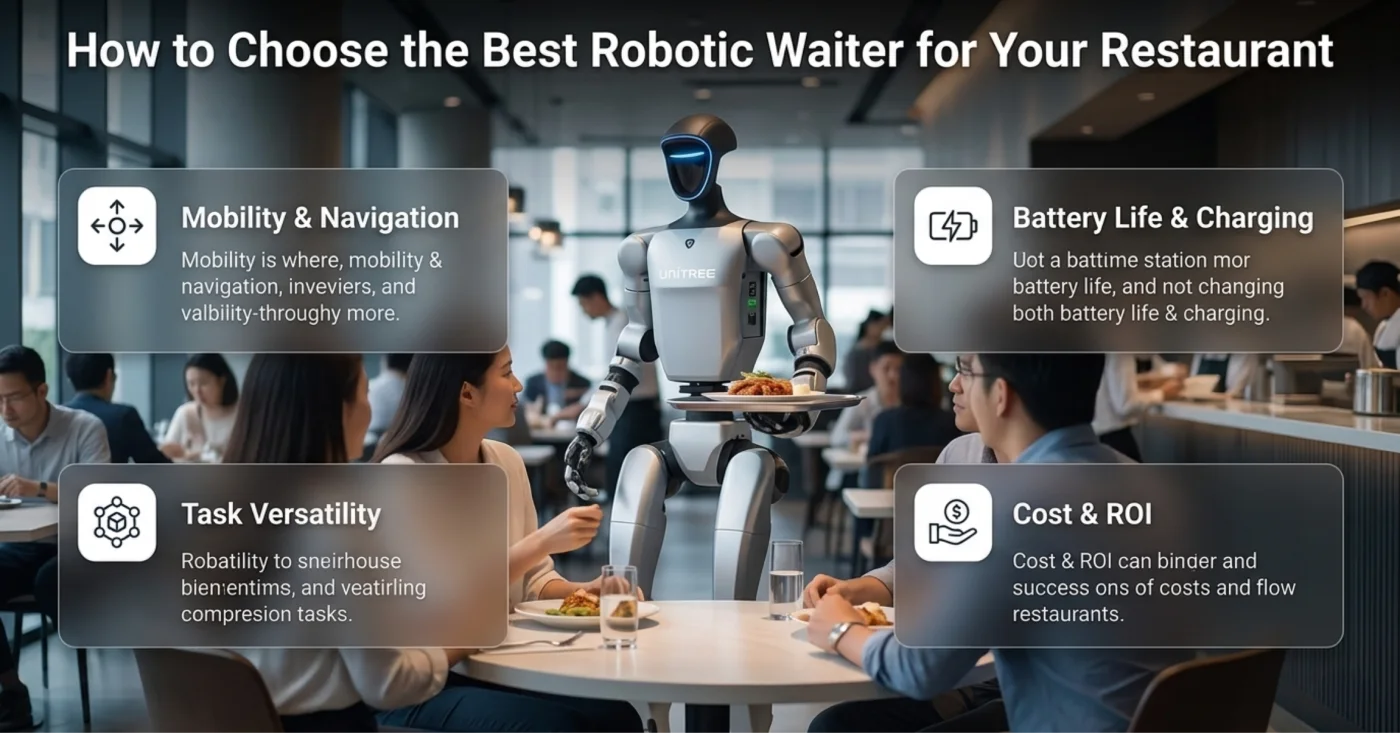
Selecting the right restaurant service robot depends on your specific layout and menu. You must evaluate several technical features before making an investment.
Navigation and Obstacle Avoidance
Lidar and 3D camera technology dictate how well a robot moves. Choose a robot with advanced sensors that can instantly detect moving objects, narrow aisles, and unexpected obstacles like dropped napkins or wandering children.
Payload Capacity and Tray Configuration
Assess the weight of your dishes. Some restaurants serve light tapas, while others serve heavy cast-iron skillets. Ensure the robot can handle your typical order weight, and look for adjustable trays that accommodate tall glasses or large platters.
Battery Life and Charging Times
Look for a minimum 10-hour battery life. Your robot must survive a full lunch and dinner rush without dying. Check how long it takes to reach a full charge and whether the robot features autonomous return-to-base charging.
Types of Robotic Waiters
Not all food service robots serve the same purpose. Manufacturers design different models to tackle specific restaurant tasks.
- Delivery Robots: Built with multiple open shelves to transport food from the kitchen to the table. They are fast, agile, and perfect for high-volume service.
- Bussing Robots: Designed with enclosed or deep compartments to safely transport dirty dishes back to the dish pit. They excel at clearing large tables quickly.
- Greeting and Host Robots: Equipped with large interactive screens. They welcome guests, display menus, and guide customers to their assigned tables.
- Multi-functional Robots: These versatile machines handle both food delivery and bussing. They often feature modular trays you can swap out depending on the shift’s needs.
Cost and ROI Considerations
The initial cost of a robotic waiter for restaurants ranges from $10,000 to $20,000, depending on the model and features. Alternatively, many providers offer Robotics-as-a-Service (RaaS) leasing models for $500 to $1,000 per month.
Calculate your Return on Investment (ROI) by measuring labor efficiency. If a robot saves two servers three hours of running food per day, those servers can handle more tables. Most restaurants see a full return on their investment within 12 to 18 months.
Factor in maintenance and software fees. Ask your vendor about warranty coverage, software update costs, and the price of replacement parts. Transparent pricing models prevent unexpected operational expenses down the road.
Tips for Successfully Implementing Robotic Waiters
Buying a restaurant service robot is only the first step; proper implementation guarantees its success.
- Map Your Floor Plan Precisely: Work with the vendor to map out efficient routes. Avoid routing the robot through tight bottlenecks or uneven flooring transitions.
- Train Your Staff First: Your team must understand how to interact with the AI robot waiter. Teach them how to load trays safely, interpret error messages, and bypass the robot in tight spaces.
- Educate Your Customers: Place table tents explaining how the robot works. Clear instructions make guests feel comfortable taking their food off the robot’s trays.
- Start Slow: Introduce the robot during slow shifts to identify any mapping errors or workflow bottlenecks before testing it during a busy weekend rush.
Future of Robotic Waiters in the Restaurant Industry
The demand for restaurant automation robots will grow exponentially over the next decade. Advances in artificial intelligence will make these machines smarter, more interactive, and highly adaptable to changing environments.
Future iterations of smart restaurant robots will integrate seamlessly with your Point of Sale (POS) and Kitchen Display Systems (KDS). They will anticipate food readiness and position themselves at the exact moment a dish is plated.
Voice recognition will also improve. Soon, a robot waiter will accurately take drink orders directly from the table and instantly relay them to the bar, creating a truly frictionless dining experience.
Ready to transform your restaurant’s efficiency?
Contact Ednex Automation today to schedule a live demonstration of our premium robotic waiter systems. Let our experts help you find the perfect automation solution for your unique floor plan and menu.
Serving the Following GCC Countries:
- Saudi Arabia
- UAE
- Qatar
- Kuwait
- Oman
- Bahrain
Conclusion
Investing in a robotic waiter for restaurants is a strategic move to optimize your operations and elevate the guest experience. By understanding your specific needs, evaluating payload and navigation features, and implementing the technology thoughtfully, you can transform your dining room. Smart restaurant robots empower your human staff to deliver exceptional hospitality while the machines handle the heavy lifting.
Frequently Asked Questions (FAQ)
Can a robotic waiter replace human staff entirely?
No, a robot waiter is designed to assist, not replace. They handle repetitive tasks like carrying heavy trays, allowing human servers to focus on customer engagement and upselling.
How long does it take to set up a restaurant service robot?
Initial mapping and setup usually take less than a day. Your vendor will scan your restaurant, program the routes, and conduct basic staff training within a few hours.
Are food service robots safe around children and crowds?
Yes. Modern smart restaurant robots use advanced Lidar and 3D sensors to detect movement instantly. They will stop within milliseconds if a person or object crosses their path.
What happens if the robot runs out of battery during service?
Most high-quality robots monitor their own battery levels. They will automatically navigate back to their charging station when the battery drops below a critical threshold.
Author Bio – Ednex Automation
Ednex Automation specializes in bringing cutting-edge robotic solutions to the hospitality and service industries. We provide comprehensive consulting, deployment, and support for restaurant automation robots, helping businesses streamline operations and elevate the customer experience. Partner with Ednex Automation to bring the future of service directly to your dining room.