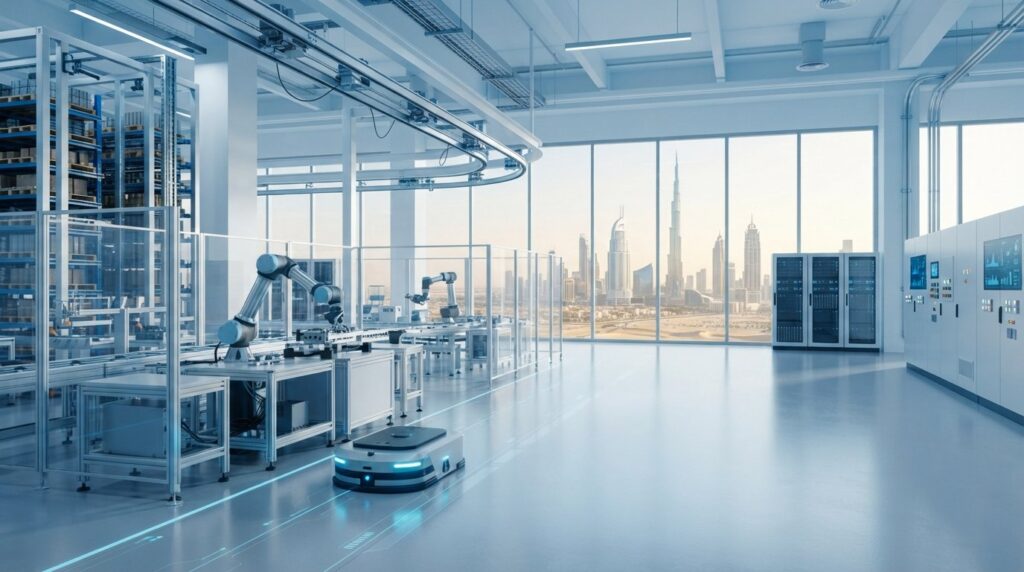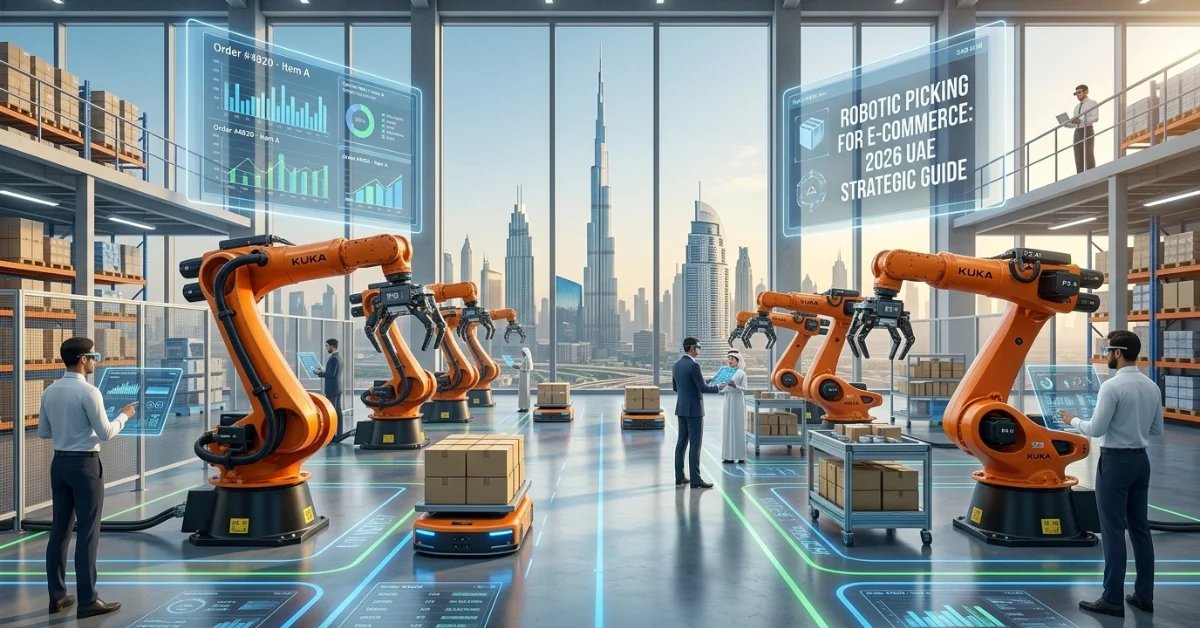
With the UAE e-commerce market reaching a valuation of USD 12.30 billion in 2026, the margin for manual fulfillment error has effectively vanished. You’ve likely experienced the mounting pressure of rising labor costs and the persistent challenge of meeting 24-hour delivery windows with traditional processes. Implementing sophisticated robotic order picking systems for e-commerce is no longer a peripheral upgrade; it’s a fundamental requirement for maintaining operational resilience in an increasingly autonomous industrial landscape.
Leveraging our position as a visionary technical partner, this guide explores how advanced robotic architectures redefine fulfillment efficiency. You’ll discover how to achieve a substantial reduction in cost-per-pick and maximize throughput during seasonal peaks through bespoke system integration. By examining the synergy between Autonomous Mobile Robots (AMRs), Automated Storage and Retrieval Systems (ASRS), and PLC-based control logic, we provide a strategic blueprint for modernizing your warehouse infrastructure. We’ll preview the technical frameworks necessary to bridge global innovation with regional industrial needs, ensuring your facility remains competitive through 2031.
Key Takeaways
- Compare the scalability of Autonomous Mobile Robots (AMRs) against the vertical density of ASRS to determine the optimal hardware configuration for your specific warehouse volume.
- Understand how 3D vision and deep learning optimize robotic order picking systems for e-commerce by solving the complex “bin picking” challenge for non-uniform items.
- Discover why PLC and SCADA integration serves as the essential digital backbone for synchronizing robotic units with existing conveyor systems and industrial lifts.
- Follow a strategic UAE enterprise framework for conducting feasibility studies that ensure long-term ROI and seamless technical integration with national industrial infrastructure.
- Identify how transitioning from manual processes to automated picking architectures mitigates rising labor costs while meeting the 24-hour delivery expectations of the modern consumer.
The Evolution of Robotic Order Picking Systems for E-commerce
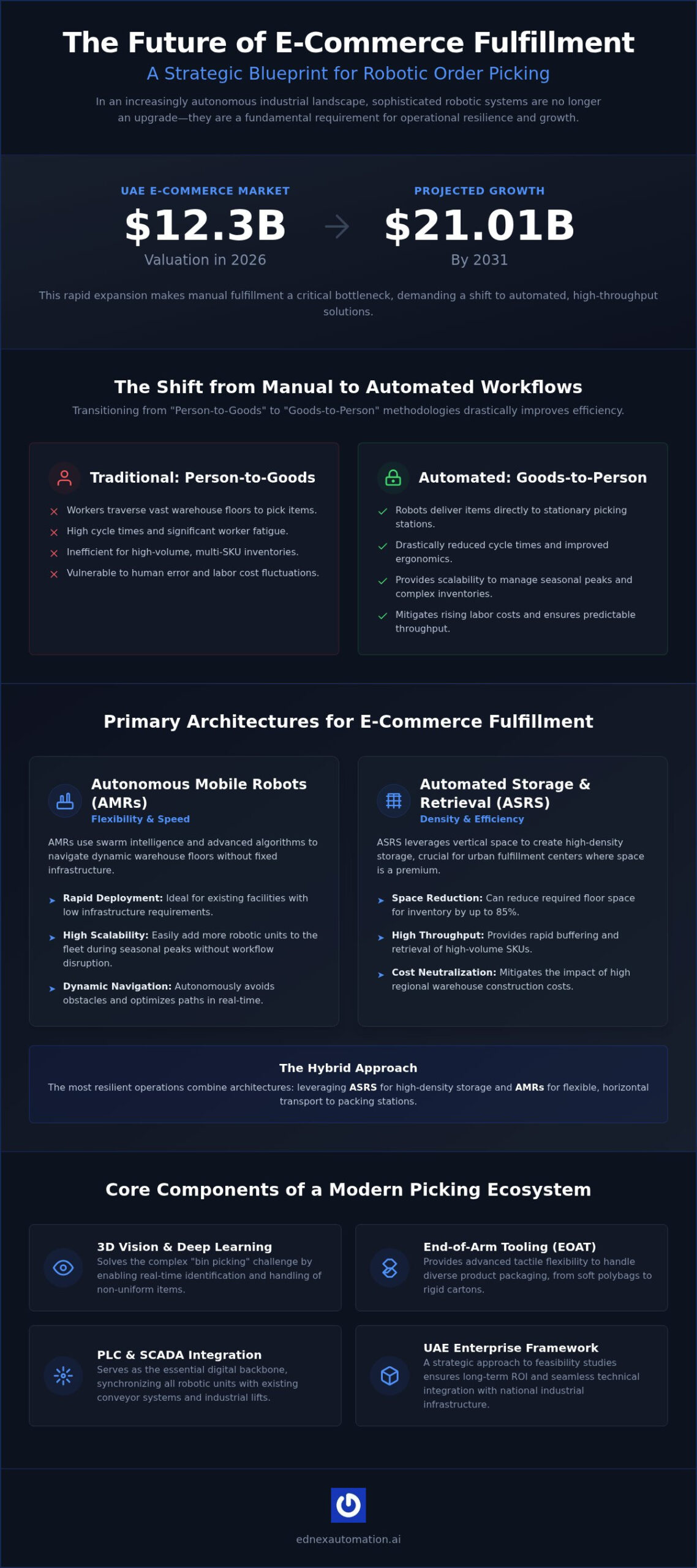
Defining robotic order picking systems for e-commerce requires viewing them as sophisticated, multi-layered architectures where mechanical hardware converges with artificial intelligence. In the context of Industry 4.0, robotic picking represents a transformative convergence of mechanical precision and data-driven intelligence that enables autonomous decision-making at the warehouse edge. Traditional person-to-goods methodologies, where workers traverse vast warehouse floors, have reached a point of diminishing returns. Transitioning to goods-to-person workflows allows high-density systems to deliver items directly to stationary picking stations, which drastically reduces cycle times and worker fatigue.
Manual picking is becoming a primary bottleneck for UAE e-commerce growth. With the sector projected to reach USD 21.01 billion by 2031, the reliance on human labor for high-volume sorting is no longer viable. Advanced robotic order picking systems for e-commerce provide the necessary scalability to manage complex, multi-SKU inventories that characterize modern digital retail. By implementing these systems, enterprises move beyond simple mechanical assistance toward a fully integrated, autonomous fulfillment model.
Drivers of Automation in the UAE Logistics Sector
The UAE’s “Operation 300bn” strategy prioritizes the adoption of advanced manufacturing and logistics technologies to bolster national GDP. As the regional e-commerce market expands, manual picking has become a critical bottleneck. High SKU counts and the consumer demand for hyper-fast fulfillment necessitate a shift toward predictable, automated throughput. By removing human variability, organizations mitigate operational risks and secure a resilient supply chain capable of handling seasonal volatility without proportional increases in labor overhead.
Core Components of a Modern Picking Ecosystem
A modern picking ecosystem relies on several integrated technologies. Central to this are Autonomous Mobile Robots that navigate dynamic environments without fixed tracks. These units often work alongside Automated Storage and Retrieval Systems (ASRS) to manage high-density inventory efficiently. Sophisticated machine vision systems utilize deep learning for real-time item identification. Advanced End-of-Arm Tooling (EOAT) provides the tactile flexibility needed to handle diverse packaging types, from soft polybags to rigid cartons, ensuring seamless handling across varied product lines.
Primary Architectures: AMRs vs. ASRS in E-commerce
Selecting the optimal architecture for robotic order picking systems for e-commerce requires a strategic evaluation of warehouse volume and operational agility. While Autonomous Mobile Robots (AMRs) offer unparalleled flexibility for dynamic layouts, Automated Storage and Retrieval Systems (ASRS) provide the high-density storage essential for urban fulfillment centers. In a typical UAE industrial facility, an ASRS can reduce the floor space required for inventory by up to 85% compared to traditional racking systems, effectively neutralizing the impact of high warehouse construction costs which have reached AED 2,500 per square meter. The most resilient operations often utilize a hybrid approach, leveraging ASRS for high-density buffering and AMRs for horizontal transport to multi-SKU packing stations.
Autonomous Mobile Robots: Flexibility and Speed
Utilizing swarm intelligence and advanced path optimization algorithms, AMRs navigate warehouse floors independently without the need for fixed tracks or wires. This autonomy allows for rapid deployment in existing facilities, making it an ideal solution for organizations that prioritize low infrastructure requirements. Scalability is a core advantage of this architecture. During seasonal e-commerce peaks, such as the high-demand periods surrounding regional shopping festivals, operators can add additional robotic units to the fleet without disrupting ongoing workflows. This modularity ensures that throughput remains consistent even as order volumes fluctuate.
ASRS: High-Density Fulfillment for Urban Hubs
Modern e-commerce demands high-speed access to thousands of unique items, a challenge best addressed by shuttle-based ASRS technology. Unlike traditional crane systems designed for heavy pallets, shuttle-based architectures excel in high-speed tote and carton handling. Maximizing throughput per square meter is critical in high-value industrial zones where vertical space is the primary asset. These systems integrate seamlessly with automated packing and sorting lines, creating a touchless fulfillment loop. If you’re looking to optimize your facility’s footprint, exploring bespoke integration of ASRS and AMRs can provide the technical framework necessary for long-term scalability.
The convergence of these two architectures represents the current gold standard for UAE logistics. By coordinating ASRS for vertical density and AMRs for horizontal agility, enterprises create a unified automation ecosystem. This synchronization is managed through a central control layer, ensuring that every movement is optimized for energy efficiency and speed. This dual-layered strategy allows fulfillment centers to maintain a high pick-per-hour rate while minimizing the physical footprint of the operation.
Advanced Vision Systems and AI in Robotic Picking
The efficacy of robotic order picking systems for e-commerce depends heavily on the sophistication of the vision systems and the underlying artificial intelligence. Utilizing high-resolution 3D vision and deep learning algorithms, modern systems can identify, localize, and pick non-uniform items from chaotic bins with high precision. This capability effectively overcomes the “bin picking” challenge, which has historically been a significant barrier to automating diverse e-commerce inventories. By integrating real-time error detection, these systems ensure quality control throughout the picking process, immediately identifying mispicks or damaged packaging before they reach the sorting line.
Maintaining continuous 24/7 operations in the UAE’s high-demand logistics hubs requires a proactive approach to equipment health. AI-driven predictive maintenance monitors mechanical stressors and sensor performance, allowing operators to schedule interventions before a component failure occurs. This intelligence layer ensures operational resilience, protecting the facility’s throughput during critical seasonal peaks when downtime is most costly. By analyzing historical pick data, the system identifies patterns that indicate wear, transforming maintenance from a reactive cost into a strategic advantage.
Grasping Complexity: End-of-Arm Tooling (EOAT)
Selecting the correct End-of-Arm Tooling is vital for handling the extreme variety of goods found in modern fulfillment centers. Suction-based grippers provide high-speed handling for flat-surfaced items, while finger-style grippers offer the tactile dexterity required for more complex geometries. Utilizing soft robotics enables the handling of delicate or irregularly shaped items without the risk of structural damage. For multi-category centers, automatic tool-changing systems allow a single robotic arm to switch between different EOAT configurations in seconds, maximizing the versatility of the industrial infrastructure. This mechanical adaptability ensures that the picking system remains future-proof as product lines evolve.
The Intelligence Layer: WMS and Robotics Integration
Orchestrating a fleet of diverse robotic units requires a seamless handshake between the warehouse management system (WMS) and the robotics control layer. This integration enables dynamic slotting, where AI algorithms reposition high-velocity inventory based on real-time demand patterns to minimize travel time. Data visualization tools provide managers with a granular view of performance metrics, allowing for immediate optimization of the picking floor. By centralizing these digital brains, enterprises achieve a unified automation ecosystem that responds intelligently to the shifting requirements of regional e-commerce. This structured approach to data ensures that every pick contributes to a broader strategy of operational excellence.
Strategic Integration: PLC and SCADA in E-commerce Automation
Establishing a cohesive automation ecosystem requires more than just high-performance hardware. It demands a robust digital architecture where PLC and SCADA integration acts as the critical backbone for facility-wide synchronization. By coordinating conveyor systems, vertical lifts, and robotic units through a unified control layer, enterprises ensure that robotic order picking systems for e-commerce operate at peak efficiency without mechanical discord. SCADA systems facilitate high-level data acquisition and supervisory control by aggregating real-time telemetry from heterogeneous robotic nodes, providing the macro-level visibility essential for comprehensive e-commerce throughput analysis and bottleneck identification.
Ensuring operational safety remains a non-negotiable priority in high-speed industrial environments. Integrated hardware-level emergency stops are hardwired into the control logic, allowing for instantaneous system-wide pauses that protect both human personnel and expensive machinery. This integrated approach to safety doesn’t just meet regulatory standards; it builds the trust necessary for large-scale industrial transformation. By embedding safety protocols directly into the communication bus, organizations mitigate the risks associated with rapid, autonomous movement.
Programmable Logic Controllers (PLC) for Localized Control
Managing the complex handshake between ASRS cranes and outbound conveyors requires the millisecond precision of Programmable Logic Controllers. These localized brains execute the specific logic needed for sorting and diverting items with minimal latency. Utilizing custom PLC programming allows for bespoke e-commerce workflows that can be adjusted as your facility’s requirements evolve. This localized control is what enables high-speed picking operations to maintain accuracy while handling thousands of unique SKUs simultaneously, ensuring that the physical movement of goods matches the digital speed of the order stream.
SCADA: The Command Center for National Fulfillment Chains
Aggregating data across multiple automated facilities allows for regional oversight that is vital for national fulfillment chains across the UAE. SCADA platforms provide a centralized command center where managers can perform remote diagnostics and troubleshooting of individual robotic picking cells without being physically present on the warehouse floor. This capability bridges the gap between operational technology (OT) and enterprise IT, creating a seamless flow of information from the robotic edge to the boardroom. If you’re ready to unify your facility’s digital brains, you can consult with our integration experts to develop a customized automation roadmap that secures your long-term business viability.
Implementing Robotic Picking Systems: A UAE Enterprise Framework
Initiating the transition to robotic order picking systems for e-commerce begins with a comprehensive feasibility study that aligns technological capabilities with specific organizational objectives. Selecting a technical partner with deep regional expertise and established global alliances ensures the solution remains grounded in the UAE’s unique economic landscape. Utilizing a phased implementation strategy allows enterprises to integrate new robotic cells into active fulfillment environments without compromising current delivery commitments. It’s a controlled evolution that minimizes operational disruption while providing a clear path toward full-scale automation.
Workforce upskilling represents a critical pillar of this strategic framework. As manual picking roles evolve, employees must be trained to oversee and maintain the digital and physical components of the automated ecosystem. This transition shifts the human role from repetitive physical labor to high-level system management, and it doesn’t just improve efficiency; it fosters a culture of innovation that supports long-term operational resilience. By investing in the intellectual capital of the workforce, organizations ensure that their human and robotic assets operate in perfect synchronization.
Calculating the ROI of Robotic Automation
Performing a granular ROI analysis for robotic order picking systems for e-commerce involves evaluating direct labor savings alongside significant gains in picking accuracy and throughput. Beyond payroll reductions, energy efficiency and vertical space optimization serve as powerful cost-reduction drivers in a market where industrial land value is at a premium. Securing long-term business viability in the UAE’s competitive logistics sector depends on achieving a low cost-per-pick while maintaining the agility to scale during peak demand. Organizations that prioritize these data-driven metrics can justify the capital expenditure by demonstrating tangible improvements in fulfillment velocity and order quality.
Partnering for Success: The EdNex Automation Approach
Positioning your organization at the forefront of the Industry 4.0 revolution requires a partner who understands the intricacies of bespoke integration. We specialize in the seamless synchronization of AMRs and ASRS for national logistics leaders, ensuring that every robotic deployment is optimized for the specific challenges of regional e-commerce. Our commitment to official certifications and global standards provides the intellectual framework necessary for successful implementation. By bridging the gap between global technological breakthroughs and local industrial needs, we empower enterprises to future-proof their infrastructure. To begin your transformation, consult with EdNex Automation for your bespoke e-commerce robotics strategy and secure your position in the future of autonomous logistics.
Securing UAE Fulfillment Leadership through Autonomous Innovation
Transitioning to a fully autonomous fulfillment model is no longer a strategic option but a fundamental necessity for long-term viability in the UAE’s high-velocity market. By synchronizing high-density ASRS with the horizontal agility of AMRs, enterprises can effectively neutralize the pressures of rising labor costs and urban space constraints. Establishing a robust digital foundation through integrated PLC and SCADA systems ensures that these robotic order picking systems for e-commerce deliver the predictable throughput required to meet 24-hour delivery expectations. It’s about building a resilient infrastructure that thrives under seasonal volatility.
Leveraging our specialized Industry 4.0 division, we provide the comprehensive PLC/SCADA and ASRS integration necessary for large-scale transformation. Our dedicated UAE national technical support ensures your facility remains at the cutting edge of industrial progress through every phase of implementation. This methodical approach to automation secures your operational efficiency while fostering a culture of technical excellence.
Scale your e-commerce fulfillment with EdNex Automation’s integrated robotic solutions to redefine your operational resilience. Embracing these advanced architectures positions your organization as a pioneer in the next era of regional industrial excellence.
Frequently Asked Questions
What are the primary benefits of robotic order picking for UAE e-commerce businesses?
The primary benefits include a significant reduction in cost-per-pick and a substantial increase in throughput during seasonal peaks. By implementing robotic order picking systems for e-commerce, businesses effectively mitigate the risks of manual error in complex multi-SKU orders. These systems provide the operational resilience needed to meet 24-hour delivery expectations while addressing rising labor costs. This transition ensures long-term business viability within the UAE’s rapidly expanding digital economy.
How do Autonomous Mobile Robots (AMRs) differ from traditional AGVs in a warehouse?
Autonomous Mobile Robots (AMRs) navigate dynamic environments using onboard sensors and path optimization algorithms, whereas traditional AGVs require fixed infrastructure like magnetic strips or wires. This distinction allows AMRs to adapt to warehouse layout changes without costly downtime. By utilizing swarm intelligence, AMRs identify the most efficient routes in real-time. This flexibility makes them superior for e-commerce facilities that require rapid scalability and minimal infrastructure investment compared to rigid AGV systems.
Is it possible to integrate robotic picking systems with my existing Warehouse Management System (WMS)?
Seamless integration with an existing Warehouse Management System (WMS) is entirely possible through standardized APIs and industrial communication protocols. This digital handshake allows for real-time data synchronization between the inventory database and the robotic control layer. Orchestrating robot fleets through a centralized WMS enables dynamic slotting and precise tracking of every pick. Such integration ensures that the physical movement of goods remains perfectly aligned with the enterprise’s digital order stream.
What is the typical ROI period for a robotic picking system in the UAE?
The ROI period for a robotic picking system typically ranges from 18 to 36 months, depending on the volume of operations and the level of integration. Factors such as labor savings, reduced error rates, and optimized space utilization drive these financial gains. In the UAE market, where warehouse construction costs are high, the vertical density provided by ASRS further accelerates the payback period. Achieving this rapid return requires a precise feasibility study and bespoke system configuration.
Can robotic picking systems handle fragile or irregularly shaped e-commerce items?
Modern robotic order picking systems for e-commerce utilize advanced End-of-Arm Tooling (EOAT) to handle fragile and irregularly shaped items with high precision. Soft robotics and suction-based grippers allow these systems to manipulate delicate packaging without causing structural damage. Machine vision systems identify the optimal grasp points for non-uniform geometries in real-time. This mechanical adaptability ensures that diverse product categories, from cosmetics to electronics, are handled safely within a single automated workflow.
How does ASRS technology improve space utilization in urban fulfillment centers?
ASRS technology maximizes vertical density by utilizing the full height of a facility, often reducing the required floor footprint by up to 85% compared to traditional racking. This is particularly critical in urban fulfillment centers where industrial land is at a premium. By automating the storage and retrieval process, these systems eliminate the need for wide forklift aisles. This high-density approach allows enterprises to maintain larger inventories closer to consumer hubs, facilitating faster last-mile delivery.
What safety standards govern the use of collaborative robots in UAE warehouses?
The use of collaborative robots in UAE warehouses is governed by Federal Decree-Law No. 33 of 2021 regarding workplace safety. Industry leaders also adhere to international standards such as ISO 3691-4 for driverless industrial trucks and ANSI/RIA R15.08 for industrial mobile robots. These frameworks ensure that robotic systems feature integrated sensors and emergency stops for safe human-robot interaction. Maintaining these rigorous safety protocols is essential for protecting personnel and ensuring continuous operational uptime.
How do PLC and SCADA systems enhance the performance of robotic picking?
PLC and SCADA systems act as the digital backbone, synchronizing robotic units with conveyors and lifts to create a unified automation ecosystem. PLCs manage localized control logic with millisecond precision, while SCADA provides macro-level visibility through real-time telemetry aggregation. This integration allows for remote diagnostics and predictive maintenance, reducing the risk of unexpected downtime. By bridging the gap between operational technology and enterprise IT, these systems optimize every pick for maximum energy efficiency and speed.