What if your production line achieved a zero-defect reality without the prohibitive costs or physical rigidity of traditional, fixed-camera infrastructure? Most industrial leaders recognize that manual inspection is no longer a viable strategy in a landscape defined by high-mix production and a chronic shortage of specialized quality inspectors. You’re likely dealing with the operational friction of slow, legacy systems that create bottlenecks and fail to provide the granular data necessary for modern compliance. Integrating advanced cobot vision systems for quality control transforms these persistent challenges into a high-speed competitive advantage by merging sophisticated machine intelligence with the versatile maneuverability of collaborative robotics.
Discover how the latest breakthroughs in AI-driven autonomy and the implementation of ISO 10218:2025 safety standards are redefining precision for the UAE’s industrial sector. We will examine the technical synergy between vision-enabled cobots and existing SCADA frameworks, providing a roadmap for achieving 100% inspection coverage while reducing operational overhead. This analysis explores the transition from static checkpoints to dynamic, vision-guided processes that ensure long-term business viability through real-time process optimization and autonomous defect detection.
Key Takeaways
- Transition from manual sampling to a 100% automated inspection model to eliminate human error and achieve a zero-defect production standard.
- Analyze the limitations of fixed-camera systems and leverage the multi-angle maneuverability of cobot arms for superior inspection in high-mix manufacturing environments.
- Master the deployment of cobot vision systems for quality control by synchronizing high-resolution hardware with deep learning software for precise anomaly detection.
- Integrate vision-guided robotics with your existing PLC and SCADA infrastructure to enable real-time data logging and comprehensive process optimization.
- Establish a robust intellectual framework for automation that ensures long-term business viability and seamless integration across the UAE industrial landscape.
The Evolution of Quality Control: Why Vision-Integrated Cobots are Essential in 2026
Industrial paradigms in 2026 demand a radical departure from the traditional inspection models of the past decade. Relying on manual sampling methods introduces a statistical risk that modern manufacturing environments can no longer tolerate. By deploying advanced cobot vision systems for quality control, organizations are transitioning from periodic checks to a model of 100% automated inspection. This shift ensures that every single component is verified against high-fidelity digital twins and defect libraries, effectively eliminating the subjective variability inherent in human judgment. The intersection of collaborative robotics and machine vision provides a sophisticated solution that doesn’t just find errors; it prevents them from entering the supply chain.
From Manual Inspection to Autonomous Assurance
Human visual inspection, while historically standard, is inherently limited by physical fatigue and the cognitive constraints of high-speed production environments. The cost of ‘escapes’, where defects bypass quality checkpoints and reach the end customer, can be catastrophic for brand reputation and operational margins. Utilizing a collaborative robot (cobot) equipped with high-resolution imaging sensors provides a level of consistency that manual labor simply cannot replicate. Vision-integrated cobots represent the definitive future of non-destructive testing by combining robotic dexterity with deep-learning analytical capabilities. These systems operate with a relentless precision that mitigates risks associated with human error, ensuring that quality assurance is a high-speed competitive advantage rather than a bottleneck.
Driving the UAE’s Industrial Digital Transformation
Aligning with national manufacturing excellence goals, the adoption of intelligent automation has become a prerequisite for regional competitiveness. The UAE’s industrial sector is currently undergoing a period of rapid modernization where data-driven quality metrics are the new standard for operational success. Cobots act as a vital bridge between legacy production lines and the fully realized smart factories of the future. By integrating these systems into existing PLC and SCADA frameworks, manufacturers can log real-time data for every unit produced, providing the transparency required for global compliance standards. EdNex Automation serves as a systematic organizer in this transition, offering the intellectual framework necessary to convert complex technological breakthroughs into practical, scalable industrial solutions. This controlled innovation ensures that local industries don’t just participate in the global market but lead it through superior technical execution.
Technical Architecture: How Collaborative Robots and Machine Vision Synchronize
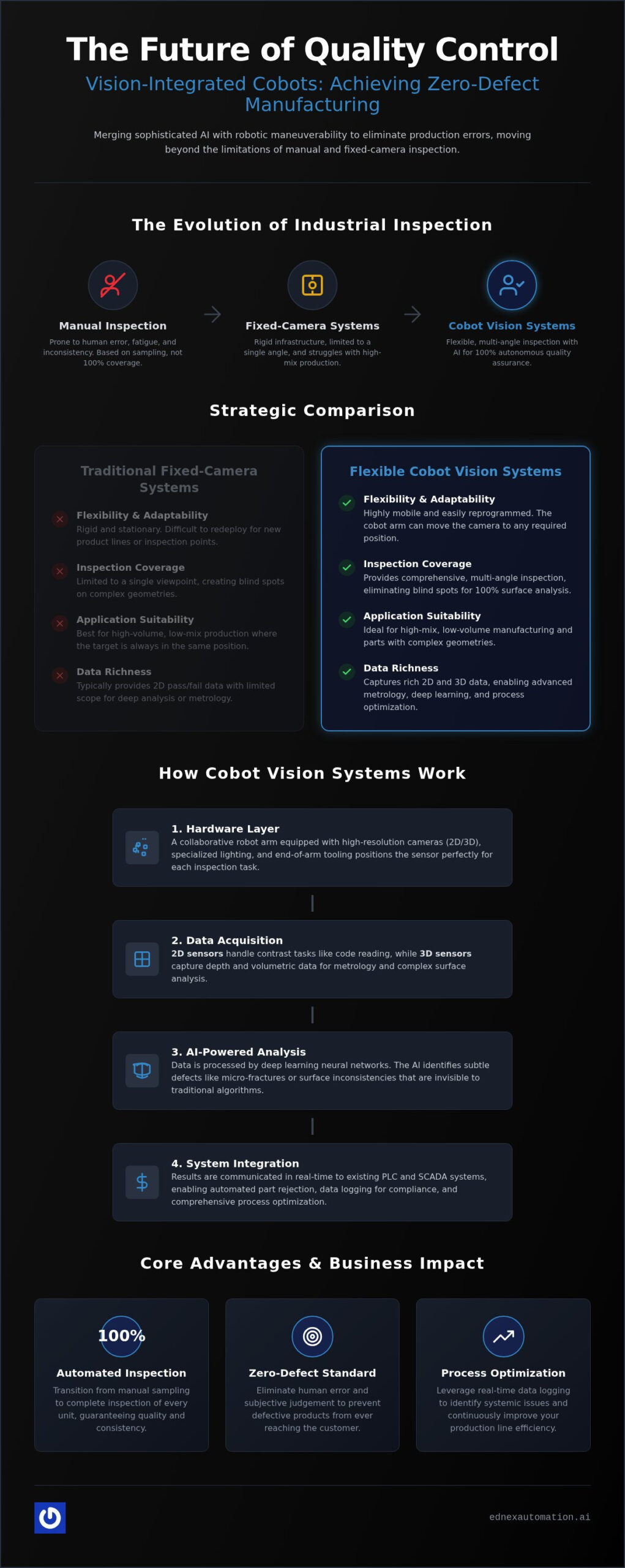
Achieving operational excellence in 2026 requires a sophisticated orchestration of hardware and artificial intelligence. The technical architecture of cobot vision systems for quality control is defined by a multi-layered stack that ensures high-fidelity data acquisition and instantaneous decision-making. At the hardware level, this includes high-resolution cameras and specialized lighting geometries designed to eliminate shadows or reflections on complex industrial surfaces. These components work in tandem with specialized end-of-arm tooling to position sensors at optimal inspection angles, ensuring that no defect goes undetected.
The ‘Eyes’ and the ‘Brain’: Hardware and AI Logic
Selecting between 2D and 3D vision sensors depends entirely on the geometric complexity of the workpiece. While 2D systems excel at contrast-based tasks like OCR or pattern recognition, 3D sensors are essential for metrology and depth-sensitive QC tasks where volumetric accuracy is paramount. These sensors feed data into neural networks that utilize deep learning to identify subtle surface defects, such as hairline fractures or micro-occlusions, which traditional rule-based algorithms often overlook. Utilizing edge computing ensures these analytical processes occur locally on the production line. This eliminates the latency associated with cloud processing and enables the immediate rejection of non-conforming parts. It’s a system built for speed.
Seamless System Integration and Communication
Successful deployment hinges on the underlying communication protocols that allow the vision controller and the robotic arm to function as a singular entity. Establishing a closed-loop control system requires robust PLC and SCADA integration services to ensure that every inspection result is logged and analyzed for long-term process optimization. This integration allows the system to adjust upstream parameters automatically when defect trends are detected, effectively preventing mass-production errors. Minimizing latency between the vision sensor’s trigger and the cobot’s response is critical for maintaining high inspection speeds without compromising safety. For organizations looking to modernize their infrastructure, partnering with a specialist to design bespoke robotic architectures ensures that these complex systems are implemented with surgical precision.
By prioritizing a steady, hierarchical flow of data, manufacturers can transform raw visual input into actionable intelligence. This structural approach ensures that the “brain” of the system is always synchronized with its mechanical “limbs,” creating a reliable framework for zero-defect manufacturing.
Strategic Comparison: Fixed Vision Systems vs. Flexible Cobot Vision
Recognizing the inherent rigidity of legacy infrastructure, many industrial operators now face a critical choice between traditional fixed-mount cameras and the dynamic capabilities of robotic integration. While fixed systems have long served as the backbone of high-volume production, they frequently lack the adaptability required for the high-mix environments that define the current manufacturing landscape. Implementing cobot vision systems for quality control offers a transformative alternative, providing the maneuverability necessary to inspect complex geometries from multiple orientations without the need for an extensive array of static sensors. This shift from static to dynamic inspection allows for a more streamlined factory footprint, reducing the physical clutter of multiple mounting brackets and cabling.
Versatility in High-Mix, Low-Volume Manufacturing
Operating within a high-mix, low-volume (HMLV) production model necessitates a level of agility that fixed-mount systems cannot provide. When SKU changeovers occur, a robotic arm can be reprogrammed to follow a new vision path in minutes, whereas a fixed system might require physical repositioning and recalibration of several cameras. This flexibility is particularly evident when inspecting internal cavities or intricate sub-assemblies where a single mobile sensor can reach angles that would otherwise remain occluded. By utilizing the six-axis dexterity of a robotic platform, manufacturers can significantly reduce the total number of cameras required for comprehensive coverage. This reduction effectively lowers hardware costs while simplifying the overall system architecture within modern factory layouts.
Total Cost of Ownership (TCO) and ROI
Analyzing the long-term financial viability of these systems reveals a distinct advantage for robotic actuators over fixed infrastructure. While the initial setup for a robotic system may involve more sophisticated integration, its long-term versatility ensures it doesn’t become obsolete as product designs evolve. Scalability is a primary driver for investment in collaborative robots UAE, allowing facilities to add vision capabilities to existing platforms as production requirements expand. Maintenance profiles also differ; whereas fixed systems require constant alignment checks across multiple mounting points, a robotic system centralizes maintenance to a single, high-performance unit. Return on investment is primarily a factor of significant defect reduction and the strategic reallocation of labor toward higher-value technical oversight. This systematic approach ensures that the transition to automated inspection is not merely a technical upgrade but a necessary evolution for maintaining regional competitiveness.
Deployment Framework: Integrating Vision Systems for Defect Detection and Metrology
Implementing cobot vision systems for quality control requires a methodical, engineering-led deployment framework to ensure the transition from manual oversight to autonomous assurance is both seamless and scalable. It isn’t simply a matter of mounting hardware; it’s the creation of a reliable digital infrastructure that provides consistent, repeatable results. Following a structured multi-step process allows plant managers to mitigate integration risks and achieve the high-speed, zero-defect objective necessary for 2026 industrial standards.
- Step 1: Identifying Parameters: Establish a comprehensive defect library by mapping every possible failure mode and critical quality parameter for each SKU.
- Step 2: Sensor and Lighting Selection: Match specific vision sensors and lighting geometries to the material properties of the workpiece, particularly when dealing with reflective or high-contrast surfaces.
- Step 3: Path Programming: Optimize the robotic arm’s trajectory to ensure the Field of View (FOV) covers every critical feature while maintaining a safe distance from other machinery.
- Step 4: AI Model Training: Utilize supervised learning to train neural networks with a diverse set of “good” and “bad” part samples, refining the system’s ability to distinguish between acceptable variations and true defects.
- Step 5: Validation: Conduct rigorous Gage R&R (Repeatability and Reproducibility) testing to verify that the system’s accuracy meets sub-millimeter industrial tolerances across varied production cycles.
Precision Metrology and Dimensional Inspection
Utilizing collaborative robots for non-contact measurement allows manufacturers to verify critical tolerances with sub-millimeter accuracy in three-dimensional space. These systems eliminate the physical wear associated with traditional gauging tools, providing a more reliable method for high-precision metrology. By automating the direct entry of these measurements into a Quality Management System (QMS), organizations ensure that every unit produced has a verifiable digital birth certificate. This high-level data logging supports long-term compliance and provides the intellectual framework necessary for continuous process optimization.
Surface Defect and Assembly Verification
Advanced vision logic enables the automatic detection of scratches, dents, and subtle color variations that often escape human notice during high-speed production. Beyond surface aesthetics, these systems verify the presence and correct orientation of every component within complex assemblies, significantly reducing the risk of functional failures. For large-scale assets or expansive warehouse environments, these inspection packages can be integrated with autonomous mobile robots to provide mobile, multi-point verification across the entire facility. To ensure your deployment meets these rigorous standards, you should consult with our technical deployment team to design a bespoke automation strategy tailored to your specific operational requirements.
Optimizing Industrial Output: Partnering with EdNex for Bespoke Automation
EdNex Automation acts as a systematic organizer of industrial innovation, providing the intellectual framework necessary for the successful implementation of high-tier robotic solutions. Moving beyond simple hardware supply, our approach focuses on the strategic alignment of vision logic with existing SCADA infrastructure to ensure long-term operational viability. By serving as a national partner with deep-rooted regional expertise, we enable manufacturers to navigate the complexities of Industry 4.0 through controlled and deliberate technological advancement. Integration is the catalyst for this transformation. We ensure that every deployment is grounded in a reliable technical strategy that prioritizes precision and data integrity.
Bespoke Integration for UAE Industry 4.0
Delivering bespoke integration requires a granular understanding of sector-specific challenges, whether in electronics assembly, pharmaceutical packaging, or automotive manufacturing. Our engineers tailor vision logic to meet these unique requirements, ensuring that cobot vision systems for quality control operate at peak efficiency within your specific environment. This integration frequently extends to linking robotics with automated storage and retrieval systems, creating a unified ecosystem where quality data informs logistics and inventory management. Our commitment to official certifications and global standards provides the legitimacy required for large-scale industrial transformation across the UAE landscape.
Securing the Future of Manufacturing
Securing the future of manufacturing involves a transition from basic hardware acquisition to a state of sustained operational excellence. We provide a clear roadmap for scaling automation, facilitating the growth from a single, high-precision inspection cell to a fully integrated, plant-wide autonomous network. This methodical expansion ensures that every stage of implementation is validated against your core business objectives, mitigating risk while maximizing throughput. Precision is our standard. By contacting EdNex for a strategic consultation, you initiate a partnership grounded in technical expertise and a shared vision for a zero-defect future. We don’t just provide tools; we provide the intellectual foundation for your organization to remain competitive in an increasingly automated global market.
Securing Industrial Dominance through Vision-Guided Autonomy
The integration of cobot vision systems for quality control marks a definitive shift toward the zero-defect manufacturing standards required for regional and global competitiveness. By replacing subjective manual sampling with high-speed autonomous assurance, industrial operators effectively mitigate the risks of human error while establishing a robust framework for real-time data logging. This transition from rigid, fixed-mount infrastructure to dynamic robotic maneuverability ensures that your production lines remain agile in the face of evolving SKU requirements. Implementing these advanced systems isn’t merely a technological upgrade; it’s a necessary evolution for maintaining long-term business viability in the UAE industrial landscape.
Leveraging our Industry 4.0 integration expertise and official global alliances ensures that your bespoke technical deployment is grounded in technical excellence and precision. We provide the intellectual framework necessary to transform complex robotic hardware into a seamless competitive advantage. Partner with EdNex Automation for your strategic quality control transformation and lead the next era of industrial precision. The path to a smarter, more efficient factory floor begins with a deliberate commitment to innovation.
Frequently Asked Questions
What are the primary benefits of using cobots for vision-based quality control?
The primary benefits include achieving 100% inspection coverage and the ability to reallocate skilled labor to higher-value technical roles. By integrating cobot vision systems for quality control, manufacturers eliminate the statistical risks associated with manual sampling. These systems provide real-time data logging for every unit produced, which ensures comprehensive compliance and facilitates long-term process optimization. This systematic approach transforms quality assurance from a static checkpoint into a dynamic, data-driven competitive advantage.
Can cobot vision systems detect microscopic defects better than human inspectors?
Can cobot vision systems detect microscopic defects better than human inspectors?
Vision-integrated cobots significantly outperform human inspectors in detecting microscopic defects due to their high-resolution sensors and relentless consistency. While human vision is subject to fatigue and subjective judgment, robotic systems maintain sub-millimeter accuracy across entire shifts. Utilizing deep learning algorithms, these cobots identify hairline fractures and surface occlusions that are nearly invisible to the naked eye. For facilities requiring advanced analytical capabilities for ultra-fine inspection, you can check out Electron Optics Instruments, LLC for specialized benchtop SEM solutions. This ensures a zero-defect output that protects brand reputation and reduces the high costs of customer escapes.
Programming a vision-guided collaborative robot has become increasingly intuitive through the use of hand-guiding techniques and AI-driven training models. Instead of writing complex code, operators teach the system by presenting “good” and “bad” part samples to the vision sensor. Most modern software platforms utilize drag-and-drop interfaces that allow for rapid path adjustments and SKU changeovers. This accessibility reduces the intellectual barrier to entry, allowing existing staff to manage advanced automation with minimal specialized training.
Do vision-integrated cobots work in low-light industrial environments?
These systems operate with absolute reliability in low-light environments by utilizing specialized lighting geometries and infrared sensors. Because the vision controller manages its own lighting environment, it remains unaffected by fluctuations in ambient factory light. This consistency is vital for maintaining inspection accuracy during night shifts or in enclosed production cells. By ensuring uniform illumination, the cobot maintains high-fidelity imaging, which prevents false rejects and ensures the integrity of the defect detection process.
What is the typical ROI for a cobot vision system in a manufacturing plant?
Most industrial applications achieve a full return on investment within 12 to 18 months through significant defect reduction and operational cost savings. While initial setup involves the robotic arm and vision hardware, the long-term value stems from labor reallocation and minimized waste. By preventing non-conforming parts from entering the supply chain, the system reduces the financial impact of rework and warranty claims. This rapid ROI makes the technology a viable evolution for organizations focused on long-term business viability.
How do vision-guided cobots handle part variation on a production line?
Vision-guided cobots handle part variation by utilizing sophisticated pattern recognition and deep learning to distinguish between acceptable deviations and true defects. Utilizing six-axis maneuverability, the arm adjusts its field of view dynamically to accommodate different orientations or SKU geometries. This flexibility allows a single inspection cell to manage high-mix production lines without requiring physical retooling. It’s a scalable solution that ensures quality consistency even as product designs and assembly complexities evolve over time.
Is it possible to integrate vision cobots with existing SCADA or PLC systems?
Integrating vision-enabled cobots with existing SCADA or PLC systems is a core capability of modern industrial automation. Establishing this closed-loop control allows the vision system to send immediate feedback to upstream machinery, facilitating autonomous process adjustments. EdNex Automation specializes in these integration services, ensuring that robotic data is seamlessly logged into the facility’s Quality Management System. This connectivity provides the transparency required for national-level compliance and the granular insights needed for comprehensive plant-wide optimization.
What safety standards apply to cobots equipped with high-speed vision sensors?
The foundational safety standards for these applications are defined by ISO 10218-1:2025 and ISO 10218-2:2025, which govern both manufacturers and system integrators. These updated regulations emphasize the safety of the collaborative application as a whole, including the vision hardware and end-of-arm tooling. Adhering to these global standards ensures that high-speed inspection occurs without compromising the safety of human personnel. This rigorous compliance framework provides the intellectual framework necessary for deploying advanced robotics in shared workspaces across the UAE.