
A robot completing a staged demonstration doesn’t prove it can perform reliably in your operation. A proof of concept for automation projects should test a defined workflow under representative working conditions, so integration needs, exceptions and human handoffs become visible before a wider commitment.
It’s reasonable to question whether a system will work beyond a controlled trial, or how to compare options when success criteria aren’t clear. For organizations evaluating cobots, autonomous mobile robots, service robots or industrial automation, a well-bounded PoC turns those uncertainties into evidence tied to an operational need.
This guide explains how to define the use case, set measurable success criteria and design a test that reflects real operating conditions. You’ll learn how to assess technical and operational feasibility, compare results and make a clear proceed, revise or stop decision. It also covers how to carry useful PoC findings into implementation, linking evaluation with the consulting, deployment and integration needed to move automation forward systematically.
Key Takeaways
- Use a bounded proof of concept for automation projects to test one representative workflow before considering wider implementation.
- Set a baseline, define operational requirements and agree on measurable success criteria before the test begins.
- Compare automation options against the same use case, weighing workflow fit, integration effort, safety needs and evidence quality.
- Assign operational, engineering, safety and decision-making roles so the PoC can be run and assessed systematically.
- Use the findings to make a proceed, revise or stop decision and shape the next steps toward implementation.
Why run a proof of concept for an automation project?
Leaders considering automation face a practical choice: test a focused use case first, or commit directly to broader implementation. A proof of concept offers a structured way to examine feasibility against agreed operational requirements before making that decision. It isn’t simply a product demonstration, where a system may be shown in prepared conditions, and it isn’t a full deployment designed to support an entire operation.
An automation PoC tests a defined workflow under representative conditions, measures performance against agreed requirements and produces evidence for a proceed, revise or stop decision. A demonstration can show what a robot or automation system can do; a PoC examines whether a proposed approach can address a specific need within the realities of the work. The general purpose of a PoC is explained in What is a Proof of Concept?
A useful proof of concept for automation projects is bounded: it has a defined task, test conditions, requirements and decision criteria. It should provide enough evidence to guide the next step without attempting to prove every aspect of a full-scale system.
What does an automation proof of concept establish?
A PoC tests whether a proposed automation approach can address a defined operational need, such as moving materials between work areas, cleaning a specified space or inspecting an asset. The test should reflect relevant conditions, not rely only on a prepared demonstration.
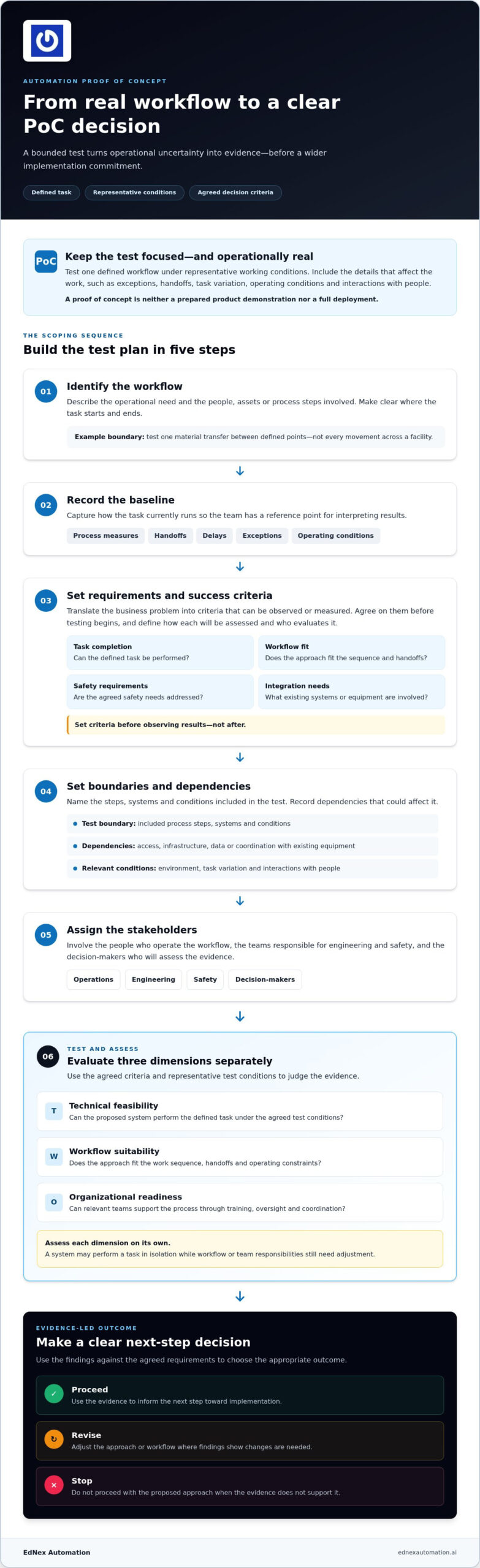
Assess three dimensions separately:
- Technical feasibility: Can the proposed system perform the defined task under the agreed test conditions?
- Workflow suitability: Does the approach fit the sequence of work, handoffs and operating constraints?
- Organizational readiness: Can relevant teams support the process, including training, oversight and coordination?
A positive result in one area doesn’t settle the others. A system may perform a task in isolation, for example, while the workflow or team responsibilities still need adjustment.
When is a PoC useful before implementation?
A PoC is especially useful when the technology is unfamiliar, integration with existing systems is complex, or operating requirements remain uncertain. It can also help compare different approaches to the same need, such as whether a workflow is better suited to a robot, a control-system change or another automation configuration.
For a meaningful comparison, keep the operational need, test conditions and assumptions consistent. Otherwise, differences in results may reflect different setups rather than the strengths of each approach.
A PoC may add little value when requirements are already clear, the implementation path is established and no material uncertainty remains to test. In that case, direct implementation planning may be more useful than repeating a feasibility exercise. For teams moving straight to implementation with smart controls or facility automation, Asthome Smart Electrical Supplies offers a range of connected devices and electrical components to support modern setups.
How to scope an automation PoC around a real workflow
A useful scope begins with the work as it happens, not with a robot’s feature list. Select one representative task or process segment, then document its normal sequence, exceptions and constraints. For example, a material-movement PoC might test one transfer between defined points rather than attempt to automate every movement across a facility. This boundary keeps the test focused while preserving the operational details that determine whether its evidence is useful.
Use this sequence to build the test plan:
- Identify the workflow. Describe the operational need and the people, assets or process steps involved. Specify where the task starts and ends.
- Record the baseline. Capture how the task currently runs, including relevant process measures, handoffs, delays, exceptions and operating conditions. This gives the team a reference point for interpreting results.
- Set requirements. Define what the proposed approach must demonstrate, including task completion, workflow fit, safety requirements and integration needs where relevant.
- Set boundaries and dependencies. Name the steps, systems and conditions included in the test, along with dependencies such as access, infrastructure, data or coordination with existing equipment.
- Assign stakeholders. Involve the people who operate the workflow, the teams responsible for engineering and safety, and the decision-makers who will assess the evidence.
Record conditions that could affect performance, such as the operating environment, task variation, existing systems and points of interaction with people. The goal isn’t to reproduce an entire facility, but to represent the factors that matter to the selected workflow. If collaborative robots are a candidate, the collaborative robots strategic guide can help frame their place in an industrial automation plan.
Set PoC objectives and success criteria
Translate the business problem into criteria that can be observed or measured, and agree on them before testing begins. Choose measures that reflect the intended task and operational need, rather than relying on a general impression that the system performed well. Define success criteria before observing results so the team can assess the evidence against a consistent standard.
Depending on the use case, criteria may address task completion, process fit, safety requirements or integration with existing systems. For each criterion, record how it will be assessed and who is responsible for evaluating it. A criterion such as “fits the workflow” is too broad on its own. Specify the handoffs or process steps that must work as intended, then document what happened during the test.
Define boundaries, resources and test conditions
Specify which workflow steps, systems, people and operating conditions are inside the PoC. Identify the access, data, infrastructure and stakeholder participation needed to run it, without assuming fixed resource amounts. State what the test excludes, such as other workflows or wider deployment conditions, so its conclusions aren’t mistaken for proof of readiness across the entire operation.
A written scope can also guide implementation planning. EdNex Automation’s automation consulting and integration expertise connects evaluation with the next steps for robotics and industrial automation projects.
How to compare PoC options and judge the evidence
Comparisons are useful only when each approach is assessed against the same operational need and assumptions. Keep the workflow, test conditions and success criteria consistent, then document where the options differ. For a material-transfer task, for example, an autonomous mobile robot (AMR) and an alternative automation approach should be judged against the same route, handoffs and process requirements. An AMR industrial autonomy guide can provide context when mobile robots are among the options.
Use a comparison matrix to keep the assessment balanced. Record evidence for each approach rather than relying on a single overall impression.
Compare the proposed solution with the current process
Use the documented current workflow as the baseline, not an assumed ideal version of the process. Compare the proposed approach with how work is actually performed, including task fit, dependencies and points where people interact with the system. This helps distinguish a meaningful operational change from a successful isolated task.
Collect the measurements needed to assess your organization’s objectives, such as task completion, process interruptions or staff involvement. Don’t infer savings or productivity gains from a short test unless the evidence supports them.
Separate PoC evidence from scale-up assumptions
A successful demonstration alone doesn’t establish readiness for wider deployment. Label each conclusion as observed, inferred or untested. For instance, a task completed in a defined test area is observed; performance across different operating conditions may remain untested.
List differences between the test environment and the intended operating environment, including systems, workflow variation and support needs. A proof of concept for automation projects informs selection, but scale-up requires its own assessment of integration, operational requirements and ongoing support. Clear evidence makes the proceed, revise or stop decision more defensible.
How to execute an automation PoC and reach a decision
A disciplined run turns the agreed scope into traceable observations, not a one-off demonstration. Before testing starts, assign clear responsibility: operations leads explain the workflow and record disruptions, engineering configures the system and documents technical issues, safety representatives oversee relevant controls, and a named decision-maker assesses the evidence against the agreed criteria.
Use a consistent execution sequence:
- Prepare: Confirm the test plan, access, equipment, operating conditions and stakeholder roles. Review how to pause or stop the test if an unexpected safety or process concern arises.
- Configure: Set up the system for the defined task and record relevant settings or changes, so the conditions can be understood when results are reviewed.
- Run: Carry out the agreed scenarios without expanding the scope mid-test. Include normal operating constraints and the variations the PoC is designed to examine.
- Observe: Capture the agreed measures alongside task completion, human intervention, deviations, incidents and unexpected dependencies. Use the same recording method across each run.
- Analyse: Compare observations with the baseline and success criteria. Separate measured results from interpretations, and note missing or inconclusive evidence.
- Document: Consolidate the method, findings, limitations and stakeholder conclusions in a report that supports a specific decision.
Run the test under representative conditions
Use scenarios that reflect the selected workflow and its normal constraints, rather than conditions arranged only to showcase the system. Keep the success criteria fixed throughout the test. If a change is necessary for safety or operational reasons, record what changed, when and why. Make limitations, such as an untested workflow variation or system dependency, visible in the findings so stakeholders understand what the evidence can and can’t establish.
Record unexpected events as carefully as successful task completion. A deviation may reveal a workflow dependency or integration question that affects implementation, even if the system completes the task in other runs.
Turn results into a decision-ready report
Summarize the objective, scope, method, evidence and limitations, then document the views of operations, engineering and safety alongside the decision-maker’s conclusion. List unresolved risks, integration questions and prerequisites for any next phase. Make clear which findings were observed, which are interpretations and which remain untested.
Define the decision before interpreting the results:
- Proceed when the agreed criteria are met and remaining actions are understood.
- Revise when evidence points to a correctable gap that warrants another bounded test.
- Stop when a critical requirement isn’t met or the evidence doesn’t support further investment.
A proof of concept for automation projects creates value when its conclusion is tied to a practical next step, such as refining the design, assessing integration requirements or planning implementation. The EdNex Automation website outlines its robotics and industrial automation services.
From automation PoC to implementation with EdNex Automation
A PoC is most valuable when its findings lead to a disciplined next step. A proceed decision can inform solution selection and implementation planning; a revise decision can identify what needs further testing; a stop decision can prevent investment in an approach that doesn’t fit the operational need. EdNex Automation connects consulting, deployment, integration and ongoing support, helping organizations translate evaluation evidence into practical plans for robotics and industrial automation.
Match the proposed solution category to what the test actually established. A successful task in a defined setting is evidence about that task and those conditions, not automatic proof that a wider system is ready. Use the report’s observations, limitations and unresolved questions to shape requirements for any next phase.
Match PoC findings to an automation solution category
If the PoC examines mobile material movement, an autonomous mobile robot (AMR) may be relevant to the workflow under assessment. Where the test identifies control-system requirements, PLC and SCADA integration may be in scope. The right direction depends on the process, existing systems and agreed requirements, rather than on a category chosen in advance.
Other findings may point toward collaborative robots (cobots), cleaning robots or automated storage and retrieval systems (ASRS). For control-system context, the PLC and SCADA integration guide can help frame how integration considerations relate to an industrial automation project. In every case, the appropriate solution and implementation approach are tailored to project requirements.
Plan the next step with an integration partner
Moving from evidence to implementation involves more than selecting equipment. The next phase may need to address system interfaces, operational responsibilities, deployment planning and ongoing support. EdNex Automation’s end-to-end expertise links consulting, deployment, integration and support, helping carry PoC findings into a coordinated implementation pathway. This connects what was tested with what must be addressed before a broader rollout.
EdNex Automation is an authorized partner of global robotics leaders including Pudu Robotics, Unitree Robotics, Franka Robotics, Kinova and FARINO. These partnerships support its work across robotics and industrial automation categories, while the solution remains guided by the use case and evidence.
Before moving forward, bring together the PoC report, agreed success criteria, operational constraints and unresolved questions. These inputs help define whether the next step is implementation planning, a revised evaluation or a decision to stop. A proof of concept for automation projects should provide a clear basis for that decision, not a promise that every scale-up assumption has been proven.
Discuss your automation project with EdNex Automation and share your PoC objectives to explore a project-specific path from evaluation to integration.
Turn PoC evidence into your next automation milestone
A proceed decision is the start of implementation planning, not the end of evaluation. Use the evidence to shape a practical roadmap: clarify operational requirements, integration priorities, responsibilities and open questions that must be addressed as the project advances. A proof of concept for automation projects becomes strategically valuable when it informs decisions beyond the test itself and helps align technology choices with long-term operational needs.
EdNex Automation brings end-to-end expertise across consulting, deployment, integration and ongoing support, with authorized partnerships with Pudu Robotics, Unitree Robotics, Franka Robotics, Kinova and FARINO. This experience can help connect PoC findings to a project-specific path forward, grounded in your workflows and requirements.
Whether your evidence points to implementation, a refined evaluation or a different approach, a considered next step keeps progress tied to operational priorities. Discuss your automation project with EdNex Automation to explore how your PoC objectives can guide the next stage.
Frequently Asked Questions
How long should a proof of concept for an automation project take?
A single, clearly defined use case typically takes 5 to 9 weeks for a PoC, while initial development for a basic PoC may take 2 to 4 weeks. These estimates describe different parts of the work, not a fixed schedule for every project. The proof of concept for automation projects should allow enough time to prepare, test representative conditions, analyse results and make a decision. Complexity and integration needs influence the plan.
What is the difference between an automation PoC and a pilot?
A PoC investigates whether a proposed approach can meet a defined need; a pilot evaluates a more developed solution in a limited but operational setting. For example, a PoC might test whether an automated process can complete a specific task under agreed conditions. A pilot may then examine how a configured solution operates with regular users, processes and support arrangements. The transition depends on what the PoC established and what remains to be validated.
Can a proof of concept fail and still be useful?
Yes. A PoC that misses a success criterion can reveal a technical limitation, workflow conflict or dependency that wasn’t visible during planning. For example, a test may show that an automation approach depends on a process handoff that teams can’t reliably provide. Record what failed, under which conditions and whether a change could address it. That evidence can support a revise or stop decision before broader resources are committed.
Who should be involved in an automation PoC?
Include people who understand the work, the technology and the risks, along with someone empowered to make the next-step decision. An operator can explain exceptions that aren’t captured in process documentation; engineering or controls specialists can assess system interactions; and safety representatives can review relevant hazards. A project sponsor can align the trial with business priorities. Include stakeholders responsible for any site-specific processes or infrastructure the test touches.
What should an automation proof-of-concept report include?
Beyond the core findings, make the report traceable: identify the system configuration used, the date and conditions of each run, the source of recorded measurements, and any changes made during testing. Include a concise decision record showing who reviewed the evidence and what actions follow. Attach run logs or observation records where useful. This allows future project teams to understand how conclusions were reached instead of relying on memory or presentation slides.
Does a successful automation PoC guarantee a successful full deployment?
No. A PoC provides evidence for the tested use case and conditions, but a wider deployment can introduce variation in workflows, operating environments, system connections and support demands. For example, a process tested in one area may behave differently when other teams or systems are involved. Treat a positive result as a basis for implementation planning, then assess scale-up requirements, operational ownership and unresolved risks before committing to broader rollout.