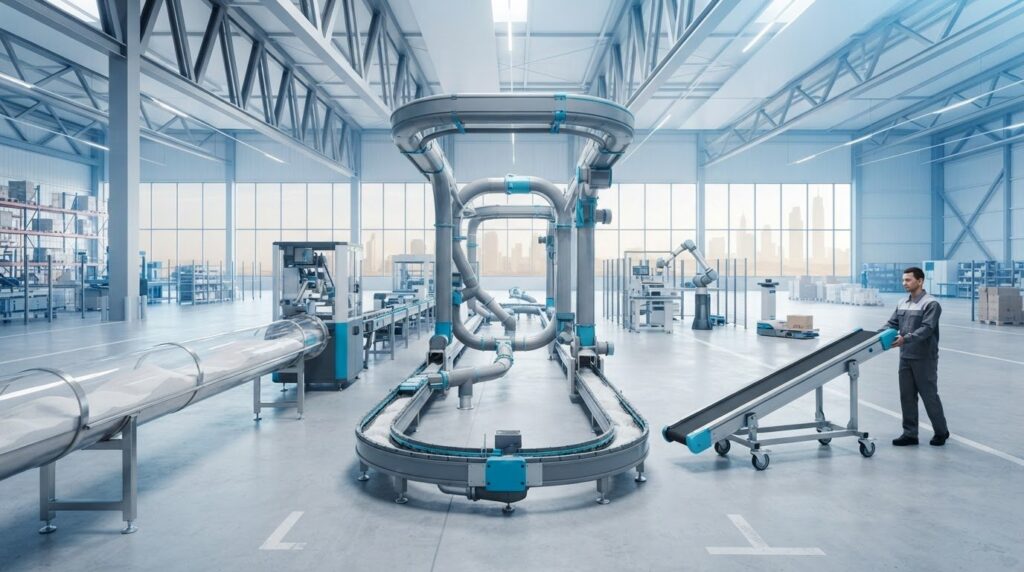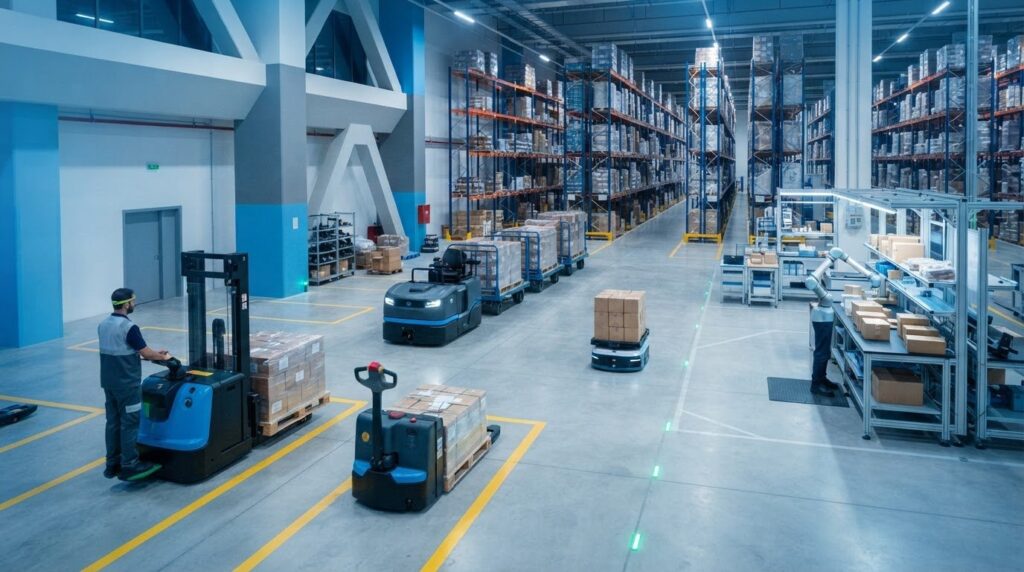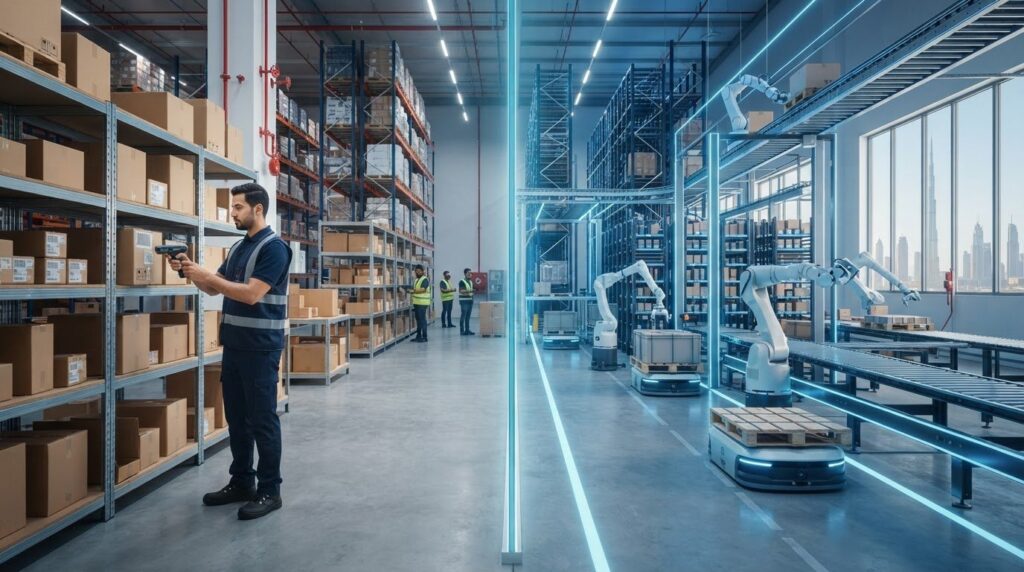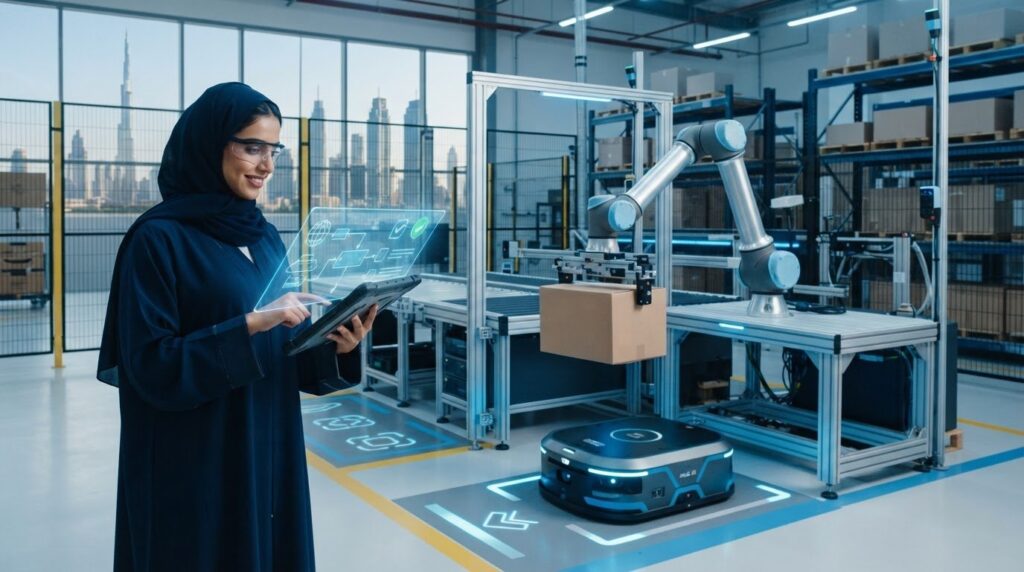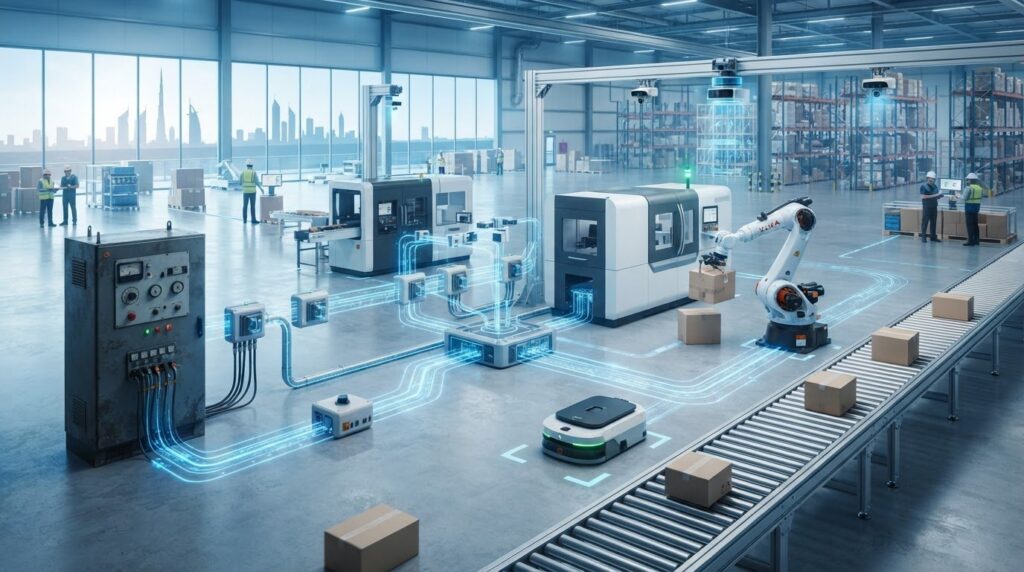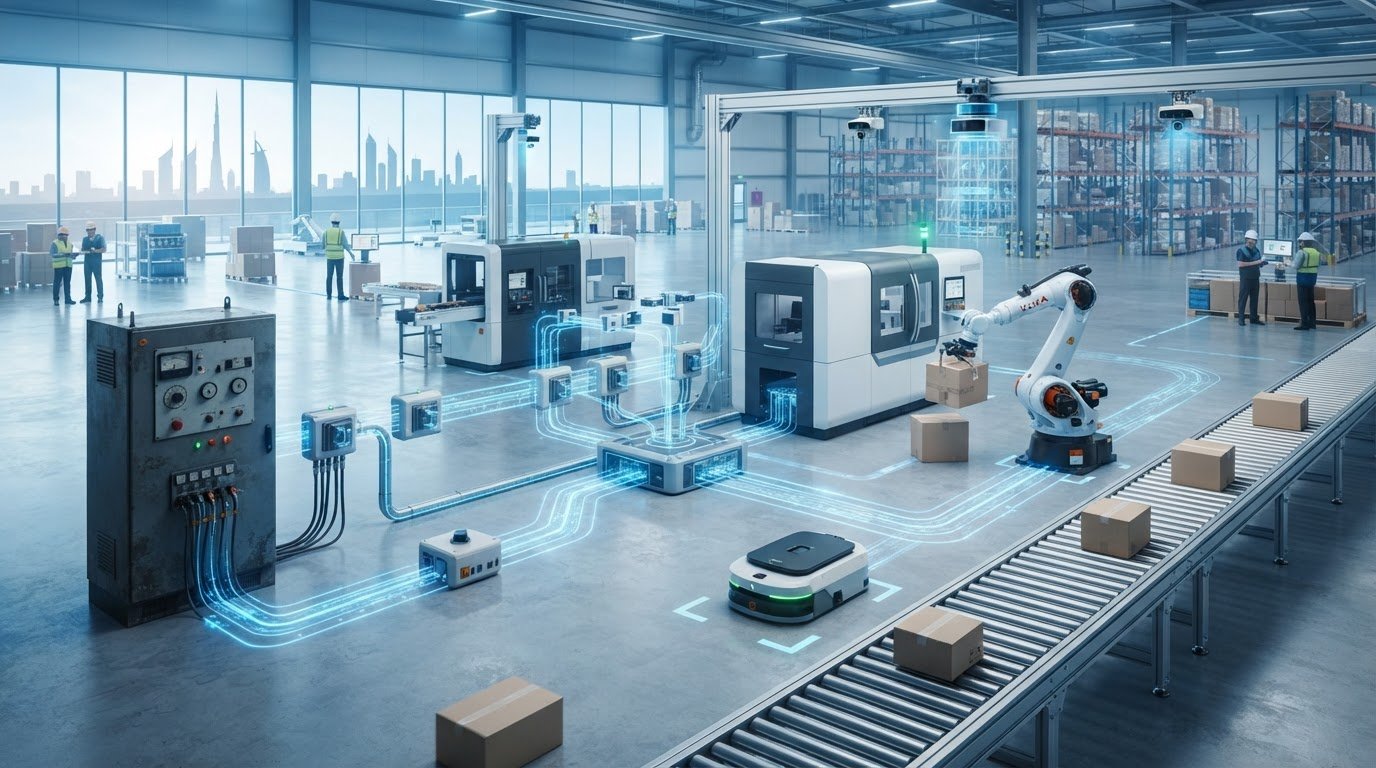
A system connection can look complete on a commissioning screen and still fail to support the operation around it. The challenges of integrating different automation systems go beyond incompatible interfaces: legacy controls, newer robotics, and material-handling equipment may exchange data inconsistently, while unclear ownership and dependencies make the project harder to manage.
If you’re concerned that integration could disrupt production or introduce cybersecurity risks, that concern is justified. Connecting PLC and SCADA environments with robotics isn’t simply a hardware task. It’s an operational architecture decision that must account for data flows, process requirements, and continuity.
This guide explains the technical and organizational risks that commonly stand in the way, then shows how to compare integration approaches against your facility’s operational constraints. You’ll learn how to define scope and ownership, assess protocol compatibility and cybersecurity needs, and plan a staged path from assessment to deployment. The goal is a coherent automation environment that connects systems deliberately while protecting day-to-day operations.
Key Takeaways
- Assess integration as an operational architecture challenge by mapping how equipment and software exchange data across your facility.
- Identify the challenges of integrating different automation systems by examining interface compatibility, shared data meaning, cybersecurity, and ownership.
- Compare direct connections, an integration layer, and phased modernization against your operational constraints and governance needs.
- Use a staged framework to define outcomes, map system exchanges, assess risk, and validate changes before expanding implementation.
- Consider PLC and SCADA integration as part of a coordinated approach to connecting robotics and control environments.
Why integrating different automation systems becomes an operational challenge
Automation integration coordinates the exchange of data and operation across different equipment and software. In a facility, that might mean connecting a machine’s control functions with supervisory monitoring, production planning, or business systems so information supports an agreed workflow. The challenges of integrating different automation systems begin when each tool works adequately on its own, but the wider process depends on information moving reliably between them.
Systems are often introduced to solve individual needs: a controller runs a machine, a robot performs a task, and separate software tracks production or inventory. Over time, these additions can form isolated layers, each with its own interface, data format, update cycle, and operational owner. A signal may pass between two systems but still be unusable if its meaning, timing, or ownership is unclear. Integration therefore involves more than establishing a connection.
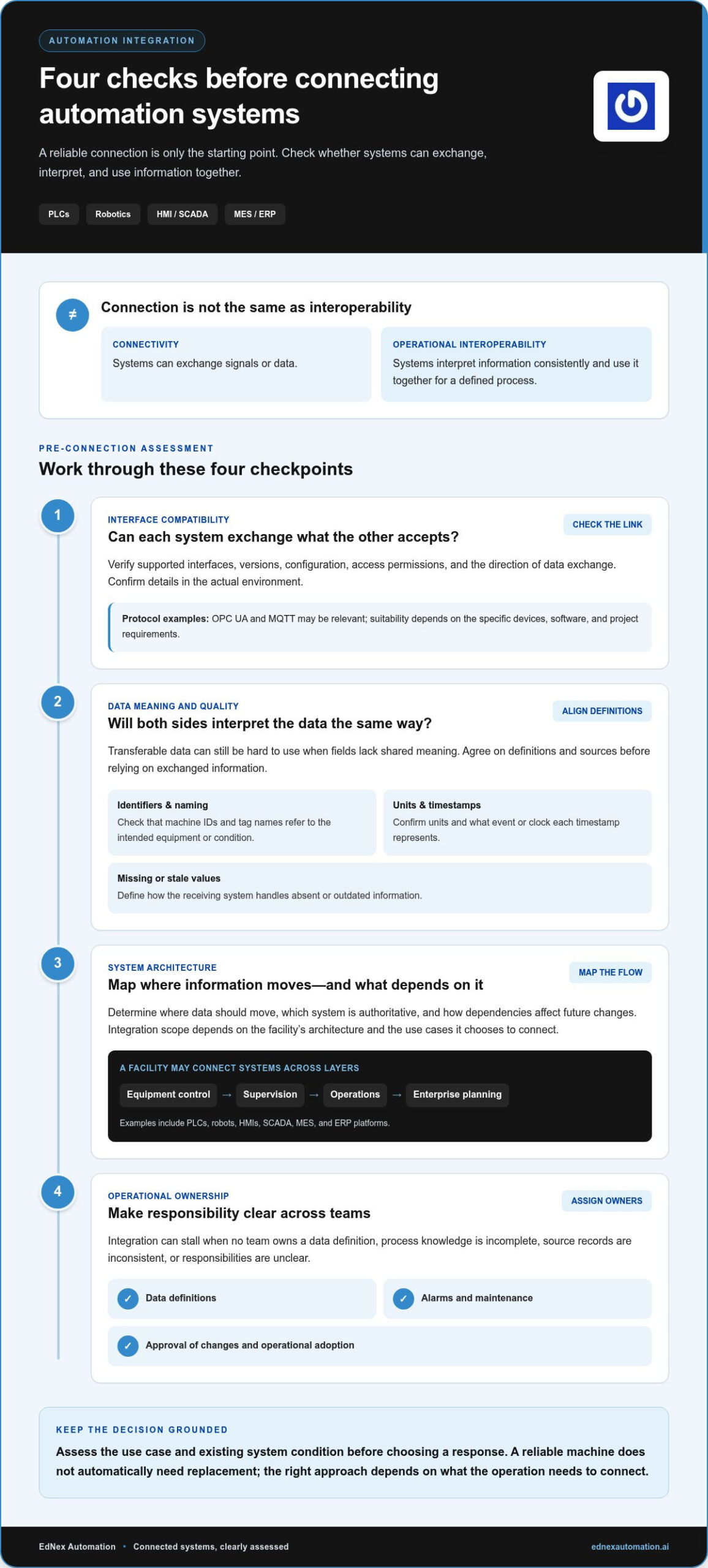
Connectivity is the ability of systems to exchange signals or data; end-to-end operational interoperability is their ability to interpret that information consistently and use it together to support a defined process. A successful link alone doesn’t establish that teams can act on the resulting information or maintain the workflow when equipment, software, or procedures change.
What counts as different automation systems?
A facility may include PLCs that control equipment, robots that perform physical tasks, HMIs that let operators interact with machines, and SCADA systems that supervise and visualize processes. MES software coordinates manufacturing operations, while ERP platforms support broader business planning. These roles span control, supervisory, operational, and enterprise layers. The Industrial Automation Overview provides broader context on the technologies and applications involved. Integration scope depends on the facility’s architecture and the use cases it chooses to connect.
How disconnected systems affect day-to-day operations
When equipment and software don’t share usable information, teams may have only partial visibility of a process. An operator might see a machine condition on an HMI while production status is recorded separately in another system. Staff may then transfer readings manually, reconcile conflicting records, or call another team to establish what happened. These handoffs complicate troubleshooting and coordinated decisions, particularly when data lacks consistent context.
Not every obstacle is technical. An interface may be incompatible, but integration can also stall because no team owns a data definition, the existing process is poorly understood, source records are inconsistent, or staff aren’t prepared for changed responsibilities. Separate these issues before choosing a response: engineering work for technical barriers, shared governance for ownership and data, process review for workflow gaps, and deliberate change management for operational adoption.
The main technical and organizational challenges of automation integration
The challenges of integrating different automation systems rarely come from a single faulty connection. They emerge when equipment, software, data practices, security controls, and teams must work as one operational environment. A legacy controller may perform its task reliably, for example, while sharing information with newer robotics or supervisory software requires careful assessment of interfaces, data structures, and operating constraints. Replacing it isn’t automatically the answer. The right approach depends on the use case and the condition of the existing system.
Connectivity lets systems exchange information; it doesn’t guarantee that they can interpret it consistently or coordinate operations safely. Treat this distinction as a design principle to reveal risks before an integration choice becomes difficult to change.
Interfaces, data quality, and system architecture
Start by asking what each system can expose, what the receiving system can accept, and whether their interface versions, configuration, and access methods align. Protocols such as OPC UA or MQTT may be relevant examples, but suitability and compatibility depend on the specific devices, software, and project requirements. Verify the details against the actual environment rather than assuming that systems using a familiar protocol will integrate without additional work.
Data can be transferable and still be hard to use when fields don’t share agreed meanings. A timestamp may reflect a different clock or event; a machine identifier may differ between systems; a value may use another unit; and naming conventions can obscure whether two tags refer to the same condition. Map the definitions and their sources as carefully as you confirm the connection itself.
- Interface compatibility: Check supported interfaces, versions, access permissions, and the direction of data exchange.
- Data meaning and quality: Agree on identifiers, units, timestamps, naming, and how missing or stale values are handled.
- Architecture: Determine where data should move, which system is authoritative, and how dependencies affect future changes.
- Operational ownership: Assign responsibility for data definitions, alarms, maintenance, and approval of changes.
Cybersecurity, ownership, and operational continuity
Connecting operational technology with other systems changes how information can move across an environment. A security review should consider proposed connections, access, data flows, and the effect of changes on the control environment. Requirements depend on project context, so assess security controls and applicable technical standards for the systems involved rather than assuming they are universal.
Governance gaps can undermine a technically sound design. If no one owns an alarm’s meaning, decides which record is authoritative, or approves a change, teams may respond inconsistently or struggle to maintain the integration. Define those responsibilities alongside the engineering scope, including who supports each interface and how updates are reviewed.
Production continuity is also a design constraint. Plan testing, rollback decisions, operational approvals, and the sequence of changes around the facility’s working requirements. No integration plan should assume that changes carry no disruption risk. For facilities assessing robotics alongside control systems, PLC and SCADA integration can be part of a coordinated project approach.
How to compare automation integration approaches for your facility
There’s no single architecture that suits every facility. The right choice depends on existing assets, the information that must move, production constraints, and project scope. Compare options against the same operational use case: what needs to communicate, who will maintain the connection, and how changes can be introduced and governed. This makes trade-offs visible before the technical design is locked in.
Direct connections versus a shared integration layer
Direct connections can suit a limited, clearly defined exchange between systems. A shared middleware or integration layer may help organize broader data flows, but it adds a component that must be designed, managed, and governed. Neither pattern guarantees scalability, security, or lower cost. Assess interfaces, data ownership, maintenance responsibilities, and the consequences of future system changes in your environment.
| Approach | Fit | Dependencies | Governance needs | Operational trade-offs |
|---|---|---|---|---|
| Direct connections | Small number of well-defined exchanges | Compatible interfaces and clear data mapping between each pair | Ownership for every connection, its data, and its maintenance | Can keep a narrow scope, while added connections may increase coordination work |
| Middleware or integration layer | Broader exchanges that benefit from a shared integration point | A suitable layer, agreed data models, and defined system boundaries | Clear responsibility for the layer, access, updates, and data definitions | Centralizes integration logic, while adding a component and related dependencies to manage |
| Phased modernization | Facilities connecting existing assets while planning changes over time | Priorities, sequencing, and a view of system condition and lifespan | Decision rights for each phase and rules for maintaining earlier connections | Introduces change incrementally, while requiring coordination across phases |
For robotics and control environments, comparing these patterns as part of automation integration planning can help align architecture decisions with operational needs.
Phased modernization versus replacing existing systems
Phased modernization connects selected existing assets and introduces wider changes in planned steps. Replacing systems is a broader option when their condition, supportability, remaining lifespan, or future requirements make continued use impractical. Neither path should be chosen by default. Evaluate production continuity, dependencies on other equipment, the consequences of a change, and the facility’s ability to support the resulting environment.
Functioning equipment doesn’t automatically need immediate replacement. A targeted connection may address a defined operational need, while a longer-term modernization plan can account for systems that are harder to maintain or constrain future changes. Manage the challenges of integrating different automation systems by matching the architecture to the use case, then documenting assumptions, ownership, and trade-offs before implementation proceeds.
A staged framework for reducing integration risk
Successful integration advances through defined decisions, evidence, and operational approval, rather than treating connection as a single commissioning event. A staged process helps teams surface dependencies early, test assumptions within a controlled scope, and establish who will own the result. Progress only when each stage produces evidence that the next change is understood, testable, and operationally governed.
Define the use case and map the current environment
Begin with an operational outcome, not a predetermined technology or product. Bring operators, engineering, IT/OT, maintenance, and business stakeholders together to identify the process to improve and the information it needs. Then map the systems, data owners, dependencies, and current information flows involved. Record continuity, security, maintenance, and future-change constraints as part of that map.
- Define outcomes. Decision question: What operational result should the integration support? Evidence: an agreed use case, success criteria, and a business owner who can approve priorities.
- Inventory systems. Decision question: Which assets and software are in scope? Evidence: a current system register covering relevant equipment, versions, owners, dependencies, and support responsibilities, assembled by engineering and maintenance.
- Map exchanges. Decision question: What information must move, between which systems, and for what purpose? Evidence: a data-flow map identifying sources, destinations, meaning, timing needs, and accountable data owners.
- Assess risk. Decision question: What could affect safe operation, security, continuity, or maintainability? Evidence: a reviewed risk register with mitigations, escalation routes, and named IT/OT, operations, and engineering owners.
Pilot, validate, and govern the integrated environment
Use a contained pilot to test the architecture against real operating conditions before expanding its scope. In complex manufacturing environments, custom integration specialists like RWC Inc. often leverage automated machine simulation alongside pilot testing to validate robotic behavior before line rollout. Agree on acceptance criteria in advance, involve the people who will run and maintain the process, and record results so the decision to proceed, revise, or stop is clear.
- Pilot. Decision question: Can the chosen use case be tested within a bounded operational scope? Evidence: a test plan, acceptance criteria, approved change window, and accountable technical and operational leads.
- Validate. Decision question: Does the integration behave as intended, including under exceptions? Evidence: test results for data meaning, system behavior, access controls, alarms, and fallback procedures, reviewed by the relevant owners.
- Govern. Decision question: Who maintains and approves the integrated environment after the pilot? Evidence: assigned responsibilities for monitoring, documentation, support, change approval, and future rollout decisions.
For a project-specific path from assessment through deployment and integration, plan your automation integration with EdNex Automation, with consulting and ongoing support as part of its approach.
How EdNex Automation supports connected robotics and control systems
Connecting robotics to an industrial environment calls for more than selecting equipment. The operational use case, control architecture, material flow, and existing systems all shape the project. EdNex Automation provides consulting, deployment, integration, and ongoing support in a connected approach, aligning project decisions with operational needs from planning through implementation.
This matters when robotics must work alongside established controls. A robot may be introduced to perform a defined task, but its place in the wider operation depends on how the facility manages equipment, information, and process coordination. Considering those relationships early frames integration as an architecture decision, not just a hardware purchase.
Bringing robotics and industrial control into the project scope
Start with the process the facility wants to support, then consider which robotic and control elements belong in the solution. For example, a collaborative robot may be relevant to a task where people and automation share a workflow, while an autonomous mobile robot may fit a material movement use case. Where equipment involves continuous rotation—such as rotary tables, carousel mechanisms, or robotic joints—specialized rotary connectors from providers like sliprings.com.au are essential for maintaining reliable electrical and signal transmission. The systems and information involved vary by project, so assess compatibility and technical requirements against the actual environment.
PLC and SCADA integration is relevant when robotics and control environments must be considered together. PLCs manage equipment control, while SCADA supports supervisory monitoring. Including both in the project scope helps clarify where the robot fits and what information the wider process needs. Explore EdNex Automation’s PLC and SCADA integration services to understand this connection in more detail.
Where the use case includes movement of goods through a facility, the project may also need to account for material-handling workflows. An autonomous mobile robot or, where storage and retrieval are part of the defined scope, an ASRS may be relevant. Consider these options in relation to the process and control environment, not as isolated additions.
Moving from integration planning to a tailored deployment
EdNex Automation’s project approach spans consulting, deployment, integration, and ongoing support. Consulting helps shape the project around operational needs; deployment and integration put the selected solution into its intended environment; ongoing support addresses the system beyond initial implementation. The scope is shaped by the facility, equipment, and use case.
For organizations assessing the challenges of integrating different automation systems, this joined-up perspective can keep robotics, PLC and SCADA integration, and material handling within a coherent project plan. EdNex Automation is an authorized partner of global robotics leaders including Pudu Robotics, Unitree Robotics, Franka Robotics, Kinova, and FARINO.
Discuss your automation integration needs with EdNex Automation to explore an approach shaped around your operational environment, existing systems, and project objectives.
Turn integration priorities into a practical next step
Turn your integration priorities into a clear project brief. Identify the operational outcome you want to enable, the systems involved, and the constraints that will shape implementation. Include the people responsible for operating, maintaining, and governing those systems so technical decisions reflect how the facility actually works.
With that foundation, the challenges of integrating different automation systems become specific decisions rather than an open-ended technology problem. A considered path can preserve useful existing assets while creating room for future capabilities, with each change assessed against operational needs and continuity.
EdNex Automation brings consulting, deployment, integration, and ongoing support together, with PLC and SCADA integration and ASRS among its offerings. Its authorized partnerships include Pudu Robotics, Unitree Robotics, Franka Robotics, Kinova, and FARINO. Discuss your automation integration requirements with EdNex Automation and take the next step toward a connected approach shaped around your operation.
Frequently Asked Questions
What are the most common challenges when integrating different automation systems?
The most common challenges involve interface compatibility, inconsistent data definitions, architecture decisions, cybersecurity, and unclear ownership. For example, a production dashboard may receive a machine status but lack the context to distinguish an active alarm from an outdated event. The challenges of integrating different automation systems can also involve process changes and maintenance responsibilities. Assess each issue against a real workflow to separate technical work from governance or training needs.
Can legacy automation systems be integrated with newer systems?
Yes, legacy equipment can often be included when its available interfaces and operating condition support the intended use case. Start by identifying what information the equipment can provide and whether an intermediary component or a limited data exchange could bridge differences. For instance, a facility might expose selected machine status information without changing the machine’s control logic. Account for supportability, security, and what happens if the connection becomes unavailable.
How do you reduce production risk during automation integration?
Reduce production risk by controlling the scope and timing of changes. Define which operations could be affected, establish who can authorize a change, and prepare a fallback procedure before implementation. Test data flows and operator responses in a suitable test environment where possible, then rehearse the planned operating steps with affected staff. Schedule implementation around production requirements and document how teams will identify and escalate unexpected behavior.
What is the difference between system connectivity and interoperability?
Connectivity means a technical path exists for systems to exchange information. Interoperability means the systems and people involved can use that information consistently to support a task. For example, two systems may exchange a temperature value yet interpret its unit, source, or timestamp differently. Agreeing on what the value represents and how it should guide an operational response makes the exchange useful beyond the connection itself.
Does integrating automation systems require replacing existing equipment?
No, integration doesn’t automatically require equipment replacement. First compare the asset’s condition and support outlook with the information and functions the project needs. If it can provide the required data and remain maintainable, retaining it may be a valid planning choice. Consider replacement if limitations prevent the required use case or create unacceptable dependencies, but make that decision after a facility-specific assessment.
Which teams should be involved in an automation integration project?
Include operators, engineering, IT/OT, maintenance, and business stakeholders. Operators can explain how work actually proceeds and where a change may affect decisions. Engineering and maintenance can assess equipment dependencies and support tasks, while IT/OT teams contribute to architecture and security review. Business stakeholders help set priorities and acceptance criteria. Assign an accountable owner for decisions that cross team boundaries, such as alarm handling or data definitions.
How should an organization choose an automation integration approach?
Choose based on the operational use case, existing assets, data exchanges, continuity constraints, and expected system changes. A small, stable exchange may suit a direct connection; broader data flows may justify assessing a shared integration layer. If equipment needs evolve at different times, phased modernization can help sequence decisions. Compare each option’s dependencies, maintenance responsibilities, and failure handling, then document why the selected design fits the facility.