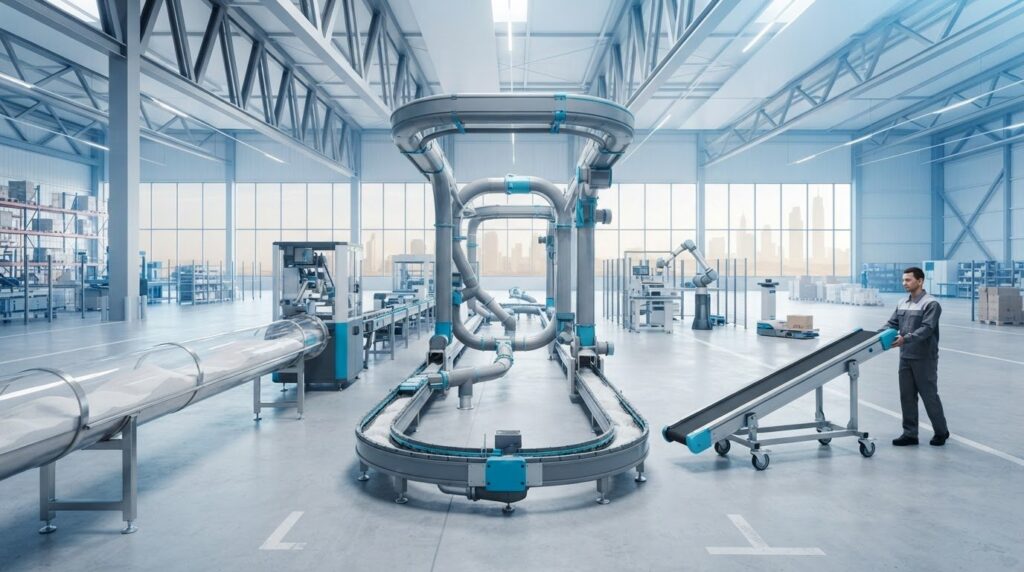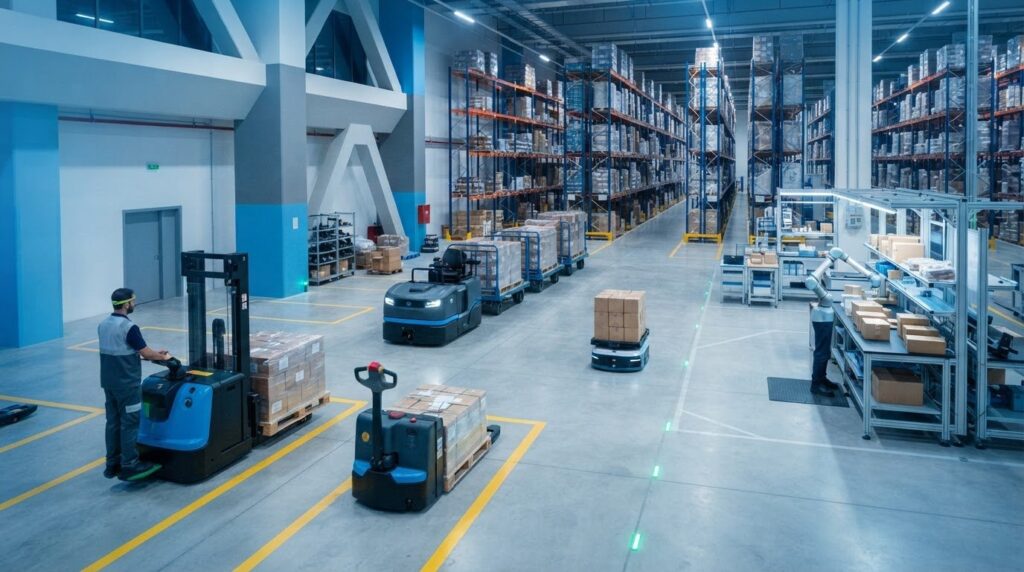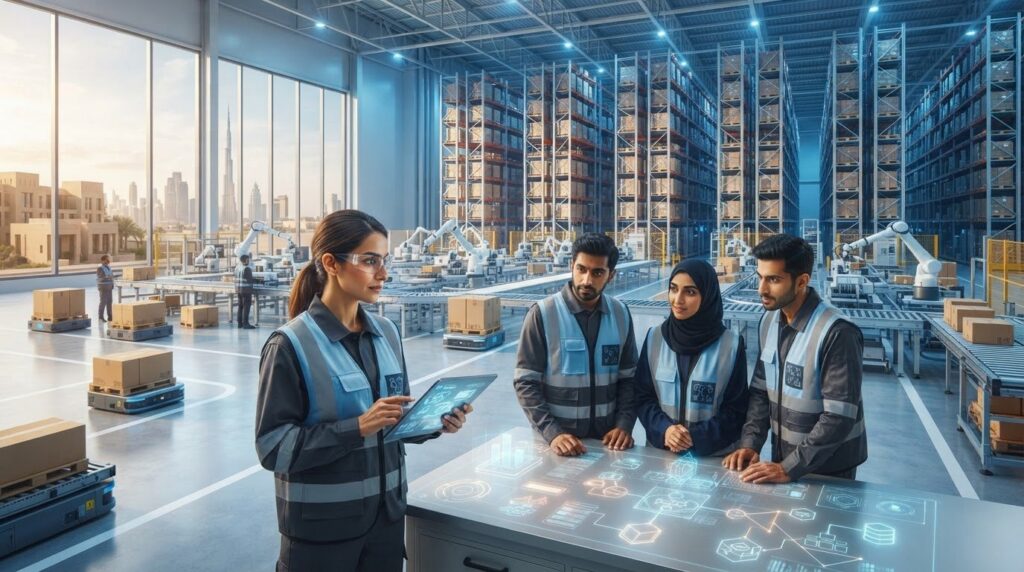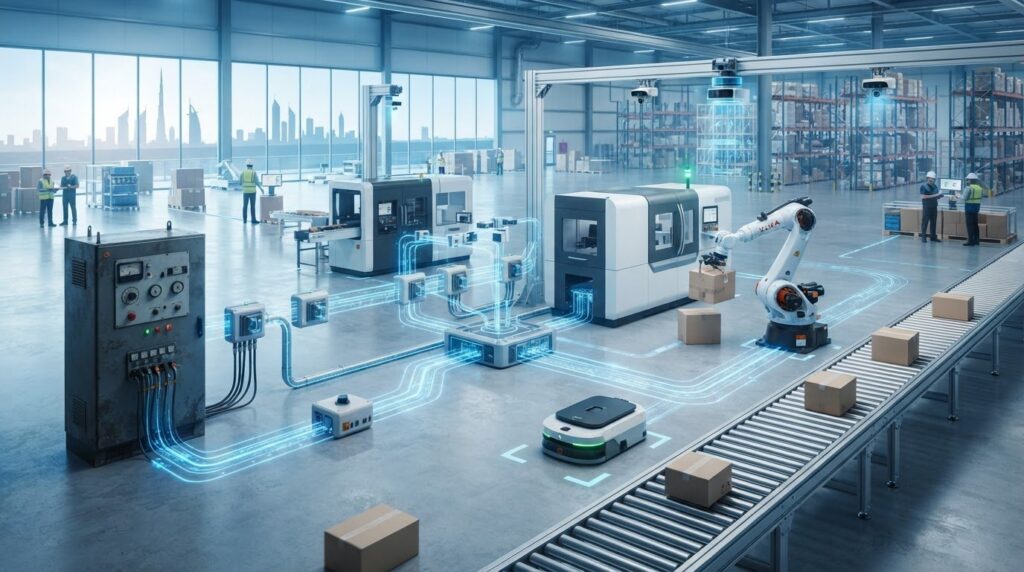
A fixed conveyor isn’t always the best fit. Pneumatic conveying can suit light powders, tubular chain systems provide enclosed routes with curves and multiple inlets or outlets, and portable conveyors can support changing material-handling needs. These conveyor system alternatives address different layout and product challenges, while belts, bucket elevators and Redler conveyors remain practical for other applications. The right choice depends on the material, route, operating conditions and how often the layout changes.
It’s understandable to favour a familiar belt or elevator, especially when the process already works. But fixed equipment can limit future changes, while other designs may better suit a specific product or route. This comparison explains how pneumatic, tubular chain and portable options fit alongside belts, bucket elevators and Redler conveyors, and what to consider when choosing between them. It also looks at alternative continuous conveyor designs, where adapting the route and material flow can matter as much as the conveying mechanism. By the end, you’ll have a practical framework for matching a system to your operation.
Key Takeaways
- Match pneumatic conveying to light powders and routes where containing material matters; assess how your product behaves before replacing a belt.
- Compare tubular chain systems with bucket elevators and Redler conveyors by power demand, route flexibility, and the need for multiple inlets or outlets.
- Consider how curves, inclines, drainage, airflow, and product grip shape a continuous conveyor design, not just the conveyor type.
- Review how fixed equipment affects warehouse space and future layout changes before selecting a system for a facility with changing workflows.
- Use conveyors for predictable fixed routes and assess AMRs or collaborative robots when material movement needs greater adaptability or human collaboration.
Pneumatic conveying as an alternative to conveyor belts
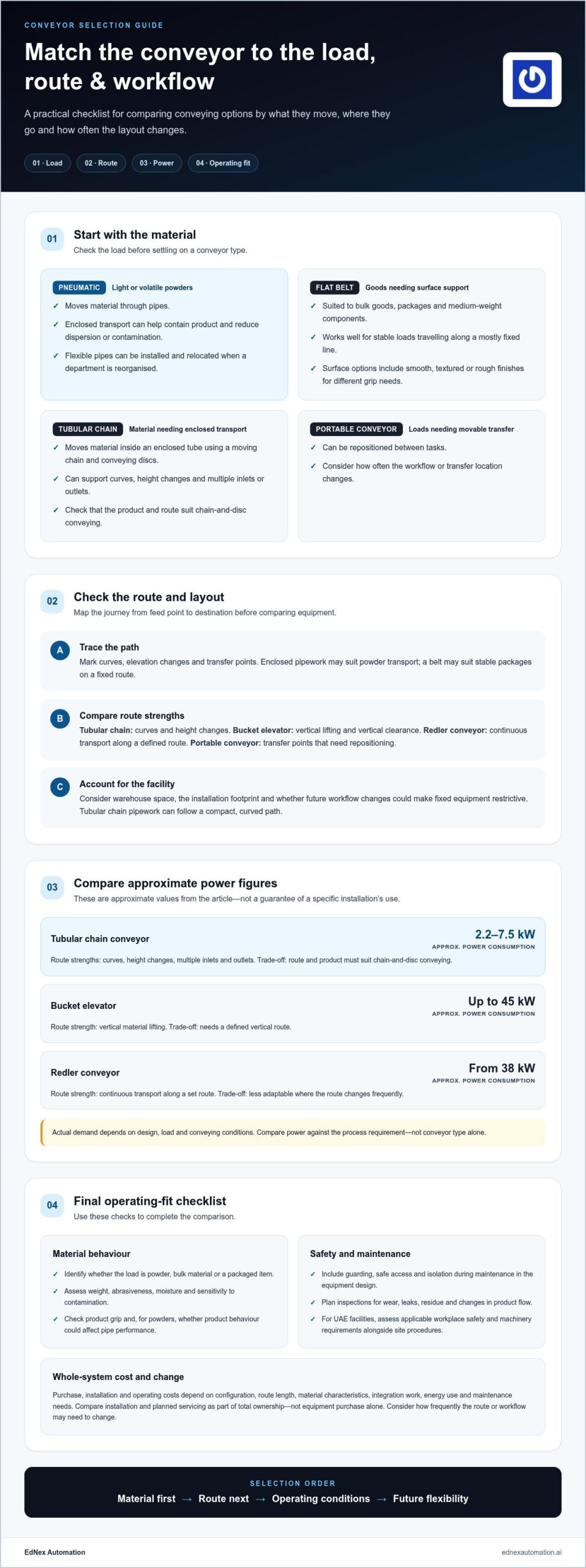
Pneumatic conveying can suit light, volatile powders that belts may not handle effectively. It moves material through pipes, helping contain the product and reduce dispersion or contamination. Flexible pipes can be installed and relocated when a production department is reorganised. A belt, by contrast, remains suitable for loads that need continuous surface support, such as packaged materials or components.
Facility layout, material properties and workflow determine which method fits. First identify whether the load is powder, bulk material or a packaged item. Then assess its weight, abrasiveness, moisture and sensitivity to contamination. Map the route, including curves, elevation changes and transfer points. For example, enclosed pipework may suit powder transport, while a belt may suit stable packages travelling along a fixed route.
| Option | Best-fit load | Route and layout | Key consideration |
|---|---|---|---|
| Pneumatic conveying | Light or volatile powders | Flexible pipe route | Containment and product dispersion |
| Flat belt | Bulk goods, packages and medium-weight components | Mostly fixed line | Surface grip and transfer points |
| Tubular chain | Material requiring enclosed transport | Curves and changes in height | Multiple inlets or outlets |
| Portable conveyor | Loads needing movable transfer | Repositioned between tasks | Workflow and relocation frequency |
Match the load first, then consider the route, containment needs and how often the layout changes.
For facilities in the UAE, assess the selected system against applicable workplace safety and machinery requirements, as well as site operating procedures. Consider the equipment’s location, how workers interact with it and controls for material exposure. Requirements depend on the facility and system configuration, so include a safety review in the design and installation process.
Purchase, installation and operating costs depend on the system configuration, route length, material characteristics, integration work, energy use and maintenance needs. A configured system’s price depends on the case and is given after a quote request. Compare the full ownership picture, including installation and planned servicing, rather than selecting on equipment purchase alone.
Risks vary by method. Pneumatic lines need attention to containment and blockages, while belts have moving surfaces and transfer points. Include guarding, safe access and isolation during maintenance in the equipment design. Schedule inspections to check for wear, leaks, residue and changes in product flow. For example, a change in powder behaviour can affect pipe performance.
Flat conveyor belts suit bulk goods, packaged materials and medium-weight components. They can run at high speeds with low noise and may have smooth, textured or rough surfaces to meet different friction and grip requirements. On inclines or declines, cleats, sidewalls or other accessories may help prevent rollback and spillage.
Specialty belts include cleated belts for inclines, sidewall belts for vertical lifting, wire mesh belts for heat or fluid exchange, and textured belts for improved grip. Modular conveyor belts are typically made from engineered thermoplastics that resist chemicals, moisture and high temperatures. If a segment is damaged, it can be replaced individually without dismantling the entire belt, reducing downtime and repair costs.
Tubular chain conveyor comparison with bucket elevators and Redler conveyors
Throughput depends on the material, route and system configuration, so compare capacity with the process requirement rather than conveyor type alone. Tubular chain systems can accommodate curves and height changes, while bucket elevators focus on vertical lifting and Redler conveyors move material along a defined route. Space requirements depend on the installation: an elevator needs vertical clearance, while tubular chain pipework can follow a compact, curved path.
A tubular chain conveyor moves material inside an enclosed tube using a moving chain and conveying discs. Its closed structure and lack of accumulation points reduce the risk of wear, clogging and product dispersion. Multiple inlets and outlets can serve different process stages, while curves and changes in height support continuous flow through a complex plant layout. For example, one route can connect equipment on different levels without a straight run.
| System | Approximate power consumption | Route strengths | Key trade-off |
|---|---|---|---|
| Tubular chain conveyor | 2.2 to 7.5 kW | Curves, height changes, multiple inlets and outlets | Route and product must suit chain-and-disc conveying |
| Bucket elevator | Up to 45 kW | Vertical material lifting | Needs a defined vertical route |
| Redler conveyor | From 38 kW | Continuous transport along a set route | Less adaptable where the route changes frequently |
These figures are approximate power-consumption values, not a guarantee of a specific installation’s use. Actual demand depends on the design, load and conveying conditions. The tubular chain conveyor’s listed range is lower than the listed values for the other two systems, but power use alone does not establish efficiency. Compare energy alongside throughput, route complexity, maintenance and product handling.
For layout planning, mark each pickup and discharge point, then map elevation changes and bends. A tubular chain design can connect several inlets or outlets and maintain continuous flow along a curved route. A bucket elevator is more direct when the process primarily requires vertical lifting. A Redler conveyor may fit a straightforward, fixed path where route flexibility is less important.
Assess how the material responds to movement and contact with conveyor components. Product characteristics affect conveying performance, while bends and transfer points influence system design. Confirm that the required flow, number of collection points and path geometry suit the chosen method.
Choose tubular chain conveying for enclosed, continuous flow along a changing route, a bucket elevator for a defined vertical lift, and a Redler conveyor for a fixed conveying path.
Choose a tubular chain conveyor when the route includes bends and elevation changes but still needs continuous flow. Its ability to follow curves and height changes with a reduced radius can help when the route is not a simple straight run. Consider the path as a whole, rather than assessing each bend or height change in isolation, and check that the proposed geometry suits the process route.
Before choosing a system, map the required path and identify where it curves or changes height. Then confirm whether continuous flow through those transitions is essential. This makes the comparison specific to the installation: the key question is whether the conveyor can follow the route and meet the intended flow pattern, not simply move material from one point to another.
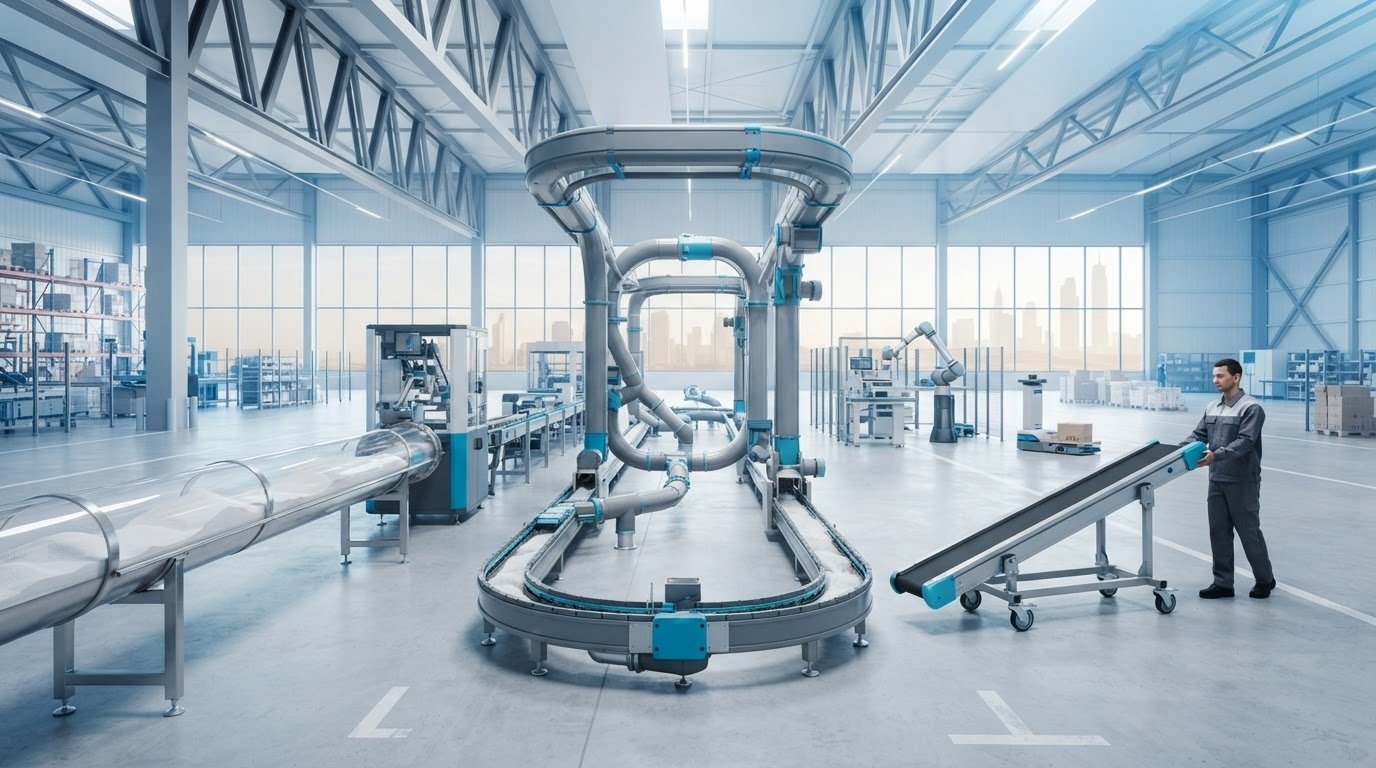
Alternative continuous conveyor design
Continuous conveying isn’t limited to one belt or a straight route. A technical design can combine suitable conveyor components, drive control and route geometry to keep material moving in line with the process. For example, a production line with curves, elevation changes and several work areas may need a different configuration from a straight transfer between two machines.
A tubular chain conveyor is one continuous option for complex routing. It can follow curves and changes in height while maintaining product flow, and it can use an inverter to regulate speed according to the material. A single motor can drive the route. Its approximate power consumption is listed from 2.2 to 7.5 kW, but the correct design still depends on the conveyed product and operating conditions.
Modular conveyor belts offer another design option. Open-grid patterns support drainage or airflow in washing, drying and cooling processes. Configurations can also accommodate tight curves, inclines up to steep angles and multifaceted layouts. Select the belt material and surface according to the product’s weight, abrasiveness, moisture and grip needs. An open-grid belt, for instance, may suit washing, while a textured surface may help handle items that need more grip.
- Map the route: Mark curves, elevations, intersections, loading points and discharge points before specifying equipment.
- Define the product: Record whether the material needs containment, drainage, airflow or controlled speed.
- Match the drive: Consider how speed control and motor placement affect the flow through each process stage.
- Validate the design: Test critical route sections and product behaviour before committing to a full-scale layout.
Overhead monorails move loads along an elevated fixed route, leaving floor area available for people, equipment or other workflows. Conveyors provide continuous movement along a defined path, while an automated storage and retrieval system (ASRS) stores and retrieves loads rather than simply moving them between process points. ASRS deployments are mostly associated with new warehouses expecting low-variable operations. High initial investment, longer waits for a return, and greater maintenance and operating complexity can make them less suitable for changing workflows.
Design validation matters for unfamiliar continuous systems. Gerald Geier’s alternative continuous conveyor thesis was awarded on 22 March 2024; it recommends testing selected system sections at reduced scale before advancing towards a prototype. That staged approach helps engineers examine material flow and technical performance before extending a design across an entire route.
Start by defining the task: choose a continuous conveyor for predictable flow between process stages, a monorail when an overhead fixed route fits, and ASRS when storage and retrieval are the main requirements. Compare route geometry, product handling, operating variability and maintenance demands as part of the decision.
Conveyor system portability and warehouse reconfiguration
Fixed conveyors take up warehouse space and may require infrastructure changes to fit the layout. Once installed, their position can make reconfiguration difficult when demand or workflows change. For example, a new picking zone may need a different route, while the fixed line still occupies its original footprint. Portable material-handling options can help teams adapt transfer points without redesigning the entire facility.
Forklifts, pallet jacks and tugger trains suit intermittent handling, changing destinations or loads that don’t follow a continuous route. A forklift can move a pallet between separate storage and dispatch areas; a pallet jack suits short, manual transfers; and a tugger train can carry several loads along a planned loop. Conveyors are more appropriate when material repeatedly travels between the same process points.
Assess portability through a practical layout review:
- Map the flow: Mark receiving, storage, picking, production and dispatch points on the current floor plan.
- Identify change points: Note where seasonal demand or production changes could shift a transfer route.
- Review handling needs: Record whether loads are pallets, individual items, containers or materials moving between process stages.
- Protect working space: Compare equipment footprints with worker access, staging areas and existing traffic routes.
Warehouses with frequently changing storage or picking arrangements may benefit from mobile handling options. Factories with stable, repeated movement between machines can use fixed conveyors, while a portable unit may suit a temporary link between production stages. Airports often move baggage between distinct handling points, and food-processing facilities may prioritise equipment suited to their products and process conditions. In each case, route stability and load type guide the choice.
Goods-to-person robots introduce another layout consideration: they move heavy shelves and need separation from people, which can require warehouse changes. Automated Storage and Retrieval Systems (ASRS) are mostly deployed in new warehouses designed around low-variable operations. Their initial investment and longer wait for a return can make them less suitable when workflows change often. Maintenance and system mastery can also bring downtime and operational challenges.
To limit disruption, plan reconfiguration in stages. First, identify the route or zone causing the handling constraint. Next, test the revised flow with representative loads and normal worker movements. Then assess whether a portable conveyor, manual vehicle or fixed system best supports the revised process. A temporary transfer between two work areas, for example, may not justify extending a permanent conveyor line.
Choose according to route predictability: fixed conveyors suit stable, repeated flows, while forklifts, pallet jacks, tugger trains and portable equipment better support variable destinations or changing layouts. For UAE facilities, include actual site access, floor space and process sequence in the comparison.
How do AGVs and AMRs compare with conveyor systems for material handling?
Conveyors move loads along fixed routes, while automated guided vehicles (AGVs) and autonomous mobile robots (AMRs) carry loads between locations. The distinction matters when a warehouse changes its flow: a conveyor suits repeated transfers between set points, while mobile systems can serve different destinations without extending a fixed line. Conveyor systems can cost about twice as much as leading collaborative mobile robots, although total project economics depend on the task and system design.
AGVs generally follow defined routes and suit repeatable material movement. Automated guided carts can support cross-docking, storage and warehouse sortation, where loads move between known stations. They are generally less intelligent, collaborative and adaptive than leading AMRs, so may be less suited to advanced picking. Changing a route can also involve updating the vehicle’s guidance or operating plan.
AMRs move materials with greater adaptability than guided carts. In a warehouse, an AMR can carry items between work zones rather than relying on one continuous conveyor path. Collaborative mobile robots can work alongside pickers to improve picking speed and accuracy. They are worth considering where workers pick across changing locations, rather than handling identical transfers along a fixed line.
Picking can account for as much as 60% of an average warehouse’s operational budget. That makes picking workflow a meaningful part of the comparison, but it doesn’t mean a mobile robot automatically lowers total costs. Assess the movement distance, order patterns, handoff points, staffing workflow and integration requirements. Goods-to-person robots can require high initial investment, and smaller operations may wait too long to realize a return.
- Choose a conveyor for consistent, high-frequency movement between fixed process points.
- Consider an AGV for repeatable transport along established routes, including cross-docking or sortation.
- Consider an AMR when destinations or workflows vary and mobile handling can support workers.
Before selecting equipment, map each material journey from origin to destination. Mark where loads change hands, where routes intersect and which tasks require a person. Then compare the operating pattern with vehicle travel or conveyor flow. A stable transfer between production stages may suit a conveyor, while variable deliveries to several picking areas may be better suited to mobile handling.
Some facilities combine approaches, using fixed conveyors for predictable movement and mobile robots for flexible transfers. Automated Storage and Retrieval Systems (ASRS) address a different need: storing and retrieving goods, rather than transporting every load between process points. Explore AMR options for material handling when mobile transport could fit your workflow.
EdNex Automation: Collaborative Robots (Cobots)
EdNex Automation offers Collaborative Robots (Cobots) for operations considering automation beyond fixed conveying. Turn to cobots when a task involves people and repeatable handling work, rather than continuous transport between fixed points. For changing routes across a facility, Autonomous Mobile Robots (AMRs) offer another material-movement option. The best fit depends on the workflow: a conveyor supports a predictable route, while a mobile robot can serve different locations.
EdNex Automation also offers cleaning robots and delivery robots for other operational tasks. Mapping the material flow, worker activities and destinations helps identify where these technologies may fit alongside existing equipment. To discuss automation options for your operation, contact EdNex Automation.
Build a More Adaptable Material-Handling Strategy
The next step is to turn your operational priorities into a clear automation brief. Identify where fixed routes limit change, which tasks require human collaboration, and where mobile handling could support a more responsive workflow. This assessment gives your team a stronger basis for deciding how conveyor system alternatives fit into a broader automation plan.
EdNex Automation offers Collaborative Robots (Cobots), Autonomous Mobile Robots (AMRs) and Cleaning robots. These solutions address different operational needs, from collaborative work and mobile movement to facility cleaning. Defining the process challenge first keeps technology selection focused on practical requirements rather than novelty.
Bring your workflow priorities and material-handling goals into the next planning conversation. Contact EdNex Automation about your options and explore a considered path toward more adaptable operations.
Frequently Asked Questions
Why do teams look for conveyor alternatives?
Teams explore conveyor system alternatives when equipment no longer matches the operation’s actual work pattern. A line designed for steady production, for example, may be underused during short batches, while new product variants can add sorting or handoff steps. Reviewing idle time, manual interventions and recurring bottlenecks can reveal whether the issue lies in the conveyor route or in how material moves between process stages.
What are the main alternatives to conveyor systems for moving materials?
Main options include pneumatic conveying, tubular chain systems, portable conveyors, forklifts, pallet jacks, tugger trains, AGVs and AMRs. Choose according to the transport task: pneumatic equipment moves powder through a line, while vehicles move discrete loads between locations. For example, a facility might use a tugger train to replenish work cells and a mobile robot for point-to-point delivery. Separate storage systems handle retrieval as well as movement.