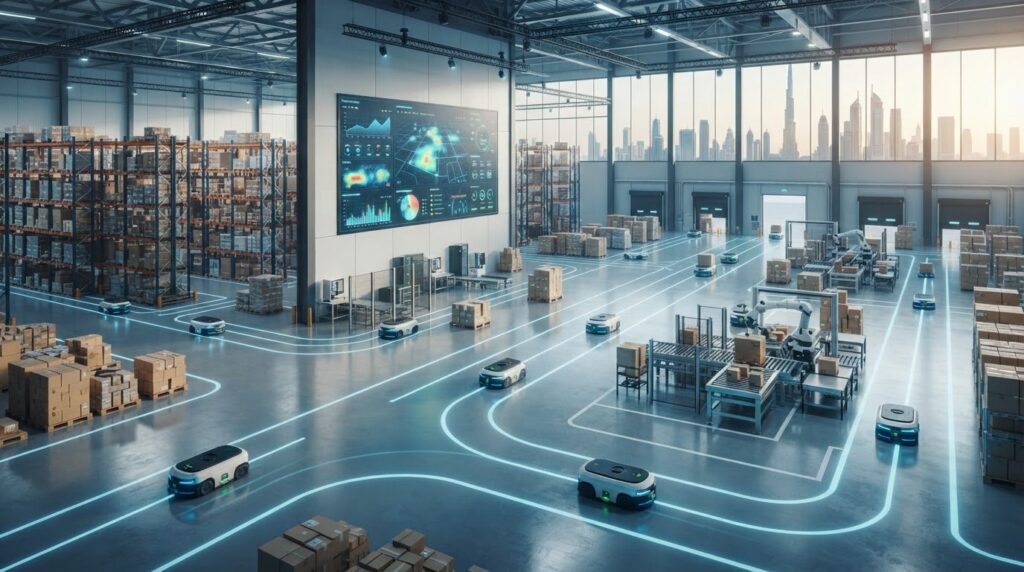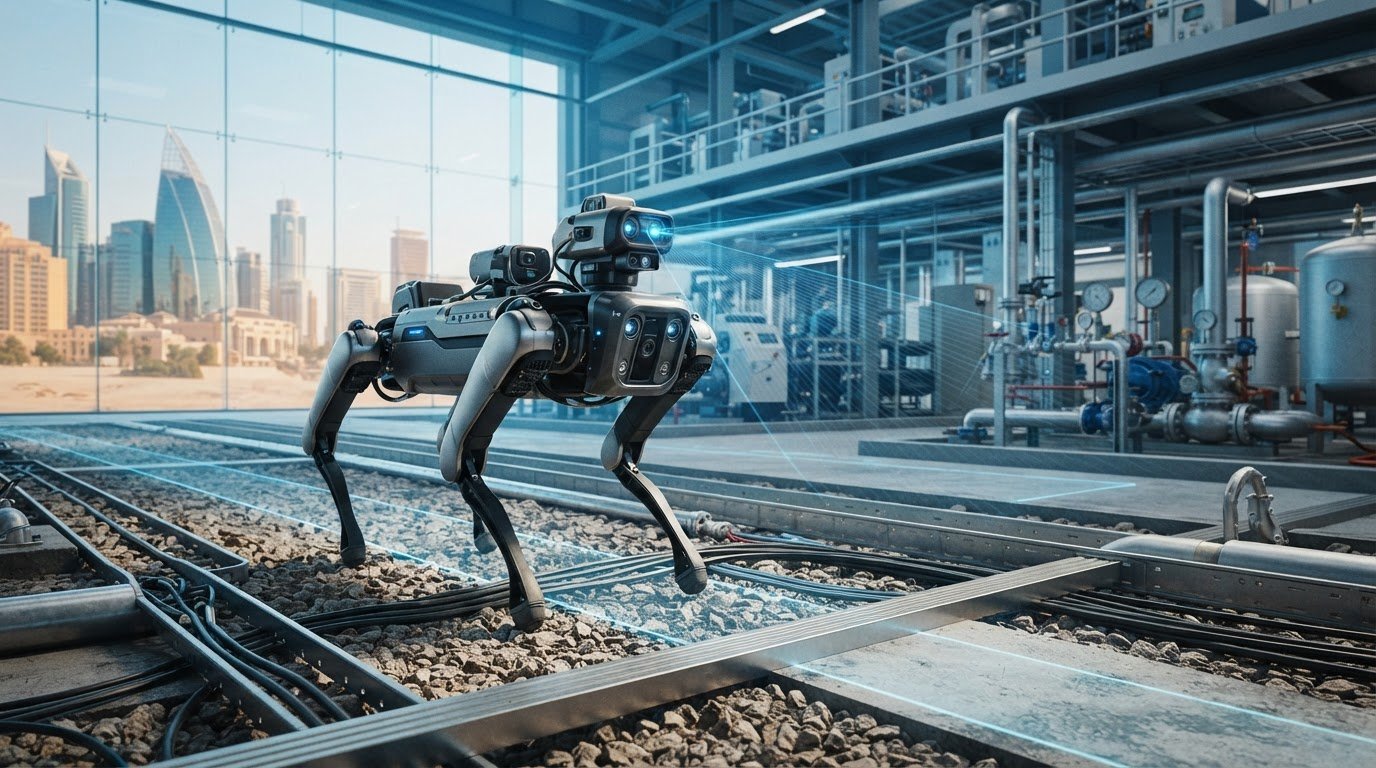
Could a robot that crosses uneven ground solve a real inspection problem, or simply add complexity to your site? That distinction is central to assessing the b2 robot. The name commonly refers to Unitree Robotics’ industrial quadruped, but a capable platform is useful only when its mobility, sensing, endurance, and autonomy match the task and operating conditions.
Headline capabilities are a starting point, not a decision. Payload, runtime, and obstacle handling matter only in relation to your routes, inspection tasks, environmental conditions, safety controls, and required system connections. This article explains what the B2 is designed to do, how to assess its fit against practical industrial requirements, and what to plan before deployment.
A task-first evaluation also helps connect a mobile robot to a wider automation strategy. For organizations across the UAE, inspection or surveillance robotics can work alongside other robotic systems and PLC or SCADA integration to support existing processes. The goal is to move from capability assessment to a practical deployment plan, not to adopt a robot for novelty alone.
Key Takeaways
- Learn how to distinguish documented Unitree B2 details from capabilities that vary by model or configuration.
- See how a b2 robot’s mobility, sensing, navigation, and mission control work together to support industrial tasks.
- Compare quadruped robots with wheeled AMRs, fixed systems, and human-led inspection based on access needs, route layout, payload, and interaction.
- Use a practical site assessment to define the mission, account for operating conditions, validate capabilities, plan integration, and pilot safely.
- Explore how inspection and surveillance robotics can align with PLC and SCADA integration in a coordinated automation plan.
What Is a B2 Robot, and What Role Could It Serve?
The B2 discussed here is Unitree Robotics’ industrial quadruped robot, a specific platform within the wider category of legged mobile robots. A robot model is a particular manufacturer’s design; a robot category describes a broader type of machine that can include models from multiple manufacturers. Keeping those terms separate helps prevent specifications or features from one platform being attributed to another.
“B2” can also appear in search results for unrelated products and services. The name alone doesn’t identify a robot or establish what it can do. Unitree Robotics is the manufacturer associated with this quadruped; its Unitree Robotics Wikipedia page provides background on the company and describes the B2 in the context of quadruped mobility. For procurement or engineering decisions, use manufacturer documentation to confirm capabilities and check that each detail applies to the exact model and configuration being assessed.
Does B2 refer to a specific robot model?
Yes. In this guide, B2 refers to Unitree Robotics’ quadruped model, not every robot that may use “B2” in its name. Confirm the manufacturer and model before comparing features. Attribute figures for payload, runtime, sensing, environmental protection, or autonomy only to reliable documentation that covers the relevant configuration. If a specification can’t be verified, treat it as unknown rather than assuming the capability.
Where can a mobile robot fit in industrial operations?
Inspection and surveillance are task categories a mobile robot may support, not guaranteed capabilities of every B2 configuration. A mobile platform can carry sensors along a route to observe conditions at different locations. Fixed sensors monitor designated points continuously or at set intervals, while human-led inspections provide judgment and hands-on assessment when needed. These approaches can complement one another; the right mix depends on the operational need.
Start with the route and mission, not the novelty of a legged machine. A quadruped may be worth assessing where uneven surfaces or obstacles constrain wheeled movement, but that potential advantage must be tested against the site and verified model capabilities. On clear, repeatable routes, another mobile platform or fixed sensing may fit the workflow better.
Mission frequency also shapes the decision. A recurring observation route may justify automation differently from an occasional inspection requiring specialist interpretation. Across UAE operations, assess actual site conditions, including indoor and outdoor transitions, surface variation, access restrictions, and exposure to heat or dust where relevant. The practical question is whether the selected robot can perform a defined task reliably, safely, and in coordination with existing procedures.
How a B2 Robot’s Mobility, Sensing, and Autonomy Work Together
A mobile robot’s usefulness depends on more than movement. Mobility positions the platform; sensors gather information about its surroundings or inspection targets; navigation uses available data to guide movement; and mission control defines what the robot should do, when to report, and how to respond when conditions change. These functions must work together for a patrol or inspection route to produce useful operational information.
For the B2, the exact sensors, software, and autonomous functions depend on the verified model configuration and deployment. Don’t assume a robot can recognize a particular asset, identify a fault, or send results into a control room simply because it can move through a facility. Those outcomes depend on installed equipment, task configuration, communications, and data interfaces. The New Atlas review of Unitree B2 offers context on the platform. Operational decisions still require checking the applicable manufacturer documentation and proposed configuration.
How do sensors and navigation support mobile inspection?
Cameras or other sensors may capture task-relevant observations, such as visual conditions around equipment. The selected model needs suitable hardware and software for the intended observation. Navigation combines localization, route information, and environmental perception to help the robot follow a planned path. Assess its performance in the actual operating area rather than inferring it from a general claim about autonomous movement.
Review lighting, temporary obstacles, surface changes, access points, and communications coverage along the route. A clear corridor and a cluttered service area pose different demands. If connectivity drops in a particular zone, determine how that affects monitoring, data transfer, and operator intervention before relying on remote oversight.
What does autonomy mean during a robot mission?
Autonomy is a robot’s ability to execute a configured task within defined operating limits and safeguards, not a guarantee of independent judgment in every situation. A robot may navigate a planned route without continuous steering while still relying on people to define the mission, supervise progress, interpret observations, and decide what to do when an exception occurs.
Before a mission, operators set its route, task parameters, and relevant boundaries. During operation, monitoring helps reveal whether the robot is progressing as intended. A blocked path, uncertain observation, or lost connection may require a pause, reroute, or human response. The appropriate behaviour depends on system design and site procedures, so plan these exception paths rather than treating autonomy as a substitute for oversight.
Data handoff also needs deliberate design. Depending on the deployment, observations may be reviewed through an operator interface or passed to operational systems, but confirm the supported connection and workflow. Define who receives alerts, who reviews findings, and how information becomes an action. For industrial and commercial sites across the UAE, align these decisions with site conditions and existing processes. EdNex Automation’s industrial robotics and integration approach connects task requirements with robotics and operational systems.
B2 Robot vs. Other Robot Types: Match the Platform to the Task
Robot selection is a workflow decision, not a contest to find one platform that can do everything. A quadruped, wheeled autonomous mobile robot (AMR), fixed system, or human-led inspection approach addresses different access, movement, interaction, and data needs. Start the comparison with the task: what must be observed or moved, where it happens, and how the result enters operational processes.
| Approach | Access and route | Payload and interaction | Integration considerations |
|---|---|---|---|
| Mobile quadruped | May suit routes with uneven surfaces or access constraints, subject to verified platform limits. | Payload depends on the model and configuration; commonly assessed for mobile sensing or observation tasks. | Assess navigation, communications, safety procedures, and how observations reach operators. |
| Wheeled AMR | Often considered for planned routes on traversable floors, such as movement between work areas. | Payload and interaction depend on the selected system and its assigned transport or service task. | Review route layout, traffic, dispatch needs, and connections to operational workflows. The autonomous mobile robots guide explores wheeled autonomy in more detail. |
| Fixed system | Monitors a defined location rather than travelling between inspection points. | Designed around a stationary sensing or monitoring task, with no mobile payload requirement. | Consider coverage, data routing, and how alerts or readings are reviewed. |
| Human-led inspection | Can adapt to changing access needs and less predictable situations, depending on site procedures. | Allows direct human observation and judgment; hands-on work remains people-led. | Plan reporting, coordination, and how findings enter maintenance or safety processes. |
No single mobile robot replaces every inspection or surveillance method. Fixed sensors can continuously monitor a specific point, while people can assess situations that require context or physical intervention. A mobile platform may add value by visiting multiple locations, but its role should complement the wider monitoring plan rather than displace tools that better fit other tasks.
When might a quadruped robot suit the operating environment?
A quadruped may merit assessment where stairs, uneven flooring, or constrained access make a wheeled route difficult. That is a potential use case, not proof that a specific model can complete it safely. For a b2 robot, compare the actual route and mission with verified model capabilities, including surface conditions, obstacles, task equipment, and operating boundaries. A pilot should test representative conditions under defined safety procedures before wider deployment.
How does a B2 robot differ from AMRs and humanoid robots?
A quadruped uses a legged form for mobile observation or inspection missions; an AMR commonly serves structured movement tasks, while a humanoid platform is designed around a human-like form and may target different kinds of interaction. These categories aren’t interchangeable. Compare the task, access requirements, payload, route predictability, and expected interaction with people. For additional context on humanoid applications, see the humanoid robots enterprise guide.
How to Evaluate a B2 Robot for an Industrial Site
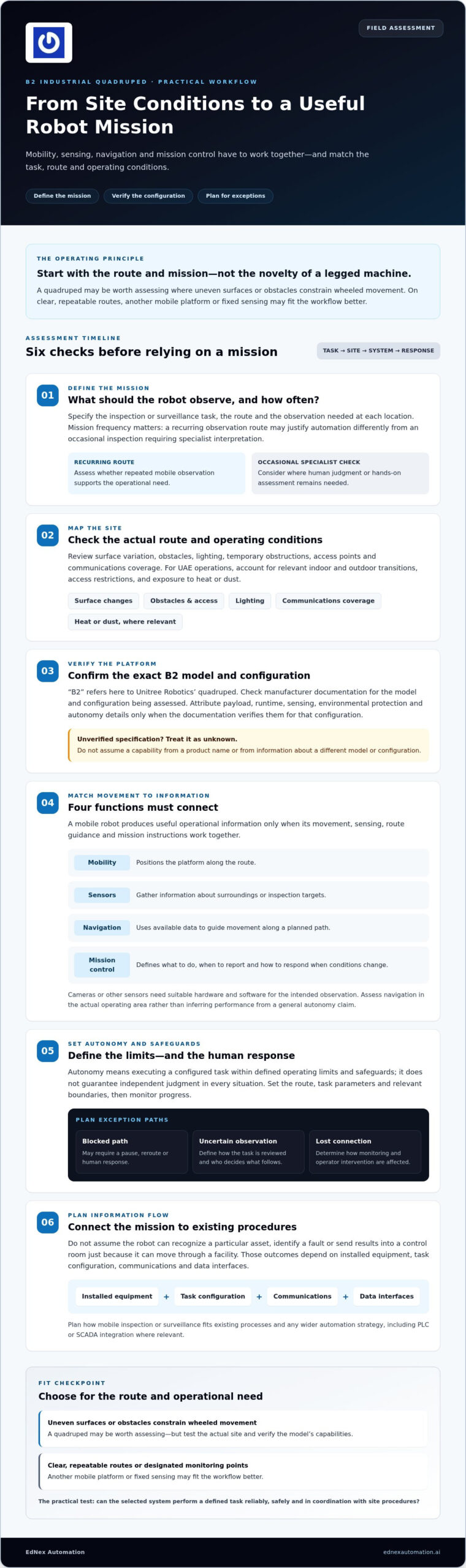
Assess a robot against a defined operational mission, not a general promise of mobility or autonomy. Platform fit depends on mission requirements and verified system limits. Conditions vary between facilities and across individual routes, so document the real environment rather than assuming one set of operating conditions applies everywhere.
- Define the mission. Specify whether the task is inspection, surveillance, or another operation. Map the route, frequency, observation points, expected outputs, and who must act on findings. Set measurable acceptance criteria, such as completing the agreed route and delivering the required observations through the intended workflow.
- Map the environment. Record access restrictions, steps or surface changes, obstacles, indoor and outdoor transitions, lighting, and relevant exposure to heat or dust. Note network coverage along the route and the operating hours the mission must support. Treat these as assessment variables, not assumptions about every facility.
- Validate capability. Compare the exact proposed model and configuration with documented limits for movement, sensing, runtime, payload, and environmental conditions. Test task equipment and software together. A platform’s general category does not establish that it can complete a specific route or capture useful data.
- Plan integration and oversight. Identify how mission status and observations will reach operators or operational systems, and define data access and handling. Assign responsibility for starting, monitoring, pausing, and resuming missions. Establish escalation paths for blocked routes, uncertain observations, communication loss, or other exceptions.
- Pilot safely. Run a controlled trial on representative routes with site procedures, defined operating boundaries, and assigned human oversight. Record deviations and pause conditions. Compare results with the acceptance criteria before deciding whether to adjust the configuration, revise the workflow, or expand deployment.
Which requirements should buyers define first?
Make requirements specific enough to guide configuration and evaluation. For inspection, identify the assets or locations to observe and the evidence operators need. For surveillance, define the route, observation points, and how an exception is reported. Include access constraints, environmental conditions, network coverage, and operating hours, then agree on pass-or-fail criteria before selecting a platform.
What should a controlled pilot validate?
Test routine operation and exceptions, not just a successful demonstration run. Check representative routes, operator handoffs, communications, and the path from captured data to review or action. Compare results with the agreed criteria, then document risks, adjustments, and each person’s responsibilities. Expand deployment only when the pilot shows that the system and workflow meet the defined need.
For a task-first evaluation that connects robot selection with operational integration, discuss your industrial robotics requirements with EdNex Automation.
Integrating B2 Robot Use Cases with EdNex Automation
A robot deployment delivers value when its assigned task, platform, and operational connections are planned as one system. For inspection or surveillance, define what the robot must observe, where the information goes, who reviews it, and how findings lead to action. EdNex Automation supplies and integrates industrial and commercial robotics, including inspection and surveillance robots, and provides PLC and SCADA integration. Assess a B2 use case against its documented capabilities and the site’s system architecture.
This distinction keeps project decisions grounded. When a particular B2 configuration is under consideration, assess its capabilities and interfaces against the mission and existing site architecture. EdNex Automation’s inspection and surveillance robotics can form part of a wider automation strategy, supported by PLC and SCADA integration when the project requirements call for it.
How can robotics connect to wider industrial operations?
Integration planning maps how information and decisions move across the workflow. A mobile inspection system may collect observations, while operators or other systems receive relevant status or findings through interfaces supported by the deployment. Define data ownership, review responsibilities, access permissions, and what happens when an observation needs follow-up.
PLC or SCADA integration can help align robotics with a broader control environment, depending on the architecture, interfaces, and project scope. For example, a site may need a clear process for associating an observation with an asset or routing an alert for operator review. Direct connection between a robot and a control system depends on supported interfaces. Base the integration plan on documented capabilities, operational priorities, and a validated design.
Human workflows matter as much as technical connections. Operators need to know when a mission is active, how to review its output, and who handles exceptions. Coordinating those responsibilities with existing procedures helps make automation usable rather than creating a separate, disconnected tool.
What does a practical next-step discussion cover?
A productive project conversation starts with the operating need, not a preselected robot. Prepare a concise description of the mission, target locations, route constraints, environmental conditions, expected outputs, and mission frequency. Include systems already in use, such as relevant control or monitoring infrastructure, and identify the people responsible for operating the workflow.
Deployment planning can then connect task definition to platform assessment and integration requirements. For a proposed B2 robot, separate manufacturer-documented capabilities from assumptions, identify interface requirements, and agree on how to evaluate a pilot. The result is a project plan shaped around validated needs and priorities, with technical questions identified before they become deployment risks.
EdNex Automation supplies and integrates industrial and commercial robotics across the UAE, including inspection and surveillance robots, alongside PLC and SCADA integration. Explore EdNex Automation’s robotics and automation solutions and discuss your industrial robotics requirements.
Turn Robot Assessment into a Practical Next Step
The next opportunity isn’t simply to add a mobile platform. It’s to decide how a clearly defined inspection or surveillance task can strengthen the way your operation detects, reviews, and responds to site conditions. Treat the b2 robot as a candidate within that wider design, with decisions guided by the mission and verified system limits.
For industrial and commercial operations across the UAE, a deployment plan can connect mobile observation with established control and reporting workflows. EdNex Automation brings inspection and surveillance robots together with PLC and SCADA integration, helping shape robotics decisions around operational requirements rather than novelty. Start by identifying one priority task, the information it should produce, and how that information should support action.
Build from a focused requirement, then develop an automation approach that can evolve with your operation. Explore EdNex Automation’s robotics and integration solutions to discuss a deployment plan grounded in your site’s needs.
Frequently Asked Questions
What is a B2 robot, and who makes it?
The B2 is an industrial quadruped robot developed by Unitree Robotics. “B2” identifies a particular model, while “quadruped” describes its four-legged robot category. For purchasing or engineering records, include the manufacturer and exact configuration rather than relying on the name alone. This helps teams match documentation, software, sensors, and operating limits to the platform being assessed.
What can a B2 robot do in an industrial environment?
A B2 may be considered for mobile tasks such as observing equipment or travelling through areas that are difficult to reach with wheeled platforms, depending on its configuration and deployment. Possible applications include inspection, exploration, and surveillance, but each requires suitable sensors, software, and mission design. For example, a visual patrol that flags areas for human review differs from a system expected to diagnose faults automatically.
Is a B2 robot suitable for inspection or surveillance?
It can be a candidate for inspection or surveillance when the required route, observation method, and operating conditions align with verified system capabilities. A recurring patrol might gather visual observations for an operator, while a fixed sensor could better suit continuous monitoring of one point. Define what counts as a useful observation, how findings are reviewed, and who responds before selecting the mobile platform.
How does a B2 robot differ from an AMR or humanoid robot?
A B2 uses a quadruped form, an AMR typically uses wheels for mobile transport or service tasks, and a humanoid robot has a human-like form intended for different kinds of tasks and interaction. These form factors address different workflows. Moving goods along a defined floor route, for example, differs from mobile observation across varied access areas or work designed around human-like interaction.
Can a B2 robot operate across uneven or restricted terrain?
Potentially, but its performance depends on the specific model, configuration, route, and verified operating limits. Assess a route with floor transitions, temporary obstructions, or narrow access points directly rather than assuming it is navigable. Review manufacturer documentation and test representative conditions under controlled site procedures. Restricted areas also need an access and safety plan that defines boundaries, supervision, and what happens if the robot cannot proceed.
What should a company evaluate before deploying a B2 robot?
Start by defining the task and the evidence the robot must produce, then document the route, access restrictions, operating environment, and communications coverage. Check verified payload, runtime, sensing, and autonomy limits against those requirements. Before wider use, run a controlled pilot and track practical measures such as route completion, missed observations, exceptions, and operator actions. Assign responsibilities for mission oversight and escalation.
How can a mobile robot integrate with PLC or SCADA systems?
Integration begins by defining which robot events or observations need to inform industrial operations, who uses that information, and how it should be reviewed. The required connection depends on the robot’s supported interfaces and the site’s control architecture, so direct compatibility should not be assumed. EdNex Automation provides PLC and SCADA integration, aligning control-system work with project requirements and operational workflows.