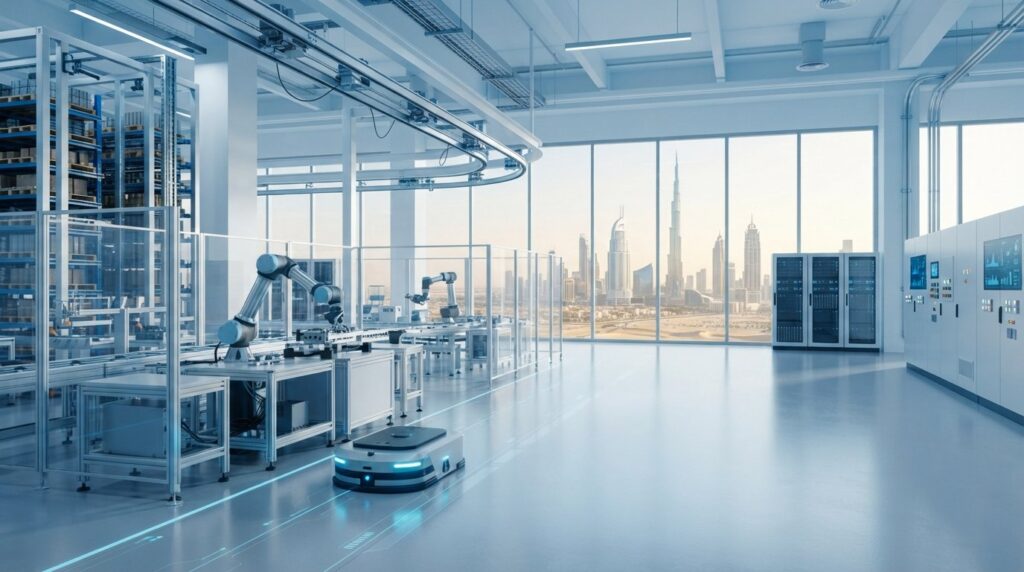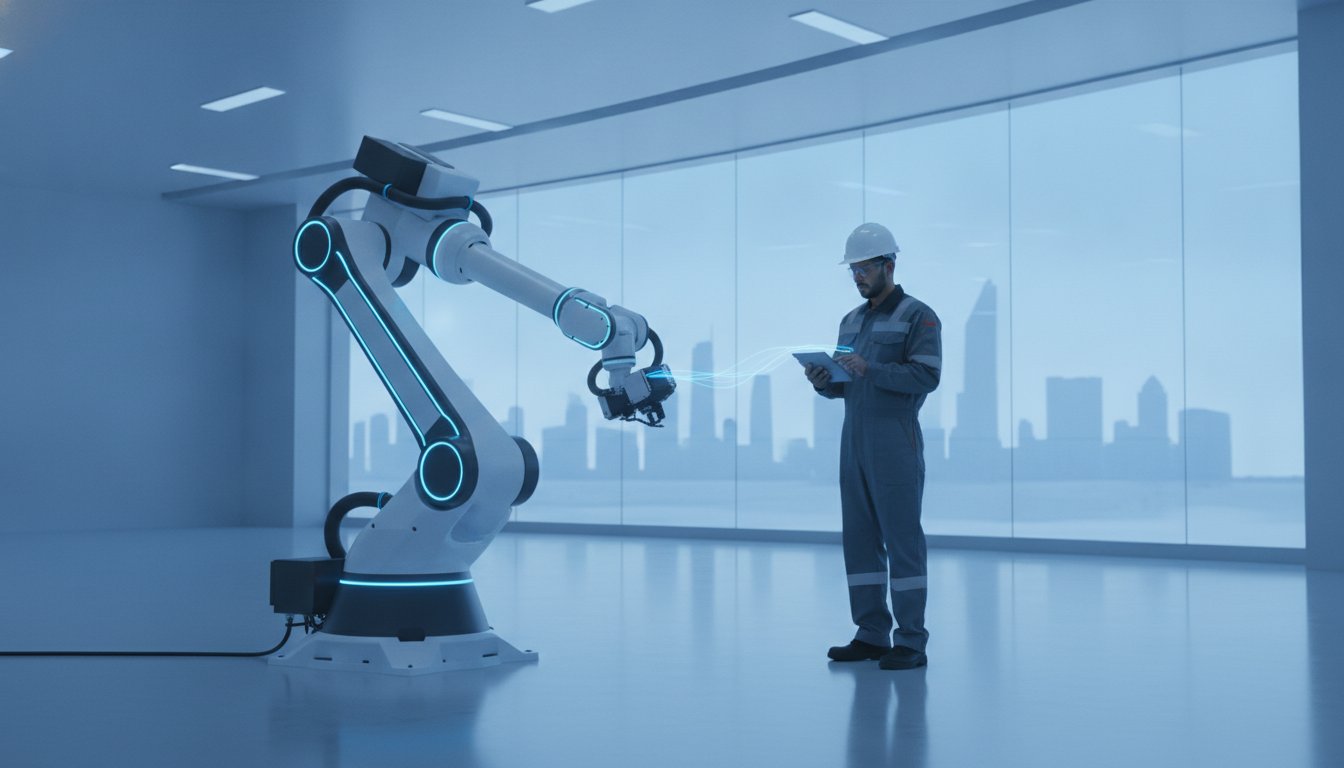
By 2026, an industrial robot is no longer a standalone tool; it’s a critical node in a hyper-connected manufacturing ecosystem where hardware specs matter less than integration intelligence. Facing the rapid acceleration of Industry 4.0, many facility managers rightfully fear investing in technology that might become obsolete before it achieves full ROI. Understanding how to choose the right industrial robot requires moving beyond basic payload and reach calculations to evaluate how a system synchronizes with your existing PLC and SCADA infrastructure.
Leveraging our deep expertise in advanced automation, we’ve developed this guide to provide the technical and strategic framework necessary to master the selection process. This ensures your chosen solution delivers measurable value through precise execution and reduced operational friction. We’ll examine the critical distinctions between collaborative robots and traditional 6-axis units, provide a comprehensive selection checklist, and demonstrate why a certified national integration partner is vital for securing your competitive advantage in the UAE market. By the end of this analysis, you’ll possess the confidence to lead your organization through a successful, long-term industrial transformation that prioritizes both autonomy and efficiency.
Key Takeaways
- Transitioning from isolated machinery to intelligent, sensor-driven nodes is fundamental for any organization seeking to maintain a competitive edge in the 2026 industrial landscape.
- Mastering how to choose the right industrial robot requires a sophisticated understanding of effective payload calculations, specifically accounting for the weight of end-of-arm tooling and necessary safety margins.
- Evaluating the distinct operational advantages of Cobots and AMRs allows for the creation of flexible, human-centric workspaces that optimize floor space without sacrificing manufacturing power.
- Implementing a rigorous 5-step selection framework mitigates the risk of technical obsolescence by aligning complex motion paths with specific environmental and hazardous zone requirements.
- Securing a specialized national integration partner ensures that advanced hardware is seamlessly unified with PLC and SCADA systems to provide comprehensive, start-to-finish operational visibility.
Understanding the Role of Industrial Robotics in 2026
By 2026, the definition of an industrial robot has transcended the traditional view of a static, repetitive machine. It’s now a sophisticated, autonomous node within an Industry 4.0 network, capable of communicating with other machines and high-level management systems. This shift is fundamental to the UAE’s national industrial strategy, which prioritizes economic diversification through the adoption of advanced manufacturing technologies. When evaluating how to choose the right industrial robot, stakeholders must recognize that they aren’t just purchasing hardware; they’re acquiring a digital asset capable of real-time optimization.
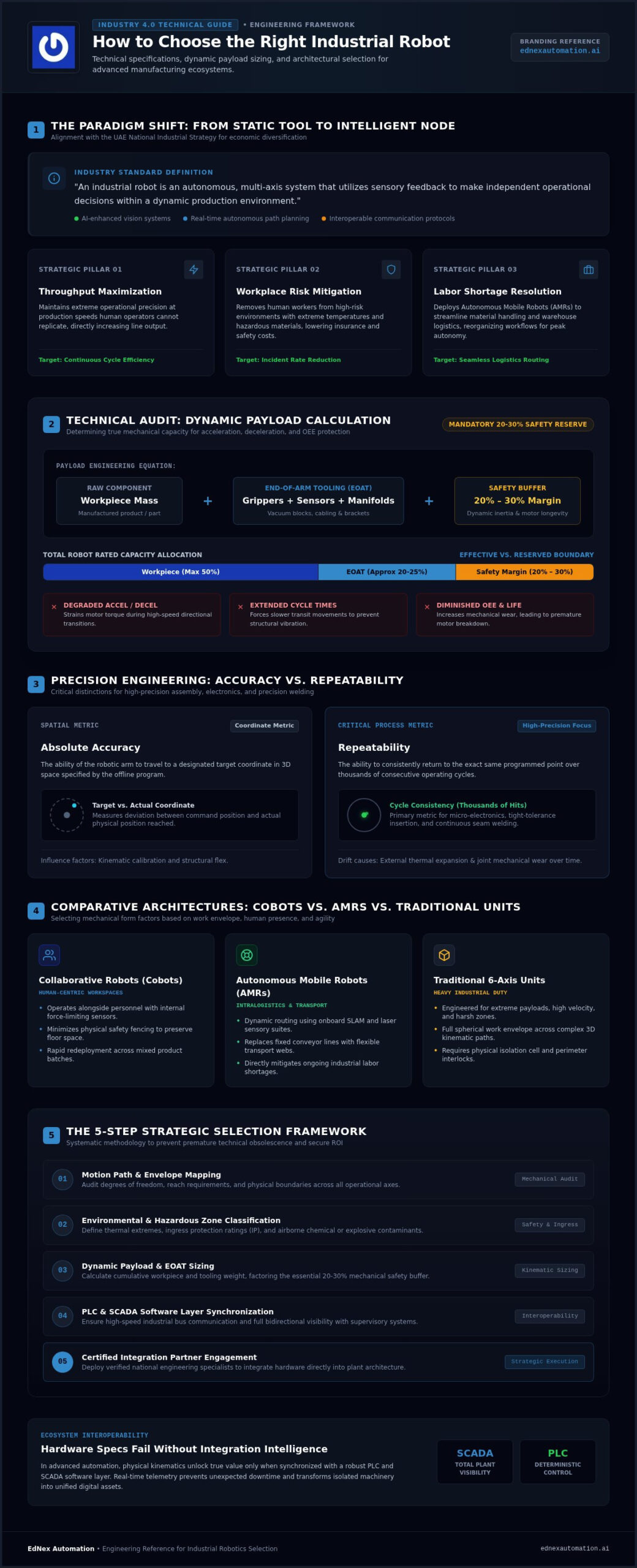
An industrial robot is an autonomous, multi-axis system that utilizes sensory feedback to make independent operational decisions within a dynamic production environment.
The Evolution of Autonomy and Intelligence
Programming has evolved from rigid, fixed-path code to AI-enhanced vision systems that allow for real-time path planning. Modern plants require high levels of interoperability, ensuring that various industrial robot configurations and kinematics work in concert via unified communication protocols. 2026 marks a specific inflection point where humanoid and service robots are moving from pilot programs to full-scale deployment in logistics and assembly. This intelligence allows robots to adapt to product variations without manual reconfiguration, reducing downtime and increasing the flexibility of the production line.
Strategic Objectives for Robot Implementation
Implementing advanced robotics serves three primary strategic pillars that directly impact the bottom line. First, it maximizes throughput by maintaining extreme precision at speeds human operators cannot replicate. Second, it removes human workers from high-risk environments involving extreme temperatures or hazardous materials, significantly reducing insurance and safety costs. Third, organizations are increasingly deploying autonomous mobile robots to solve persistent labor shortages in material handling and warehouse operations. These systems don’t just fill gaps; they reorganize the workflow for maximum efficiency. Understanding these objectives is the first step in learning how to choose the right industrial robot for long-term viability.
Technical Parameters: Evaluating Payload, Reach, and Degrees of Freedom
Understanding how to choose the right industrial robot begins with a meticulous audit of mechanical specifications. It’s not enough to match a robot’s rated capacity to your part weight; you must account for the dynamic forces exerted during high-speed maneuvers. Engineers must evaluate the entire work envelope to ensure the robot can reach all necessary points without compromising structural integrity or violating workplace robotics safety guidelines. While mechanical specs are the starting point, their true value is unlocked only when they’re synchronized with a robust PLC and SCADA software layer.
Calculating Dynamic Payload Requirements
Effective payload is the sum of the workpiece and the end-of-arm tooling (EOAT), which includes grippers, sensors, and vacuum manifolds. We recommend reserving a 20-30% payload margin to ensure long-term mechanical stability and motor longevity. Overloading a unit doesn’t just risk mechanical failure; it significantly degrades the acceleration and deceleration phases of the robot cycle, directly extending your production times and reducing overall equipment effectiveness (OEE).
Precision, Repeatability, and Accuracy
In high-precision assembly, distinguishing between accuracy and repeatability is vital for operational success. Accuracy defines the robot’s ability to reach a specific coordinate in space, whereas repeatability measures its ability to hit that same point consistently over thousands of cycles. For applications like electronics assembly or precision welding, repeatability is the more critical metric. It’s also important to consider external factors like thermal expansion and mechanical wear, which can shift these parameters over time.
Selecting a 6-axis robot has become the industry standard because it provides the necessary degrees of freedom (DoF) to mimic human arm movement, allowing for complex orientations in tight work envelopes. This flexibility is essential for optimizing floor space and ensuring the robot can adapt to future product changes. Achieving this level of precision requires a sophisticated integration strategy that connects hardware to the broader industrial network. For organizations aiming to implement these complex systems, a consultation with EdNex Automation can provide the technical roadmap needed to align mechanical specs with tangible business outcomes.
Comparing Robot Architectures: Cobots vs. AMRs vs. Traditional Units
Defining the optimal robotic architecture is a critical step in the modernization journey. Fixed articulated robots remain the heavy-duty powerhouses of the industry, delivering unmatched speed and payload for high-volume manufacturing environments. Utilizing the International Federation of Robotics classifications allows technical teams to categorize these units by their specific mechanical structures, such as SCARA, Cartesian, or Delta configurations. When determining how to choose the right industrial robot, decision-makers must weigh the raw power of these traditional units against the adaptive intelligence and mobility of next-generation autonomous systems.
When to Choose Collaborative Robots
Transitioning toward human-centric automation, Collaborative Robots (Cobots) have redefined the shared workspace. These units are ideal for low-to-medium volume production where high variability and frequent task switching are the norm. Unlike traditional units that demand extensive safety fencing and dedicated zones, collaborative robots UAE industries implement utilize advanced force-torque sensors to operate safely alongside human technicians. This safety-first design enables rapid redeployment across different assembly tasks, providing a level of agility that traditional fixed robotics cannot match.
The Strategic Advantage of Mobile Autonomy
While fixed robots dominate the assembly line, Autonomous Mobile Robots (AMRs) are transforming internal logistics by navigating dynamic environments without the need for physical guide wires or magnetic tape. Comparing AMRs to legacy AGV systems reveals a significant gap in intelligence; AMRs use onboard SLAM technology to calculate the most efficient paths in real-time, avoiding obstacles autonomously. Integrating these mobile units with automated storage and retrieval systems (ASRS) creates a seamless, high-efficiency loop from the warehouse directly to the production station. This strategic scalability allows for expanded logistics capacity without requiring modifications to the existing floor infrastructure.
Beyond the standard production floor, specialized units like humanoid and autonomous cleaning robots are becoming essential components of modern facility management. These systems handle everything from complex human-like manipulation to large-scale industrial sanitization. Understanding the specific operational gap you intend to close is the cornerstone of how to choose the right industrial robot for long-term business viability. By aligning these architectural choices with your broader Industry 4.0 goals, you ensure that your investment acts as a scalable asset rather than a temporary fix.
The 5-Step Strategic Selection Framework
Mastering how to choose the right industrial robot involves a systematic transition from high-level operational goals to granular technical validation. By following a structured framework, organizations can bridge the gap between visionary automation goals and the practicalities of a high-performance production floor. This methodical approach ensures that every technological acquisition contributes directly to long-term business viability and operational resilience.
- Step 1: Application Audit – Identifying the exact motion paths, cycle time requirements, and process complexity to determine if the task requires high-speed articulated units or collaborative flexibility.
- Step 2: Environmental Assessment – Factoring in temperature fluctuations, humidity, and the presence of particulate matter or hazardous chemicals that dictate mechanical housing requirements.
- Step 3: Integration Mapping – Ensuring seamless communication between the new robotic node and existing infrastructure through professional PLC and SCADA integration services.
- Step 4: Safety & Compliance – Adhering to both international ISO standards and national industrial safety regulations to protect human personnel and equipment.
- Step 5: Lifecycle Cost Analysis – Calculating the total cost of ownership (TCO), which accounts for initial capital expenditure, energy consumption, and scheduled maintenance intervals.
Environmental and Safety Considerations
Selecting the appropriate Ingress Protection (IP) rating is essential for robots deployed in harsh industrial environments or outdoor cleaning applications where dust and moisture are prevalent. For the oil, gas, and chemical sectors, units must meet stringent explosion-proof certifications to operate safely in volatile atmospheres. Safety protocols also vary significantly between high-speed robotic cells, which require physical or light-curtain guarding, and collaborative zones where power and force-limiting technologies allow for direct human interaction. Prioritizing these environmental factors early in the selection process prevents costly mechanical failures and ensures a safe, compliant workspace.
Determining True ROI and TCO
Evaluating the success of a robotic implementation requires looking beyond simple labor cost savings to analyze quality improvements and the significant reduction of material waste. In the UAE market, accounting for energy efficiency and the local availability of spare parts is vital for maintaining high uptime and predictable operational costs. Implementing intelligent robotic nodes effectively elevates a facility’s valuation by converting volatile labor dependencies into stable, high-performance technological assets. This strategic shift ensures that your automation investment remains a scalable component of your industrial evolution. To ensure your selection aligns with these high-level business outcomes, schedule a strategic automation audit with EdNex Automation to define your bespoke integration roadmap.
Partnering for Success: Integration with EdNex Automation
Hardware acquisition is only the initial phase of industrial transformation. To truly understand how to choose the right industrial robot, organizations must prioritize the integration layer that connects physical movement to digital intelligence. A specialized system integrator acts as the essential bridge, transforming a standalone machine into a synchronized component of a larger production line. Without professional oversight, even the most advanced 6-axis units risk becoming underutilized silos of automation that fail to deliver a clear return on investment.
The EdNex End-to-End Integration Model
EdNex Automation provides a comprehensive framework that begins with bespoke consulting to identify the ideal robotic architecture for specific sector needs. Whether deploying high-payload articulated arms or agile collaborative robots, our team ensures that every unit is fully optimized for its intended application. We specialize in the technical deployment of complex control systems, facilitating seamless machine-to-machine communication through advanced PLC and SCADA protocols. This end-to-end approach includes:
- Strategic architectural design and high-fidelity workflow simulation.
- Hardware-to-software synchronization for real-time operational visibility.
- Ongoing modernization strategies to maintain Industry 4.0 compliance.
- Bespoke end-of-arm tooling (EOAT) design for specialized manufacturing tasks.
Our commitment extends beyond the initial installation phase. We provide the intellectual framework necessary for long-term scalability, ensuring that your robotic nodes can evolve alongside changing market demands. By integrating scalable ASRS and AMR logistics solutions, we help facilities achieve a level of future-readiness that mitigates the risk of technical obsolescence.
Advancing National Industrial Excellence
Operating as a specialized division of the EdNex group, we ground our high-tech aspirations in the specific economic context of the UAE. We align every robotic implementation with national industrial goals, fostering a resilient, high-tech manufacturing foundation that drives regional economic diversification. Our national support network ensures that technical expertise is always accessible, providing the reliable partnership required for large-scale industrial transformation. Mastering how to choose the right industrial robot is a complex endeavor, but with a certified integration partner, it becomes a controlled and deliberate path toward operational excellence.
Consult with EdNex Automation for your high-level industrial integration and secure your organization’s competitive standing in the future of manufacturing.
Securing Your Industrial Competitive Advantage in 2026
Transforming your production facility through advanced automation is a strategic evolution that requires precise technical alignment and a forward-looking vision. Mastering how to choose the right industrial robot involves moving beyond basic mechanical specifications to embrace a holistic framework that prioritizes interoperability, safety, and long-term asset value. By following a rigorous selection process and evaluating the distinct advantages of architectures like AMRs and Cobots, organizations can build a resilient infrastructure capable of navigating the complexities of Industry 4.0.
As a specialized Industry 4.0 division of the EdNex group, we provide the intellectual framework and technical precision necessary for high-level implementation. Our national UAE technical support team ensures that your transition to automated excellence is supported by comprehensive PLC, SCADA, and ASRS integration expertise. This end-to-end approach ensures that every technological node contributes to a unified, high-performance ecosystem that drives measurable results.
Partner with EdNex Automation to modernize your industrial operations and lead your organization toward a future of unprecedented efficiency and growth. It’s time to secure your position as an industry leader through controlled and deliberate innovation.
Frequently Asked Questions
What is the difference between an industrial robot and a collaborative robot?
Traditional industrial robots are designed for high-speed, high-precision tasks in isolation, typically requiring physical safety barriers to protect human operators. In contrast, collaborative robots, or cobots, utilize advanced force-torque sensors and power-limiting technology to operate safely alongside personnel in shared workspaces. While traditional units excel in high-volume production, cobots offer the flexibility needed for variable assembly tasks where human dexterity and robotic precision must coexist without extensive safety guarding.
How do I calculate the payload for an industrial robot?
Determining how to choose the right industrial robot requires calculating the total effective payload by summing the weight of the workpiece and all end-of-arm tooling (EOAT). This includes grippers, sensors, and vacuum manifolds. Engineers must also factor in dynamic forces during high-speed acceleration. We recommend maintaining a safety margin of 20 to 30 percent above the calculated weight to ensure long-term mechanical stability and prevent premature wear on the robot’s motors and joints.
Can industrial robots be integrated with my existing PLC and SCADA systems?
Industrial robots are most effective when they’re fully integrated with existing PLC and SCADA systems to provide real-time operational visibility. This connectivity allows for centralized control, data collection, and synchronization across the entire production line. Modern robotic controllers support standard industrial protocols like EtherNet/IP or PROFINET, enabling seamless machine-to-machine communication. This integration is fundamental for achieving the high levels of autonomy and optimization required in a sophisticated Industry 4.0 manufacturing environment.
What are the safety requirements for installing robots in a UAE facility?
Installing robotics in a UAE facility requires adherence to international ISO 10218 standards alongside specific national industrial safety regulations. These protocols mandate a comprehensive risk assessment to identify potential hazards in the robot’s work envelope. Depending on the robot type, requirements may include physical fencing, light curtains, or pressure-sensitive mats. For collaborative systems, safety validation must confirm that force-limiting settings align with established human-safety thresholds to ensure a secure and compliant operating environment.
How long does it typically take to realize ROI on an industrial robot?
The timeline for realizing a full return on investment typically ranges from 12 to 24 months, though this varies based on application complexity and production volume. Beyond direct labor savings, organizations should factor in gains from increased throughput, improved quality consistency, and reduced material waste. High-performance systems often provide long-term value by stabilizing operational costs and increasing the overall asset value of the facility through modernized, scalable industrial infrastructure that remains competitive for years.
Are autonomous mobile robots (AMRs) better than automated guided vehicles (AGVs)?
Autonomous Mobile Robots (AMRs) represent a significant technological leap over legacy Automated Guided Vehicles (AGVs). While AGVs rely on fixed paths like magnetic tape or wires, AMRs utilize onboard sensors and SLAM technology to navigate dynamically. This allows AMRs to calculate the most efficient routes in real-time and navigate around obstacles without human intervention. This intelligence makes AMRs far more scalable and flexible for modern logistics, as they don’t require expensive modifications to the physical floor infrastructure.
What maintenance is required for high-performance industrial robots?
How does EdNex Automation support national industrial projects in the UAE?
EdNex Automation acts as a strategic bridge-builder, connecting global technological breakthroughs with regional industrial needs across the UAE. We provide comprehensive, start-to-finish expertise for national projects, ranging from bespoke robotic design to full-scale PLC and SCADA deployment. Our national technical support team offers the reliable intellectual framework necessary for implementing complex systems like ASRS and humanoid units. This ensures that UAE organizations can modernize their operations with the confidence of a certified, locally-present integration partner.