Investing in industrial automation without a verified integration roadmap is no longer a calculated risk; it is a guaranteed operational bottleneck. You likely recognize that the shift toward Industry 4.0 is inevitable, yet the persistent fear of system downtime and integration incompatibility with legacy PLC or SCADA systems often stalls progress. To secure a future-proof facility, you need a definitive list of questions to ask a robotics integrator before signing any contract. Identifying a partner who bridges the gap between global technological breakthroughs and regional UAE requirements is the difference between a failed pilot and a seamless transition to full autonomy.
This 2026 strategic checklist provides the intellectual framework necessary to vet integration partners for sophisticated systems like Collaborative Robots (Cobots) and Autonomous Mobile Robots (AMRs). We’ll explore how to ensure long-term operational efficiency through robust local technical support and end-to-end infrastructure management. By following this framework, you’ll gain the clarity needed to select a partner capable of optimizing complex environments through controlled, deliberate innovation. We begin by analyzing the architectural compatibility of your current infrastructure with modern Automated Storage and Retrieval Systems (ASRS) and specialized robotic solutions.
Key Takeaways
- Identify the strategic difference between hardware procurement and full-scale systems integration to ensure your automation lifecycle remains robust and scalable.
- Implement a phased deployment methodology that prioritizes data sovereignty and strict adherence to global safety protocols such as ISO 10218.
- Utilize our definitive list of questions to ask a robotics integrator to vet the compatibility of new Cobots or AMRs with your existing industrial control systems.
- Prioritize long-term operational efficiency by securing a partner capable of providing local technical support and comprehensive training for your internal workforce.
- Ensure regional compliance by selecting an integrator that maintains official certifications and global alliances within the UAE industrial landscape.
Defining the Strategic Role of a Robotics Integrator
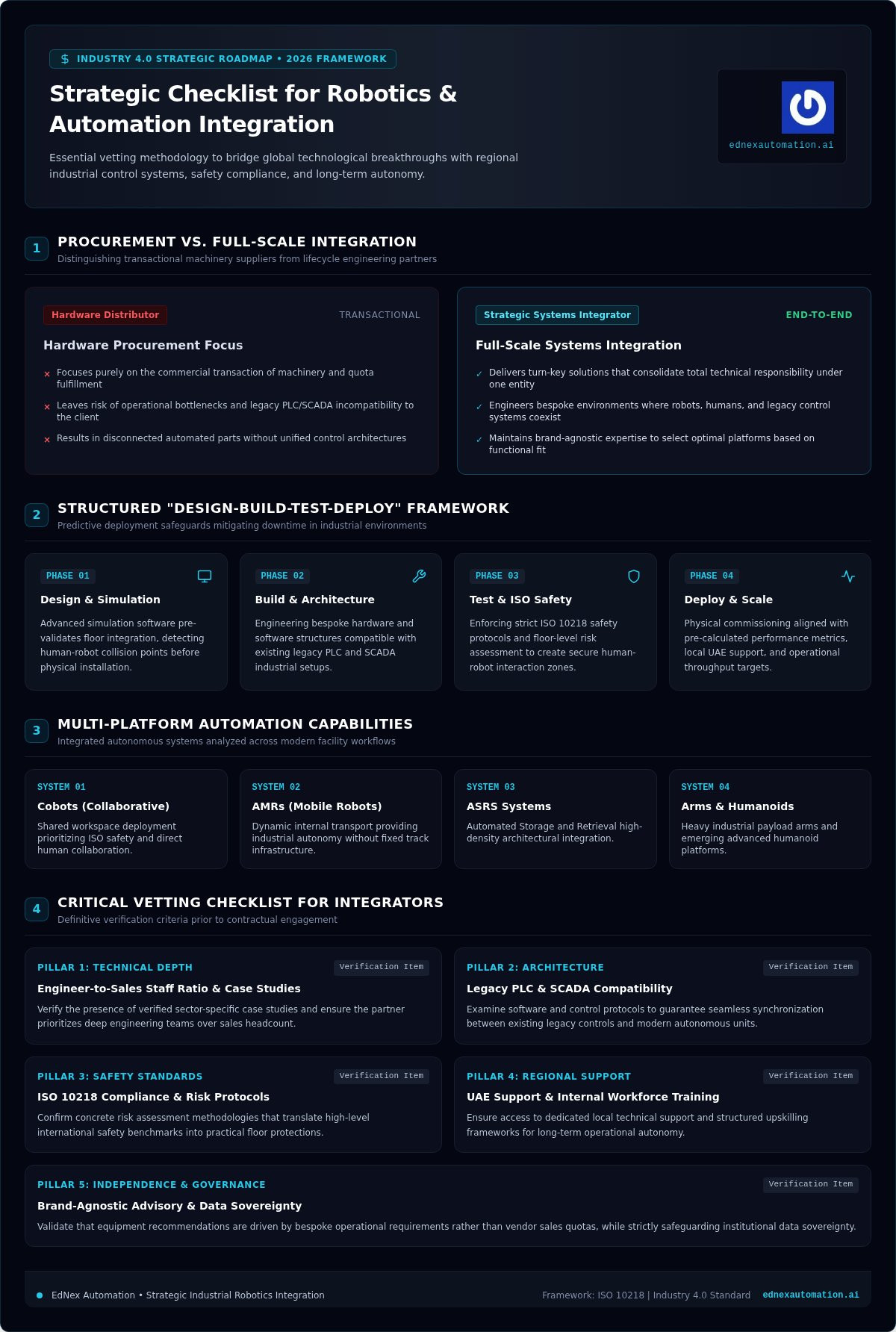
Distinguishing a hardware vendor from a strategic partner remains the foundational step in any successful automation journey, as the difference between procurement and implementation determines the ultimate viability of the project. While a simple distributor focuses on the transaction of machinery, a full-service systems integrator provides the intellectual framework required for complex industrial robotics integration. This distinction is vital because integration represents the most critical phase of the automation lifecycle, acting as the bridge between raw hardware and a functional, revenue-generating system.
Delivering turn-key solutions serves as a hallmark of high-level consultancy, significantly reducing operational risk for UAE enterprises by consolidating responsibility under a single technical entity. When formulating your initial questions to ask a robotics integrator, you must evaluate their ability to manage the entire lifecycle from initial design to final deployment. A reliable partner doesn’t just deliver equipment; they engineer a bespoke environment where robots, human workers, and legacy control systems coexist with maximum efficiency. Establishing this baseline ensures that your investment results in a systematic optimization of your facility rather than a disconnected collection of automated parts.
Experience and Proven Industry Track Record
Evaluating technical depth requires looking far beyond a polished sales presentation. One of the essential questions to ask a robotics integrator is whether they can provide documented case studies within your specific industrial sector. Reviewing past deployments of Collaborative Robots (Cobots) or heavy industrial arms in similar environments provides tangible proof of their engineering capability. You should also assess the ratio of technical engineers to sales staff. A visionary partner prioritizes deep technical expertise, ensuring that the team designing your system understands the gravity of large-scale industrial transformation and the nuances of varied robotic platforms.
The Importance of Brand-Agnostic Expertise
Selecting the correct technology for a specific task requires an integrator who remains independent of manufacturer quotas. By maintaining a brand-agnostic approach, an expert ensures the chosen solution fits the facility’s unique requirements rather than fulfilling an integrator’s sales targets. This independence allows for the deployment of a diverse portfolio, ranging from autonomous mobile robots to sophisticated humanoids, each selected for its specific functional benefit. High-performance automation thrives on this flexibility, allowing for the optimization of bespoke systems that remain competitive and adaptable within the rapidly evolving global market.
Vetting the Integration Methodology and Safety Standards
Applying a rigorous, phased methodology ensures that every automation project transitions from a theoretical model to a high-performance reality without compromising operational integrity. A structured “Design-Build-Test-Deploy” framework acts as a safeguard against the unpredictable variables of industrial environments. During the design phase, utilizing advanced simulation software allows engineers to pre-validate the integration plan, identifying potential human-robot collision points before a single piece of hardware is installed. This predictive approach significantly mitigates risk, ensuring that the physical deployment adheres strictly to the pre-calculated performance metrics and throughput targets.
Adhering to global and national safety standards, such as ISO 10218, is non-negotiable for any enterprise aiming for long-term viability in the 2026 industrial landscape. One of the critical questions to ask a robotics integrator involves their specific risk assessment protocols and how they translate abstract safety regulations into practical floor-level protections. By identifying every potential hazard in the human-robot interaction zone, a visionary integrator creates a controlled environment where efficiency and safety are mutually inclusive. To secure your infrastructure, you should request a comprehensive safety audit to ensure your facility meets these evolving benchmarks.
Safety and Collaborative Workspaces
Implementing collaborative robots requires a sophisticated understanding of the difference between robot-level and system-level safety. While a cobot might have built-in force-limiting sensors, the entire system, including the end-of-arm tooling and the specific workpiece, must be validated for safe operation. Professional integrators evaluate whether your application requires physical guarding or sensor-based virtual barriers to maintain a secure workspace. Asking questions to ask a robotics integrator about their validation process for collaborative cells will reveal their depth of expertise in managing these complex, high-intelligence interactions.
Project Management and Timeline Transparency
Maintaining project momentum requires a dedicated project manager who understands the unique logistics of the UAE national industrial landscape. Identifying potential bottlenecks in the global supply chain or the software programming phase early prevents costly delays during the final handover. A transparent timeline, stretching from the initial audit to final site acceptance testing, provides the intellectual framework necessary for your internal teams to prepare for the transition. This level of transparency ensures that the shift to Industry 4.0 remains a systematic organizer of progress rather than a source of industrial friction.
Software, Control Systems, and Data Sovereignty
Positioning software as the primary driver of operational value, visionary leaders understand that a robotic arm is merely an actuator for the sophisticated logic residing within the control system. While hardware provides the physical capability, it’s the integration of high-level intelligence that dictates the efficiency and longevity of the entire cell. Establishing robust data collection through Industrial Internet of Things (IIoT) frameworks allows for real-time performance monitoring, transforming raw operational metrics into actionable business intelligence. This level of oversight ensures that any deviation from peak performance is identified and rectified before it impacts the bottom line or causes system-wide downtime.
Securing a unified control environment requires a deep expertise in PLC and SCADA integration services, as these platforms serve as the central nervous system of a modern facility. One of the most technical questions to ask a robotics integrator is how they intend to synchronize the high-speed motion of a robot with the broader cycles of existing conveyor systems or environmental sensors. Without this synchronization, the resulting friction leads to micro-stoppages that erode throughput. A partner who can bridge the gap between global software breakthroughs and legacy hardware ensures that your transition to Industry 4.0 remains a systematic organizer of progress rather than a source of technical debt.
Interoperability with Existing Infrastructure
Ensuring the long-term viability of an automation investment demands a focus on open communication protocols that prevent vendor lock-in. You must ask how the robotic cell will interface with your specific PLC architecture, particularly if you are also deploying automated storage and retrieval systems alongside your robotic fleet. Seamless communication between warehouse management software and floor-level robotics is essential for maintaining a truly autonomous supply chain. By prioritizing interoperability, you create a modular environment that is ready for future expansions without requiring a total overhaul of your existing control logic.
Cybersecurity and Network Integrity
Protecting the industrial network from external threats is a critical component of modern integration that many hardware-focused vendors overlook. Connected robots represent potential entry points for cyber vulnerabilities, making it essential to define strict network security protocols from the outset. Another vital point in your list of questions to ask a robotics integrator involves the ownership of operational data. You must establish clear parameters regarding who owns and controls the metadata generated by your systems. Retaining full data sovereignty allows you to leverage your own operational insights for future optimization while maintaining the highest levels of corporate security.
Assessing Long-Term Support and Scalability
Recognizing that the successful deployment of a robotic system is merely the beginning of a multi-year journey, visionary enterprises focus on the intellectual framework required for sustained operational longevity. While the initial installation marks a significant milestone, the true measure of success lies in “Day 2” support and the system’s ability to scale alongside your business. One of the most strategic questions to ask a robotics integrator involves the reconfigurability of the system for varying SKUs or shifting production workflows. A partner who designs for modularity ensures that your investment in Collaborative Robots or AMRs remains a dynamic asset rather than a static piece of machinery, allowing for seamless adaptation to future industrial cycles.
Training and Knowledge Transfer
Empowering your internal workforce through comprehensive training programs is a fundamental requirement for reducing operational friction. You should ask what specific level of training is provided for on-site operators, focusing on their ability to handle routine troubleshooting and minor adjustments without external intervention. Modern integration partners often deploy remote diagnostics and AR-based support tools to provide immediate technical guidance, ensuring your team has the resources to maintain peak performance. This systematic transfer of knowledge builds a layer of internal resilience, allowing your staff to manage the complexities of modern automation with confidence and precision.
Maintenance and Technical Support Tiers
Establishing clear maintenance protocols and technical support tiers is vital for minimizing the risk of system downtime in critical environments. When vetting a partner, you must evaluate their physical presence across the national UAE landscape to ensure they can provide rapid on-site assistance when remote diagnostics aren’t enough. It’s essential to understand their guaranteed response times for critical failures and how they manage the availability of specialized spare parts. A reliable partner provides a structured preventative maintenance roadmap that identifies potential wear points before they lead to catastrophic failure, securing your facility’s long-term business viability. To secure a future-proof automation strategy for your facility, you should explore our comprehensive support and maintenance offerings today.
Strategic Partnership and Regional UAE Compliance
Aligning automation goals with the UAE’s national industrial transformation initiatives requires a partner who understands the gravity of regional economic evolution. As you finalize your questions to ask a robotics integrator, you must evaluate their ability to act as a bridge between global technological breakthroughs and local industrial requirements. A partner with established alliances with global entities and a clear focus on the national geographic context provides the intellectual framework necessary for long-term business viability. This alignment ensures that your facility doesn’t just modernize; it evolves in lockstep with the nation’s broader push toward a diversified, automated, and knowledge-based economy.
Regulatory and Environmental Standards
Operating in the region involves managing unique environmental stressors, including high-temperature and high-dust conditions that can compromise sensitive sensors and mechanical joints. You should ask whether their solutions, such as autonomous cleaning robots, are specifically engineered to withstand these local facility types and maintain peak performance. Compliance with UAE-specific electrical and safety codes ensures that your deployment meets all legal requirements while maintaining operational integrity. Identifying an integrator who prioritizes these regional standards protects your infrastructure from premature wear and ensures that your facility remains a safe, controlled environment for both human workers and advanced systems.
The Value of a Local Integration Partner
Selecting an integrator with a permanent, on-site technical team based within the UAE eliminates the risk of extended downtime caused by international travel or customs delays for critical components. Local presence is a marker of legitimacy that guarantees immediate intervention when required, rather than relying on remote support from different time zones. A regional expert possesses the localized data necessary to calculate ROI within the specific economic context of the UAE, accounting for local labor dynamics, energy tariffs, and regional supply chain logistics. This level of proximity ensures that your questions to ask a robotics integrator result in answers grounded in the reality of the regional market, securing a partnership that supports your growth through 2026 and beyond.
Mastering the Evolution of UAE Industrial Autonomy
Transitioning to Industry 4.0 requires more than a simple hardware acquisition; it demands a partner who understands the architectural synergy between advanced robotics and complex control systems. By utilizing this definitive framework of questions to ask a robotics integrator, you’ve established the intellectual foundation necessary to vet potential partners on their safety protocols, data sovereignty, and regional expertise. True operational efficiency stems from a systematic approach that bridges global innovation with the specific requirements of the UAE industrial landscape. Ensuring your facility is ready for 2026 means prioritizing long-term scalability and robust local support over mere installation speed.
As a visionary leader in regional transformation, EdNex Automation provides the specialized Industry 4.0 expertise and comprehensive PLC/SCADA integration required for large-scale success. Our technical leadership ensures that your journey toward autonomy is controlled, deliberate, and high-performing. Partner with EdNex Automation for your strategic industrial transformation and secure your organization’s position at the cutting edge of modern manufacturing. The future of your facility is a strategic evolution, and with the right framework, it’s a future you can lead with confidence.
Frequently Asked Questions
What is the difference between a robot manufacturer and a robotics integrator?
A manufacturer focuses on the production of standardized robotic hardware, while an integrator designs the total system that makes that hardware functional within your specific facility. Manufacturers produce units like Cobots or AMRs as standalone tools. Integrators provide the intellectual framework, custom end-of-arm tooling, and PLC synchronization required to transform those tools into a revenue-generating industrial solution.
How much does a typical robotics integration project cost in the UAE?
Integration costs depend on the technical complexity of the control systems and the specific robotic platforms required for your application. Factors influencing the total investment include custom engineering, software programming, and rigorous safety validation. Rather than providing generic estimates, professional integrators offer a detailed ROI analysis based on your facility’s unique operational throughput and long-term business goals.
Can a robotics integrator work with my existing legacy machinery?
Yes, an expert integrator specializes in bridging the gap between modern robotics and legacy industrial infrastructure. This process involves sophisticated PLC and SCADA integration to ensure seamless communication between new AMRs and older mechanical systems. Utilizing open protocols prevents technical friction, ensuring that your legacy hardware remains a productive and synchronized part of your automated workflow.
What are the most common reasons for robotics integration failure?
Integration failures typically stem from poor architectural planning or a lack of clear questions to ask a robotics integrator during the initial vetting phase. Incompatibility with existing control systems, inadequate operator training, and the absence of local technical support often cause persistent system downtime. Adopting a phased approach to deployment minimizes these risks and secures long-term operational efficiency.
How do I calculate the ROI of a robotic integration project?
Calculating ROI requires comparing total system lifecycle costs against documented gains in throughput, safety, and reduced operational waste. You must factor in labor optimization, consistent cycle times, and the elimination of human error in high-precision tasks. A visionary partner provides the data-driven framework needed to project long-term viability and competitive advantage within the national UAE industrial landscape.
What certifications should a robotics integrator hold in 2026?
A qualified integrator must hold valid industrial safety certifications, including ISO 10218 for robotic systems and all relevant regional UAE compliance standards. They should also maintain official alliances with global technology entities and possess specialized certifications for PLC and SCADA infrastructure. These markers of legitimacy ensure the integrator follows a systematic, controlled approach to innovation and facility safety.
Do integrators provide software updates for the robots after installation?
Comprehensive integrators provide ongoing software management and system updates as part of their long-term technical support tiers. This includes refining the system logic to handle new SKUs or updating cybersecurity protocols to protect the industrial network. Regular updates ensure your robotic cell continues to operate at peak efficiency and remains fully compatible with evolving warehouse management software.
Is it better to hire a local UAE integrator or a global firm?
Hiring a local UAE integrator ensures rapid on-site support and eliminates potential customs delays for critical components. While global firms offer technology, a local partner like EdNex Automation connects global breakthroughs with specific regional industrial needs. This proximity allows for immediate troubleshooting and ensures the integration remains compliant with national safety and electrical codes from day one.