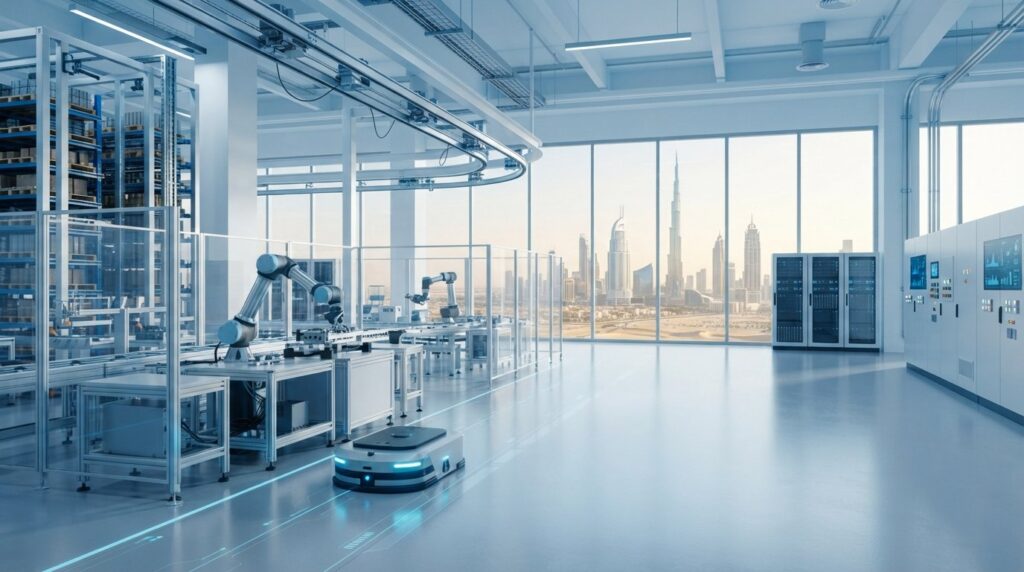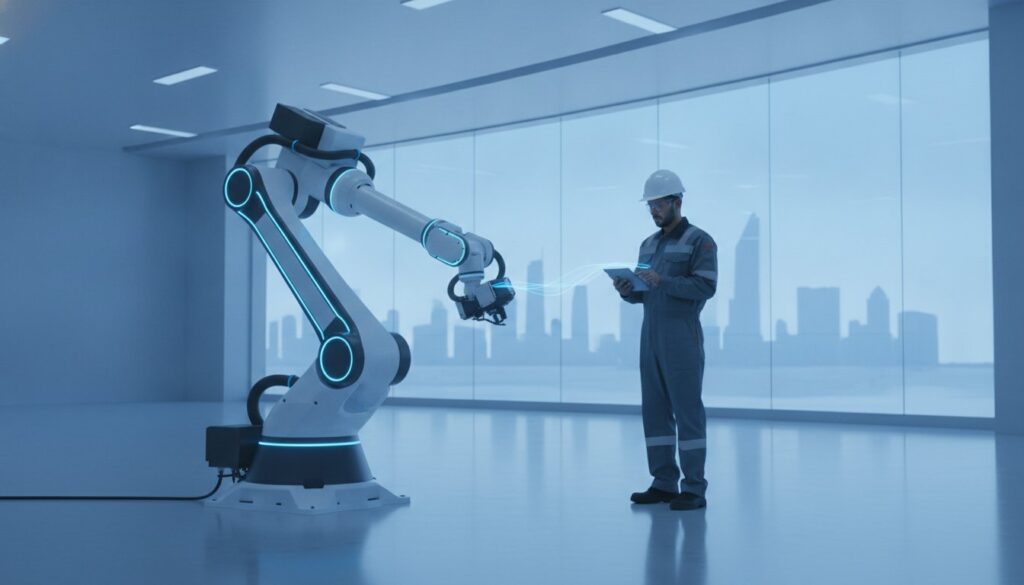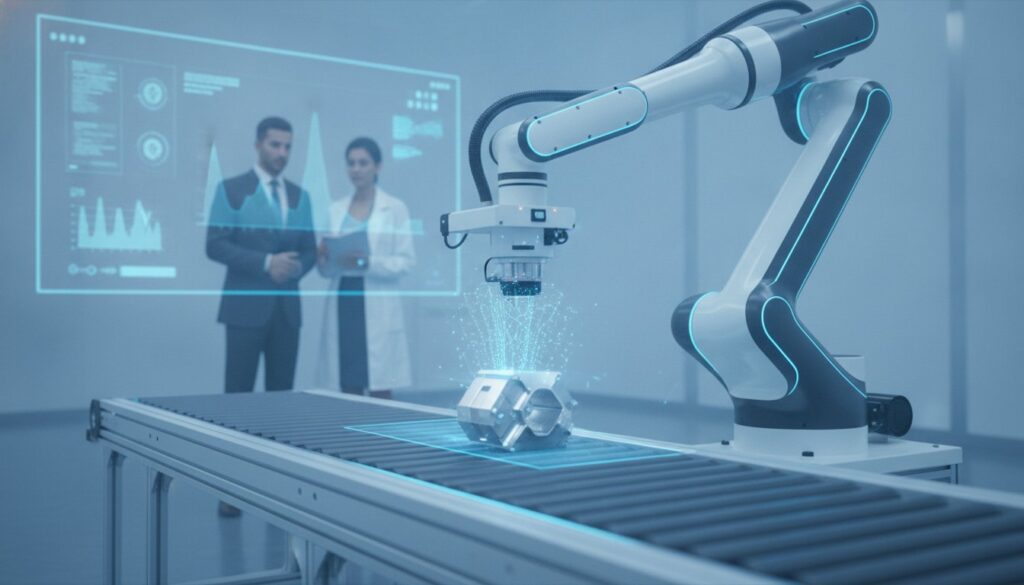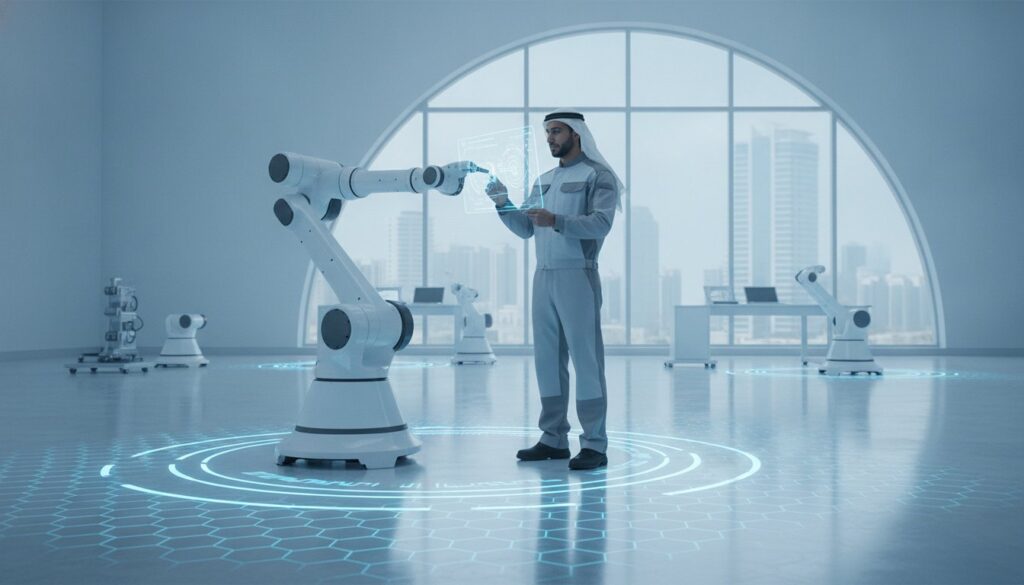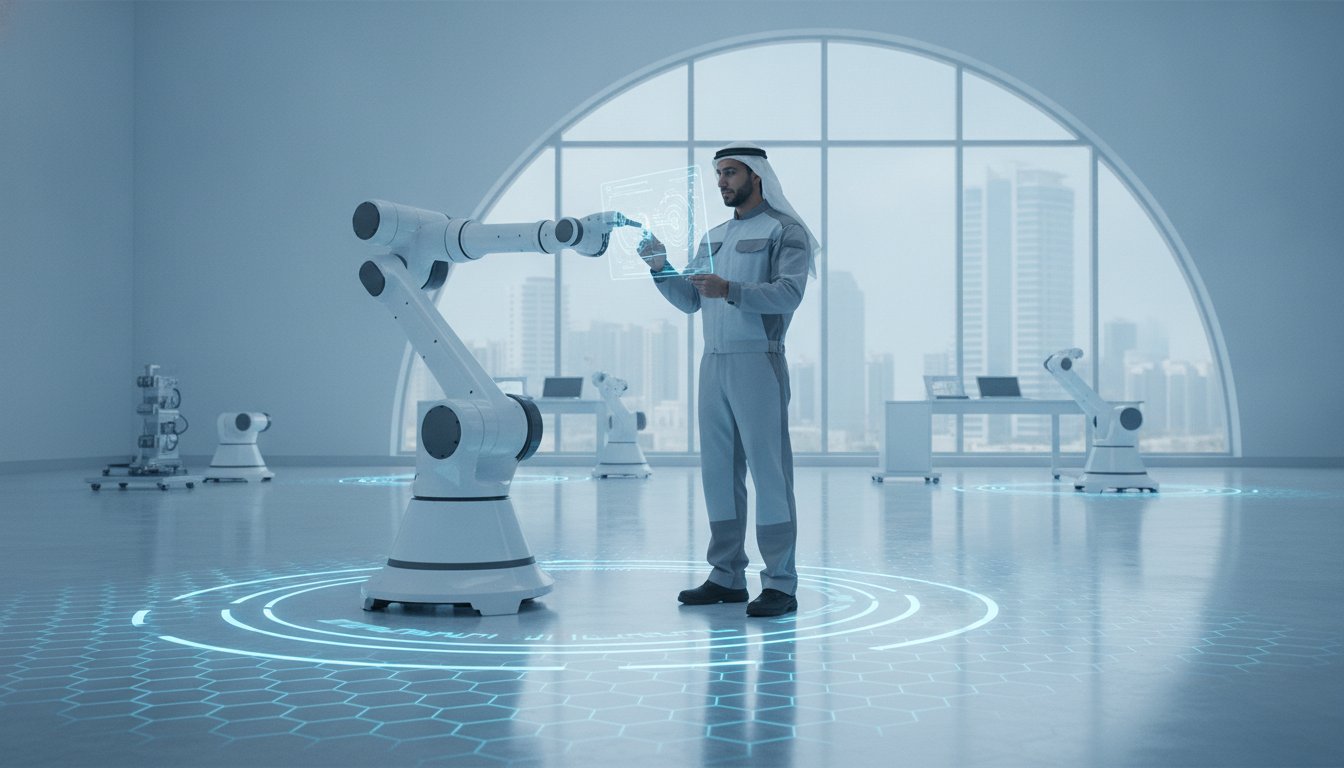
As the global collaborative robot market is projected to soar to 19.93 billion AED by 2026, industrial leaders are increasingly acknowledging that high-speed production must not compromise personnel security. Forward-thinking operators, especially within the UAE, recognize that the real challenge in scaling Industry 4.0 lies not in the hardware, but in the intricate technical complexity of ensuring cobot safety in a shared workspace. Moving beyond reactive stop-and-go systems to proactive spatial intelligence demands more than just basic sensors; it requires rigorous adherence to the latest ISO 10218:2025 framework to safeguard human capital and maintain peak operational tempo.
Industry pioneers universally concur that the ambiguity between evolving international standards and practical local implementation frequently leads to paralyzing fears of operational downtime. At EdNex Automation, we assert that robust compliance is the cornerstone of continuity. This technical guide delivers the essential framework required to confidently navigate the transition from outdated guidelines to the comprehensive requirements of the 2026 industrial landscape. By mastering these critical technical protocols and advanced integration strategies, you will secure your facility’s long-term viability, effectively bridging the gap between global innovation and regional industrial excellence.
Key Takeaways
- Align your operations with the ISO 10218:2025 updates to ensure your facility meets the latest global and UAE industrial safety benchmarks.
- Master the technical requirements for ensuring cobot safety in a shared workspace by applying the biomechanical force and pressure limits established in ISO/TS 15066.
- Implement sophisticated safety modes like Safety-Rated Monitored Stop to eliminate collision risks without compromising the efficiency of your production cycle.
- Develop a human-centric safety culture using visual signaling and specialized training that empowers your workforce to interact confidently with autonomous systems.
- Leverage integrated PLC and SCADA monitoring to provide a high-level safety framework that supports complex deployments across your warehouse or factory floor.
The Paradigm of Human-Robot Collaboration: Defining the Shared Workspace
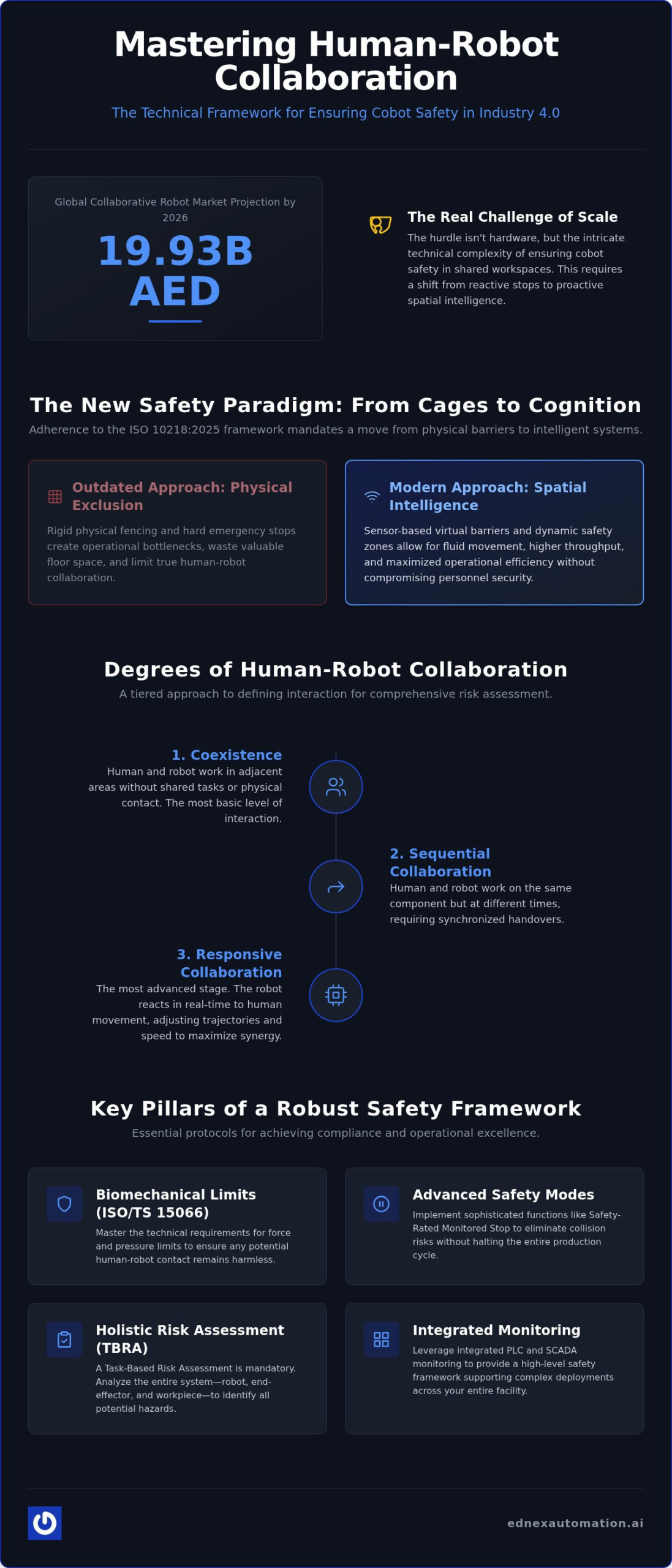
Harnessing the full potential of Industry 4.0 requires a fundamental shift in how we define the collaborative workspace. According to the latest industrial robotics nomenclature, this area is a designated zone within the safeguarded space where the robot and a human can perform tasks concurrently. Implementing the paradigm of human-robot collaboration effectively means moving beyond the rigid constraints of traditional industrial fencing. Instead, engineers now deploy sensor-based virtual barriers that allow for fluid movement and higher throughput. Ensuring cobot safety in a shared workspace depends on this transition from physical exclusion to intelligent, real-time spatial awareness.
Distinguishing between intermittent interaction and continuous shared-task environments allows for more bespoke safety configurations. In an intermittent setup, humans enter the workspace only for maintenance or material loading, whereas continuous environments involve constant proximity. Transitioning to these advanced workflows requires a sophisticated understanding of how sensors and software interact to create a secure perimeter. By replacing static cages with dynamic safety zones, manufacturers can maintain high-speed operations without risking personnel injury.
Degrees of Collaboration in Modern Industry
Defining specific levels of interaction is critical for a comprehensive risk assessment. Coexistence represents the most basic level, where human and robot work in adjacent areas without shared tasks or physical contact. Moving toward sequential collaboration, the human and robot work on the same component but at different times, requiring synchronized handovers. The most advanced stage is responsive collaboration, where the robot reacts in real-time to human movement and input. This synergy utilizes high-frequency data to adjust trajectories or speeds, ensuring cobot safety in a shared workspace while maximizing the unique strengths of both biological and mechanical labor.
The Business Case for Integrated Safety
Deploying collaborative robots UAE wide requires a focus on tangible ROI. Intelligent safety systems minimize operational downtime by utilizing fault detection and slow-down zones instead of hard emergency stops. By eliminating physical guards, facilities recover valuable floor space, often reducing the footprint of a robotic cell by a significant margin. This optimization aligns directly with national industrial modernization goals, positioning safety as a strategic asset rather than a regulatory burden. Investing in certified safety protocols ensures long-term business viability, protecting both the workforce and the bottom line from the catastrophic costs of workplace accidents.
Establishing a Rigorous Safety Framework: ISO Standards and Risk Assessment
Achieving technical compliance in 2026 requires a precise understanding of the third editions of ISO 10218-1 and ISO 10218-2. These updated standards provide the authoritative bedrock for robotic integration, mandating that the entire system, not just the robot arm, meets stringent safety criteria. Research from the NIOSH Center for Occupational Robotics Research emphasizes that worker protection depends on a holistic view of the automated environment. Ensuring cobot safety in a shared workspace starts with acknowledging that a robot’s inherent safety features are only one component of a secure cell. The end-effector, the workpiece, and the surrounding infrastructure all contribute to the overall risk profile.
Executing a Task-Based Risk Assessment (TBRA) is a non-negotiable step for every unique application. This systematic process identifies potential hazards such as pinch points where a human limb could be trapped; it also accounts for the high-speed momentum of the robot during non-collaborative phases. Even a cobot becomes hazardous if it carries a sharp tool or handles heavy, jagged components. By analyzing every motion sequence, engineers can implement mitigation strategies that prioritize human well-being without sacrificing the speed of production.
Force and Pressure Limiting (FPL) Protocols
Utilizing the data-driven guidelines in ISO/TS 15066, integrators establish biomechanical limit values for different parts of the human body. These limits define the maximum allowable force and pressure during a transient or quasi-static contact event. Implementing Power and Force Limiting (PFL) at the joint level ensures the robot stops instantly upon detecting an unexpected resistance. Validating these settings requires specialized bio-fidelic sensors that mimic human skin and bone density, providing empirical proof that the system operates within safe physiological boundaries.
The Role of System Integrators in Compliance
Professional PLC and SCADA integration services are essential for documenting the safety lifecycle from initial design to final decommissioning. These systems provide the high-level monitoring necessary to verify that safety protocols remain active and effective. Expert integrators ensure that all third-party hardware meets the rigorous standards of UAE industrial regulations, bridging the gap between global technological breakthroughs and local operational needs. Consulting with an industry leader for bespoke safety integration ensures your deployment remains compliant and efficient throughout its entire operational life.
Technical Implementation of Collaborative Safety Modes
Modern robotics engineers prioritize four distinct safety modes to maintain peak operational efficiency without compromising personnel security. Safety-Rated Monitored Stop (SRMS) ensures the robot maintains zero motion when a human enters the collaborative zone; it allows the system to resume immediately without a full restart once the area is clear. Hand Guiding empowers operators to use the robot as a power-assist tool, providing direct human control for precise positioning or heavy lifting tasks. Speed and Separation Monitoring (SSM) introduces dynamic scaling, reducing robot velocity as personnel approach. Finally, Power and Force Limiting (PFL) utilizes internal sensing mechanisms to detect impacts, ensuring cobot safety in a shared workspace by limiting contact forces to safe physiological thresholds.
These modes don’t operate in isolation. They’re often combined to create a multi-layered defense strategy. For example, a system might use SSM to slow down as a worker approaches and then switch to PFL for the final interaction phase. This sophisticated orchestration of safety modes is what allows for the high-speed performance required in UAE’s competitive manufacturing landscape. It’s the difference between a system that merely stops and one that intelligently adapts to its environment.
This adaptability is particularly valuable in complex processes like robotic welding, where solutions like those from TME Systems Pty Ltd utilize no-code teaching software to allow for intuitive human-robot interaction while maintaining rigorous safety protocols.
Advanced Sensing and Predictive Safety Systems
Integrating 3D LiDAR and Time-of-Flight (ToF) sensors provides the robot with 360-degree situational awareness that far exceeds legacy light curtains. These systems utilize AI-driven computer vision to predict human intent and future trajectory, allowing the robot to adjust its path before a worker even reaches the cell. Linking this high-fidelity sensor data to autonomous mobile robots prevents cross-traffic collisions in dense warehouse environments. This proactive approach ensures that both stationary and mobile assets synchronize their movements, creating a fluid and secure operational ecosystem.
Spatial Zoning and Speed Separation
Designing a robotic work cell requires the configuration of ‘Green, Yellow, and Red’ zones to manage human-robot proximity effectively. In the green zone, the robot operates at full industrial speed to maximize throughput. As personnel enter the yellow zone, automatic deceleration triggers reduce the velocity to collaborative levels. Entry into the red zone results in an immediate safety-rated monitored stop. Implementing ‘Safe-Move’ software parameters further restricts the robotic reach, ensuring that even in the event of a control error, the mechanical arm cannot exit its designated safe volume. This layered technical implementation is fundamental to ensuring cobot safety in a shared workspace across the UAE industrial sector.
Operational Protocols for Human-Centric Safety and Workforce Integration
Implementing a structured integration plan involves five essential steps:
- Step 1: Conduct specialized training sessions. Technical staff must understand not just the robot’s function, but its specific force-limiting thresholds and the sensor boundaries established during the risk assessment.
- Step 2: Implement visual and auditory signaling. Standardizing status indicators for Active, Idle, and Fault states across the plant floor ensures immediate recognition of the robot’s current operational mode.
- Step 3: Establish clear E-Stop accessibility. Every operator must have an unhindered path to a physical emergency stop, providing a fail-safe manual override that is reachable regardless of the robot’s pose.
- Step 4: Develop a ‘Trust-But-Verify’ culture. Regular safety audits and sensor recalibrations prevent the gradual degradation of technical safeguards, ensuring that the system remains as secure as the day it was commissioned.
- Step 5: Monitor psychological comfort levels. Continuous assessment helps identify “automation complacency,” where workers lose the necessary level of vigilance due to an over-reliance on the robot’s safety features.
Developing a Culture of Shared Responsibility
Transitioning to a proactive safety culture means empowering floor staff to identify hazards before they lead to downtime. Utilizing the intuitive interaction models found in humanoid robots for sale UAE serves as a strategic benchmark for how humans and machines should communicate in a high-tech environment. Feedback loops between operators and automation engineers allow for the continuous refinement of safety zones based on actual workflow patterns. This collaborative approach ensures that safety protocols evolve alongside your production needs, protecting your human capital while driving efficiency.
Signaling and Intuitive Communication
Standardizing LED color coding across the production floor reduces the cognitive burden on workers, allowing for split-second decision-making during collaborative tasks. Beyond visual signals, many facilities are now integrating haptic feedback through wearable devices that vibrate when a worker nears a hazardous zone. Refining the UI/UX of teach pendants ensures that manual programming tasks don’t introduce accidental overrides of core safety parameters. To implement these high-level protocols within your own facility, consult with our technical specialists for bespoke safety integration that aligns with international 2026 standards.
Scaling Secure Automation: The EdNex Approach to Integrated Safety
EdNex Automation positions itself as the visionary architect for the UAE’s industrial transformation, providing the intellectual framework required to deploy complex robotic systems with absolute precision. Unlike off-the-shelf equipment that offers generic safety features, our approach focuses on the bespoke integration of hardware and software to meet the unique demands of your facility. By synchronizing cobot cells with automated storage and retrieval systems, we create a unified safety ecosystem where every component communicates in real-time. Ensuring cobot safety in a shared workspace requires this high-level coordination; a single isolated safety feature cannot account for the unpredictable nature of a multi-robot environment.
Scaling your automation journey necessitates a shift from simple hardware acquisition to a systematic safety architecture. Our engineers prioritize risk mitigation through the deployment of advanced PLC and SCADA systems, which act as the central nervous system for your safety protocols. This method doesn’t just meet current standards, it anticipates future regulatory shifts, providing a foundation for long-term business viability in an increasingly competitive global market. Ensuring cobot safety in a shared workspace is a prerequisite for any organization wishing to remain at the cutting edge of industrial innovation.
Bespoke Safety Architecture for Complex Environments
Customizing safety logic within PLC systems allows for the management of multi-robot environments where overlapping work zones are common. Utilizing advanced digital twin simulations, we validate every safety protocol before a single robot is deployed on the factory floor. This virtual testing phase identifies potential bottlenecks and collision risks, ensuring that your physical installation is optimized for both safety and speed from day one. Maintaining these systems through continuous firmware and safety updates protects your investment against emerging hazards and evolving 2026 industrial standards.
Consultation and Strategic Partnership
Navigating the path from initial risk assessment to final ISO certification support requires a partner with deep regional expertise. We act as a bridge-builder, connecting global technological breakthroughs with the specific industrial landscape of the UAE. Our comprehensive approach includes everything from the initial task-based risk assessment to the final documentation of the safety lifecycle. Future-proofing your facility begins with a systematic evaluation of your current infrastructure. Contacting EdNex for a comprehensive facility safety audit provides the clarity needed to transform your shared workspace into a zero-incident environment.
Future-Proofing Your Industrial Ecosystem with Intelligent Safety
Prioritizing the integration of advanced robotics is a strategic necessity for maintaining global competitiveness within the UAE’s industrial sector. Mastering the technical nuances of ISO 10218:2025 while implementing sophisticated modes like Speed and Separation Monitoring provides the requisite foundation for sustainable growth. Ensuring cobot safety in a shared workspace requires a meticulous blend of high-fidelity sensing, rigorous risk assessment, and a culture of shared responsibility. It’s this synergy between human intuition and mechanical precision that transforms your facility into a high-performance environment that values personnel security as much as production speed.
Since 2018, EdNex Automation has pioneered Industry 4.0 implementation, bridging the gap between global innovation and regional operational needs. Our ISO-certified integration standards and extensive UAE-wide technical support network ensure that your transition to autonomous systems is both seamless and secure. Choosing a partner that provides a comprehensive safety architecture allows you to scale your operations with absolute certainty. Partner with EdNex Automation for Bespoke Cobot Integration and lead the evolution of your facility toward a more efficient and secure future.
Frequently Asked Questions
Are collaborative robots legally required to have safety fencing in the UAE?
Collaborative robots don’t require physical fencing if they operate under the Power and Force Limiting (PFL) mode defined by ISO/TS 15066. UAE industrial safety regulations prioritize the findings of a task-based risk assessment over generic hardware requirements. If the robot’s speed or the sharp nature of its end-effector poses a risk, you must implement virtual barriers or sensors. These technical safeguards serve as the legal equivalent of physical guarding, maintaining compliance while enabling human-robot proximity.
What is the difference between a safety-rated monitored stop and power limiting?
A safety-rated monitored stop (SRMS) ensures the robot maintains zero motion while a human is within the collaborative zone, whereas power and force limiting (PFL) allows the robot to continue moving but restricts impact forces. SRMS relies on external sensors to pause operations immediately. PFL utilizes internal sensors to detect resistance, ensuring cobot safety in a shared workspace by preventing injury during unintentional contact. Each mode serves a distinct operational purpose within a secure cell.
Can any industrial robot be converted into a collaborative robot?
Converting a traditional industrial robot into a collaborative one is technically possible but requires extensive external hardware. You must integrate high-fidelity sensors and safety-rated controllers to manage Speed and Separation Monitoring (SSM). This process is complex and often more expensive than deploying a purpose-built cobot. Most UAE manufacturers prefer bespoke integration using robots designed with inherent safety features. This approach simplifies the certification process and ensures long-term reliability for your automated production lines.
How often should a cobot risk assessment be updated?
You should update your risk assessment whenever there’s a change in the robot’s task, end-effector, or workspace layout. Even minor adjustments to the payload or the proximity of human workers can invalidate previous safety data. Performing a formal review annually is a best practice to ensure your protocols align with the latest 2026 industrial standards. Regular audits maintain the integrity of your safety framework and protect your facility from unforeseen operational hazards or compliance failures.
What are the most common causes of accidents in shared workspaces?
The most frequent causes of accidents include inadequate risk assessments, the use of hazardous end-effectors, and personnel bypassing safety sensors. While the robot arm itself might be safe, a sharp tool or a heavy workpiece can cause significant injury. Automation complacency also plays a role. Workers sometimes lose their sense of vigilance after prolonged interaction with a robot. Standardized signaling and continuous safety training are essential for maintaining a high level of situational awareness in every shared environment.
Does the use of a cobot affect my facility’s insurance premiums in the UAE?
Implementing certified robotic systems typically results in more favorable insurance terms due to the documented reduction in workplace injury risks. UAE insurers recognize that adhering to ISO 10218:2025 lowers the statistical probability of high-cost accidents. By ensuring cobot safety in a shared workspace through professional integration, you demonstrate a commitment to risk mitigation. This proactive stance often translates into lower premiums as your facility’s safety profile improves through the use of controlled and deliberate innovation.
How do I calculate the ‘safe distance’ for a cobot using SSM technology?
Calculating the safe distance requires following the formulas established in ISO 13855, which account for the robot’s stopping time and the human approach speed. You must consider the total system response time, including the sensor detection latency and the mechanical braking duration. This technical calculation ensures the robot reaches a full stop or a safe speed before any contact occurs. Professional integrators use these metrics to configure the ‘Yellow’ and ‘Red’ zones accurately for your facility.
What specific certifications should I look for in a robotics integrator?
Look for integrators who hold official certifications in PLC and SCADA systems and have a proven track record of ISO-compliant deployments. A reliable partner should provide comprehensive support from the initial risk assessment to the final safety certification. In the UAE, it’s vital to choose an integrator with regional expertise who understands local industrial requirements. This ensures your automation strategy is technically sound and legally robust for the 2026 manufacturing landscape, protecting your long-term business viability.