What if the true cost of manual warehouse operations isn’t the labor itself, but the invisible friction of a system that can’t scale with the UAE’s 2026 industrial targets? You likely recognize that rising operational expenses and the persistent shortage of specialized technical labor are no longer just hurdles; they’re systemic risks to your long-term viability. Integrating automated material handling robots UAE is a necessary evolution, yet the prospect of synchronizing sophisticated robotics with your existing PLC and SCADA infrastructure often feels like a technical gamble rather than a clear strategy.
This guide will demonstrate how to transform your logistics from a cost center into a high-performance asset through precise, strategic integration. We’ll provide a technical roadmap for seamless deployment that prioritizes operational continuity and risk mitigation. You’ll gain a comprehensive understanding of the ROI distinctions between AMRs and AGVs, alongside insights into finding a reliable national partner for end-to-end industrial modernization. By aligning global technological breakthroughs with regional industrial requirements, you’ll ensure your facility remains competitive in an increasingly autonomous economy.
Key Takeaways
- Understand how aligning with the UAE’s Operation 300bn mandates a transition from manual handling to autonomous systems to overcome production bottlenecks.
- Identify the specific operational advantages of deploying AMRs, Cobots, and ASRS to achieve unprecedented flexibility in palletizing and sorting.
- Master the technical requirements for synchronizing automated material handling robots UAE with legacy PLC and SCADA systems to ensure a unified control architecture.
- Learn to calculate the true Total Cost of Ownership by factoring in throughput increases and error reduction into your long-term ROI equations.
- Discover a systematic roadmap for end-to-end robotic integration that bridges global innovation with the specific requirements of the national industrial landscape.
The Evolution of UAE Industry: Why Automated Material Handling is Mandatory
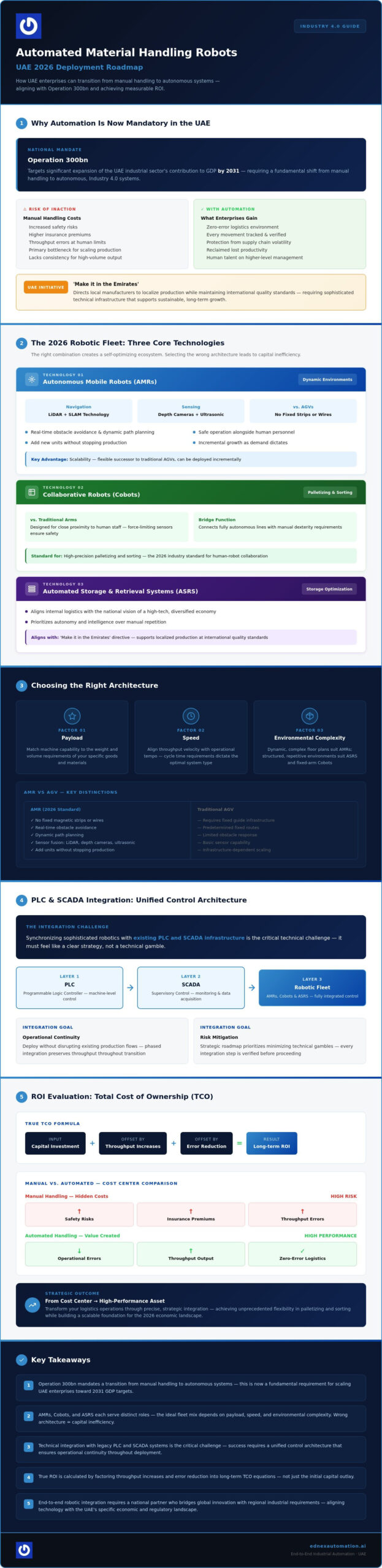
The UAE industrial sector is undergoing a profound transformation driven by the ambitious mandates of Operation 300bn. This national strategy seeks to expand the industrial sector’s contribution to the GDP significantly by 2031, setting a rigorous standard for operational excellence and technological adoption. To meet these aggressive targets, enterprises are moving away from reactive equipment procurement toward a proactive Industry 4.0 framework. Within this strategic shift, the deployment of automated material handling robots UAE has transitioned from a visionary choice to a fundamental requirement for any organization aiming to scale. By automating the movement of raw materials and finished goods, businesses effectively insulate themselves against global supply chain volatility and regional labor fluctuations.
Aligning with the National Strategy for Industry 4.0
The ‘Make it in the Emirates’ initiative provides a clear directive for local manufacturers to localize production while maintaining international quality standards. Achieving this requires a sophisticated technical infrastructure that supports sustainable, long-term growth. Integrating robotics isn’t just about increasing speed; it’s about building a scalable foundation that remains viable in the 2026 economic landscape. By deploying advanced solutions such as automated storage and retrieval systems, companies align their internal logistics with the national vision of a high-tech, diversified economy that prioritizes autonomy and intelligence over manual repetition.
The Cost of Inaction: Manual vs. Automated Handling
Relying on manual material handling introduces invisible costs that erode profit margins over time. These include increased safety risks, higher insurance premiums, and the inevitable throughput errors that occur when human operators reach their physical limits. Manual handling acts as the primary bottleneck in scaling national production, as it lacks the consistency required for high-volume industrial outputs. Material handling efficiency is defined by the realization of a zero-error logistics environment where every movement is tracked, verified, and optimized. Transitioning from labor-intensive models to high-output, autonomous environments allows enterprises to reclaim lost productivity and focus human talent on higher-level technical management. This evolution is a strategic necessity for any organization wishing to remain competitive in a future defined by controlled and deliberate innovation.
Decoding the 2026 Robotic Landscape: AMRs, Cobots, and ASRS
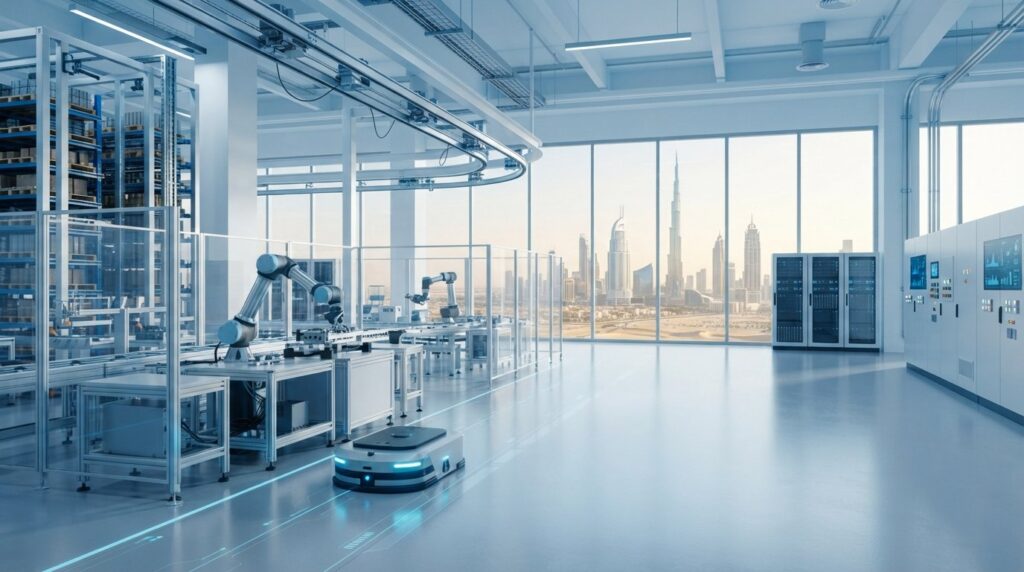
Understanding the technical nuances of modern machinery is essential for any facility manager looking to deploy automated material handling robots UAE. The 2026 landscape isn’t defined by a single machine. Instead, it’s characterized by a heterogeneous fleet of specialized systems working in concert. Selecting the wrong architecture leads to capital inefficiency. Conversely, the right combination creates a self-optimizing ecosystem that scales with your throughput requirements. Identifying the ideal mix requires an engineering-minded approach to payload, speed, and environmental complexity.
Autonomous Mobile Robots (AMRs) for Dynamic Environments
Utilizing LiDAR and SLAM technology, autonomous mobile robots navigate complex floor plans without the need for fixed magnetic strips or wires. These units represent the flexible successor to traditional AGVs, offering real-time obstacle avoidance and dynamic path planning. Modern 2026 models employ advanced sensor fusion, combining depth cameras and ultrasonic sensors to ensure safe operation alongside human personnel. Scalability is a primary advantage here; you can add new units to an active environment without stopping production, allowing for incremental growth as demand dictates.
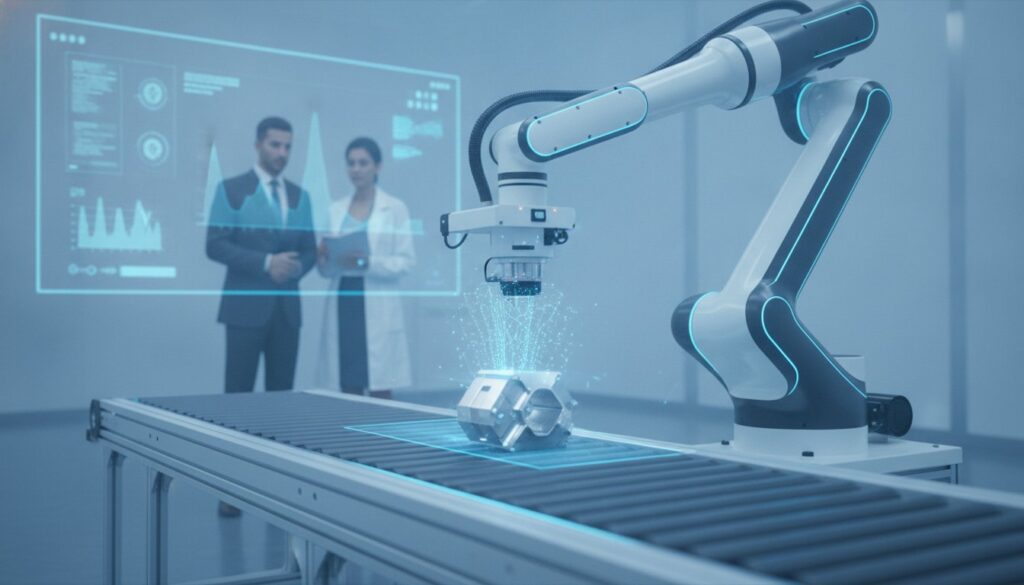
Collaborative Robots (Cobots) have emerged as the standard for high-precision palletizing and sorting. Unlike traditional industrial arms, Cobots are designed with force-limiting sensors, enabling them to work safely in close proximity to human staff. They bridge the gap between fully autonomous lines and manual dexterity, particularly in facilities where product dimensions vary frequently. Integrating these systems into your sorting line reduces the physical strain on your workforce while maintaining a zero-error output.
Automated Storage and Retrieval Systems (ASRS) for Maximum Density
Maximizing vertical space is a strategic priority for national enterprises facing rising real estate costs. Deploying automated storage and retrieval systems allows for high-density storage that manual forklifts can’t reach. These systems integrate directly with your Warehouse Management System (WMS), providing real-time inventory accuracy and high-speed fulfillment. ASRS technology is particularly effective in specialized environments like cold storage, where maintaining temperature integrity while maximizing throughput is critical for long-term viability.
Choosing between these architectures depends on your facility’s specific payload and the complexity of your workflows. Whether you’re moving heavy pallets or individual SKUs, the goal is to create a unified system that minimizes human intervention. If you’re ready to evaluate how these technologies fit your specific site, exploring bespoke industrial robotics solutions is the first step toward a modernized floor.
Strategic Integration: Connecting Robotics to PLC and SCADA Systems
Achieving true industrial autonomy requires more than just the deployment of high-performance hardware. When integrating automated material handling robots UAE, the success of the investment hinges entirely on the underlying control architecture. A robot operating in isolation is merely a tool; when connected to a unified system, it becomes a strategic asset. National enterprises often struggle with the complexity of bridging new robotic fleets with legacy plant machinery, which can lead to fragmented workflows. This challenge necessitates bespoke PLC and SCADA integration services to ensure unified operations across the entire facility. By establishing rigorous industrial communication protocols, we mitigate the risks of data silos and operational friction, creating a ‘single pane of glass’ that allows managers to monitor robotic fleets and heavy machinery simultaneously.
The Role of PLC in Robotic Coordination
Programmable Logic Controllers (PLCs) act as the immediate, tactical decision-makers on the factory floor. Synchronizing robotic movement with conveyor belts, assembly lines, and sorting stations requires sophisticated, low-latency programming to prevent collisions and maximize throughput. Our approach involves custom logic development designed specifically for complex multi-robot material handling environments where precision is non-negotiable. Real-time responsiveness is the hallmark of a well-integrated system. It’s the difference between a staggered, inefficient process and a fluid, high-output production line that adapts to changing demand in seconds.
SCADA: Real-Time Data and Operational Oversight
While the PLC handles the immediate execution, the Supervisory Control and Data Acquisition (SCADA) system provides high-level oversight and historical analysis. Visualizing robotic performance metrics, battery health, and cycle times allows operators to make informed decisions from a centralized hub. This visibility is essential for predictive maintenance when managing a fleet of automated material handling robots UAE, as SCADA data identifies subtle performance drifts before they escalate into costly mechanical failures. SCADA serves as the central nervous system of an automated plant, facilitating seamless communication between every component of the industrial ecosystem. By leveraging these deep insights, UAE enterprises can maintain peak operational efficiency while ensuring the long-term reliability of their robotic investments.
Evaluating ROI: The Business Logic of Robotic Material Handling
Calculating the return on investment for automated material handling robots UAE requires a perspective that extends far beyond the initial capital expenditure. A sophisticated Total Cost of Ownership (TCO) model must account for the entire lifecycle of the system, including bespoke integration, scheduled maintenance, and the intellectual capital gained through operational data. The most significant acceleration of the payback period occurs through the transition to 24/7 operations. While human shifts are limited by fatigue and regional labor regulations, robotic systems maintain peak performance across three consecutive shifts. This effectively triples the utility of the hardware without a linear increase in operational costs.
Factoring in throughput increases and error reduction is essential for an accurate ROI equation. In a manual environment, the cost of a single sorting error can ripple through the supply chain, leading to returns, lost trust, and wasted logistics fees. Automated systems eliminate these variables, providing a predictable output that allows for precise production forecasting. The long-term value of data insights generated by integrated systems also provides a strategic edge. By analyzing the performance metrics captured by the SCADA layer, managers can identify micro-inefficiencies that were previously invisible, turning raw operational data into actionable business intelligence.
Direct vs. Indirect Cost Savings
Direct savings are often the most visible, primarily through the reduction of labor dependency and the elimination of associated recruitment and training expenses. However, indirect savings provide the foundation for long-term profitability. Optimized robotic path planning significantly lowers energy consumption compared to manual forklift operations, contributing to more sustainable facility management. This commitment to sustainability is often complemented by sourcing from local experts like Duboxx Packaging LLC, whose eco-friendly materials ensure that precision handling minimizes material waste and product damage while preserving the integrity of high-value inventory. These cumulative efficiencies ensure that the system pays for itself while simultaneously improving the plant’s overall safety profile.
The competitive advantage of rapid response to market demand shifts cannot be overstated. Facilities equipped with flexible robotic architectures can reconfigure workflows in hours rather than weeks, allowing for the quick onboarding of new product lines. This advanced automation status serves as a marker of legitimacy, attracting high-value industrial partnerships with global entities who demand technical excellence. As we move toward the next phase of Industry 5.0, establishing this robotic foundation is essential for future human-robot synergy. Organizations that invest now are not just buying machines; they are securing their position in the 2026 industrial hierarchy. To begin your financial modeling for a facility upgrade, you can consult with our technical specialists to determine your specific payback timeline.
EdNex Automation: A National Partner for End-to-End Transformation
Leveraging global alliances with pioneers like Franka, Unitree, and Kinova allows us to deliver world-class technology tailored to the specific needs of UAE enterprises. We don’t operate as a simple equipment vendor; we’re a technical partner specializing in the bespoke integration of automated material handling robots UAE. This ensures that global breakthroughs are successfully adapted to regional industrial conditions, providing a reliable intellectual framework for large-scale transformation. Our status as authorized partners for global leaders like Pudu and Kinova guarantees that your facility receives the most advanced autonomous systems available on the market today, backed by the credibility of official certification status.
Bespoke Consulting and Systematic Deployment
Our methodology begins with a rigorous assessment of your unique facility requirements before any hardware is proposed. We don’t suggest specific robotic models until we understand your payload complexities, floor layout, and existing PLC or SCADA control systems. This ‘start-to-finish’ expertise is vital for minimizing implementation friction and ensuring that new robotic units sync perfectly with your current infrastructure. By adhering to official certification standards and focusing on national industrial excellence, we provide a clear roadmap that guarantees long-term operational viability. Our systematic approach brings order and efficiency to complex environments through controlled and deliberate innovation, reflecting an engineering-minded approach where every deployment serves a specific purpose.
Partnering for the Future of UAE Industry
Securing your place in the 2026 industrial landscape requires a strategic investment in collaborative robots and autonomous mobile systems. Our comprehensive portfolio includes everything from AMRs and ASRS to specialized cleaning, delivery, and inspection robots. This breadth of offerings allows us to act as a systematic organizer for your entire facility, connecting high-tech aspirations with clear geographic and economic goals. We bridge the gap between visionary technology and practical application, ensuring your operations remain competitive and resilient in an increasingly automated economy.
We invite you to consult with our high-level automation experts to begin your journey toward a fully autonomous future. Our national technical support team is ready to provide the ongoing guidance needed to maintain peak performance and maximize your ROI. Partnering with EdNex means you’re gaining the intellectual framework necessary for successful implementation, not just the tools. Let’s build a more efficient, high-output industrial environment together that aligns with the nation’s visionary future.
Securing Your Industrial Legacy in the 2026 Economy
Transitioning to a fully autonomous facility is no longer an optional upgrade; it’s a strategic imperative for any enterprise aligning with the UAE’s Operation 300bn targets. By prioritizing the integration of automated material handling robots UAE, you establish a resilient infrastructure capable of overcoming labor shortages and rising operational costs. We’ve explored how the synergy between advanced hardware like AMRs and robust PLC/SCADA control systems creates a unified, high-output ecosystem. This technical evolution ensures that your investment delivers measurable ROI through 24/7 uptime and zero-error logistics.
As an authorized distributor for global leaders such as Pudu, Unitree, and Franka Robotics, we provide the localized expertise necessary for seamless deployment. Our specialized PLC/SCADA integration team offers nationwide UAE industrial support, bridging the gap between global innovation and your specific facility requirements. Partner with EdNex Automation for your strategic industrial transformation to ensure your operations remain at the cutting edge of the regional industrial landscape. The future of material handling is autonomous, and the time to build that foundation is now.
Frequently Asked Questions
What is the difference between an AMR and an AGV in material handling?
AMRs use advanced LiDAR and SLAM technology to navigate dynamically without fixed infrastructure like magnetic strips or wires. This makes them the flexible successor to traditional AGVs, which are restricted to pre-defined paths. In the context of automated material handling robots UAE, AMRs offer superior obstacle avoidance and real-time path planning. This flexibility allows enterprises to reconfigure warehouse layouts without costly downtime, ensuring long-term operational viability in a shifting market.
How do automated material handling robots integrate with existing PLC systems?
Integration occurs through low-latency PLC programming that synchronizes robotic movement with existing assembly lines and conveyor systems. Our technical team develops custom logic to ensure every unit communicates seamlessly with your plant machinery. This process prevents operational friction and ensures that your robotic fleet acts as a unified extension of your current infrastructure. Establishing these rigorous industrial communication protocols is essential for achieving the high-output production targets mandated by national industrial strategies.
What is the typical ROI period for a warehouse robot system in the UAE?
The payback period for a robotic system depends heavily on your facility’s throughput and shift frequency. Transitioning to 24/7 operations typically accelerates the ROI, as robots maintain peak efficiency across three shifts without the overhead associated with manual labor. While initial capital expenditure is a factor, the reduction in error rates and recruitment costs significantly shortens the timeline. Most industrial enterprises find that the strategic value of increased scalability outweighs the initial hardware costs.
Can collaborative robots (cobots) be used for heavy material handling?
Collaborative robots are primarily engineered for precision tasks like sorting and palletizing where human-robot synergy is required. While traditional industrial arms handle extreme payloads, modern cobots are increasingly capable of managing substantial weights while maintaining safety through force-limiting sensors. They’re ideal for facilities where product dimensions vary frequently and human dexterity is still needed for complex oversight. This allows for a zero-error output in environments where traditional, caged robotics aren’t feasible.
What maintenance is required for autonomous mobile robots in industrial environments?
Maintaining automated material handling robots UAE involves regular sensor calibration, battery health monitoring, and firmware optimization. Utilizing SCADA data for predictive maintenance allows technical teams to identify performance drifts before they lead to mechanical failure. This proactive approach ensures that autonomous mobile robots remain operational with minimal downtime. Routine inspections focus on the integrity of LiDAR components and drive systems to maintain the high safety standards required in modern industrial environments.
Do automated material handling robots require a complete facility redesign?
A complete redesign is rarely necessary because modern robotics are built for brownfield integration. AMRs navigate existing floor plans using internal mapping, and cobots occupy a small footprint without the need for safety cages. While solutions like ASRS require specific vertical space, they’re designed to optimize your current facility’s density rather than requiring a new building. This modular approach allows for incremental automation, meaning you can scale your robotic fleet as your production demands grow.
How does SCADA integration improve robotic material handling performance?
SCADA integration acts as the central nervous system of your facility by providing a single pane of glass for monitoring robotic performance. It allows managers to visualize real-time data, track cycle times, and manage predictive maintenance schedules from a centralized hub. By linking your robotic fleet with plant-wide metrics, you gain actionable business intelligence that micro-optimizes throughput. This high-level oversight is critical for mitigating risks and ensuring that every component of your automated system operates at peak efficiency.
Is technical support available nationally for international robotic brands in the UAE?
Yes, EdNex Automation provides nationwide industrial support across the United Arab Emirates for global brands like Unitree, Franka, and Pudu. Our technical team offers start-to-finish expertise, from high-level consulting and bespoke integration to long-term maintenance. Having a reliable national partner ensures that your international robotic systems receive the specialized support necessary for operational continuity. This localized framework bridges the gap between global technological breakthroughs and the specific requirements of the national industrial landscape.