With labor expenses consuming 33% of total operating revenue and over half of hotel operators reporting chronic understaffing according to 2026 industry data, the traditional service model is reaching a critical inflection point. You likely recognize that maintaining a high-tech brand image in a saturated luxury market requires more than just standard automation; it demands a seamless blend of sophisticated interaction and operational precision. The persistent challenge of high labor turnover in service roles makes it difficult to guarantee the 24/7 consistency that premium guests expect. This guide explores how humanoid robot applications in hospitality are moving beyond marketing novelty to become core pillars of the guest journey. You’ll discover a strategic roadmap for humanoid deployment, identifying the specific tasks where bipedal systems excel, from VIP baggage handling to multilingual concierge services. By bridging global technological breakthroughs with regional industrial needs, we provide the framework to integrate these intelligent front-ends with your existing building management systems to ensure long-term business viability and operational excellence.
Key Takeaways
- Identify the strategic transition from basic operational efficiency to experience-driven automation within the luxury hospitality sector.
- Analyze high-impact humanoid robot applications in hospitality, focusing on automated concierge services and seamless guest interaction.
- Evaluate the technical necessity of PLC and SCADA integration to link humanoid front-ends with existing industrial-grade building infrastructure.
- Determine the specific operational scenarios where bipedal humanoid mobility justifies the investment over traditional wheeled autonomous mobile robots.
- Access a comprehensive framework for managing the UAE’s unique deployment requirements through expert regional integration partnerships.
The Paradigm Shift: Why Humanoid Robots are Essential for 2026 Hospitality
Entering 2026, the hospitality sector is witnessing a fundamental transformation where humanoid service robots are no longer experimental curiosities. These platforms are defined as AI-driven systems featuring anthropomorphic characteristics specifically engineered for high-level social interaction. By adopting a sophisticated humanoid robotics architecture, these machines move beyond the rigid movements of early automation to mimic human kinematics and expressions. This evolution is central to the UAE’s national Industry 4.0 goals, positioning the region as a global leader in high-tech service integration. High-end hospitality groups are increasingly seeking humanoid robots for sale in the UAE to align with these digital transformation mandates.
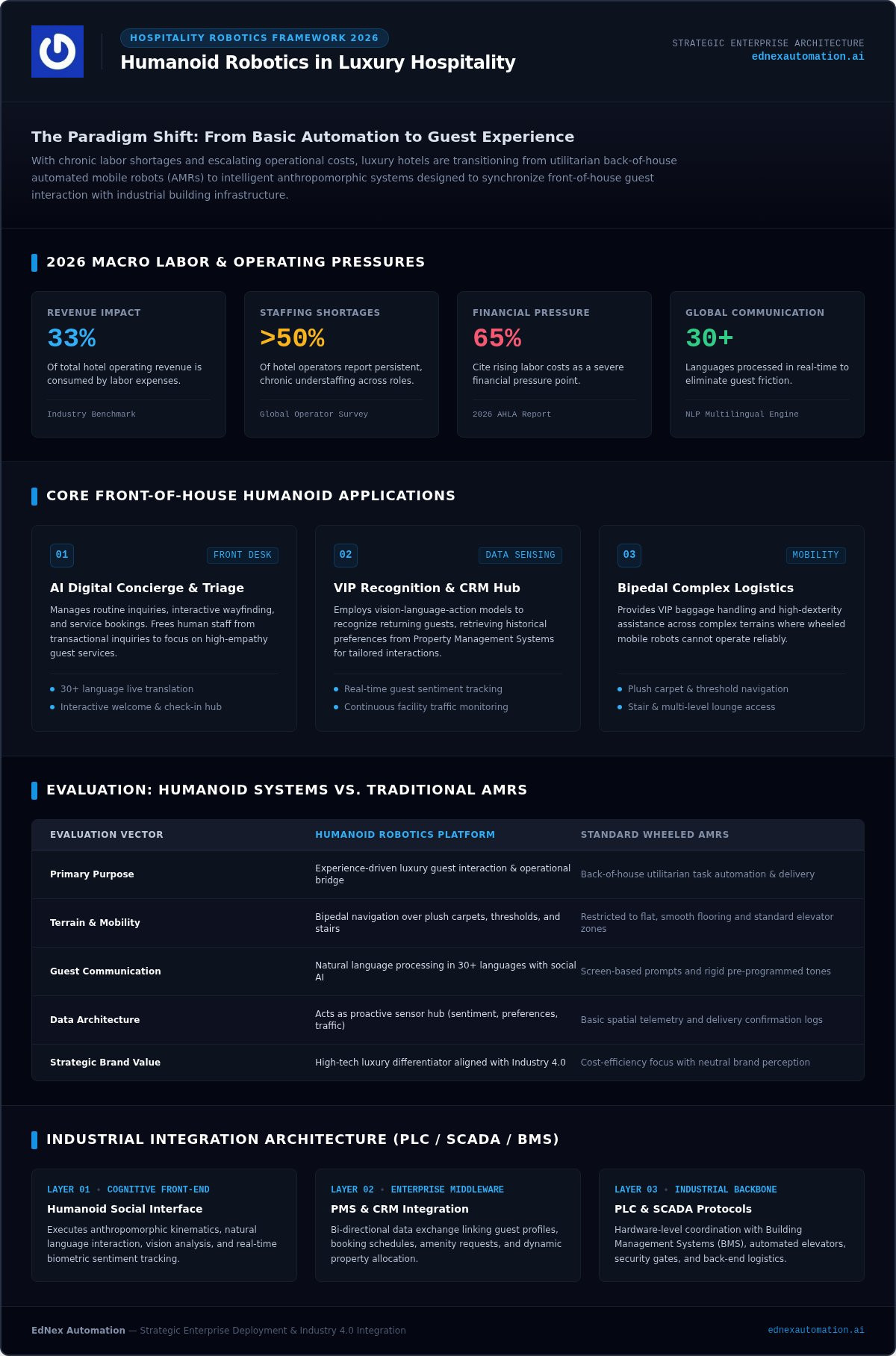
While traditional automation historically focused on back-of-house efficiency, luxury hospitality now prioritizes automation for experience. Strategic humanoid robot applications in hospitality serve as a bridge between cold operational logic and warm guest engagement. With 65% of hotel operators citing labor costs as a severe financial pressure according to the 2026 AHLA report, humanoids provide a scalable solution for 24/7 operational readiness. They don’t just fill a labor gap; they elevate the brand by providing a consistent, high-tier interaction that manual staffing often struggles to maintain across rotating shifts.
Redefining the Guest Journey
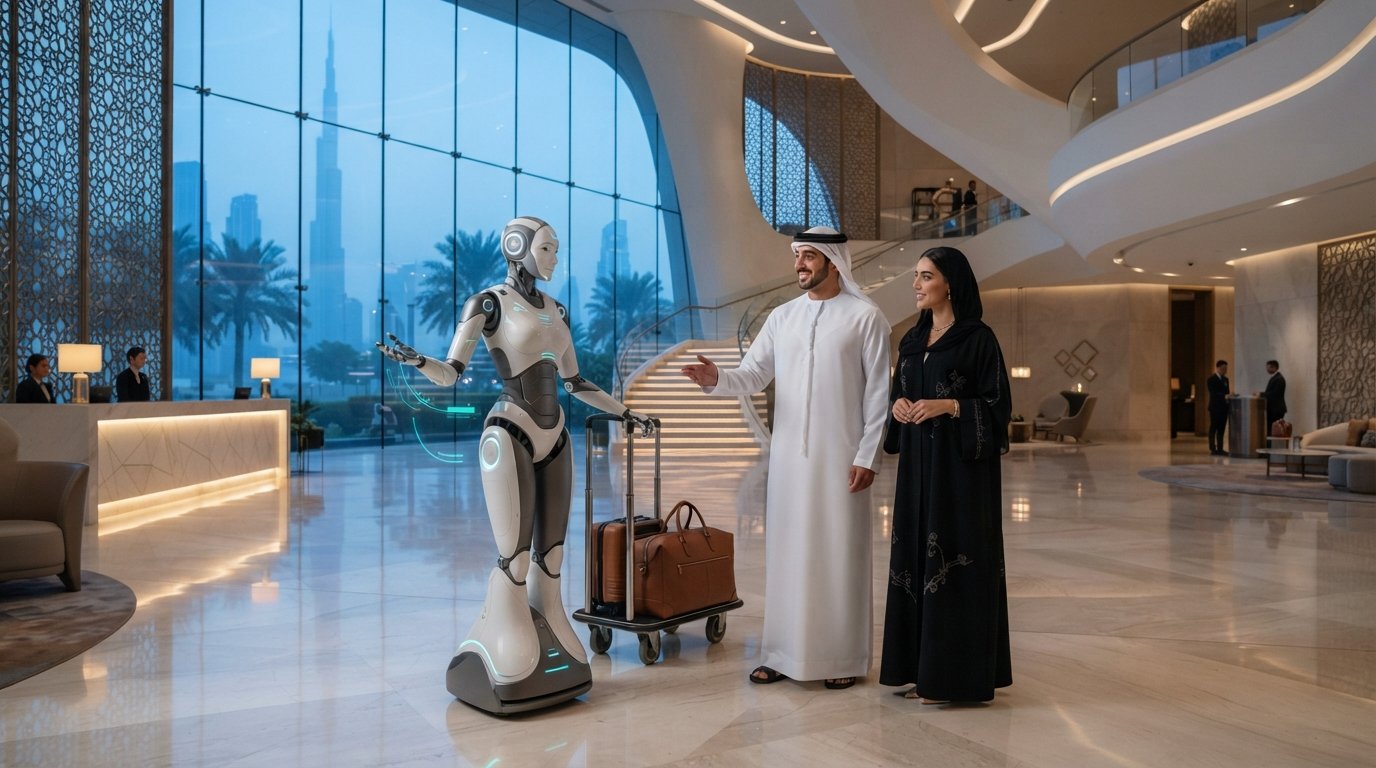
Traditional reception desks are evolving into interactive hubs where AI-assisted systems lead the welcome process. This transition creates an immediate psychological impact, establishing a “wow” factor that drives guest loyalty and brand differentiation. In multilingual environments, these robots eliminate communication friction by utilizing real-time translation across 30+ languages. This ensures every guest feels understood from the moment they arrive, allowing staff to focus on complex, high-value guest needs that require human empathy.
Humanoids as Data Hubs
Core Humanoid Robot Applications in Modern Hotel Environments
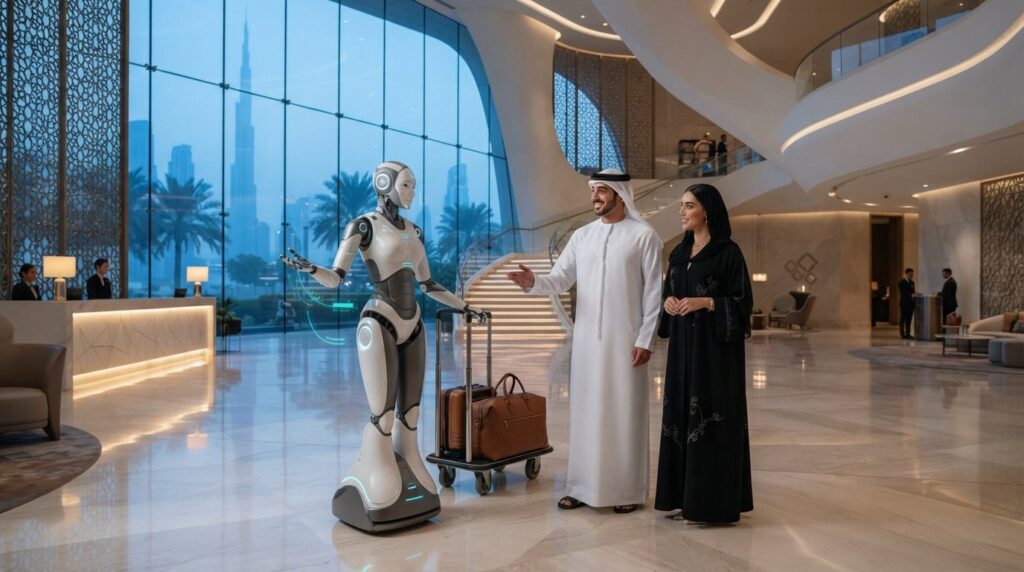
Deploying advanced humanoid platforms allows luxury hotels to redefine operational standards through multi-functional utility. Modern humanoid robot applications in hospitality extend far beyond simple greeting tasks, acting as intelligent hubs that synchronize guest needs with back-end logistics. By utilizing bipedal or highly dexterous units, properties can navigate complex environments like plush carpets or stair-access lounges where traditional wheeled units struggle. These systems serve as the primary interface for guests, ensuring that every interaction is backed by real-time data and precise execution.
Recent hospitality service robot integration studies emphasize that hybrid human-robot workflows significantly enhance consumer perception when the technology facilitates seamless service rather than just performing isolated tasks. This is particularly evident in VIP personalization. Humanoids equipped with vision-language-action models can recognize repeat guests, recalling specific preferences from Property Management Systems to tailor their greetings and service suggestions. This level of technical sophistication ensures that humanoid robot applications in hospitality maintain the “high-touch” feel essential for luxury branding.
Front-of-House: The Digital Concierge
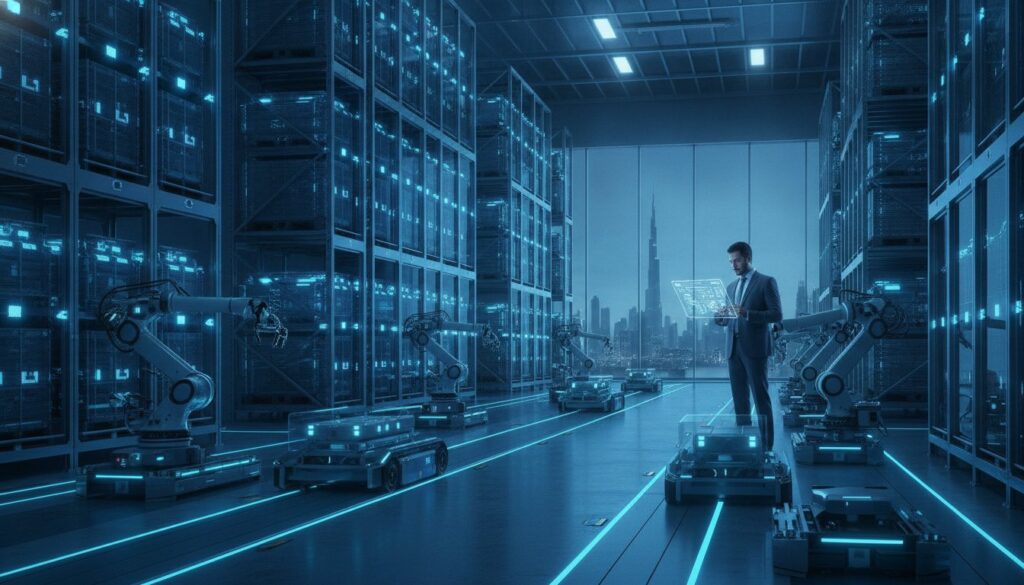
The true power of a humanoid interface lies in its ability to orchestrate back-of-house assets. These units act as the “brain” for a fleet of delivery robots, assigning tasks based on guest requests captured through natural language. Furthermore, they communicate directly with autonomous cleaning robots to confirm room readiness or trigger immediate maintenance alerts. By integrating with ASRS systems for automated luggage retrieval, humanoids ensure that the transition from storage to guest is handled with industrial precision. If you’re looking to optimize these complex workflows, exploring the latest robotics integration solutions can provide the necessary technical foundation for your property.
Strategic Evaluation: Humanoid Service Robots vs. Traditional AMRs
Selecting the appropriate robotic architecture requires a nuanced understanding of the operational environment and the specific guest outcomes intended. While traditional Autonomous Mobile Robots (AMRs) excel at repetitive, point-to-point delivery tasks, they often lack the communicative depth required for high-tier guest engagement. In contrast, humanoid robot applications in hospitality prioritize social-centric interactions, leveraging human-like kinematics to build trust and facilitate complex service requests. Although humanoids involve a higher initial CAPEX compared to wheeled AMRs, their operational flexibility allows them to execute diverse tasks that single-purpose units cannot, such as navigating uneven thresholds or performing bi-manual tasks like baggage handling. From a lifecycle perspective, modern humanoid platforms are engineered for high-traffic environments, utilizing modular components that simplify maintenance and extend the unit’s operational viability over several years.
The ‘Social Presence’ Advantage
Humanoid form factors significantly outperform tablet-based kiosks in terms of guest interaction rates and satisfaction scores. Utilizing non-verbal communication, such as subtle gestures and maintained eye contact, these robots create a sense of presence that fosters immediate trust. This psychological engagement is vital for guest-facing roles where the ‘human’ element is a core part of the brand value. By mimicking human movement patterns, these systems reduce the friction often associated with interacting with cold, industrial machinery. It’s this ability to evoke a positive emotional response that justifies the investment in humanoid technology for luxury properties seeking to maintain a cutting-edge reputation.
Unified Fleet Management
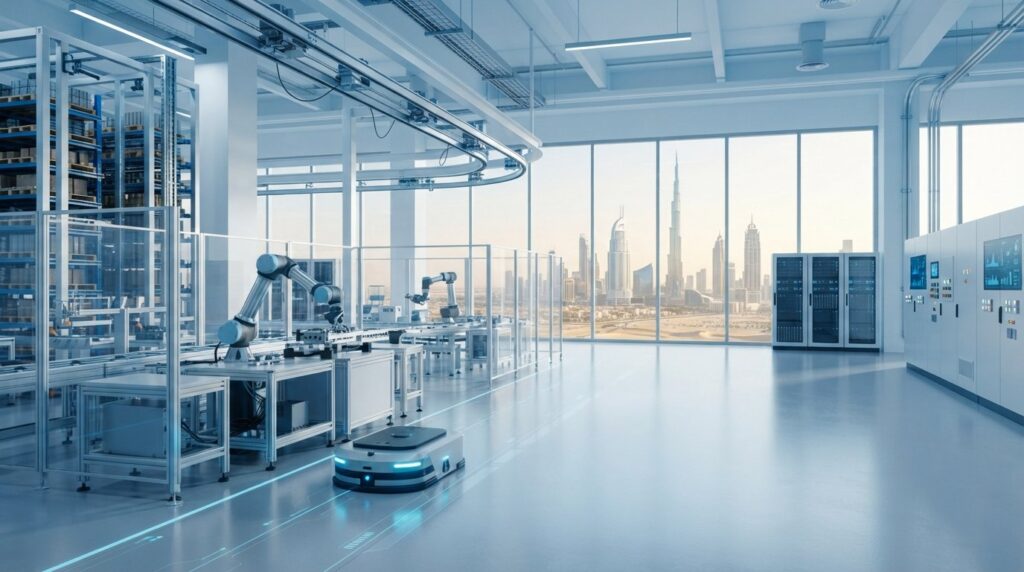
Effective 2026 hospitality strategies treat the humanoid not as a standalone novelty, but as the orchestrator of a wider robotic ecosystem. In this framework, the humanoid acts as the visible ‘face’ of the hotel, communicating guest orders directly to back-of-house systems. For instance, a humanoid concierge can coordinate with collaborative robots in the kitchen to ensure that room service preparation is perfectly timed with the arrival of a delivery unit. Managing this diversity through a single control architecture is essential for maintaining operational flow and data integrity. This integrated approach ensures that humanoid robot applications in hospitality drive measurable ROI by optimizing the performance of the entire automated fleet, rather than just automating isolated tasks. By centralizing control, operators gain a holistic view of facility performance, allowing for real-time adjustments to service workflows.
Technical Integration: PLC, SCADA, and Network Infrastructure
Standalone robotic units often fail in complex hospitality environments because they lack a unified industrial control framework. Achieving high-tier service requires more than just sophisticated hardware; it demands PLC and SCADA integration services to bridge the gap between anthropomorphic interfaces and physical building infrastructure. Without this backbone, humanoid robot applications in hospitality remain isolated novelties, unable to navigate elevators or respond to emergency fire safety protocols. Integrating these systems ensures that every robotic movement is synchronized with the facility’s core operating logic.
Reliable performance depends heavily on the underlying network architecture. Humanoid units generate massive volumes of low-latency telemetry and high-definition video streams that cannot run on guest-facing Wi-Fi. Successful deployments utilize Wi-Fi 6E or private 5G networks with segregated VLANs to prevent packet loss during critical maneuvers. This robust connectivity is paired with rigorous cybersecurity protocols, ensuring that guest data and robotic control networks are shielded from external threats through encrypted MQTT or OPC UA communication channels.
The Role of Control Systems
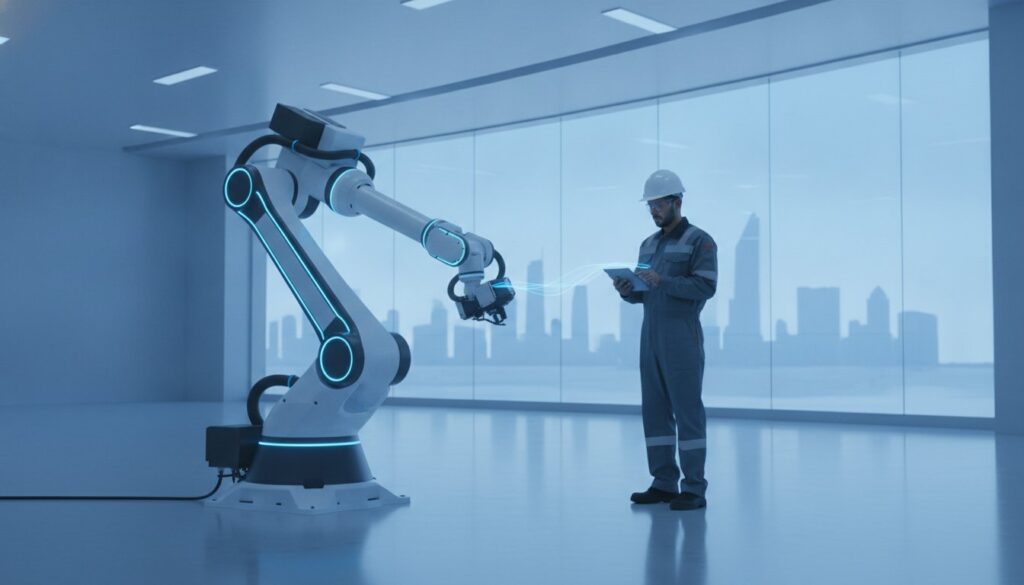
Utilizing SCADA systems allows operators to maintain real-time monitoring of robotic fleet health, battery status, and precise location across multi-floor properties. While SCADA handles high-level supervision, PLC integration manages the physical interactions required for autonomous mobility. This includes interfacing with elevator IoT gateways via BACnet/IP or Modbus TCP protocols to facilitate vertical transit between floors. Compliance with ISO 13482 safety standards is mandatory, requiring the control system to trigger immediate emergency overrides if the building’s fire alarm is activated. This fail-safe architecture ensures that robots enter designated park states instantly, maintaining guest safety in all scenarios.
Implementation Roadmap
Successful execution follows a structured, three-step methodology to mitigate risk and ensure long-term business viability. Initially, a comprehensive network audit and infrastructure readiness assessment identify potential dead zones or bandwidth bottlenecks. The second phase involves custom API development to link the robot’s interface with Property Management Systems like Oracle Opera or Cloudbeds, enabling personalized guest interactions. Finally, a phased deployment begins with non-critical guest interactions, such as wayfinding in common areas, before scaling to complex room service tasks. If you’re ready to modernize your facility’s infrastructure, our team provides the technical expertise for seamless robotics integration.
Future-Proofing Your Enterprise with EdNex Automation
Establishing long-term business viability in a competitive hospitality market requires a partner who understands both global technological breakthroughs and regional industrial needs. By focusing on humanoid robot applications in hospitality, EdNex Automation acts as a systematic organizer for properties ready to evolve their service models. We provide the intellectual framework necessary for implementation, ensuring that advanced systems solve complex operational challenges rather than creating new ones. As the authorized system integrator for premier global brands, we offer a curated selection of humanoid robots for sale in the UAE, ensuring each unit meets local certification standards and performance benchmarks. Scaling from a single pilot unit to a national service fleet requires robust local technical support, making our regional presence a critical asset for maintaining the high-uptime operations expected in luxury environments.
Consultative Approach to Automation
Our consultative methodology moves beyond simple hardware procurement to analyze ROI through the lens of operational efficiency and brand equity. Providing end-to-end solutions, we handle everything from initial hardware sourcing to bespoke software integration with your existing building management and property management systems. We don’t just deliver tools; we deliver results-oriented strategies that mitigate risk and optimize resource allocation. Crucially, we provide the training necessary for human staff to work alongside their new robotic colleagues, ensuring a harmonious hybrid service environment. This human-centric approach to high-tech integration fosters internal acceptance and maximizes the functional benefits of your robotic fleet.
A Vision for UAE Excellence
Aligning your hospitality strategy with the nation’s 2030 and 2050 innovation visions positions your property as a global benchmark for excellence. By integrating humanoid robot applications in hospitality, you’re not just adopting a current trend but participating in a necessary evolution for any organization wishing to remain competitive in the future. We act as a bridge-builder, connecting global technical expertise with the unique cultural and economic context of the regional market. Setting a global benchmark for luxury requires controlled and deliberate innovation, ensuring that every technological addition enhances the guest experience without compromising safety or reliability. To begin your property’s robotics transformation and secure your place at the cutting edge of service, contact EdNex Automation for a strategic consultation today.
Empowering the Next Era of Luxury Hospitality
Adopting advanced automation is no longer an optional upgrade but a strategic necessity for properties aiming to maintain a competitive advantage in the luxury market. Integrating humanoid robot applications in hospitality allows operators to bridge the gap between back-end efficiency and front-of-house engagement, effectively solving chronic labor deficits while elevating brand equity. Success depends on moving beyond standalone hardware toward a unified control architecture. Utilizing specialized PLC and SCADA expertise ensures that your robotic fleet interacts seamlessly with essential building infrastructure, from elevator transit to emergency safety protocols. This systematic approach guarantees that your investment delivers measurable ROI and long-term operational resilience.
Positioning your property at the cutting edge of innovation requires a partner who understands the specific technical and economic landscape of the region. Our specialized UAE-based integration team provides the intellectual framework and comprehensive portfolio of service and industrial robots needed for a seamless transition. You can scale your hospitality operations with EdNex’s humanoid solutions to set a new global benchmark for service excellence. The future of hospitality is intelligent, autonomous, and ready for deployment today.
Strategic Insights: Frequently Asked Questions
What are the primary benefits of humanoid robots in the hospitality sector?
The primary benefits of humanoid robot applications in hospitality include standardized 24/7 guest interaction, reduced operational friction, and a significant reduction in front-desk workload. These platforms provide a high-tech brand differentiator that appeals to luxury travelers while simultaneously capturing valuable guest preference data through natural language processing. By automating routine inquiries and concierge tasks, hotels can redirect human staff toward high-value, empathetic guest services that require human intuition.
Can humanoid robots fully replace hotel reception staff?
Humanoid robots are designed to augment and assist rather than fully replace hotel reception staff. While they excel at handling repetitive tasks like check-in, wayfinding, and basic inquiries, human professionals remain essential for managing complex guest emotions, conflict resolution, and bespoke VIP requirements. The most effective hospitality models utilize a hybrid approach where robots handle high-volume interactions, allowing human colleagues to focus on the nuanced social elements that define luxury service.
How do humanoid robots integrate with existing hotel management software?
Integration occurs through custom API development that connects the robotic interface directly to Property Management Systems (PMS) like Oracle Opera or Cloudbeds. This connectivity allows the robot to access real-time room status, guest profiles, and billing information. EdNex Automation utilizes PLC and SCADA integration to ensure these front-end interfaces communicate with the building’s physical infrastructure, enabling robots to request elevators or trigger automated delivery protocols based on real-time PMS data.
What is the typical ROI period for a humanoid robot in a luxury hotel?
The typical ROI period for a humanoid robot in a luxury hotel generally ranges between 18 and 36 months, depending on the deployment scale and labor cost savings. Properties often see immediate gains in operational efficiency and guest satisfaction scores, which contribute to long-term brand equity. Many hotel operators utilize Robots-as-a-Service (RaaS) models to manage capital expenditure, paying monthly rates that cover maintenance and software updates while providing a predictable path to profitability.
Are humanoid robots safe to operate around children and crowded lobbies?
Modern humanoid robots are engineered with advanced safety protocols to operate reliably around children and in crowded lobbies. Compliance with international standards like ISO 13482 and ANSI/CAN/UL 3300 ensures these units feature power and force limiting mechanisms and acoustic path signaling. Integrated LiDAR and vision sensors allow for real-time obstacle avoidance and speed adjustments, ensuring the robot maintains a safe distance from guests while navigating high-traffic areas during peak operational hours.
What technical infrastructure is required to support a fleet of humanoid robots?
Supporting a fleet of humanoid robots requires a robust network infrastructure, specifically dedicated Wi-Fi 6E or private 5G networks to ensure low-latency communication. Properties must also implement a unified control architecture through PLC and SCADA integration to facilitate physical interactions with elevators and automated doors. A secure, segregated VLAN is necessary to protect robotic telemetry and guest data from external threats while ensuring the robots remain synchronized with the building management system.
How do humanoid robots handle multiple languages in a diverse market like the UAE?
Humanoid robots handle multiple languages by utilizing native Vision-Language-Action models and conversational LLMs that support over 30 languages. In a diverse national market like the UAE, this capability allows robots to provide seamless, real-time translation for international guests. These systems can instantly switch between languages based on guest input, ensuring that technical information, wayfinding directions, and concierge recommendations are communicated clearly and accurately to every visitor regardless of their native tongue.
What maintenance is required for humanoid service robots in 24/7 environments?
Maintaining humanoid service robots in 24/7 environments involves a combination of routine hardware checks and predictive software monitoring. Operators must perform regular sensor calibration, battery health assessments, and joint lubrication to prevent mechanical wear. EdNex Automation provides local technical support and maintenance contracts that include proactive fleet health monitoring via SCADA systems. Modular component designs allow for rapid part replacement, ensuring high uptime and minimizing any potential disruptions to the guest experience.