The most capable inspection robot isn’t automatically the right one for your site. Choosing robotic inspection systems UAE means matching the platform and its sensors to the asset, inspection task, environment, safety requirements, and data workflow. A long feature list matters less than whether the system can collect useful, repeatable evidence under your actual operating conditions.
Manual inspections can place personnel in hazardous or hard-to-reach areas, but adopting robotics brings its own decisions. Which platform suits the route? What must it observe? Who will review its findings, and how will those records reach the systems your teams use? Answering these questions helps turn a technology purchase into a practical inspection process.
This 2026 guide explains how inspection robots work and how to assess them against your assets and operating conditions. It covers sensor options, environmental limits, safety arrangements, and integration requirements to verify before selection. It also shows how to define a pilot with clear objectives and acceptance criteria, so you can assess performance before considering wider deployment. With a structured approach, robotics can support safer inspections and more actionable operational insight across the UAE.
Key Takeaways
- Compare robotic inspection systems UAE buyers are considering by asset, task, access conditions, sensing needs, and required human oversight.
- Inspection data becomes useful through a defined workflow, from route planning and anomaly flagging to human review and maintenance action.
- Wheeled, tracked, legged, and fixed systems suit different settings. Verify site fit and sensor capabilities before narrowing your options.
- Check how inspection outputs can connect with existing operational systems, including whether PLC or SCADA integration fits the project scope.
- Use a representative pilot to establish baseline measures, agree safety controls, and define acceptance criteria before considering wider deployment.
What robotic inspection systems do for UAE industrial operations
Industrial teams need consistent ways to inspect assets while managing difficult access, personnel exposure, and the operational impact of taking equipment offline. A robotic inspection system combines a mobile or fixed robot, a sensor payload, software, and a reporting workflow to collect and organize information about asset condition. The right configuration depends on the specific task and site.
A robotic inspection system uses a robot and task-matched sensors to collect repeatable condition data, giving teams observations to review and act on. This differs from surveillance, which focuses on security monitoring, and cleaning, which removes dirt or residue. General-purpose mobile robots may move people or materials without assessing asset condition. Some platforms may support more than one function, but confirm that a proposed system is designed and equipped for the inspection task you need.
For robotic inspection systems UAE projects, site requirements matter as much as the asset. Routes, access restrictions, operating conditions, connectivity, and limits on interrupting operations can all affect what is practical. Assess these factors at the facility rather than assuming one configuration will suit every industrial environment.
Which inspection tasks can robots support?
Depending on the robot and verified payload, tasks may include visual checks, thermal observations, or mapping. Camera-based visual inspection is related to Automated optical inspection (AOI), which uses cameras to examine items for visible features or defects. The robot’s route, camera, lighting, and analysis software must still suit the asset and the inspection objective.
Routine condition monitoring is not the same as specialist non-destructive testing (NDT). A camera or thermal sensor does not, by itself, establish that a system can perform a required NDT method. Before procurement, review technical documentation to verify sensor suitability, environmental operating limits, supported payloads, and the inspection method. Treat automated anomaly flags as prompts for review, not as a substitute for qualified human assessment when the task requires it.
Where are robotic inspection systems used?
Potential applications include energy assets, transport infrastructure, manufacturing lines, utilities, and large facilities. The use case depends on the asset and how the robot can reach it. A confined route, elevated component, long corridor, or active production area each presents different constraints. Use asset geometry, access, operating conditions, and required evidence to guide system selection.
A Railway Technology report on UAE rail inspection describes autonomous track and infrastructure monitoring using LiDAR, lasers, and 3D cameras. This is a sector-specific example, not proof that the same sensors, robot design, or performance will suit another site. Confirm the requirements and capabilities for each proposed application.
How robotic inspection systems capture and turn site data into action
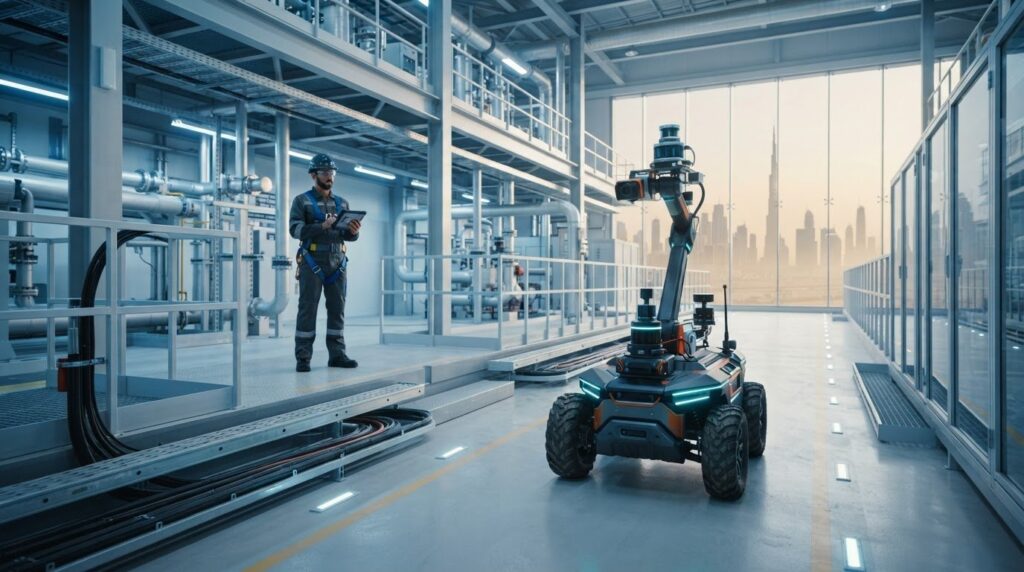
An inspection route creates operational value only when its observations can be reviewed, compared, and acted on. A typical workflow starts by defining the route and inspection points, then configuring the robot to navigate and capture the required readings. Software may flag observations that differ from set thresholds or previous records. Inspection personnel review those flags, assess their significance, and decide whether to monitor, investigate, or initiate maintenance.
Sensor data is an observation to assess, not a confirmed engineering diagnosis. An image, temperature reading, or acoustic signal may identify a condition for review, but does not establish its cause or severity on its own. AI-based detection can help teams sort and prioritize findings, provided the model and thresholds are validated for the task, asset, and operating conditions.
Navigation, sensing, and anomaly detection
Mapping and localization help a robot follow a planned route and revisit inspection points, supporting consistency between inspection cycles. Choose sensors based on the question being asked. Cameras may capture visible surface conditions, while thermal or acoustic sensors may support other observations if the selected system includes suitable equipment. Don’t assume a sensor is available or appropriate based on a general product description.
For a UAE site, compare the proposed robot’s navigation performance and environmental operating limits with actual routes, surfaces, access constraints, and site conditions. Request documentation for supported sensors, payloads, detection performance, and data outputs. Test representative inspection points during a controlled evaluation, and check whether the system collects usable records under the conditions it will encounter.
From inspection findings to maintenance workflows
After data collection, decide who reviews findings, how they’re prioritized, and what triggers escalation. For example, a flagged observation could go to an engineer for verification, then move into the organization’s work-order process if a maintenance action is approved. Agree in advance how images or readings will be identified, stored, compared over time, and linked to the correct asset.
Integration needs vary. Inspection records may need to flow into an asset management platform or connect with operational systems, but compatibility depends on the robot’s interfaces, data format, and site architecture. EdNex Automation provides PLC and SCADA integration alongside robotics solutions. Review its PLC and SCADA integration services, then verify the project-specific scope and interfaces before selection.
For robotic inspection systems UAE deployments, repeatable routes and consistently labelled records can help teams compare observations across inspection cycles. To assess how inspection and integration requirements may fit together, review EdNex Automation’s inspection robot and integration capabilities against your site needs.
How to compare robotic inspection systems for your UAE site
The right platform depends on the inspection job, not the number of features in a brochure. Compare each option against the asset, route, required observations, operating conditions, data workflow, and level of human oversight. One robot may not suit every asset or inspection method, so assess each use case against its own requirements.
| Requirement | What to assess |
|---|---|
| Asset and task | Identify the component and condition to inspect, and whether the task is routine monitoring or a specialist inspection method. |
| Access and mobility | Check route width, surface, obstacles, stairs, slopes, and whether the robot must remain stationary at inspection points. |
| Sensor and evidence | Specify the observations required, then verify supported sensors, payloads, detection performance, and limits in technical documentation. |
| Data and oversight | Confirm output formats, connectivity, review responsibilities, and when a human-led check or escalation is required. |
Match robot form factor and sensor payload to the asset
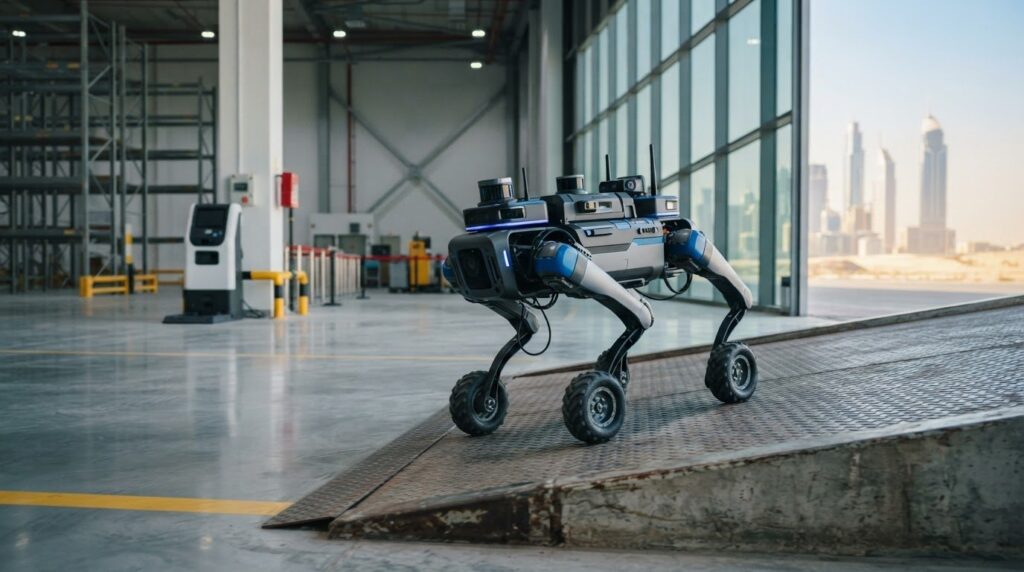
Wheeled platforms may suit accessible routes with relatively even surfaces. Tracked systems may be worth evaluating when the route calls for a different ground-contact approach. Legged robots can be considered for routes with steps or obstacles, while fixed systems may suit a defined inspection point. These are broad categories, not guarantees of capability. Compare the actual route and verify mobility, dimensions, payload support, and operating limits with the vendor. For mobile-platform context, review autonomous mobile robot capabilities.
Choose sensors based on the condition you need to observe, not a generic feature checklist. Before a trial, compare site-specific heat, dust, surface conditions, and connectivity with documented system limits. Confirm detection claims under representative conditions. Specialist inspection methods, including some forms of non-destructive testing, may require dedicated equipment or human-led checks rather than a general-purpose inspection robot.
Evaluate data, safety, and operating fit
Ask vendors how inspection records are exported, where data is stored, who owns it, and what connectivity and cybersecurity requirements apply. Verify whether the outputs can be used by existing asset or operational platforms instead of assuming compatibility. Define operator oversight, access controls, route permissions, and site safety procedures before trials begin.
For robotic inspection systems UAE procurement, treat autonomy, detection accuracy, and environmental suitability as claims to validate against the intended task. A structured comparison can show when one platform fits a particular route, while another approach or a human-led method is more suitable elsewhere.

Plan a robotic inspection pilot, integration, and acceptance process
A controlled pilot helps determine whether a robotic inspection system fits the asset, workflow, and operating conditions before a wider rollout. Start by documenting the current process: inspection frequency, effort required to access the asset, quality and consistency of existing records, and how findings reach maintenance teams. This baseline gives stakeholders a fair comparison. Don’t promise savings until the pilot produces evidence that can be measured against it.
Define a controlled pilot and measurable acceptance criteria
Choose a representative asset and a bounded inspection task with a clear owner. Before testing begins, agree on the scope, route, inspection points, safety controls, data handling, and who will review the results. Set acceptance criteria in advance, such as:
- Whether the robot completes the agreed route and captures the required inspection points consistently.
- Whether collected records are clear, correctly associated with the asset, and useful to reviewers.
- Whether findings can be assessed and handed to the relevant maintenance workflow.
- How often human intervention is needed, and how exceptions or route failures are handled.
Run the trial under representative site conditions, recording deviations as well as successful runs. Define when to pause for safety concerns, unreliable data, or repeated navigation issues. Agree what evidence would justify expanding the pilot, changing the configuration, or stopping the evaluation.
Plan deployment, training, and integration
Before rollout, map the required interfaces and confirm how records will move from the robot to the people and platforms that use them. Verify connectivity, output formats, data permissions, cybersecurity requirements, escalation responsibilities, and any intended links to asset management or control systems. Confirm compatibility and integration scope for the specific project rather than assuming they will work as required.
Prepare operators to run the agreed inspection task, review system alerts, recognize exceptions, and follow site procedures. Assign responsibility for robot upkeep and establish a fallback inspection method for situations where the system can’t complete its route or produce usable data. Ask the selected provider to define what installation, commissioning, training, and ongoing support include, and who owns each activity.
For robotic inspection systems UAE deployments, documented acceptance criteria turn a technology trial into a practical operational decision. EdNex Automation supplies and integrates inspection robots, with PLC and SCADA integration among its wider capabilities. Verify the proposed configuration and project scope against your requirements. Discuss an inspection automation requirement.
Work with EdNex Automation to assess robotic inspection requirements
Selecting robotic inspection systems UAE projects is a requirements-led process. Define the task, check site fit, compare sensor and data needs, then evaluate the proposed approach through a scoped pilot. A platform that suits one asset may not suit another, so discuss capabilities and constraints with a supplier before moving toward procurement.
EdNex Automation supplies and integrates inspection robots for commercial and industrial customers across the UAE, with PLC and SCADA integration among its wider capabilities. Whether it is a fit depends on the asset, inspection method, operating environment, and required interfaces. Prepare practical site information to make a supplier discussion specific.
What information to prepare before a supplier discussion
Summarize the asset type, inspection locations, current inspection method, and access limitations. Note what observations the task must capture, such as visual condition or another task-specific reading. Identify locations or operating conditions that could affect robot access, and list the records or reports your team needs after each inspection.
- Site and task: Describe the asset, route, access constraints, operating conditions, and inspection objective.
- Data and systems: List required outputs, existing asset or control platforms, connectivity expectations, and data-handling constraints.
- Project stakeholders: Identify the operations, safety, maintenance, IT or cybersecurity, and procurement contacts who need to assess the proposal.
This preparation helps separate essential requirements from optional features and makes it easier to raise risks early.
Turn a technical discussion into a defined next step
Ask the supplier to confirm how the proposed platform matches your task, including supported sensor options and payloads, environmental operating limits, detection performance, and data interfaces. Request documentation for claims that matter to the inspection decision. Confirm which requirements can be demonstrated and what conditions a test would need to reproduce.
Then agree on a practical next step, such as a site assessment, technical workshop, or scoped pilot. Define its purpose, participants, required information, and expected outputs before scheduling work. If integration is required, clarify the specific PLC or SCADA scope and verify compatibility with your systems rather than assuming it.
EdNex Automation can discuss inspection robots and related integration needs. Share your asset type, inspection task, operating constraints, and required outputs to start a focused assessment. Discuss robotic inspection systems with EdNex Automation.
Turn Inspection Requirements into a Practical Robotics Plan
Choosing robotic inspection systems UAE projects starts with the inspection task, asset access, and evidence your teams need, not a generic list of robot features. Match the platform and sensors to site conditions, then verify operating limits, data interfaces, and human oversight requirements before procurement.
A structured pilot can show whether routes are repeatable, records are useful, and findings fit existing maintenance workflows. Set a baseline and acceptance criteria first, so decisions about wider deployment rely on measured results rather than assumptions.
EdNex Automation supplies inspection robots and provides robotics and automation integration, including PLC and SCADA integration. Confirm the right configuration and project scope against your specific assets, inspection methods, and systems.
Ready to define a practical next step? Discuss your robotic inspection requirements with EdNex Automation and move forward with a clear, site-specific plan.
Frequently Asked Questions
What are robotic inspection systems?
Robotic inspection systems combine a robot, one or more sensors, software, and a reporting process to collect information about asset condition. Depending on the configuration, a robot may capture images, thermal readings, or other task-specific observations. The purpose is to produce reviewable inspection data, not an automatic engineering diagnosis. Confirm the system’s sensors, payload, and inspection method against the asset and the evidence your team needs.
How do robotic inspection systems work?
A robotic inspection system follows a planned route or visits defined inspection points, using sensors to collect data. Software can organize results and flag observations for review, while inspection personnel assess their significance and determine appropriate action. Repeating routes and recording data consistently can support comparisons over time. Reliable results depend on suitable sensors, operating conditions, human review, and a clear maintenance follow-up process.
Which industries use robotic inspection systems in the UAE?
Potential applications in the UAE include energy, transport, manufacturing, utilities, and large facilities. For example, an operator might assess whether a robot can inspect a defined route around industrial equipment or capture repeatable observations along infrastructure. Suitability depends on the asset, access constraints, inspection task, and site conditions. An application reported in one sector does not prove that the same robot or sensor configuration will suit another facility.
Can inspection robots operate in hot or dusty UAE environments?
Some systems may suit hot or dusty conditions, but suitability depends on the specific robot, sensors, and operating limits. Don’t assume a platform can tolerate the site’s heat, dust exposure, or other environmental conditions based on a general description. Request technical documentation for the proposed configuration and compare it with measured site conditions. Where possible, evaluate the system under representative conditions before relying on it for routine inspections.
Do robotic inspection systems replace human inspectors?
Robotic inspection systems generally support inspection teams by collecting repeatable observations or reaching areas that may be difficult to access. People remain important for reviewing data, validating flagged anomalies, applying engineering judgment, and deciding on maintenance action. Some inspection methods may require specialist equipment or human-led checks. Before deployment, define which tasks the robot will perform, which decisions need human approval, and how exceptions will be escalated.
How do I choose a robotic inspection system for my facility?
Start with the asset and inspection task, then assess access, route conditions, mobility, required sensors, data outputs, and human oversight. For robotic inspection systems UAE projects, compare site-specific heat, dust, surface conditions, and connectivity with vendor documentation. Verify detection claims, payload support, and environmental limits instead of relying on broad marketing statements. A representative pilot can test suitability before you decide whether to proceed with wider deployment.
How can inspection robot data connect with existing industrial systems?
Data connections depend on the robot’s available interfaces and formats, your existing systems, and the project’s integration scope. Inspection records may need to reach asset management workflows or operational platforms, but confirm compatibility rather than assuming it. EdNex Automation provides PLC and SCADA integration alongside robotics solutions. Ask vendors to verify the required interfaces, data permissions, connectivity, cybersecurity needs, and how approved findings will move into maintenance workflows.
What should a robotic inspection pilot measure?
A pilot should measure performance against a documented baseline and acceptance criteria. Track whether the robot completes the agreed route, revisits inspection points consistently, captures usable data, and produces findings reviewers can assess. Record human interventions and route exceptions, and check whether data reaches the intended workflow. Compare inspection frequency, access effort, and record quality with the existing process. Don’t claim savings or performance improvements unless the pilot produces evidence to support them.