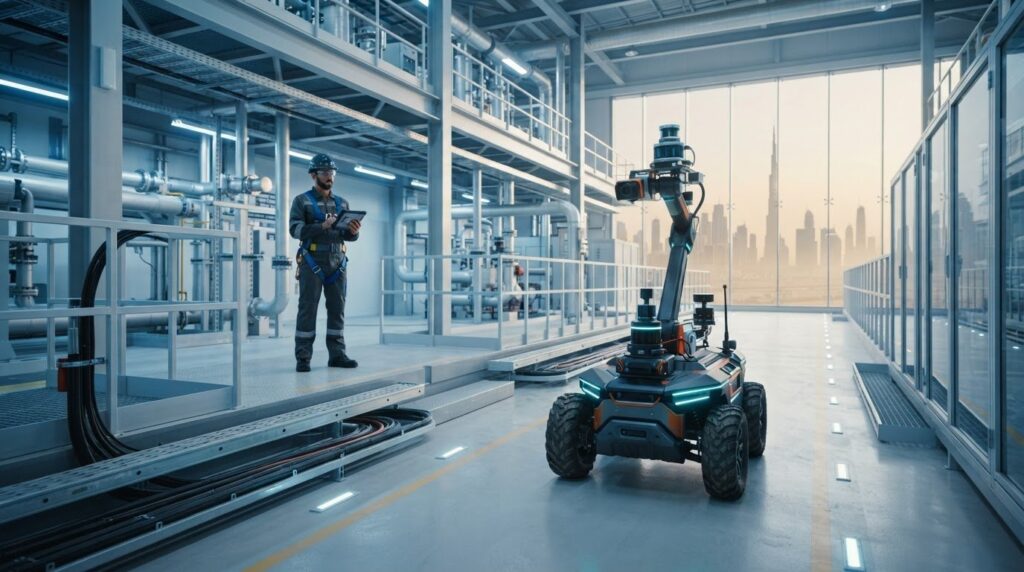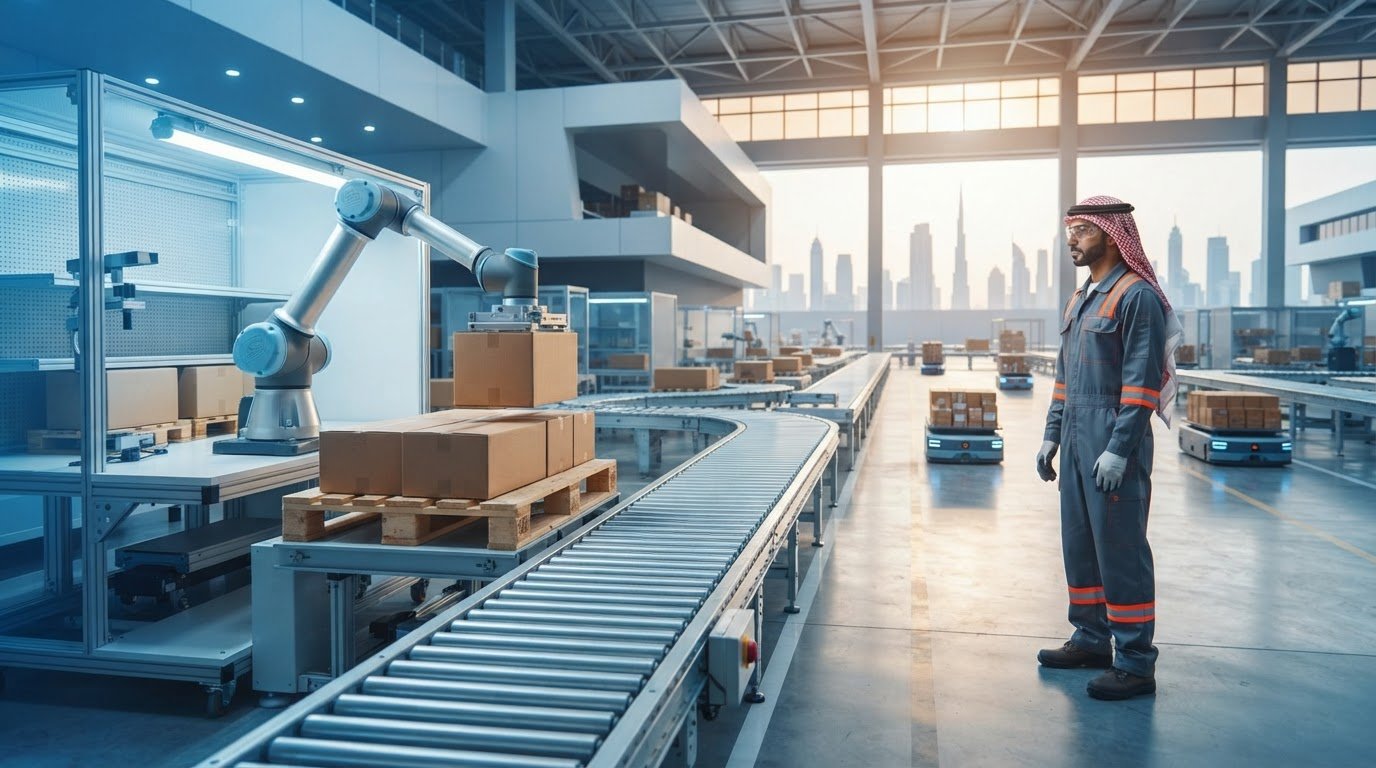
What if the safest way to handle a load is to redesign the task rather than ask a worker to lift it more carefully? Repeated lifting, carrying, bending, reaching, and handling can place workers under avoidable physical strain. The ergonomic benefits of robotic material handling come from reducing exposure to these demands, but automation helps only when it fits the work as it is actually done.
Robots do not automatically remove ergonomic risk. A system may reduce heavy lifts while introducing new demands around machine interaction, jam clearing, or maintenance. The design needs to account for people, tasks, and material flow together.
This guide explains how to identify high-strain handling tasks that may suit automation and how collaborative robots, autonomous mobile robots, and automated storage and retrieval systems can change workers’ roles. It also covers ways to compare tasks before and after implementation, practical ergonomic assessment methods, and new risks in human-robot workflows. A structured assessment helps decision-makers evaluate whether robotic handling is a meaningful ergonomic improvement for their operation.
Key Takeaways
- The ergonomic benefits of robotic material handling depend on which physical demands the system removes and how the remaining work is redesigned.
- Match the automation approach to the movement pattern: robotic arms handle defined transfers, AMRs move materials between locations, and ASRS automates storage and retrieval.
- Assess the full workflow, including loading, unloading, replenishment, exception handling, and maintenance, to identify where physical demands remain.
- Build a useful before-and-after comparison by recording task frequency, load characteristics, reach, posture, walking, and worker-reported difficulty.
- Use task demands, human interaction, material flow, and operational constraints to shape a system that supports workers without overlooking new risks.
What Ergonomic Benefits Can Robotic Material Handling Deliver?
Ergonomic material handling means designing tasks, workstations, and equipment around people’s capabilities and the demands of the job. The goal is to limit unnecessary physical exposure while keeping work flowing effectively. Robotic material handling uses automated equipment to take on selected demanding movements, reducing workers’ exposure to high-force, repetitive, or awkward handling tasks.
Industrial robots are part of the broader category of material-handling equipment. Task requirements help determine whether mechanised positioning is appropriate. Automation does not remove every physical demand or guarantee that discomfort and injuries will disappear. It changes how work is performed. The ergonomic benefits of robotic material handling depend on which tasks are automated and what workers still need to do around the system.
Which physical demands can robotic handling reduce?
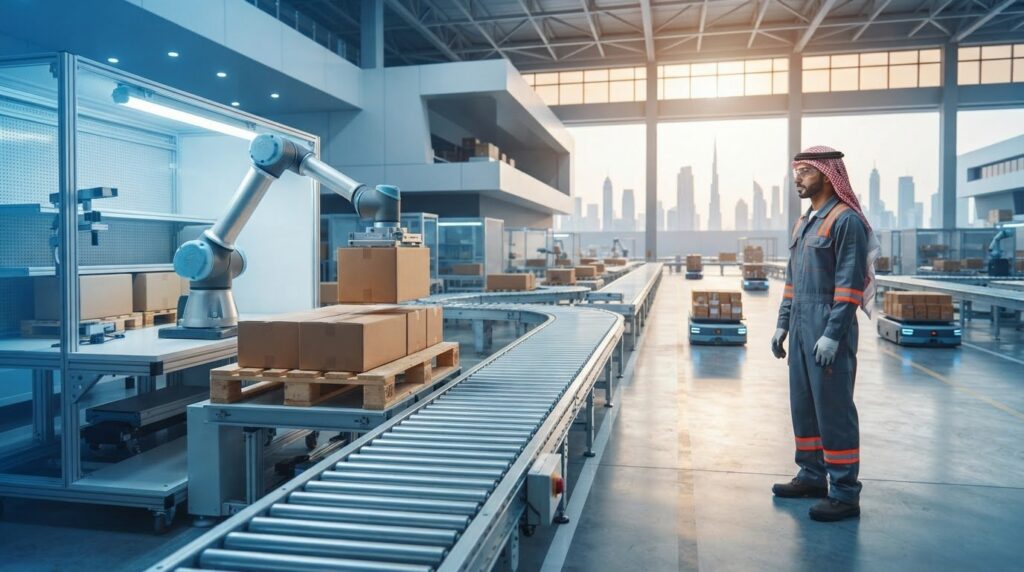
Repeated lifting and lowering, carrying loads between work areas, and transferring items from one position to another are all potential automation targets. A robotic arm may perform a defined pick-and-place movement, while an autonomous mobile robot can transport materials along a route. These systems are most relevant when they take over movements workers would otherwise repeat throughout a shift.
Look beyond the load itself. Repeated bending to reach low containers, twisting while transferring items, reaching across a workstation, and exerting force to move materials can all add physical demands. The exposure created by a task depends on its frequency, load characteristics, cycle, workstation layout, and place in the wider workflow. A robot that handles one lift may leave frequent manual repositioning or other strenuous movements unchanged.
Why task design matters as much as robot capability
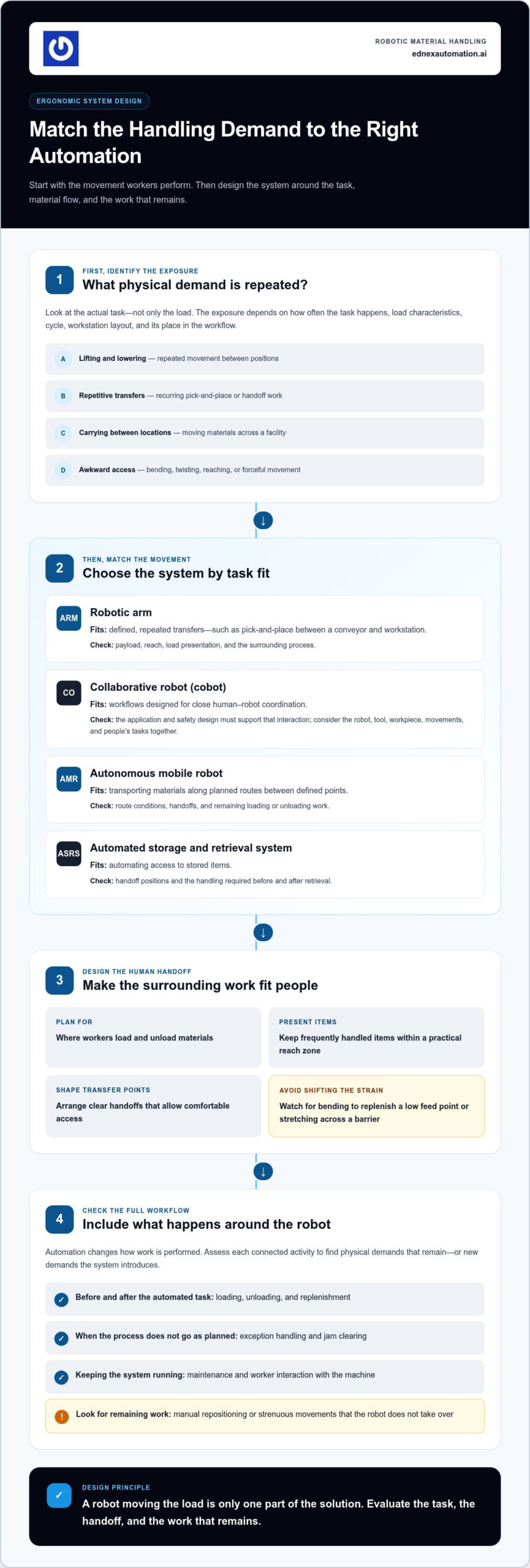
A robot’s ability to move an item is only one part of the design. Consider where workers load and unload materials, how items are presented, and whether handoff points allow comfortable access. Keep frequently handled items within a practical reach zone, and arrange clear transfer points to avoid replacing one awkward movement with another.
A poorly planned layout may preserve the postures automation was intended to address. For example, workers may still need to bend to replenish a low feed point or stretch across a barrier to retrieve completed items. In those cases, the system may shift exposure rather than eliminate it. Evaluate the actual task and workflow, including the human activities surrounding the robot, before deciding whether a proposed design reduces physical demands.
How Robotic Material Handling Changes Lifting, Repetition, and Movement
Different handling demands call for different automation approaches. A fixed robotic arm may take over a repeated transfer at a workstation, while an autonomous mobile robot (AMR) can move materials between operational points. An automated storage and retrieval system (ASRS) can automate access to stored items. The ergonomic benefits of robotic material handling depend on matching the system to the physical demand, not simply selecting a robot that can move the load.
- Lifting and lowering: A robotic arm can handle repeated pick-and-place movements between defined positions, reducing workers’ direct involvement in those transfers. Payload, reach, load presentation, and the surrounding process all affect whether the application fits.
- Repetitive transfers: Fixed arms can perform repeated transfers along a consistent path. Cobots may support tasks designed for human-robot collaboration when the application and safety design support that interaction.
- Long-distance movement: AMRs can transport materials along planned routes between defined points, potentially reducing how often workers carry items across a facility. Route conditions, handoffs, and remaining loading or unloading work matter.
- Awkward access and storage: ASRS can automate storage and retrieval activities, changing how workers access inventory. The effect on posture depends on the system’s handoff positions and the work required to handle items before and after retrieval.
Robotic arms and cobots for repetitive transfers
For a repeated transfer between a conveyor and a workstation, a fixed robotic arm may perform the movement while an operator handles other parts of the process. A cobot may suit a workflow that requires close human-robot coordination. Collaborative design does not remove the need to assess hazards: the robot, tool, workpiece, movements, and people’s tasks need to be considered together. OSHA’s overview describes robots as useful for repetitive and other demanding tasks; its guidance on robotics is a U.S. reference, not UAE regulatory guidance.
AMRs and ASRS for movement and storage tasks
An AMR may reduce repeated carrying between a production area and a staging point, but workers may still need to load, unload, replenish, or resolve exceptions. An ASRS can automate storage and retrieval, while the ergonomic result depends on how items are presented for the next task. Learn more about autonomous mobile robots and automated storage and retrieval systems.
Automation changes the human task; it does not simply remove work. Workers may shift from carrying or transferring items to loading, monitoring, replenishing, or handling exceptions. Before selecting an approach, evaluate payload, reach, route, handoff points, and the full workflow. EdNex Automation supplies and integrates robotic and industrial automation solutions across the UAE, including AMRs and ASRS.
Manual vs Robotic Material Handling: Where Ergonomic Gains, and Risks, Differ
Automation can reduce a specific physical demand, but it does not guarantee a less demanding workflow overall. A robot may handle a transfer while workers still lift materials to feed the system, retrieve completed items, replenish supplies, or clear exceptions. The ergonomic benefits of robotic material handling depend on how every stage is designed, including the work that remains around the equipment.
| Task | Manual exposure | Possible robotic contribution | Remaining human activity |
|---|---|---|---|
| Loading | Lifting, reaching, or positioning items at a workstation | Present or transfer materials through an automated process | Prepare loads, replenish inputs, and manage handoffs |
| Repeated transfers | Frequent lifting, lowering, and handling between points | Perform consistent pick-and-place or transfer movements | Monitor the process and conduct quality checks |
| Movement between areas | Carrying materials and walking repeated routes | Transport items between operational points | Load, unload, and respond to delivery exceptions |
| Storage and retrieval | Reaching, bending, or handling items at storage locations | Automate selected storage and retrieval steps | Handle items at the system interface and replenish stock |
| Maintenance and recovery | Manual intervention may involve difficult access or force | Automation may reduce routine handling but can create new intervention points | Inspect, maintain, and resolve faults using the planned procedures |
How to spot risk transfer in an automated workflow
Follow the material from input to output. Check whether workers still bend or reach awkwardly to load equipment or unload completed items. Consider what happens when a load is misaligned, a route is blocked, or a process stops. Exception recovery can bring unplanned lifting, rushed movements, or difficult access back into the task. Review visibility, walking routes, control access, and maintenance positions with the workers who use the system. NIOSH discusses how robotics can support worker well-being in its guidance on occupational robotics.
How human-robot collaboration affects task design
In a shared workflow, people may supervise operations, replenish materials, check quality, or resolve exceptions while a robot performs selected handling movements. Set the system’s speed and handoff rhythm to suit the actual task, so workers are not pushed into hurried loading or repeated interruptions. A collaborative robot still requires suitable task and safety design. Consider how cobots fit into the specific human-robot workflow rather than assuming proximity alone makes a task collaborative or safe.
Avoid assuming that robotic handling automatically removes ergonomic risk. It can support better task design, but the outcome depends on the full system: equipment, workflow, human roles, and the points where people interact with the process.
How to Evaluate Ergonomic Benefits Before and After Automation
Assess the task before choosing the technology. A baseline makes it possible to compare the work people did before automation with the work they do afterward, including duties that remain or shift to new points in the process. This gives decision-makers evidence to guide adjustments rather than relying on assumed ergonomic benefits.
A site-level ergonomic assessment measures exposure in a specific workflow. Broad industry injury statistics describe wider patterns and cannot prove that a particular automation project improved conditions.
Map the handling task and establish a baseline
Start by tracing the material from its starting point to its destination. Include routine steps, handoffs, replenishment, exceptions, and supporting activities. Observe the process under representative operating conditions, and involve the workers who perform or supervise it. Their feedback can reveal difficult movements or interruptions that a process diagram may miss.
- Map tasks: Break the process into distinct actions and handoffs before deciding which steps automation might address.
- Record baseline exposure: Document task frequency, load characteristics, reach, posture, walking, and worker-reported difficulty. Note when and where each demand occurs.
- Choose a suitable assessment method: Tools such as the Revised NIOSH Lifting Equation, REBA, or RULA may help assess particular manual tasks when their scope fits. Verify the appropriate method and current guidance before applying it.
- Design the workflow: Use the baseline to plan equipment, handoff points, and human roles together, then identify what measures will be reviewed after deployment.
Keep the observation method consistent. Compare the same handling stages and record the same factors under similar operating conditions. Operational records can help describe task frequency or exception patterns, while worker feedback adds context about effort, access, and interruptions.
Review the redesigned workflow after deployment
After implementation, revisit the original task map. Compare the same stages and measures, then check whether workers’ duties have changed at loading, unloading, replenishment, exception handling, and maintenance points. Ask whether access, posture, walking, or perceived difficulty has shifted, and document any remaining manual work. If the system creates new awkward interactions, record them and plan follow-up adjustments.
Interpret results carefully. A change observed after deployment does not, by itself, establish that automation caused it. Note other process changes and limitations in the assessment. This disciplined approach helps determine whether the ergonomic benefits of robotic material handling are evident in the actual workflow and where further refinement may be needed.
EdNex Automation supplies and integrates robotics and industrial automation systems. Explore EdNex Automation’s solutions for handling workflows.
Designing an Ergonomic Robotic Material Handling Solution
A suitable system starts with the handling problem, not a preferred robot. Identify the physical demand to address, the people who interact with the process, how materials move through the operation, and the constraints of the site. Configure the equipment and workflow together so that automation targets a defined task without creating avoidable strain at the next handoff.
Use the assessment findings to define what success should look like. That might mean changing how often workers lift an item, how far materials are carried, or how easily they can access a work point. These are project-specific objectives, not assumed results. The ergonomic benefits of robotic material handling depend on matching the automation approach to the task and reviewing the full workflow.
Match the automation approach to the task
Different handling patterns point toward different system options. A solution should account for the load and task cycle, the locations involved, worker interaction, and operating constraints such as space and material flow.
- Repetitive transfers: Assess whether a robotic-arm or cobot configuration fits the repeated movement and the way people load, receive, or oversee items.
- Recurring transport: Consider AMRs where materials regularly move between operational points. Plan routes and handoffs as part of the workflow, not as an isolated equipment choice.
- Storage and retrieval: Assess ASRS where automated access to stored materials aligns with inventory movement, replenishment, and downstream handling needs.
No single approach suits every operation. A process may need one technology or a coordinated combination, depending on the task and site layout.
Plan an integrated, worker-aware deployment
Robotics deployment involves more than placing equipment at a workstation. Plan how the system connects to existing processes, where materials pass between people and machines, and how operators, replenishment staff, and maintenance teams will interact with it. Define operating roles and consider access and safety during both normal work and exception handling.
Where project requirements call for it, PLC and SCADA integration can connect robotic equipment with industrial control systems. This helps coordinate interfaces and process signals within the wider operation while keeping the system design aligned with material flow and worker activities.
EdNex Automation supplies and integrates collaborative robots, AMRs, and ASRS for commercial and industrial operations across the UAE. The company also provides PLC and SCADA integration. Explore EdNex Automation solutions for information about its robotics and integration capabilities.
Turn Ergonomic Priorities Into a Practical Automation Plan
Robotic material handling can reduce exposure to selected high-force, repetitive, or awkward tasks, but the ergonomic benefits of robotic material handling depend on how the whole workflow is designed. Match the automation to the specific demand, then consider the human work that remains at loading, handoffs, replenishment, exception recovery, and maintenance.
A clear before-and-after assessment helps ground decisions in the operation: map tasks, document a baseline, and review the same measures after deployment. This makes it easier to identify improvements as well as new demands that may need attention.
For commercial and industrial operations across the UAE, EdNex Automation brings together collaborative robots, AMRs, and ASRS, supported by PLC and SCADA integration. Consider equipment, controls, people, and material flow together when shaping a solution around real working conditions.
Explore EdNex Automation solutions to discuss a worker-aware automation plan for your material handling needs. With the right assessment and system design, ergonomic improvement can become part of a more resilient operation.
Frequently Asked Questions
What are the ergonomic benefits of robotic material handling?
Robotic material handling can reduce workers’ exposure to selected high-force, repetitive, or awkward tasks. For example, a robotic arm may perform repeated transfers, while an autonomous mobile robot can move materials between operational points. The benefit depends on the complete workflow: loading, unloading, replenishment, and exception handling may still involve physical demands. Assess the task before and after automation rather than assuming the equipment will improve ergonomics by itself.
Can robotic material handling prevent workplace injuries?
Robotic material handling may help reduce exposure to some physical demands associated with injury risk, but it cannot guarantee that injuries will be prevented. Workers may still handle loads, reach into equipment, or respond to process interruptions, and automation can introduce new interaction or maintenance hazards. Assess the full system, including normal operation and exception recovery, then monitor worker feedback and task conditions to identify whether exposure has changed.
Which material handling tasks are most suitable for robotic automation?
Tasks with frequent, consistent transfers, repeated lifting or lowering, or recurring transport between defined points may be suitable for assessment. A robotic arm or cobot can be considered for repeatable pick-and-place work, AMRs for material movement, and ASRS for storage and retrieval activities. Suitability depends on factors such as the load, cycle, reach, route, workstation, and handoffs, so evaluate the whole process rather than one movement in isolation.
How do robots reduce repetitive strain in material handling?
Robots can take over selected movements that workers would otherwise repeat, such as transferring items between a conveyor and a workstation or transporting materials along a recurring route. This may reduce the frequency of particular handling actions. However, workers might still load or unload the system, replenish inputs, or resolve exceptions. Review those remaining duties to see whether repetition has actually decreased or simply shifted to another task.
Do collaborative robots make material handling safer for workers?
Collaborative robots can support workflows in which people and robots work in proximity, but the “collaborative” label alone does not establish that a task is safe. Safety depends on the robot, end-of-arm tooling, workpiece, movements, layout, and worker roles. Assess the specific application and plan how people load, supervise, and respond to exceptions. A suitable risk assessment remains important even when a cobot is intended for collaborative use.
How can a company measure ergonomic improvements after automation?
Establish a baseline before deployment, then compare the same task stages afterward. Record task frequency, load characteristics, reach, posture, walking, and worker-reported difficulty, and use consistent observation methods. Review operational records and feedback alongside the measurements, including exception handling and maintenance activities. Document limitations and any workflow changes. This site-level comparison can show how exposure has changed, but it should not claim that automation caused an outcome without supporting evidence.
Can robotic material handling eliminate manual work entirely?
Usually, automation changes the work rather than removing every human task. People may continue to prepare and load materials, unload outputs, replenish supplies, check quality, monitor operations, maintain equipment, or handle exceptions. These responsibilities can carry their own physical demands, particularly if handoff points or access are poorly designed. Map the full process to identify which movements automation takes over and what work remains for employees.