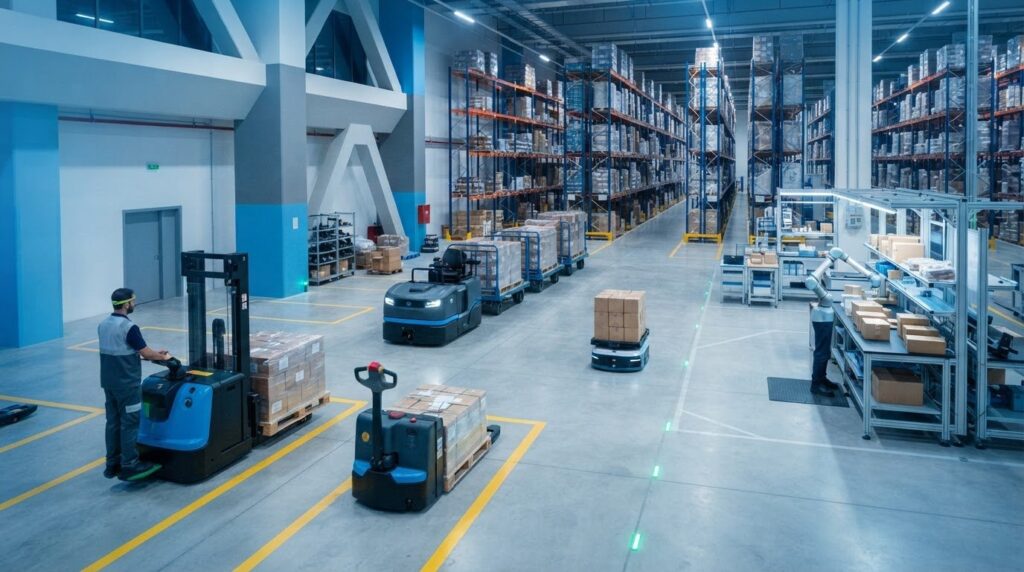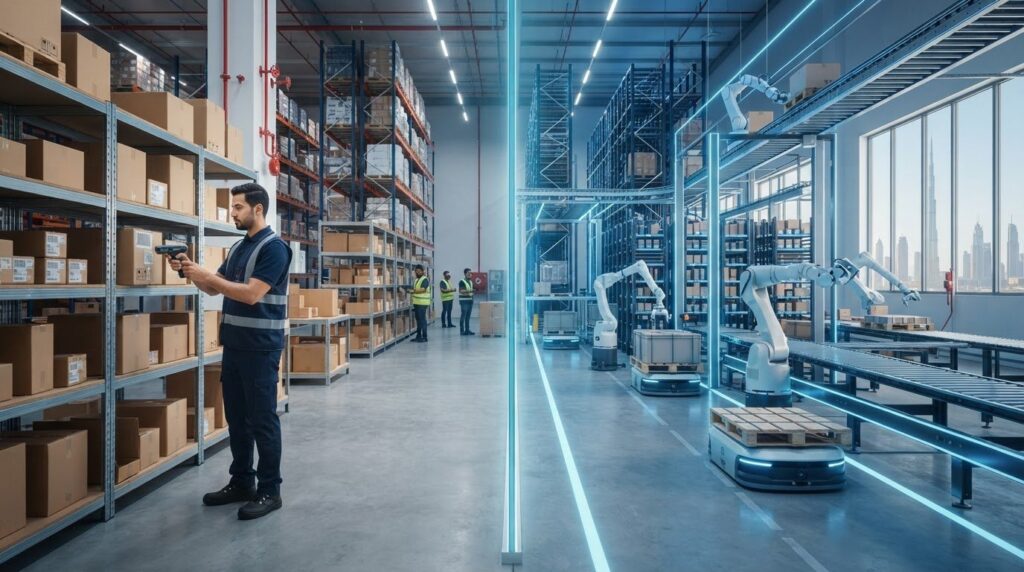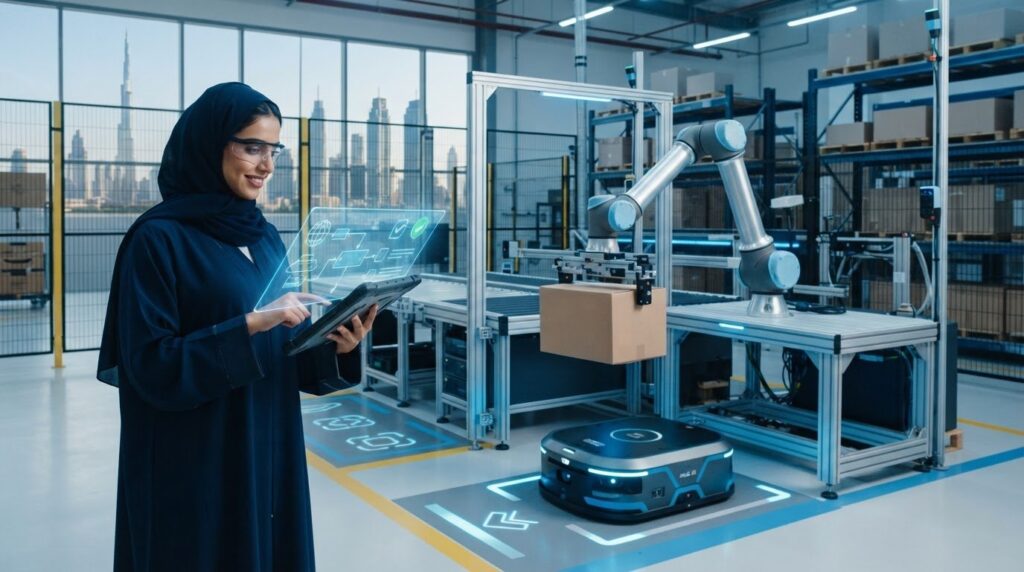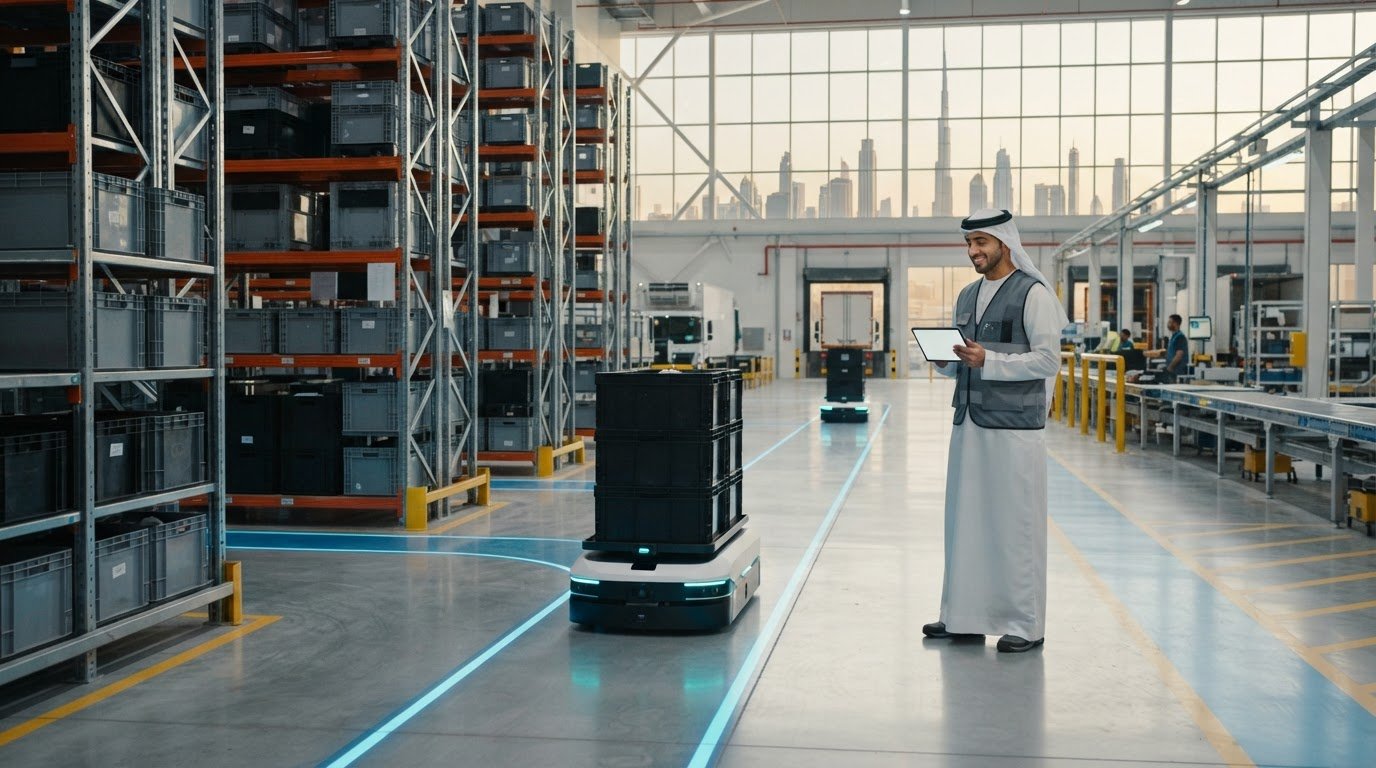
For teams searching for advanced automation solutions, the best first step isn’t choosing a robot. It’s examining the work the robot needs to do. Across the UAE, recurring transport tasks may be suitable for automation, but only when the workflow, facility, and supporting systems are ready to work together.
Start by assessing whether your operation has enough repeatable movement to justify mobile automation, and how systems would interact with employees, traffic, existing processes, and control architectures. Selecting equipment before answering these questions can leave important integration needs unresolved.
This guide explains how to assess AMR fit across commercial and industrial operations in the UAE, identify workflows where mobile robots may contribute, and evaluate the facility conditions and system connections that shape a project. It also compares AMRs with fixed-route AGVs and outlines practical next steps for an evaluation. EdNex Automation supplies and integrates AMRs, connecting robot capabilities with operational requirements and relevant automation systems, including PLC and SCADA integration.
Key Takeaways
- Start with recurring transport tasks between operational points to identify where mobile automation could address a practical workflow need.
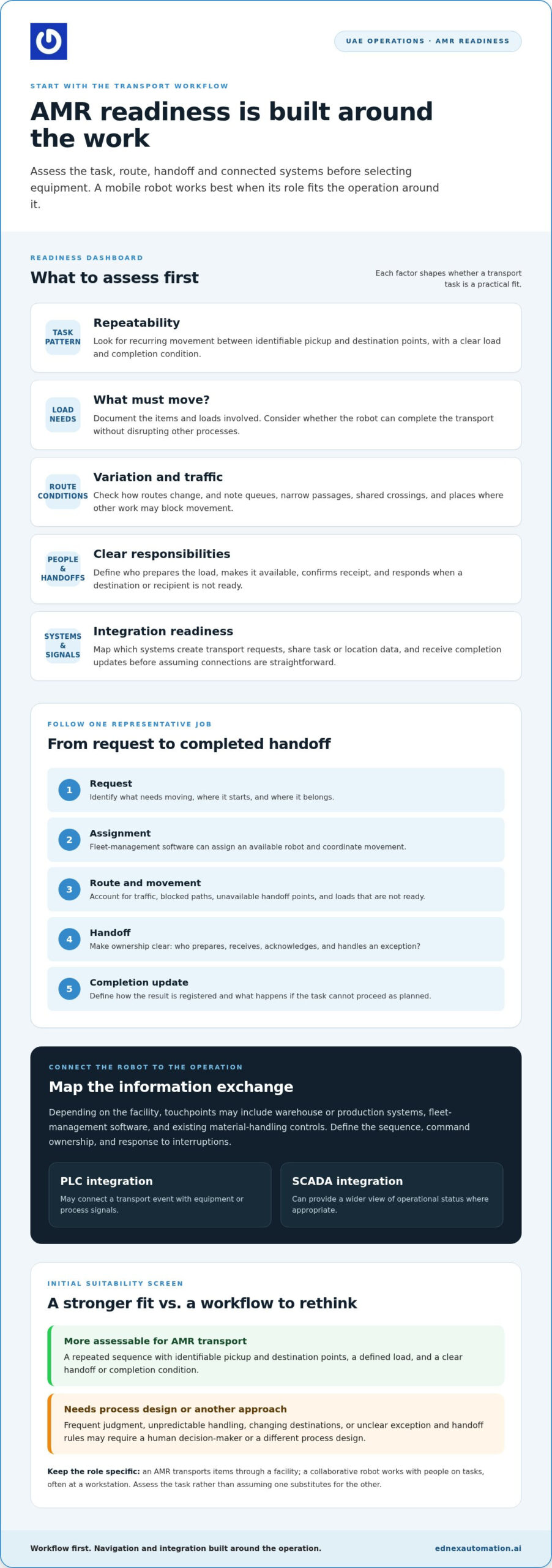
- Trace each task from request to handoff, noting how routing, traffic, people, and system connections shape the robot’s role.
- Compare AMRs and AGVs against route variability, task repetition, handoff complexity, and human interaction rather than assuming one option fits every operation.
- Assess an AMR project across the UAE by documenting task frequency, loads, operating hours, route conditions, and exceptions before defining a pilot.
- Connect robot selection to facility constraints, control-system interfaces, and clear pilot measures when planning an integrated AMR solution with EdNex Automation.
What autonomous mobile robots can do for UAE operations
An autonomous mobile robot (AMR) navigates a work environment to carry out assigned transport tasks. In commercial and industrial facilities across the UAE, that may mean moving materials between storage, production, staging, and handoff points. Rather than starting with a robot model, identify where people or existing equipment repeatedly move items and what the process requires.
An AMR project is not simply the purchase of a standalone robot. It is the design of a transport workflow in which the robot, people, handoffs, and connected systems work together.
Suitability depends on the work pattern. Assess how often a task occurs, what loads need to move, how routes change during operations, and whether the robot can complete the transport without disrupting other processes. The specific workflow matters more than a general expectation that automation will improve every movement.
Which recurring workflows may suit an AMR?
Look for repeated transport between identifiable points: delivering components from storage to a production station, moving finished items to a staging location, or replenishing supplies at a defined handoff. These tasks are easier to assess when the pickup point, destination, load, and completion condition are clear.
Work involving frequent judgment, unpredictable handling, or changing destinations may need a human decision-maker or a different process design. As an initial screen, ask whether the task follows a repeatable sequence, even if its route or timing varies. Sector labels alone are not enough: two facilities in the same industry can have different material flows, traffic patterns, and handoff requirements.
AMRs in the wider automation landscape
Mobile robots can complement employees, fixed automation, and established material-handling processes by taking on suitable transport steps. This can leave people to focus on tasks that call for judgment or hands-on work. Define the AMR’s role around a process need, such as connecting storage with a production line, rather than adding equipment without a clear operational purpose.
AMRs differ from collaborative robots, or cobots. An AMR moves through a facility to transport items; a cobot is designed to perform tasks in collaboration with people, often at a workstation. They may support different parts of an operation, but neither should be treated as a substitute for the other without examining the task.
For a broader explanation of autonomy and industrial use cases, see this autonomous mobile robots guide. The foundational concept of an Autonomous robot helps frame the technology, but a practical AMR decision still comes down to the transport process, its constraints, and its fit with the wider operation.
How AMR projects connect workflows, navigation, and facility systems
An AMR transport task is a chain of connected decisions, not just a trip from one point to another. A request must identify what needs moving and where it belongs. Fleet-management software can then assign an available robot, coordinate its movement, and register the result. The workflow determines what information passes between each stage and who responds if the task cannot proceed as planned.
AMR performance depends on aligning workflow and system integration with navigation. Task instructions, facility conditions, and handoffs all need to work together.
From transport request to completed handoff
Trace one representative job from initiation to completion. A request might arise when a production process needs replenishment or a staging point signals that an item is ready to move. The request needs a defined pickup point, destination, load information, and a clear completion condition. Depending on the process, an operator or connected system may initiate it.
Next, examine the physical route and its decision points. Mark queues, narrow passages, shared crossings, pickup and drop-off areas, and places where other work could block movement. Define how the robot should respond to interruptions, unavailable handoff points, or a load that isn’t ready. These are workflow design questions, not minor exceptions: unclear rules can leave tasks waiting or shift unplanned work to staff.
Make handoff ownership explicit. Decide who prepares the load, who makes it available, how receipt is acknowledged, and what happens if the recipient or destination isn’t ready. Clear responsibilities help employees and the robot follow a predictable process, particularly where several teams share a route.
Connecting AMRs with existing automation
Integration planning identifies which systems create transport requests, provide location or task data, and receive completion updates. Depending on the facility, touchpoints may include warehouse or production systems, fleet-management software, and existing material-handling controls. Map the information exchange before assuming a connection is straightforward.
In an industrial process, PLC integration may connect a transport event with equipment or process signals, while SCADA can provide a wider view of operational status where appropriate. These links can coordinate a movement with a production or handling step, but the sequence, command ownership, and response to interruptions need to be defined. EdNex Automation integrates AMRs with relevant automation capabilities, including PLC and SCADA integration, around operational requirements.
For teams researching “autonomous mobile robots Dubai,” documenting system exchanges early can clarify how a fleet may fit into existing operations. Map one complete task, including its request, route, handoff, system messages, and exception path. This gives an integration discussion a concrete foundation. Explore PLC and SCADA integration in relation to connected industrial workflows, or discuss AMR integration with EdNex Automation’s robotics team.
AMRs, AGVs, and other automation: compare options by task
Choose a transport method by examining how work moves through the facility, not by starting with a technology label. An AMR may suit workflows where routes or destinations vary, while an automated guided vehicle (AGV) may fit a repeatable route in a stable environment. These are broad distinctions, not guarantees: navigation methods, controls, and deployment designs vary between systems.
Use these task factors to structure an initial comparison:
- Route variability: Consider whether journeys follow a consistent path or change with production needs, obstructions, or destination. AMRs are commonly associated with dynamic navigation, while AGVs often follow defined routes. Actual capabilities depend on the system and its design.
- Task repetition: Record how consistently the transport task recurs and whether its origin, destination, and load are predictable. A repeatable, high-volume transfer may suit a fixed process, while varied requests may call for a more adaptable approach.
- Handoff complexity: Assess whether a load is simply collected and delivered or must be coordinated with equipment, staff, or another process. Complex handoffs need clear operating rules regardless of vehicle type.
- Human interaction: Map where employees share space with transport equipment and where people need to make decisions or handle materials. The required coordination shapes the workflow and technology assessment.
Manual movement can remain a sensible baseline if transport is infrequent, routes are short, or the task changes too much to define a stable process. Assess fixed automation where the layout and transfer pattern remain consistent. Neither approach should be dismissed simply because a newer option is available. Compare alternatives against the same task requirements and facility conditions rather than headline features.
When an AMR may fit better than an AGV
An AMR may be a candidate when transport needs to respond to changing routes or destinations, while an AGV may suit a more predictable route. The distinction isn’t absolute: navigation methods and operating requirements differ by system. Compare the route, traffic, pickup points, and expected changes at the site. This AMR versus AGV comparison can help frame the options.
When another automation approach may be more appropriate
For stable layouts and repeated high-volume transfers, assess fixed-route automation alongside AMRs. Keep the task itself in view: a collaborative robot works with people on a task, while an AMR transports items through a facility. A manual process may also remain appropriate where movement is limited or variable handling dominates. Site conditions and operational requirements should guide the choice.
Assess AMR readiness before planning a deployment
A structured readiness review turns a broad automation idea into a project that can be assessed against real operating conditions. For teams considering autonomous mobile robots Dubai, begin with the movement task and gather site information before defining a pilot or selecting a system.
- Choose one workflow. Identify a recurring transport process with a clear operational purpose, such as moving materials between a supply point and a production area. Define what starts the task and what counts as completion.
- Document the routes. Record origins, destinations, travel paths, access points, shared zones, crossings, queues, and areas where congestion could arise. Note route conditions during the hours the task would run.
- Map the handoffs. Specify who prepares and receives each load, where it is placed, and how staff or systems signal that a pickup or delivery is ready. Include what should happen when a destination is blocked or an item is unavailable.
- Assess interfaces and requirements. Identify any warehouse, production, fleet-management, PLC, or SCADA systems involved, along with the information they may need to exchange. Verify facility safety considerations and applicable UAE requirements for the specific site and use case.
- Define a pilot. Set a bounded scope, assign operational ownership, establish a baseline, and choose measures that reflect the task. Specify how staff feedback, exceptions, and interface performance will inform the next decision.
What to document about the facility and workflow
Build a practical site record rather than relying on a floor plan alone. Describe the materials and loads, their origin and destination, task frequency, operating hours, timing expectations, and process variations. On the facility map, mark access points, shared travel zones, handoff locations, and potential congestion areas. Record relevant environmental and operating conditions for engineering assessment, and capture exceptions such as a blocked route or an unavailable drop-off point.
These details help distinguish a route that works in normal conditions from one that becomes difficult during a shift change, peak activity, or process interruption. They also give operations, facilities, safety, and technical teams a shared basis for reviewing the proposed movement. Verify site-specific safety and regulatory considerations for the intended application rather than relying on a general checklist.
How to frame a practical AMR pilot
Choose a contained workflow with clear start and end points, an accountable owner, and observable measures. First document the current process as a baseline. Depending on the task, useful measures might include completed transfers, waiting points, task interruptions, or staff time spent coordinating movement. Select measures that are relevant to the operation, and avoid assuming benefits before results are available.
During the pilot, capture staff feedback alongside route exceptions and system-interface issues. Review what changed, what caused delays, and whether handoffs worked as designed. These findings can guide the next stage of an integrated AMR project. Explore EdNex Automation solutions to connect your workflow and readiness findings with an AMR project plan.
Plan an integrated AMR solution with EdNex Automation
Once you have assessed a transport workflow, turn its requirements into an integrated project scope. EdNex Automation supplies and integrates autonomous mobile robots for commercial and industrial operations across the UAE, connecting each robot with the task it must perform and the systems that support the process. Consider more than movement: load handling, pickup and delivery points, route conditions, handoff responsibilities, operational interfaces, and pilot measures all inform the solution.
For businesses researching “autonomous mobile robots Dubai,” a project-specific approach connects operational priorities with technical decisions. A documented workflow can guide robot selection, while facility constraints shape route planning and system interfaces determine how transport requests and completion updates fit into existing operations. The objective is a coherent design, not a standalone machine added to an undefined process.
From operational assessment to an integrated solution
EdNex approaches AMR planning by relating the intended task to the facility and its automation environment. Project scope can account for route conditions, load requirements, handoff design, operating patterns, and relevant system connections. Where the workflow calls for it, PLC and SCADA integration can connect mobile transport with industrial controls. ASRS capabilities may also be relevant when automated storage is part of the material flow.
Consider these components in relation to one another. A transport request may need to align with a production event or storage handoff, while pilot measures should reflect the operational result the project is intended to assess. Mapping dependencies early helps teams define interfaces, responsibilities, and assessment criteria without assuming a particular specification or outcome in advance.
Define the next step for your AMR project
Bring the assessment into a focused project discussion by outlining the target transport task, facility context, and desired operational outcome. Useful inputs include the current process, task frequency, material or load details, operating hours, mapped routes, handoff points, known exceptions, and any warehouse, production, fleet-management, PLC, or SCADA systems involved. A clear brief helps connect the operational challenge to a project-specific assessment and solution scope.
Use pilot findings to guide decisions about what happens next. Baseline measures, observed exceptions, employee feedback, and interface requirements can show whether the workflow is ready to progress and what needs refinement. This gives operations and technical teams a shared basis for evaluating the proposed design, rather than relying on broad expectations about automation.
EdNex Automation brings AMR supply and integration together with relevant industrial automation capabilities to support commercial and industrial projects across the UAE. If your team has identified a recurring transport challenge, discuss your AMR project with EdNex Automation and outline the workflow, facility conditions, and goals you want the solution to address.
Turn your AMR assessment into a practical next step
The strongest automation projects begin with a focused operational question: what movement should change, and how will your team know whether the solution fits? Use that question to align decision-makers around a clear project scope, relevant site conditions, and outcomes worth measuring. This creates a sound basis for evaluating the requirements behind an AMR project without letting technology choices outrun the operational case.
For the next step, bring your target workflow and facility context into a project discussion. EdNex Automation connects AMRs with relevant robotics and industrial systems, drawing on PLC and SCADA integration and ASRS capabilities where they fit the requirement. Its work supports commercial and industrial operations across the UAE, with integration shaped around the project rather than a one-size-fits-all approach.
Discuss an AMR project with EdNex Automation and move from an initial transport challenge toward a defined, integrated solution. A clear first workflow can be the starting point for more deliberate automation planning.
Frequently Asked Questions
Can AMRs operate in facilities with existing Wi-Fi?
Possibly, but existing Wi-Fi coverage alone doesn’t confirm that a particular AMR system is compatible. Connectivity needs depend on the selected robot, fleet-management design, coverage quality, and facility conditions. Assess signal strength across the full operating area, including storage aisles, loading zones, and potential dead zones. Map where the robot needs to exchange information, then include those findings in system planning.
Can autonomous mobile robots use elevators or automatic doors?
Some systems may support these movements when suitable equipment and coordinated interfaces are part of the design, but don’t assume every robot can use every elevator or door. Planning should cover access-control permissions, communication between the robot and building systems, safety procedures, and how a journey resumes if access is delayed. Feasibility depends on the specific facility and system design, so test the complete movement sequence on site.
Do AMRs need a dedicated route through a warehouse?
Not necessarily. Route requirements depend on the robot’s navigation approach, facility layout, traffic rules, and intended operation. Some deployments may use defined travel areas, while others may use different routing arrangements. Map shared work zones, crossings, temporary obstructions, and pickup or delivery points. Then validate the intended movements in the actual facility rather than assuming every AMR needs marked lanes or can navigate every environment.
Can AMRs work alongside employees on the same shift?
They can be planned for shared operation, but working alongside people isn’t an automatic guarantee of safety. The project should define traffic rules, handoff responsibilities, staff orientation, and how employees report or respond to unexpected situations. Assess the actual work area, including visibility, crossing points, and nearby tasks, then verify applicable safety requirements for the specific project. Clear procedures help staff understand where the robot operates and how its movements fit into daily work.
Can one AMR fleet serve more than one workflow?
Potentially, depending on the tasks, robot configuration, fleet-management capabilities, scheduling, and operational priorities. A team might compare two workflows that use similar pickup points or handoff processes, then identify where their requirements differ. Consider whether competing requests could affect task allocation and which workflow takes priority during busy periods. Assess shared requirements before designing the fleet rather than assuming one configuration can handle every load, route, or transport task.
Are AMRs suitable for outdoor operation?
Suitability depends on the equipment and operating environment. Indoor material movement and outdoor inspection or security tasks can involve different requirements. Surface conditions, weather exposure, route changes, and robot design all affect whether outdoor use is appropriate. EdNex Automation’s broader robotics portfolio includes outdoor cleaning, inspection, and surveillance robots, but this doesn’t mean every AMR is designed for outdoor operation. Assess the specific route and equipment for the intended application.
How should a business measure an AMR pilot?
Choose measures that reflect the workflow being tested, such as completed tasks, successful handoffs, route-related exceptions, or staff time spent coordinating transport. Record the current process first so pilot observations have a meaningful baseline. Decide how each measure will be collected, who will review it, and how interruptions or incomplete tasks will be logged. Use the evidence to guide next steps; don’t assume a specific productivity gain or return before project results are available.