A larger AMR fleet doesn’t automatically create a more reliable operation. Without clear coordination, robot traffic, stalled tasks, and unresolved exceptions can disrupt the workflows automation is meant to support. AMR fleet management best practices start with the operation, not the robot count.
Robots need to work in step with people, warehouse or production processes, and the systems that direct work. If fleet activity isn’t connected to those workflows, teams may struggle to find bottlenecks, respond consistently to exceptions, or assess whether automation is delivering value.
This guide covers practical routines for coordinating a fleet, integrating AMRs with operational systems, and tracking measures such as task completion, downtime, utilisation, and empty travel. It also explains how to plan for safety, traffic management, and future growth. Treating deployment as an operational integration initiative, rather than simply a hardware purchase, creates a stronger foundation for reliable performance. EdNex Automation supplies and deploys AMRs, with integration expertise to help align the fleet with operational needs.
Key Takeaways
- Start with the material movement challenge and desired workflow outcome, then determine the fleet scope that fits.
- AMR fleet management best practices include defining clear responsibilities across business systems, fleet orchestration, and production operations.
- Use leading indicators to spot emerging bottlenecks, alongside outcome measures that show how well tasks are completed.
- Make operating-area reviews, issue handling, and improvement actions part of a consistent fleet routine.
- Scale through measured deployment phases, validating task flow and handoffs before expanding the fleet.
AMR fleet management best practices start with the operation, not the robot count
A fleet is more than a group of mobile robots. AMR fleet management coordinates robot tasks, movement, system interfaces, and performance so materials reach the right process at the right time. The term Autonomous Mobile Robot (AMR) describes a category of mobile robots used for tasks such as transporting materials. The right fleet plan depends on how those tasks fit the facility’s actual workflows.
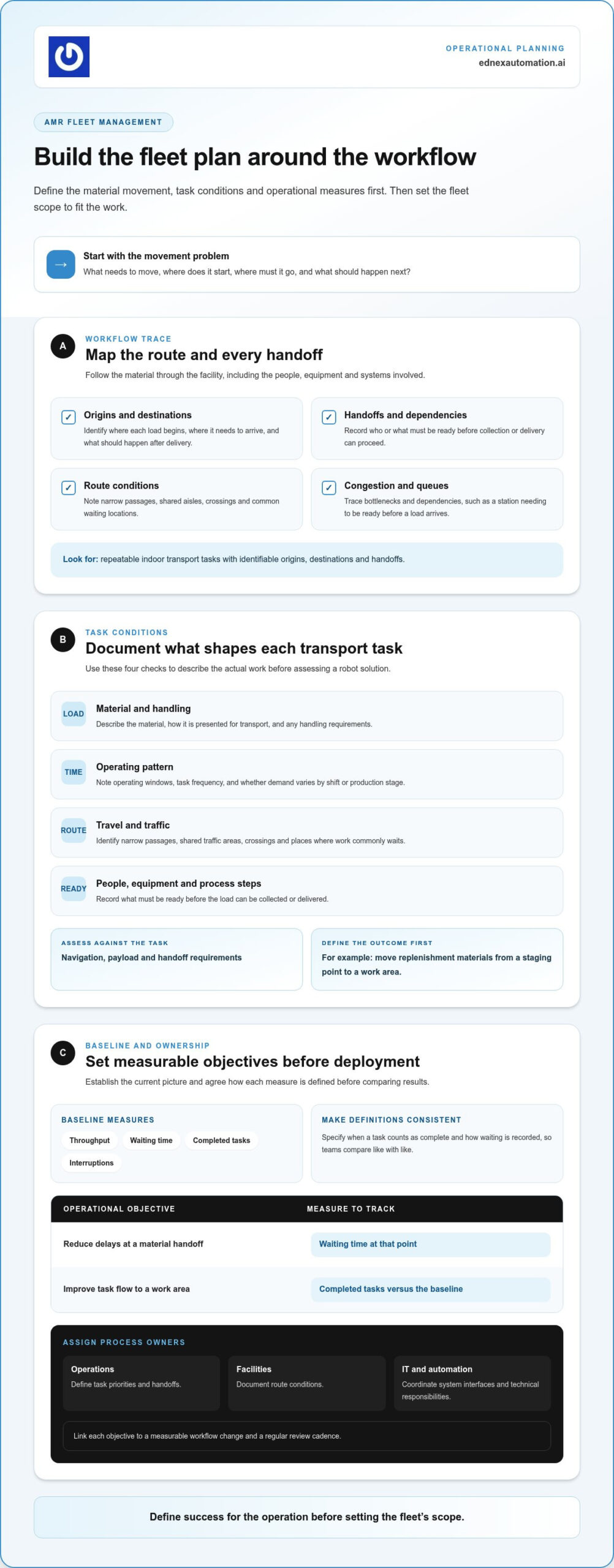
Start with the movement problem: what needs to move, from where, to which destination, and what should happen next? Map each handoff between people, equipment, and systems, then trace the material’s route. Note congestion points, shared aisles, queues, and dependencies, such as a station needing to be ready before a load arrives. This shows where automation may improve flow and where a process change could be needed first.
Set objectives from that map, not from an assumed robot quantity. Fleet performance depends on process fit as well as robot capability. A deployment can be technically capable yet operationally misaligned if task timing, handoffs, or routes don’t match how the facility works.
Which workflows are suitable for AMR fleet management?
Look first at repeatable indoor transport tasks with identifiable origins, destinations, and handoffs. Before choosing a robot solution, document the conditions that shape each task:
- Load: Describe the material, how it is presented for transport, and any handling requirements.
- Timing: Note operating windows, task frequency, and whether demand varies by shift or production stage.
- Route: Identify narrow passages, shared traffic areas, crossings, and locations where work commonly waits.
- Dependencies: Record the people, equipment, or process steps that must be ready before collection or delivery.
Define the required workflow outcome before assuming what a robot can do. For example, describe the need as moving replenishment materials between a staging point and a work area. Then assess the navigation, payload, and handoff requirements against the actual solution being considered.
Set operational objectives before deployment
Establish a baseline before changing the workflow. Measure current throughput, waiting time, completed tasks, and interruptions using consistent definitions. For example, specify when a task counts as complete and how waiting is recorded. Otherwise, teams may compare data that describes different things.
Assign process owners across operations, facilities, IT, and automation. Operations can define task priorities and handoffs, facilities can document route conditions, and IT and automation teams can coordinate system interfaces and technical responsibilities. Link each objective to a measurable workflow change and a regular review cadence.
- Objective: Reduce delays at a material handoff. Measure: Track waiting time at that point.
- Objective: Improve task flow to a work area. Measure: Compare completed tasks with the established baseline.
These AMR fleet management best practices give teams a decision-ready foundation: define success for the operation before setting the fleet’s scope.
Build an AMR fleet architecture that coordinates traffic and facility systems
A reliable architecture gives each system a defined role. The warehouse management system (WMS), warehouse control system (WCS), manufacturing execution system (MES), fleet manager, and material-flow controls may all contribute to a transport request, but they shouldn’t issue conflicting instructions. Responsibilities vary by site, so document who owns each decision, data field, and response before connecting systems.
Map AMR fleet software to warehouse and production systems
Trace a representative movement request to expose gaps between systems. For example, a production process signals that material is needed; an upstream system releases or prioritises the task; the fleet manager assigns and coordinates robot work; and the receiving process records completion. If a pickup point is unavailable or a task cannot proceed, define which system records the exception, who decides what happens next, and how status returns to the originating system.
A responsibility map can clarify the handoffs:
| System or layer | Typical responsibility | Key question to resolve |
|---|---|---|
| WMS | Warehouse orders, inventory-related requests, and task release priorities | Which event releases a transport task, and what data accompanies it? |
| WCS or material-flow control | Coordination of material movement and connected handling processes | How does it sequence work across equipment and transport steps? |
| MES | Production context, work progress, and operational records | What production status should trigger a request or confirm delivery? |
| Fleet manager | Robot task orchestration, movement coordination, and fleet status | How are assignments, completion updates, and exceptions communicated? |
System interfaces should follow the operational workflow, not force the workflow to conform to software boundaries. Document the request sequence, required data, system of record, response expectations, and exception path. This makes integration requirements testable and reduces ambiguity during commissioning and later operational changes.
Plan interoperability across robot and software environments
A single-vendor environment may simplify coordination within one fleet ecosystem. A mixed fleet can broaden equipment choices, but it requires careful interface and responsibility planning. Compare both approaches against operational needs, including traffic coordination, task allocation, status exchange, and how the site will manage changes to robot or software configurations.
VDA 5050 is an interoperability standard to evaluate, not proof that particular robots or fleet systems will work together. Its version 2.x approach standardises communication between a central controller and vehicles using MQTT, but compatibility still depends on the specific implementations and interfaces. Confirm which messages and functions are supported, how errors are reported, and which system remains authoritative for each task. The autonomous mobile robots guide provides broader context for planning this architecture.
For projects connecting AMRs with production controls or storage systems, robotics and industrial automation integration can help align system interfaces with operational requirements.
Improve AMR fleet performance with useful KPIs and exception routines
A fleet dashboard can show activity without explaining whether the operation is improving. Choose measures that connect robot activity to the site’s workflow outcomes, then use them to investigate delays and make decisions. A fleet dashboard is useful when its measures trigger decisions. Counting robot movement alone can obscure whether tasks are completed, loads are waiting at handoff points, or interruptions are limiting work.
Select measures that reveal fleet and workflow performance
Define every KPI before comparing results. Document what counts, the data source, who owns the measure, and how often it will be reviewed. For example, define a completed task by its agreed operational endpoint. Decide whether waiting time includes delays before pickup, during transport, or at delivery. Consistent definitions make trend reviews more reliable.
Separate leading indicators from outcome measures. Leading indicators reveal conditions that may create a bottleneck, such as rising waiting time at a handoff or recurring interruptions on a route. Outcome measures show what the operation ultimately achieved, such as completed tasks or task completion time. Interpret them together: a drop in completed work might reflect lower upstream demand, not reduced fleet performance.
- Completed tasks: Compare completed transport work with requests released by the upstream process.
- Waiting: Identify where tasks or loads spend time idle, and distinguish pickup delays from downstream handoff delays.
- Availability: Define the period in which a robot is considered available for assigned work, and record the source used to determine that status.
- Interruptions: Track disrupted or paused work by category so repeated causes can be investigated instead of hidden in a general total.
Compare each measure with the site’s own baseline, not an unsupported industry benchmark. Review robot activity alongside task demand and receiving-process readiness. Assign an operations owner to interpret workflow outcomes and a fleet or automation owner to examine robot-related records. Agree on a review cadence that matches operational needs.
Turn AMR exceptions into controlled operational routines
Exceptions become actionable when teams classify them consistently. Record the affected task, location or route, time, and operational impact, then assign a category such as route, task, environment, system, or handoff. A load waiting because a receiving point is occupied, for example, needs a different investigation from a task interrupted by an interface issue.
Establish clear ownership instead of relying on informal messages. The person who identifies an issue should record it through the site’s agreed process. The designated operational owner should assess the immediate workflow impact and escalate safety or production concerns through organizational procedures. Facilities, IT, or automation teams can investigate issues in their areas, while the process owner confirms whether normal work can resume. Set escalation paths and responsibilities, but don’t invent response-time targets that don’t reflect the site’s actual operating requirements.
Review recurring patterns, not just individual incidents. If a route repeatedly contributes to waiting, assess its conditions. If tasks fail at the same handoff, examine process readiness and system data exchange. Feed findings into task, interface, route, or process reviews, then check the relevant KPI to see whether the change improved performance. These AMR fleet management best practices turn operational data into a disciplined improvement cycle.
Standardize AMR fleet safety, maintenance, and workforce practices
Reliable fleet operations depend on consistent decisions from the people who share, supervise, and maintain the operating environment. Documented procedures help teams respond predictably to routine work and changing conditions. Site-specific risk assessment keeps safety controls grounded in actual routes, handoffs, equipment, and work practices. Maintain these AMR fleet management best practices as operational documents, not one-time deployment paperwork.
Create clear operating procedures for people and AMRs
Set procedures for operating zones, access expectations, material handoffs, and issue reporting. Training should reflect each role: operators need to understand normal task flow and how to flag an interruption; supervisors need to coordinate operational decisions and escalation; maintenance staff need to record service activity and unresolved faults; facilities teams need to communicate area or layout changes; and system administrators need to manage access and report interface issues through the site’s process.
Use a repeatable review routine:
- Review area readiness. Check that routes, handoff points, and shared work areas match the site’s current risk assessment and operating procedures.
- Confirm responsibilities. Ensure affected teams understand who can report, assess, escalate, and resolve each type of issue.
- Review open issues. Examine reported interruptions, maintenance records, and unresolved concerns, assigning an owner for follow-up.
- Record improvement actions. Document procedure, training, or process changes and communicate them to the roles they affect.
- Reassess after change. Review controls and instructions when workflows, layouts, system interfaces, or fleet scope change.
This routine supports informed operational decisions without substituting a generic checklist for the organization’s own safety processes. Keep instructions accessible to the teams doing the work, and make the escalation route clear for conditions that require stopping or changing an activity under site procedures.
Make maintenance and continuous improvement repeatable
Assign responsibility for planned inspections, service records, and tracking unresolved maintenance issues. Follow the maintenance process and instructions applicable to the equipment and site rather than assuming a universal service interval. Record findings consistently, including what was inspected, what needs attention, who owns the next action, and whether the issue affects planned operations.
Review maintenance information alongside fleet interruptions and workflow measures. A repeated interruption associated with the same area or task may point to an operating condition, process dependency, or equipment issue that warrants investigation. Use the evidence to decide whether to update procedures, clarify training, adjust task flow, or plan maintenance. Where AMRs connect with storage and material-handling processes, align improvement reviews with EdNex Automation’s Automated Storage and Retrieval Systems (ASRS) solutions so changes support the wider intralogistics workflow.
For consistent AMR procedures, maintenance responsibilities, and integration practices, EdNex Automation provides AMR deployment and integration.
Scale AMR fleet management through a measured deployment and integration plan
Expansion should follow evidence from the operation, not assumptions about how many robots a site will eventually need. A measured rollout tests whether task flow, system interfaces, handoffs, and support arrangements work together under real operating conditions. It also helps teams find gaps before extending automation to additional routes or processes.
Use a phased roadmap, with operations, IT, facilities, and automation stakeholders involved in planning and acceptance reviews:
- Assess the workflow. Confirm the operational scope, intended material flow, handoff points, dependencies, and measures that will show whether the process is working.
- Define interfaces and ownership. Document which systems exchange information, who owns each task or status, how exceptions are handled, and what support responsibilities apply.
- Deploy within an initial scope. Begin with a defined workflow or operating area that allows teams to test real task requests, movement, handoffs, and exception handling without extending the change across the whole facility.
- Review operational evidence. Compare observed workflow outcomes with the baseline, examine interruptions, and gather feedback from the teams responsible for daily work and support.
- Refine before expanding. Resolve material process or integration issues, update procedures where needed, and adjust the next stage to reflect what the deployment has demonstrated.
Acceptance should cover more than whether robots can complete a task. Confirm that requests reach the fleet system as intended, status returns to the right operational process, handoffs are understood, and responsibilities for routine support and unresolved issues are clear. Record dependencies that could affect expansion, such as changes to interfaces, facility arrangements, or the availability of trained personnel.
Use a deployment roadmap that keeps operations involved
Operations teams can validate whether the workflow works in practice; IT and automation stakeholders can assess interfaces and system ownership; facilities teams can review operating-area requirements. Bring these groups into planning and acceptance, then use their findings to shape the next phase. Expand only when performance evidence and process readiness support the additional scope.
Apply the best practices with an integration partner
AMR deployment is an operational integration initiative, not simply a hardware purchase. EdNex Automation supplies and deploys AMRs and provides consulting, integration, and ongoing support, combining robotics expertise with wider industrial automation capabilities. The deployment approach can align the intended workflow, system interfaces, and operational responsibilities.
Applying AMR fleet management best practices as a staged programme helps organizations scale deliberately while keeping operational requirements in view. Explore EdNex Automation’s robotics solutions to plan an AMR deployment and integration approach suited to your operation.
Turn your AMR roadmap into sustained operational progress
The next stage of automation isn’t defined by fleet size alone. It’s the ability to adapt as production priorities, material flows, and facility requirements evolve. Treat each deployment decision as an investment in operational capability: identify the next constraint, decide how to assess progress, and make room for the people and systems that will sustain the change.
That perspective gives AMR fleet management best practices a lasting purpose. They help teams build an automation programme that can respond to new demands without losing sight of safe, coordinated day-to-day work. Start with the opportunity that matters most to your operation, then plan a practical path from current processes toward a more connected flow of materials.
EdNex Automation brings end-to-end robotics expertise to help organizations plan their next step with operational requirements in view. Explore EdNex Automation’s robotics solutions and take the first step toward an AMR fleet strategy designed around your operation.
Frequently Asked Questions
Is an AMR fleet management system the same as a WMS?
No. A WMS typically manages warehouse work such as inventory records and order-related tasks, while fleet management software coordinates robot assignments and movement. They may exchange task and status information, but their responsibilities should be defined for each site. For example, the WMS can issue a replenishment request, while the fleet manager handles the robot’s assignment. Decide which system owns each record to avoid duplicate or conflicting updates.
Can AMRs from different manufacturers operate in one fleet?
Yes, in some deployments, but interoperability depends on the robots, fleet software, and implemented interfaces. Standards such as VDA 5050 or the MassRobotics AMR Interoperability Standard can inform technical evaluation; their existence doesn’t guarantee that specific systems are compatible. Before planning a mixed fleet, define which vehicles must exchange information, what functions need coordination, and how exceptions will be handled. Validate those requirements against the actual system configurations.
How should an organization calculate AMR fleet utilization?
Define utilization to match the operational question. A practical measure is productive mission time divided by the time robots are available for assigned work, multiplied by 100. State whether charging, planned maintenance, or unassigned periods count in the denominator, and apply that rule consistently. Review utilization alongside completed work and waiting: a high figure alone doesn’t show whether the fleet is serving the right tasks or creating congestion.
What should an AMR fleet dashboard show?
Show information that helps each role take action, rather than filling the screen with activity data. A useful view can include task status, completed work, waiting, availability, interruptions, and the location or process stage associated with a blockage, where those data are available. Provide a fleet-level view for supervisors and a task-level view for investigating a specific delay. Make the reporting period and KPI definitions visible so comparisons remain meaningful.
How can AMRs work alongside employees and other vehicles?
They can share an operating environment when the organization defines how people, AMRs, and other vehicles interact, then applies site-specific risk assessment and procedures. Map shared aisles, crossings, loading points, and areas where visibility or access may be limited. Establish clear right-of-way and access expectations, communicate them to affected teams, and include reporting steps for unsafe conditions or near conflicts. Review arrangements when traffic patterns, work areas, or equipment change.
When is an AMR fleet ready to expand?
A fleet is ready to expand when evidence shows the current workflow is stable enough to support added scope and teams can manage the operational and support responsibilities involved. Review task outcomes, recurring interruptions, handoff performance, system interfaces, and staff readiness against the original acceptance criteria. For AMR fleet management best practices, make expansion a decision based on verified process performance, not a fixed calendar date or a target robot count.