The most capable tracked robot may still be the wrong fit for your site. Choosing an agilex bunker means matching the platform to the terrain, payload, and task, rather than relying on a headline specification alone.
A rugged tracked chassis may suit demanding ground, but figures for payload, slopes, and obstacles do not tell the whole story. Bunker generations and configurations can differ, and the platform is a starting point. Sensors, control software, and application hardware may be needed to make it work within an operational system.
This guide explains how the AgileX Bunker platform works, how the Mini, Standard, and Pro variants differ, and what to assess before planning a deployment in the UAE. Learn how to evaluate terrain and payload requirements, interpret specifications in context, and map the integration needs that shape a practical tracked-robot project. For commercial and industrial operations, a clear evaluation connects the robot to the task and the wider automation environment.
Key Takeaways
- The agilex bunker is a tracked chassis platform, so plan for the sensors, controls, and task equipment needed to build a working system.
- Compare Bunker variants by intended duty and site demands, and distinguish model generations before relying on published specifications.
- Assess payload as a total mass budget that includes tools, mounts, sensors, and other equipment, not just the main application hardware.
- Evaluate terrain, access, operating conditions, and autonomy needs to determine whether tracked mobility suits the mission.
- Build a staged deployment plan with clear acceptance criteria for terrain, payload, communications, safety, and task completion.
AgileX Bunker: Understanding Tracked UGV Capabilities
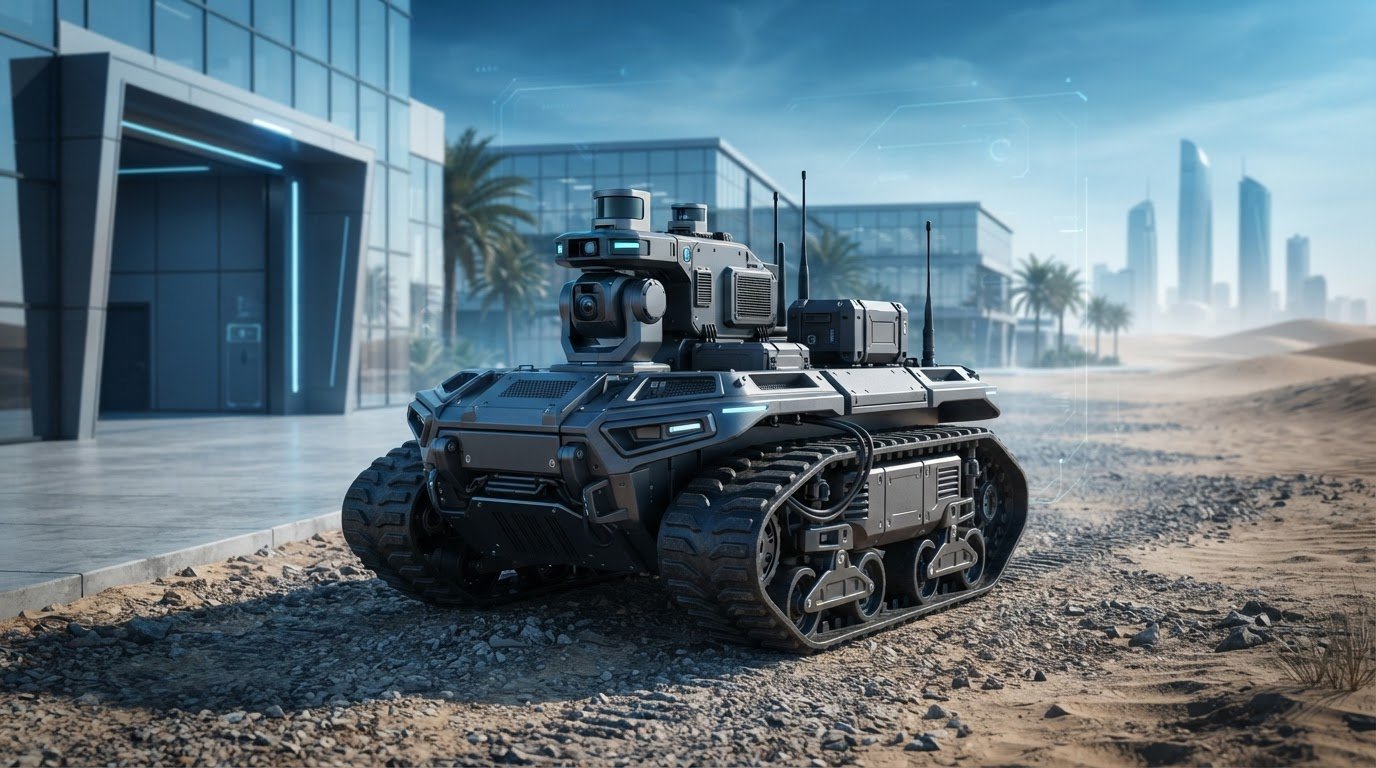
The agilex bunker is a tracked unmanned ground vehicle (UGV) platform: a mobile chassis designed to carry equipment and support development of a task-specific robotic system. It is not, by itself, a complete inspection, surveying, or transport robot. Its tracks offer a mobility option for sites where uneven ground, loose surfaces, or obstacles may limit wheeled movement. The application still depends on how the platform is configured.
Understanding the distinction between a UGV and its eventual role helps set realistic expectations. A general overview of Unmanned Ground Vehicles (UGVs) places platforms like Bunker within a broader category of ground vehicles that can be remotely controlled or configured for varying levels of autonomy. A chassis becomes an application only when its mobility, controls, sensors, and task equipment are selected to work together.
How does tracked mobility change the operating envelope?
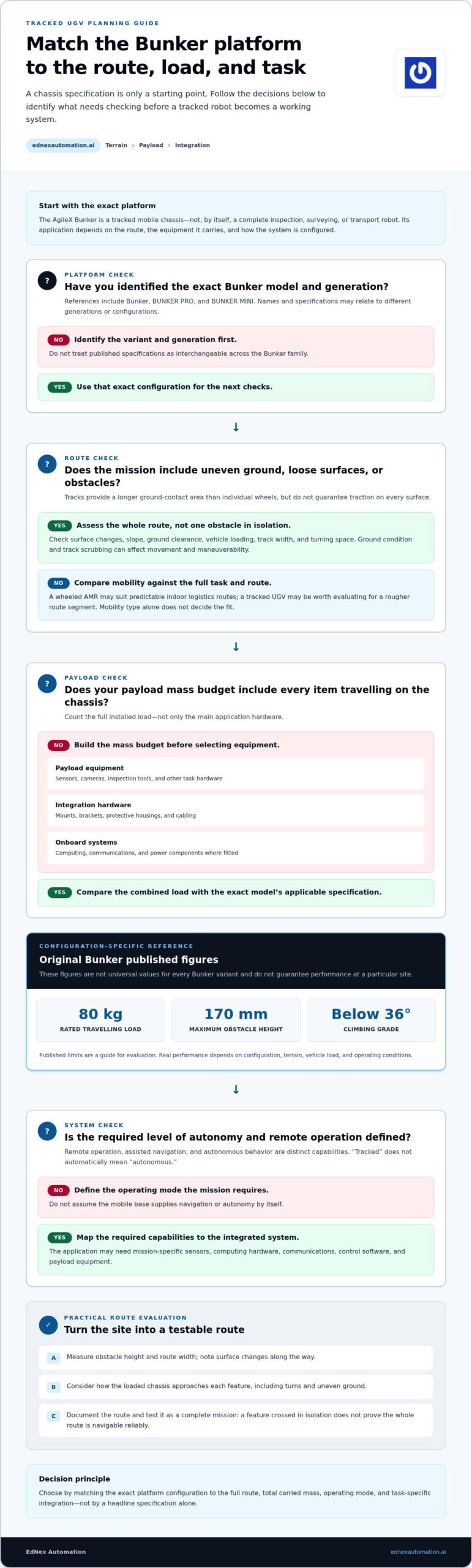
Continuous tracks create a longer ground-contact area than individual wheels. This can help distribute the vehicle’s weight and maintain contact over irregular surfaces, but it does not guarantee traction on every surface. Ground condition, slope, vehicle loading, track design, and turning space all affect suitability.
Many tracked platforms use differential steering: the left and right tracks move at different speeds, or in opposite directions, to turn the vehicle. This gives the chassis maneuverability without a conventional steering axle, though turning can cause the tracks to scrub against the ground. That matters in confined spaces and on surfaces where scuffing or resistance could affect movement.
Consider a route that moves from a hard floor onto uneven outdoor ground. A wheeled AMR designed for structured logistics may suit predictable indoor routes, while a tracked UGV may be worth evaluating for the rougher segment. Choose based on the full route and task, not the mobility type alone.
Is AgileX Bunker a complete autonomous solution?
A UGV platform is the mobile base; a deployed application is the integrated system configured to perform a defined task. The base may need mission-specific sensors, computing hardware, communications, control software, and payload equipment. Navigation and autonomy depend on those components and their configuration, so “tracked” does not automatically mean “autonomous.” Remote operation, assisted navigation, and autonomous behavior are distinct system capabilities.
The Bunker family includes different references, such as Bunker, BUNKER PRO, and BUNKER MINI. Names may refer to different model generations or configurations, so specifications should not be treated as interchangeable. Before making a design decision, identify the exact variant and generation, then assess how its chassis and controls align with the proposed application. This platform-first approach connects mobility choices to practical integration requirements across commercial and industrial operations.
How the AgileX Bunker Chassis Handles Terrain, Payload, and Obstacles
Terrain capability is a system-level result, not a single figure on a specification sheet. Track design, suspension, ground clearance, steering, vehicle load, and the surface itself all affect how an agilex bunker moves. A firm, even slope and loose or uneven ground can present very different demands, so published limits should guide evaluation rather than guarantee performance at a particular site.
Which chassis features matter on uneven ground?
Tracks maintain contact across a longer section of the chassis than individual wheels, while suspension helps the vehicle respond to changes in ground height. That movement can reduce shocks transmitted to the frame and mounted equipment, but it does not eliminate vibration or ensure a payload remains stable. Mounting position, load distribution, speed, and terrain all matter.
Ground clearance affects whether the underside can pass over raised features, while track width and turning behavior influence access in narrow routes. Differential steering can turn the vehicle by varying track speeds, but turning space and surface friction still shape maneuverability. Manufacturer figures describe a defined configuration; real site performance depends on operating conditions.
For example, a route with a shallow raised edge, loose material, and a narrow turn should be assessed as a sequence of distinct challenges. Measure the obstacle and route width, note surface changes, and consider how the loaded chassis will approach each feature. Documenting the route gives teams a practical basis for testing and helps distinguish an obstacle the vehicle can cross in isolation from a route it can navigate reliably as a complete mission.
How should teams interpret payload and obstacle specifications?
Start with the exact model and generation. A specification record for the original Bunker lists an 80 kg rated travelling load, a maximum obstacle height of 170 mm, and a climbing grade below 36 degrees. These are configuration-specific published figures, not universal values for Bunker variants or guarantees for a loaded vehicle on every surface.
Build a mass budget before selecting application hardware. Include all equipment that will travel on the chassis, not just the main tool:
- Payload equipment: sensors, cameras, inspection tools, or other task hardware.
- Integration hardware: mounts, brackets, protective housings, and cabling.
- Onboard systems: computing, communications, and power components where fitted.
Compare the combined mass with the applicable travelling-load rating. Do not assume a separately stated spin-load rating, if present in model documentation, means the same thing for continuous movement. The figures describe different operating conditions. Confirm payload, obstacle, slope, clearance, and environmental limits against the manual for the exact unit before using them in a design decision.
For commercial and industrial applications in the UAE, include the wider control environment in the evaluation. Robotics and automation integration can be part of this systems-level planning.
Comparing AgileX Bunker, BUNKER PRO, and BUNKER MINI
Compare each Bunker by its exact generation, intended operating profile, and documented limits. The table separates the original Bunker specification record from the 2.0 models; it does not treat the family as one interchangeable platform. Published figures help narrow options, but model manuals should guide design decisions, especially where reported values differ.
| Model and basis | Intended duty and footprint | Published capability and protection |
|---|---|---|
| Original Bunker, specification record | Tracked mid-tier platform; compare its physical dimensions with the access route and planned payload. | 80 kg rated payload; IP54; 2 × 650 W brushless servo motors; 170 mm maximum obstacle height; climbing grade below 36 degrees. |
| BUNKER PRO 2.0, Pro generation listed | Heavy-duty positioning for demanding off-road applications; confirm the required footprint against site access. | 120 kg payload; IP67; dual 1800 W brushless servo motors; published obstacle figures include 180 mm high obstacles and 40 cm trenches. |
| BUNKER MINI 2.0, compact model | Compact positioning for confined areas and off-road work; listed dimensions are 690 × 570 × 335 mm. | Payload is reported as 25 kg by AgileX and 35 kg by some distributors; protection is reported as IP66 or IP67. A 30-degree climbing grade is listed. |
Figures identify the model and generation they describe. Specifications may vary by configuration, and the Mini payload and protection ratings conflict across published references. Use current documentation for the exact unit before sizing equipment or setting acceptance limits.
When does the compact BUNKER MINI profile make sense?
The Mini’s compact positioning makes it a candidate where doorways, narrow passages, or a constrained work footprint affect access. Its listed dimensions help with an initial clearance check, but do not establish turning space or route suitability. Compactness also says nothing by itself about runtime or usable payload: account for sensors, mounts, computing hardware, and task equipment, then compare the total with the applicable model rating.
When should teams evaluate BUNKER PRO or the original Bunker?
The PRO’s heavy-duty positioning and higher published payload may warrant evaluation when the mission calls for a robust tracked base and substantial onboard equipment. The original Bunker is a separate comparison point, with its own reported load, obstacle, and protection figures. Model-generation differences can change specification comparisons, so a family name alone does not establish that two figures describe equivalent configurations.
For the agilex bunker platform, shortlist models against three practical constraints: the narrowest access point, the complete loaded mass, and the most demanding terrain feature on the route. Then assess protection requirements against actual operating conditions. An IP rating describes an enclosure-protection classification, not overall suitability for every outdoor environment or task.
Where a Tracked AgileX Bunker Platform Fits, and What Integration Requires
A tracked chassis is worth evaluating when the mission and route call for more than movement between predictable indoor points. Inspection, research, and off-road transport are possible application concepts, not guaranteed outcomes: each requires suitable payload, controls, an operating plan, and site validation. For logistics along structured routes, wheeled autonomous mobile robots may be the more relevant comparison. Select the platform based on the task and environment.
How should an application be scoped before deployment?
Before selecting add-on hardware for an agilex bunker, document the mission as a sequence of operating conditions. A practical assessment should cover:
- Task: Define what the robot must observe, carry, or do, and what counts as successful completion.
- Surface: Record terrain types, transitions, slopes, loose material, and obstacles along the full route.
- Access: Measure clearances and turning areas, and identify interaction points with people, vehicles, and equipment.
- Payload: Set the required equipment list and total mass, including mounts, sensors, and protective housings.
- Operating conditions: Document relevant exposure, visibility, communications coverage, and operating duration for the site.
- Autonomy: Specify whether the task needs remote driving, navigation assistance, or autonomous behavior, and define operator oversight.
Plan how the operator will monitor progress, issue commands, and respond if the vehicle stops, loses communication, or needs recovery. A route drawing should show not only where the robot travels but also where it pauses, gathers data, or interacts with fixed equipment. This detail turns a broad use case into testable requirements.
What does system integration add to a tracked robot?
Integration connects the mobile platform to the application. Sensors must provide information the software can interpret; task equipment must be mounted and powered appropriately; and communications must support the intended control and monitoring workflow. The control architecture coordinates these parts. Define compatibility, data flow, and safe responses to faults during design, then exercise them in site testing.
In a research project, the application layer might combine navigation sensors and data collection tools. An inspection concept could pair cameras or other instruments with a defined route and operator review. Off-road transport would instead prioritize the carried load, secure mounting, and delivery criteria. These examples describe planning possibilities, not assured performance from a chassis alone.
When a mobile system must exchange operational information with facility controls, PLC and SCADA integration can support the wider control environment. EdNex Automation connects robotics and industrial automation within commercial and industrial systems across the UAE. Explore integrated robotics system planning around the task, site, and control requirements.
AgileX Bunker: From Research to Deployment Plan
A sound deployment plan separates the choice of mobile base from engineering the application around it. Treat the agilex bunker as one element in a larger operational system: define the mission, compare suitable configurations, design the application layer, then test the integrated setup against agreed acceptance criteria. This sequence helps expose constraints before they become commissioning problems.
What should a deployment brief contain?
Build a brief that describes actual work conditions, not only the desired outcome. Record the task, route, surface changes, access limits, interaction with people or equipment, expected payload, and required operating duration. Identify sensors, task tools, operator controls, communications coverage, and the data the system must capture or pass to other systems.
Use the brief to progress through these stages:
- Define the mission: State the task, operating area, intended users, and measurable completion condition.
- Compare platforms: Match documented model specifications to the route, access envelope, load, and operating conditions. Keep model generation and configuration explicit.
- Engineer the application: Specify mounts, sensors, payload equipment, control functions, communications, and required data outputs.
- Validate the site: Test on representative surfaces and transitions, through relevant access points, and under the planned operating conditions.
- Commission against criteria: Record results, resolve gaps, and establish operator procedures before routine use.
Set acceptance criteria before testing begins. For terrain, specify route segments and the conditions the vehicle must negotiate. For payload, define the complete loaded configuration and confirm it remains within the applicable rating. For communications, identify the coverage needed to monitor and control the mission, including the response if the connection is interrupted. Document safety expectations for people, equipment, stopping, and recovery. Finally, define task completion in observable terms, such as reaching designated inspection points or collecting the required data, rather than relying on a general statement that the robot “works.”
How can EdNex Automation support a robotics integration discussion?
Product selection answers which base may fit; application engineering determines how that base, its payload, controls, and information flow work as a system. Commissioning then evaluates the configured system against the site and agreed criteria. Keeping these decisions distinct makes it easier to trace a failure or performance gap to the relevant part of the design.
EdNex Automation supplies and integrates robotics and industrial automation systems for commercial and industrial clients across the UAE, with capabilities that include specialized robots and PLC and SCADA integration. This systems perspective connects robotics requirements to facility workflows and the control environment.
Bring the task, route details, payload requirements, and acceptance criteria into the planning conversation. Explore EdNex Automation and discuss your operational challenge as a practical step toward a defined robotics integration plan.
Turn Your Platform Decision into Operational Progress
Turn your agilex bunker evaluation into a clear operational brief. Define what the system must accomplish, who will operate it, and how the result will fit into existing workflows. This keeps decisions grounded in the work itself, rather than treating a mobile chassis as the finished solution.
For commercial and industrial teams in the UAE, the opportunity lies in connecting robotics with the wider automation environment. EdNex Automation brings robotics integration together with specialized robotic systems and industrial control integration, helping organizations consider how a robotic application relates to people, processes, and facility systems.
Start with your operational challenge and the outcome you need to achieve. Explore EdNex Automation’s robotics and integration capabilities and take the next step toward a purposeful automation plan. With a defined mission and a systems-level perspective, your team can move forward with greater clarity.
Frequently Asked Questions
Is the AgileX Bunker an AMR or a UGV?
The AgileX Bunker is a tracked unmanned ground vehicle (UGV); AMR describes a robot that can move autonomously, often in a logistics setting. These terms describe different aspects, so they are not necessarily mutually exclusive. A Bunker chassis may become part of an autonomous mobile system when suitable navigation, control, and safety functions are integrated. For an application involving regular indoor deliveries, compare its role with purpose-built logistics AMRs.
Can the AgileX Bunker navigate autonomously without an operator?
Autonomous navigation is not a guaranteed capability of the chassis alone. It depends on the sensors, computing hardware, software, and controls configured for the specific system. A deployment might use remote operation, operator-assisted navigation, or more autonomous behavior, depending on its design. Even with autonomous functions, teams should define how an operator monitors the mission and responds to a stop, obstacle, or communications interruption.
What battery options are listed for the original AgileX Bunker?
Original Bunker configurations list 48 V battery options. Treat voltage as one data point, not a complete runtime estimate. Battery selection and operating duration depend on the unit and system load, so use the documentation for the exact configuration when planning a mission.
How is the AgileX Bunker controlled?
Control depends on the Bunker configuration and the system built around it. AgileX’s software ecosystem includes ROS and ROS 2 compatibility and development packages, which can support custom control and navigation applications. This does not specify the controller or operating mode on every unit. For a project, identify whether commands will come from an operator, onboard software, or a wider control system, then design monitoring and stop procedures accordingly.
What operating temperatures are listed for the AgileX Bunker?
Operating-temperature limits can vary across Bunker models and generations. Temperature can affect battery behavior, electronics, and sensors. For UAE site planning, distinguish expected operating conditions from storage conditions and consider exposure along the route. Use the exact model’s current manual to set temperature limits and acceptance conditions for testing.
Can the AgileX Bunker carry a robotic arm or other equipment?
A Bunker platform can be considered as a base for application equipment, potentially including an arm, sensors, or inspection tools, but suitability depends on the exact configuration. Check the applicable payload rating and account for the arm, mount, cabling, and other onboard hardware together. Also assess how the equipment’s height, reach, and movement affect stability, clearance, power needs, and safe operation. A payload figure alone does not establish compatibility.
What is the difference between Bunker and BUNKER PRO 2.0 specifications?
Published figures for the original Bunker specification record include an 80 kg rated payload, IP54 protection, and 2 × 650 W motors. The BUNKER PRO 2.0 lists a 120 kg payload, IP67 protection, and dual 1800 W motors. Those figures refer to different model generations, not interchangeable configurations. Compare each unit’s own documentation and assess how payload and protection ratings apply to the complete application.