The traditional assumption that high-speed industrial robots are the only viable path to manufacturing excellence is increasingly challenged by the rise of intelligent, collaborative systems. While raw speed is often prioritized, the hidden costs of safety infrastructure and rigid programming can actually hinder the agility required in the modern Emirati industrial sector. You’ve likely felt the pressure of escalating labor costs for repetitive tasks and the frustration of a floor plan dominated by bulky safety cages. Mastering the strategic choice of a cobot vs industrial robot is essential for any facility manager looking to integrate within the Operation 300bn framework effectively.
This guide provides a definitive decision-making framework, uncovering the critical technical and economic differences to ensure your automation strategy is both compliant and profitable. You’ll gain a comprehensive understanding of the total cost of ownership and safety standards like ISO/TS 15066 to determine which technology provides the necessary intellectual foundation for your specific operational needs. We’ll examine how bespoke integration and safety compliance under the 2026 UAE AI Act transform these machines from simple tools into long-term assets for industrial modernization.
Key Takeaways
- Distinguish between high-payload traditional systems and sensor-driven collaborative units to define your facility’s specific technical requirements.
- Assess total cost of ownership by evaluating the hidden expenses of safety fencing and complex integration against the lower entry barriers of modern collaborative technology.
- Navigate the regulatory landscape of ISO 10218 and ISO/TS 15066 to ensure your cobot vs industrial robot strategy aligns with international safety protocols.
- Optimize manufacturing output by matching high-speed, hazardous tasks with industrial robots while utilizing cobots for applications requiring frequent human intervention.
Defining the Core Divergence: Cobots vs. Traditional Industrial Robots
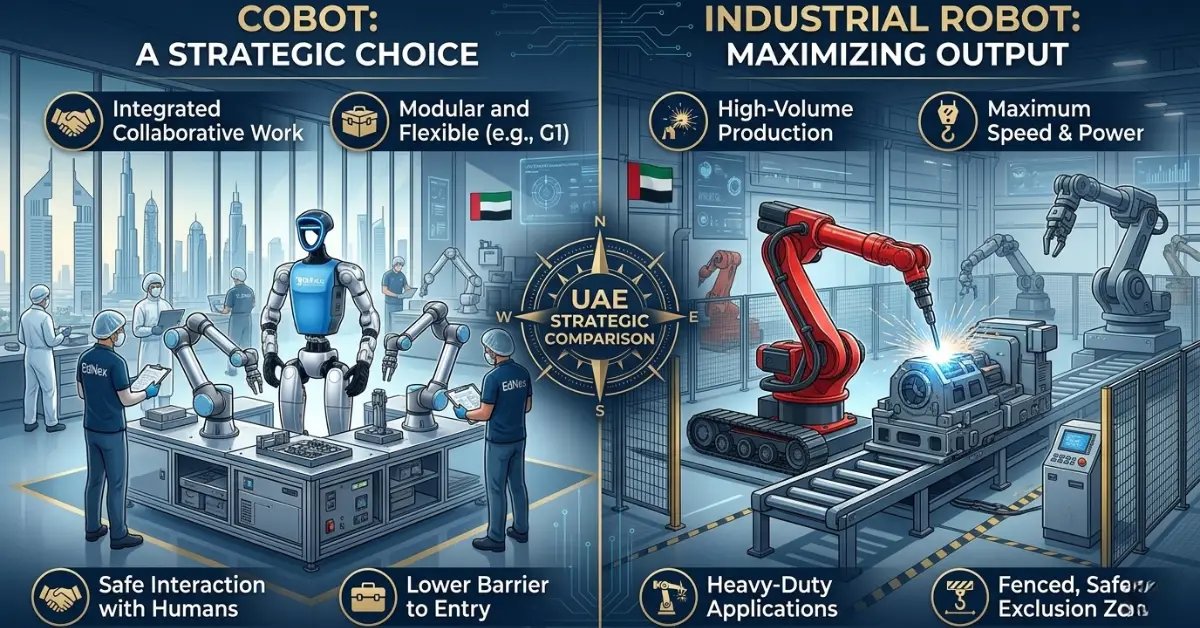
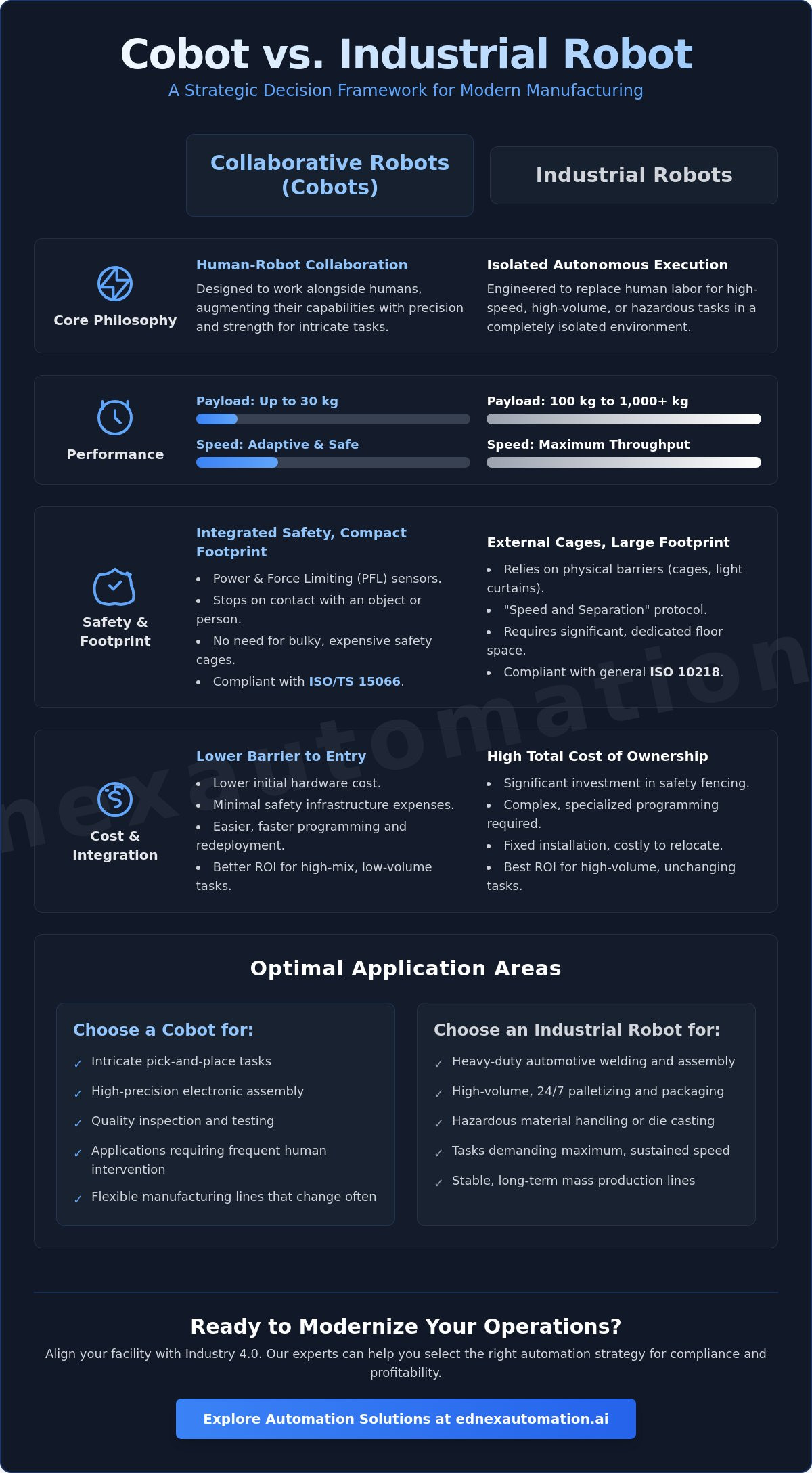
Analyzing the structural evolution of automation reveals a fundamental split in how machines occupy the modern factory floor. Traditional industrial robots operate as high-velocity, high-payload assets that fundamentally exclude human presence through physical barriers or light curtains to maintain safety. In contrast, collaborative robots, or cobots, utilize integrated force-torque sensors to facilitate safe, direct interaction without the need for expansive safety fencing. This core architectural difference in the cobot vs industrial robot comparison dictates not just the layout of a facility, but the entire operational philosophy of the production line.
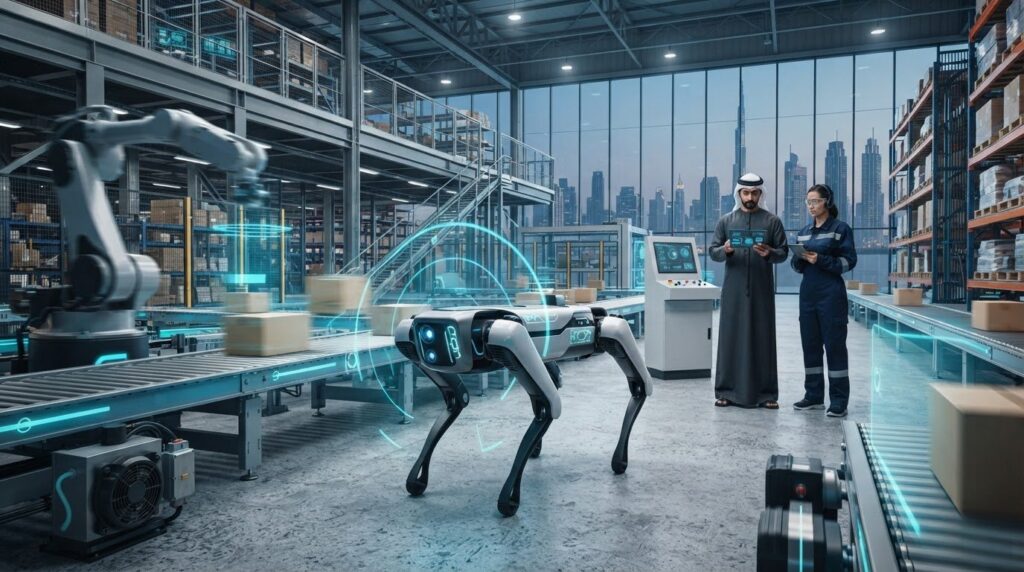
While traditional robots are designed for isolated autonomous execution, cobots are engineered for human-robot collaboration. Modern UAE manufacturing facilities are moving away from a binary choice, instead adopting a tiered approach where both technologies coexist. Within this hybrid framework, high-speed industrial arms manage heavy-duty cycles in restricted zones while collaborative units handle intricate tasks alongside technicians, optimizing every node of the value chain. This focus on precision is also a hallmark of specialized digital manufacturing; for example, Embroidery n Sewing provides the high-quality digital designs required for machines to execute intricate patterns with consistent accuracy.
The Philosophy of Interaction
True collaborative units rely on Power and Force Limiting (PFL) technology to ensure operational safety. By monitoring the current in their joints, these robots detect abnormal resistance and halt motion instantly upon contact. This stands in sharp contrast to the “Speed and Separation” protocols of high-output industrial units. Traditional machines maximize throughput by operating at velocities that would be lethal in a shared space, making physical isolation a technical necessity rather than a choice. This shift represents a broader movement in Industry 4.0: moving from replacing human labor to augmenting human capability with precision tools.
Historical Evolution of Robotic Autonomy
Tracing the trajectory from the 1960s Unimate arms to today’s AI-driven systems reveals a relentless drive toward machine intelligence. While raw speed was the primary metric of the 20th century, the 2026 industrial landscape demands adaptability and rapid redeployment. Defining Cobots in this era requires looking at their ability to perceive their environment and respond to human presence in real-time.
Deploying collaborative robots UAE has become a strategic imperative for regional digital transformation, particularly as businesses align with the “Operation 300bn” initiative. These systems provide the intellectual framework necessary for flexible manufacturing, allowing companies to pivot production lines without the massive decommissioning costs associated with traditional, fixed-cage robotics. As the UAE AI Act of 2026 mandates stricter risk-based assessments, the inherent safety of collaborative technology offers a streamlined path to regulatory compliance and long-term business viability.
Technical Architecture and Performance Boundaries
Evaluating the mechanical capabilities of a cobot vs industrial robot requires a deep dive into the engineering trade-offs between raw power and adaptive intelligence. Traditional industrial robots are the undisputed heavy lifters of the manufacturing world, frequently engineered to handle payloads ranging from 100kg to over 1,000kg with relentless consistency. In contrast, collaborative robots are designed for dexterity and human proximity, typically peaking at payload capacities of 20kg to 30kg. This distinction effectively dictates the types of applications each system can support, from the heavy-duty automotive chassis welding handled by industrial arms to the delicate pick-and-place tasks optimized for cobots.
Payload and Speed: The Throughput Trade-off
High-volume palletizing and mass-production lines still rely on heavy-duty industrial arms because they maintain maximum velocity throughout 24/7 duty cycles. While a cobot can perform similar motions, its operational speed is often throttled by integrated safety systems that detect human presence. Adhering to Safety Protocols and Regulatory Compliance requires a deep understanding of these velocity thresholds to ensure human protection without compromising operational efficiency. In the context of high-precision electronic assembly, repeatability is defined as the machine’s ability to return to a programmed position with sub-millimeter precision, often within a margin of +/- 0.03mm. While both categories offer high repeatability, industrial robots maintain this precision at much higher speeds than their collaborative counterparts.
Flexibility and Ease of Deployment
Capitalizing on the “plug-and-play” nature of modern automation, Small and Medium Enterprises (SMEs) are increasingly turning to cobots for high-mix, low-volume (HMLV) production. These units feature intuitive “lead-through” programming, allowing operators to teach the robot new paths by physically moving the arm rather than writing complex proprietary scripts or G-code. This accessibility contrasts sharply with the intensive commissioning and specialized PLC programming required for a fixed industrial robot cell.
Expanding the utility of these systems, forward-thinking facilities are now integrating collaborative arms with autonomous mobile robots to create mobile manipulation platforms. This pairing allows the robot to move between different work cells, performing varied tasks throughout the day and maximizing the return on investment. If you are uncertain which architecture fits your current infrastructure, exploring a bespoke automation assessment can clarify the technical path forward. By prioritizing flexibility over raw speed, regional manufacturers can build a more resilient production environment that adapts to shifting market demands without requiring a total overhaul of the factory floor.
Evaluating the Total Cost of Ownership (TCO) and ROI
Calculating the true financial impact of a cobot vs industrial robot requires a shift in perspective from initial purchase price to long-term operational viability. While a collaborative arm often presents a lower entry point in terms of capital expenditure, its lower throughput may extend the payback period in high-volume environments. Conversely, a traditional industrial robot offers unmatched speed but carries significant hidden costs associated with mandatory safety perimeters and complex commissioning. Developing a robust automation strategy involves balancing these variables against the specific labor dynamics and infrastructure costs of the UAE manufacturing sector.
The Hidden Costs of Safety Infrastructure
In high-density UAE industrial zones where floor space carries a premium, the physical footprint of a robotic cell is a critical financial metric. Traditional industrial robots necessitate expansive safety fencing, interlocks, and light curtains that can effectively double or triple the required workspace. Cobots eliminate these “real estate” costs by operating safely alongside human technicians, allowing for a much higher density of automation within existing facilities. To maintain a clear view of these performance metrics, utilizing PLC and SCADA integration services is essential for capturing the real-time data necessary to track energy efficiency and cycle-time optimization across the production line.
Long-term Strategic Value
The resilience of an automation investment is often defined by its adaptability to future product iterations. Industrial robots are engineered for a decade or more of grueling, high-speed service, but re-deploying them to a new task is a costly, technical endeavor involving specialized scripting and physical relocation of safety barriers. Collaborative units provide superior strategic flexibility because they’re designed for rapid re-programming and mobility. This reduces the “Time to Value”—the window between delivery and full production—ensuring that your facility remains competitive as market demands shift.
Operational downtime also weighs heavily on the TCO. While industrial units are built for longevity, their complexity means that repairs often require high-level external technicians. Cobots, while utilizing sophisticated sensors that require precise calibration, often allow for faster internal troubleshooting. By prioritizing systems that offer ease of re-deployment, regional manufacturers can mitigate the risk of asset obsolescence, ensuring their technology remains a functional component of the UAE’s industrial evolution rather than a static expense.
Safety Protocols and Regulatory Compliance
Adhering to rigorous safety standards is the bedrock of any successful automation deployment, particularly as regional regulations become more sophisticated. While the cobot vs industrial robot debate often centers on throughput, the regulatory environment defined by ISO 10218 and ISO/TS 15066 provides the actual legal framework for operation. These global standards distinguish between machines designed for physical isolation and those engineered for power and force limiting. However, a common industry misconception is the “inherently safe” status of collaborative units. In reality, the safety rating isn’t determined by the robot alone; it’s the result of a comprehensive assessment of the entire application, including the workpiece and the end-effector.
Performing a systematic risk assessment is a mandatory requirement for any robotic installation in a professional environment. This process identifies potential pinch points, collision risks, and the severity of impact in shared Human-Robot Interaction (HRI) zones. By designing a facility that respects both machine efficiency and human safety, manufacturers can create a systematic organizer of labor that minimizes risk while maximizing uptime. Following the guidelines of the 2026 UAE AI Act ensures that your facility doesn’t just adopt technology, but does so within a controlled and deliberate framework of innovation.
Fenced vs. Fenceless Operations
Leveraging advanced sensing technologies like LIDAR, high-resolution torque sensors, and 3D vision systems, modern cobots facilitate fenceless environments that optimize floor space. These sensors create dynamic safety zones where the robot automatically adjusts its velocity or halts motion based on human proximity. Interestingly, even a traditional industrial robot can operate without a physical fence if it’s integrated with sophisticated area scanners that enforce strict speed and separation monitoring. According to current RIA standards, a collaborative workspace is defined as the area within the operating space where the robot and a human can perform tasks simultaneously during production operation.
The Role of End-of-Arm Tooling (EOAT)
The choice of End-of-Arm Tooling (EOAT) significantly impacts the final safety profile of the robotic cell. Utilizing a cobot for high-heat applications or the handling of sharp metal components essentially negates its collaborative benefits, as the tool itself poses a primary hazard to the operator. This necessitates the use of safety-rated grippers and specialized sensors that can detect resistance and trigger an emergency stop. Ensuring that your tooling matches the safety capabilities of the arm requires the intellectual framework provided by a professional integrator. To ensure your facility meets these complex requirements, consult with our safety integration experts to design a compliant, high-performance robotic cell.
Selecting the Optimal Robotic Strategy for Your Facility
Finalizing a robotic investment requires a precise alignment between technological capability and long-term business objectives. Selecting collaborative robots is the strategic choice for assembly, machine tending, and testing applications that necessitate frequent human intervention or rapid task changes. Conversely, traditional industrial robots remain the standard for heavy material handling, high-speed pick-and-place, and isolation within hazardous environments. The decision in the cobot vs industrial robot debate shouldn’t be viewed as a binary conflict but as a nuanced selection of the right tool for a specific operational node. Partnering with a regional expert like EdNex Automation ensures that your automation roadmap aligns with the UAE’s national Industry 4.0 goals, transforming your facility into a hub of controlled and deliberate innovation.
Achieving true operational excellence often requires a synthesis of both technologies within a larger, interconnected infrastructure. Integrating collaborative arms for intricate, fine-motor tasks while utilizing traditional systems for bulk movement within a unified ASRS environment creates a synergistic effect that maximizes both floor space and throughput. This hybrid approach allows for the systematic organization of workflows, ensuring that each machine operates within its peak performance envelope while maintaining total safety compliance.
When to Prioritize Throughput
Defining the “Cycle Time Threshold” is essential for determining when traditional industrial robots become the only viable option for a production line. When a process requires continuous, sub-three-second cycles in a 24/7 “lights-out” manufacturing environment, the raw velocity of a traditional arm is necessary to maintain profitability. Managing the high-density data streams generated by these high-velocity assets requires advanced SCADA systems that provide real-time visibility into machine health and performance. In these scenarios, the machine-centric focus of industrial robotics provides the intellectual framework for massive, high-efficiency output that cobots simply aren’t designed to match.
When to Prioritize Agility
Recognizing the need for flexibility in R&D and small-batch production often leads manufacturers toward collaborative technology. Cobots provide a unique advantage in environments where product life cycles are short and production lines must be reconfigured weekly. Beyond the technical metrics of a cobot vs industrial robot, the psychological impact on workforce morale is significant; employees often view cobots as supportive tools that offload ergonomically taxing tasks, which accelerates technology adoption across the organization. Before committing to a specific hardware path, seeking a comprehensive consultative assessment is a necessary evolution for any organization wishing to remain competitive in the future. This methodical approach ensures that your chosen system provides the long-term viability required in the evolving Emirati industrial landscape.
Modernizing the Emirati Industrial Landscape through Strategic Automation
Developing a resilient production environment requires a precise alignment between machine capability and the specific economic goals of your facility. Choosing between a cobot vs industrial robot is no longer a simple matter of selecting for speed; it’s a strategic decision that factors in floor space optimization, total cost of ownership, and the necessity of human-machine synergy. By prioritizing safety compliance and technical adaptability, regional manufacturers can build a robust foundation for Industry 4.0 that evolves alongside shifting market demands.
Navigating this complex transition demands the expertise of a grounded, reliable technical partner who understands the intricacies of the local industrial sector. Specializing in UAE Industry 4.0 transformation, our team provides the end-to-end PLC and SCADA support needed to ensure every robotic installation acts as a systematic organizer of efficiency. We invite you to Request a Strategic Robotics Assessment from EdNex Automation to collaborate with certified industrial automation integrators who can turn your visionary goals into tangible operational results. It’s time to secure your organization’s future in the global manufacturing hub.
Frequently Asked Questions
Is a cobot always safer than a traditional industrial robot?
The safety of a robotic system is determined by the final risk assessment of the entire application rather than the machine alone. While cobots feature integrated force-limiting sensors, the addition of sharp end-effectors or hazardous workpieces necessitates additional safety measures. Professional integrators must evaluate the complete collaborative workspace to ensure compliance with ISO/TS 15066 and regional safety standards.
Can an industrial robot be converted into a collaborative one?
Converting a traditional industrial robot into a collaborative application is possible through the integration of advanced area scanners and speed-monitoring sensors. This setup allows the machine to slow down or stop when humans enter a pre-defined zone, though it lacks the inherent power-limiting architecture of a dedicated cobot. This hybrid approach provides high-speed efficiency while maintaining the necessary safety protocols for shared environments.
What is the typical payload limit for a collaborative robot in 2026?
In 2026, the typical payload limit for collaborative robots ranges from 20kg to 30kg, representing a significant increase from earlier models. This advancement allows for more versatile applications in palletizing and machine tending without sacrificing the safety-rated sensors required for human proximity. When evaluating a cobot vs industrial robot for heavy material handling, the traditional industrial arm remains the superior choice for payloads exceeding these thresholds.
Do cobots require specialized programming skills compared to industrial robots?
Cobots utilize intuitive hand-guiding and lead-through programming interfaces that significantly reduce the technical barrier for floor operators. Unlike traditional industrial robots that require specialized G-code or proprietary scripting, collaborative units can be taught new paths by physically moving the arm. This ease of deployment allows SMEs to pivot production lines rapidly without the need for high-level external programming consultants.
How does floor space affect the cost of an industrial robot installation?
Floor space requirements for traditional industrial robots significantly increase the total cost of ownership due to mandatory safety fencing and light curtains. In high-density UAE industrial zones, the expansive footprint of a fenced cell can effectively double the real estate costs of an automation project. Cobots mitigate these expenses by facilitating fenceless operations, allowing for a higher density of machinery within the existing facility layout.
What industries in the UAE benefit most from cobot technology?
The UAE electronics, pharmaceutical, and food-and-beverage sectors benefit most from cobot technology due to the high-mix, low-volume nature of their production. These industries require the agility to switch between product iterations quickly, a task where collaborative units excel. Integrating these systems supports the national Operation 300bn initiative by modernizing manufacturing nodes that require delicate handling and frequent human interaction.
Can cobots and industrial robots work on the same production line?
Integrating both machine types on a single production line is a common strategy for optimizing throughput and flexibility. High-speed industrial robots handle bulk material movement in restricted zones, while cobots manage assembly or quality inspection tasks alongside human workers. This hybrid cobot vs industrial robot strategy ensures each asset operates at its peak performance level within a unified, SCADA-managed infrastructure.
What are the maintenance requirements for a collaborative robot?
Maintenance for collaborative robots focuses heavily on the calibration of sophisticated force-torque sensors rather than just mechanical lubrication. While cobots often experience less physical wear than high-speed industrial units, their sensor-based safety systems require regular health checks to maintain compliance. Ensuring long-term business viability involves a systematic maintenance schedule that prioritizes software updates and sensor accuracy to prevent operational downtime.