The robot arm is only one part of a successful automation decision. For cobots for electronics manufacturing, the real test is whether the complete application can handle delicate components, meet process requirements and integrate with the production line. A model that looks suitable on paper may not deliver consistent results if its tooling, fixtures, controls or workcell layout don’t match the task.
Choosing a cobot can feel complex because electronics assembly combines varied processes, from pick-and-place and screwdriving to inspection and machine tending. Each has different requirements for handling, positioning, cycle time and changeovers. Worker safety and dependable production matter just as much as the robot’s specifications.
This guide explains how to determine whether a cobot suits your process and how to compare options using practical application criteria. You’ll learn what to assess across task fit, product handling, safety and integration, including connections to existing equipment and PLC or SCADA systems. With an application-led approach, you can plan a focused evaluation and build a solution around your production needs.
Key Takeaways
- Identify electronics tasks where repetitive work, delicate components or product variation make cobot support worth assessing.
- Evaluate cobots for electronics manufacturing against each task’s demands, including payload, reach, repeatability, cycle time and tooling.
- Build a readiness assessment by documenting the current process, desired outcomes, product variants, exceptions and operator roles.
- Plan how the robot arm, end effector, workcell and control interfaces must work together to support production.
- Treat integration as a coordinated process, from application definition and cell design to controls coordination and validation.
Where Cobots Fit in Electronics Manufacturing
A collaborative robot, or cobot, is designed for applications where people and robots may share aspects of a work environment. That doesn’t mean people can safely make unrestricted contact with a moving robot. Safe operation depends on the complete application, including the task, tooling, components, cell layout and how people interact with the system. For a foundational overview, see What is a Cobot?
In electronics production, cobots are typically considered for defined operations within a process, rather than as replacements for entire production lines. The arm is one element of the application. Fixtures, an end effector, control interfaces and surrounding equipment all affect how well the task performs.
A cobot is a robot designed for a collaborative task; an automated assembly system is the complete arrangement of equipment, controls and processes that performs the work.
What makes electronics assembly a distinctive automation challenge?
Electronics assembly combines small components, carefully sequenced steps and frequent product changes. A workcell may need to place a component in a defined position, secure it and pass the product to the next operation. If part presentation or positioning varies, the assembly may not meet process requirements, so consistency at each step matters.
Some tasks follow a stable, repeatable sequence and may be candidates for automation. Others require human judgement, such as responding to an unusual part, identifying an unexpected condition or managing a changeover. Mapping the difference helps teams target cobot support without forcing variable work into a fixed cycle.
Which electronics tasks can cobots support?
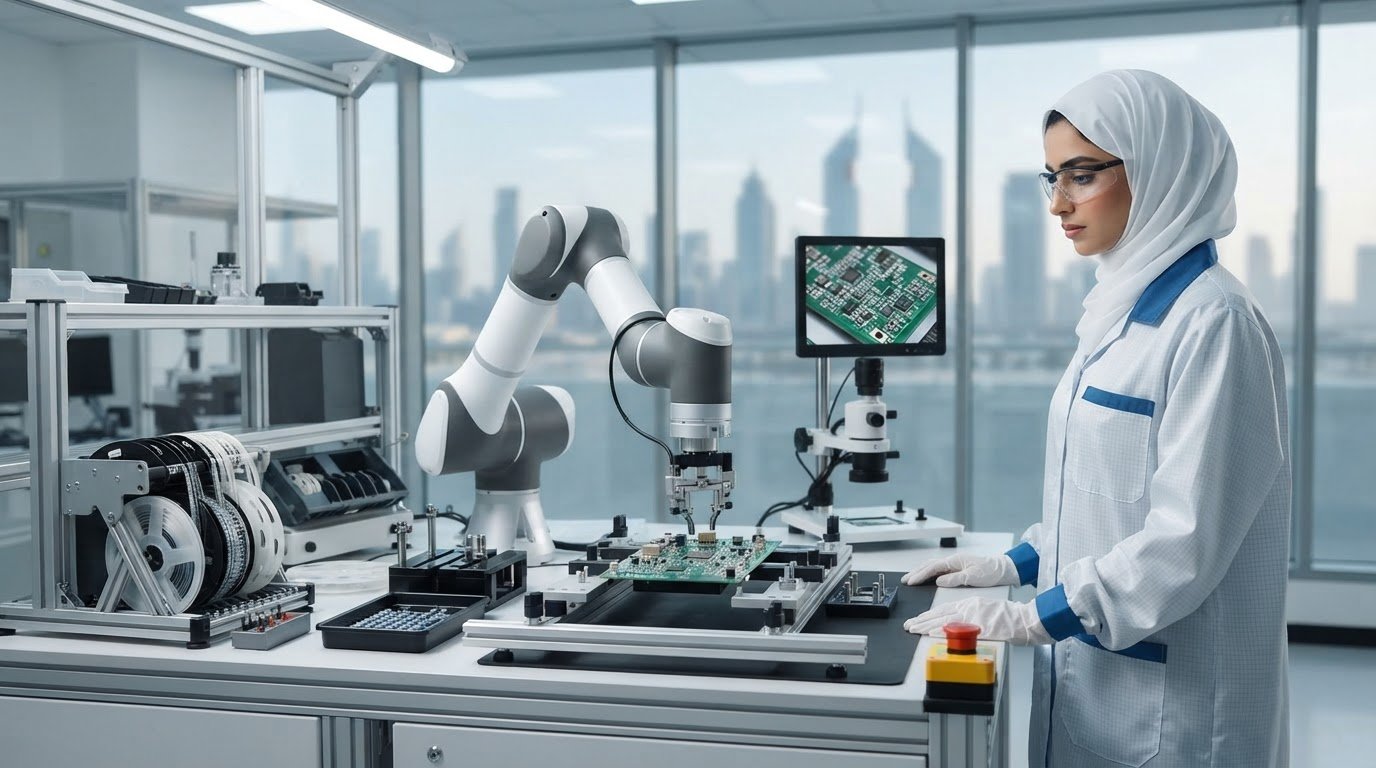
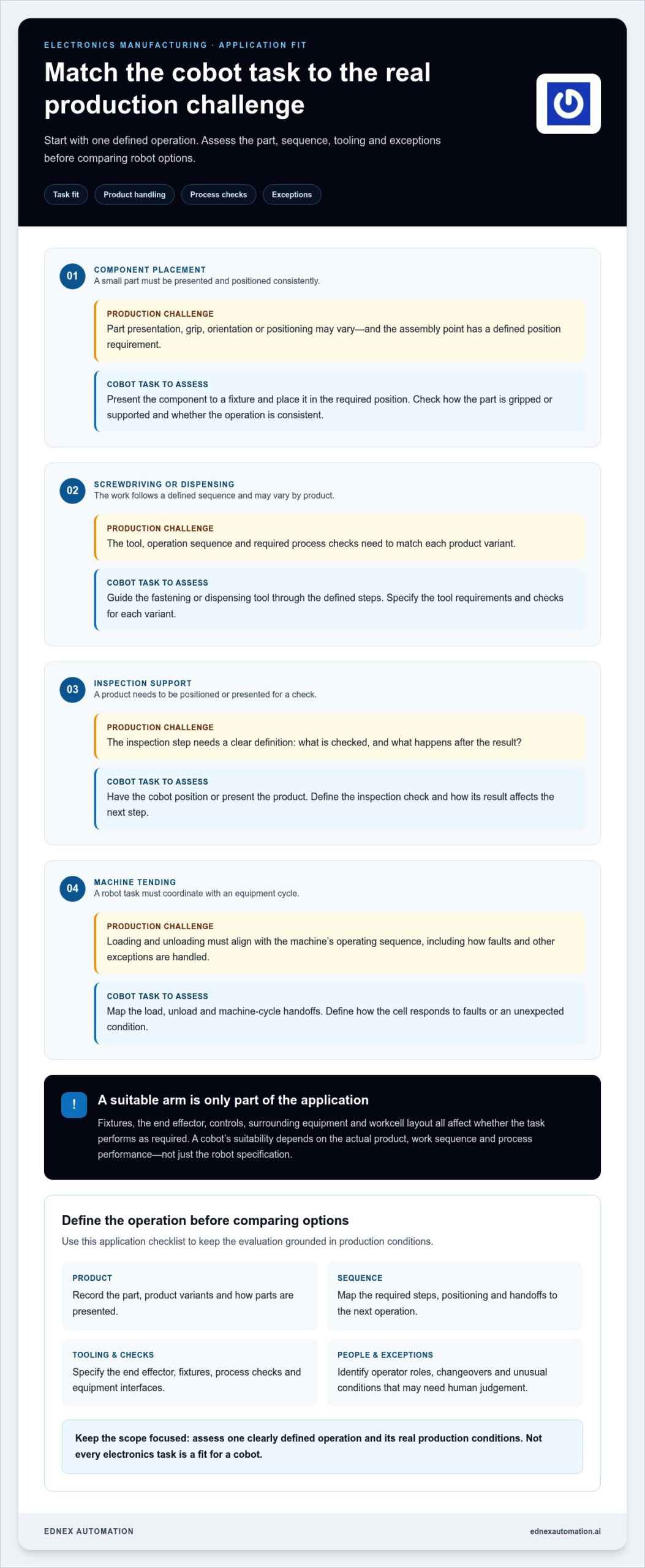
Potential applications include component placement, screwdriving, dispensing, inspection support and machine tending. For example, a cobot might present a component to a fixture, guide a fastening tool through a defined sequence or load and unload a machine. These are tasks to assess against the actual process, not a guarantee that every operation will suit a cobot.
For cobots for electronics manufacturing, suitability depends on the product, work sequence and required process performance. Determine what the robot must reach, how the component can be gripped or supported, and whether the tooling can perform the operation consistently. Also account for product variants and exceptions that may require operator intervention.
- Component placement: Assess part presentation, grip, orientation and the positioning required at the assembly point.
- Screwdriving or dispensing: Define the sequence, tool requirements and process checks for each product variant.
- Inspection support: Specify what the cobot positions or presents, what the inspection checks and how the result affects the next step.
- Machine tending: Map loading, unloading and coordination with the machine cycle, including how faults and other exceptions are handled.
Start with one clearly defined operation and its real production conditions. Record the part, sequence, required checks and exceptions before comparing robot options. This keeps the evaluation focused on process fit instead of assuming that choosing an arm alone will resolve the wider automation challenge.
How Cobots Work Alongside People and Electronics Production Equipment
A cobot cell is a coordinated work area, not simply a robot arm placed beside an operator. The arm follows programmed movements, while an end effector, the tool attached to its end, interacts with parts or equipment. That tool might grip a component, drive a fastener or dispense material. Fixtures locate and support the product, helping keep each operation aligned with the process.
Control interfaces connect the cobot’s task sequence with equipment and, where needed, operator inputs. A cycle might begin when a correctly loaded fixture signals that a component is ready. The robot performs its assigned step, then signals that the station can proceed. Operators may replenish components, supervise normal cycles and handle exceptions such as a misplaced part or a changeover. Define each handoff so the cell doesn’t advance before a required step is complete.
How a cobot cell connects with assembly tools and equipment
Tooling and station design determine how the cobot interacts with the product. A gripper needs a suitable way to hold the part; a screwdriver or dispenser must perform the intended operation; sensors can provide information about part presence or process state. Fixtures and consistent part presentation establish repeatable starting positions, while task sequencing defines when each action happens.
The cobot must also coordinate with the relevant machine or station. Machine tending, for example, requires robot movements to align with the equipment’s operating sequence so loading or unloading happens at the appropriate point. Where production controls need to exchange signals with a cobot cell, PLC and SCADA integration can form part of the broader controls architecture. EdNex Automation’s industrial controls integration guide provides further context on coordinating these systems.
What human-robot collaboration means in practice
Collaboration can take different forms. In a human-led arrangement, an operator performs the main task while the cobot handles a defined supporting action. In a robot-assisted process, the robot repeats a step while the operator supplies parts or checks outcomes. A more automated arrangement may let the cobot complete a defined cycle, with a person overseeing production and responding to exceptions. The Benefits of Cobots in Manufacturing resource from the National Institute of Standards and Technology offers broader manufacturing context.
Collaboration depends on application-specific risk assessment and cell design, not on the cobot label alone. The assessment needs to consider the robot, tool, workpiece, layout and how people enter or interact with the work area. Collaborative intent doesn’t remove that responsibility, and no single safety feature or operating arrangement should be assumed to suit every model or task.
For cobots for electronics manufacturing, define the operator’s role, exception path and equipment handoffs as part of the cell design. EdNex Automation’s cobot and automation integration capabilities connect robot selection with the wider production-system discussion.
How to Compare Cobots for Electronics Manufacturing
Compare the application, not just the robot specifications. Start with each candidate task and record what the process requires, what the cobot must do and how the cell will fit existing production. Build a comparison table with one row per task, such as component placement or machine tending, and apply the same criteria to each. This makes trade-offs visible and helps prevent a strong specification in one area from masking a poor process fit.
Match robot capabilities to the task
Start with the part and the full movement the task requires. Include the weight of the workpiece and tooling when assessing payload, then map reach against the actual working envelope, fixtures and access points. Compare repeatability with the positioning consistency the process requires. Assess cycle-time needs using production records rather than estimates. Account for the end effector, sensing and how parts arrive at the work area.
Use the comparison to capture both requirements and assessment questions. A component-placement task may need stable part presentation and controlled positioning, while machine tending depends on access to the station and coordination with its cycle. Record evidence from the existing process, then identify where testing or validation is needed. A published specification alone doesn’t demonstrate how the complete cell will perform.
- Payload: What is the combined weight of the part, gripper and any attached tooling?
- Reach and access: Can the arm reach each required position without obstructing fixtures, equipment or operator access?
- Repeatability: What positioning consistency does the process require, and how will the completed operation be checked?
- Cycle time: How long does the current task take, and what cycle does the production sequence require?
- Tooling and presentation: How will parts be held, oriented and supplied, and what tools or sensing support the task?
- Integration and maintenance: What signals or interfaces must connect with existing equipment, and how will routine adjustments and upkeep fit operations?
Compare production flexibility and integration needs
Product variants can change the programming, fixtures, tool setup and station layout needed for each run. Include changeovers in the comparison: note which settings or components must change, who performs the change and how the correct configuration is selected. Document operator interaction and exception handling too, so a candidate isn’t judged only on its normal cycle.
Assess the control interfaces needed to coordinate the cobot with existing equipment; don’t assume compatibility is plug-and-play. Consider the work required to define signals, sequence actions and validate the complete cell. Human-robot collaboration planning is also part of the decision. EdNex Automation’s cobot strategy guide provides additional context. The strongest candidate is the one whose capabilities, tooling and integration needs align with the real process, not simply the one with the most impressive specification.
How to Assess Cobot Readiness Before Selecting a Solution
A structured readiness assessment turns a broad automation idea into a defined engineering brief. For cobots for electronics manufacturing, the goal is to understand the task, its production context and the conditions a solution must meet before comparing robot options. Use this sequence to build a clear picture.
- Select a target task. Choose a specific operation with clear inputs and outputs, rather than starting with a goal to automate an entire line. Note why it’s being considered, such as repetitive handling or a defined assembly step.
- Document the current process. Record the task sequence, cycle-time expectations, quality checks, product variants, operator actions and exception cases. Include handoffs to upstream and downstream stations.
- Define the intended outcomes. Set measurable acceptance criteria before reviewing solutions. These might include meeting a documented cycle requirement, maintaining a defined quality check or reducing manual handling at a particular step.
- Assess constraints and trial conditions. Map the workstation, tooling, part presentation, equipment interfaces and worker interaction points. Where feasible, run a representative process trial with real parts under relevant production conditions.
Build a process brief for the target application
A useful brief describes the operation as it actually runs, not just its ideal cycle. Capture workstation dimensions, component presentation, tools, surrounding equipment and variations between products. Describe what happens when a part is missing, misaligned or outside the expected condition, and who resolves the issue.
Define acceptance criteria that can be assessed during a trial. For example, specify the required sequence, relevant quality checks and cycle-time expectation using validated process information. Clear criteria help distinguish a solution that completes a demonstration from one that fits production demands.
Plan for safety, validation, and production readiness
Assess the complete workcell under intended operating conditions, including the robot, end effector, workpiece, fixtures, layout and nearby equipment. Map where workers load parts, clear exceptions, perform changeovers or access the station for maintenance. Consider foreseeable risks during normal cycles and non-routine events, then plan access, guarding and emergency response as part of cell design.
Safety isn’t established by the cobot label alone. Identify the standards and regulatory requirements applicable to the project, then verify them against the relevant jurisdiction and application. Validation should examine the integrated cell and its operating procedures, rather than treating the robot arm as a standalone device.
Before moving forward, confirm that the process brief, acceptance criteria, trial plan and safety considerations align. This creates a decision record that production, engineering and operators can use to assess readiness and identify unresolved constraints. EdNex Automation’s robotics and integration capabilities support application-led assessment; its cobot application information provides an overview.
Integrating Cobots into an Electronics Manufacturing System
A cobot project succeeds when the robot application is engineered as part of the production system. For cobots for electronics manufacturing, that means aligning the task, workcell, people, equipment and controls before deployment, then validating the integrated process against agreed acceptance measures. A robot arm alone can’t manage every handoff or production condition.
Integration typically moves through four connected stages: define the application, design the cell, integrate it with relevant equipment and controls, then validate its operation. Each stage informs the next. The selected robot and tooling depend on the part and task, while station layout and production sequencing shape where the cell fits and how operators interact with it.
What an integrated cobot deployment needs to account for
Cell design brings together the robot, end-of-arm tooling, safety measures and station interfaces. A gripper or process tool must suit the part and task; fixtures and part presentation support consistent positioning; and the equipment interface helps coordinate the work sequence. Operator access, loading, changeovers and exception handling also affect the cell configuration.
Controls coordination defines how the cobot cell exchanges relevant signals with existing production equipment. PLC and SCADA integration can support communication across industrial systems, helping connect the application to wider operational controls. Define the interface and sequence around the actual process instead of assuming that different equipment will connect without configuration or validation.
Move from application assessment to a defined project
Project scoping should bring the process brief and comparison work into one practical plan. Capture the task sequence, product variants, cycle expectations, tooling, existing equipment, operator roles and exception paths. Then document the candidate robot requirements, integration interfaces, identified risks and measurable acceptance criteria. This gives engineering and production teams a shared basis for design and validation.
Validation should examine the complete application under representative operating conditions, including relevant parts, changeovers and interactions with connected equipment. Review the intended workflow and safety measures as part of the cell, and verify applicable standards and regulatory requirements against the project context. This helps identify integration gaps before the system is relied on in production.
EdNex Automation supplies collaborative robots and integrates industrial automation systems, connecting cobot selection with the process and controls environment. Its PLC and SCADA integration capabilities can contribute to planning how an application communicates with existing production systems. The project scope should reflect the complete application, rather than a robot selection made in isolation.
For an electronics-manufacturing automation requirement, explore EdNex Automation’s robotics solutions to see how cobot and integration planning can align with the production process.
Turn Your Cobot Evaluation into a Practical Next Step
Treat automation as a planned capability, not a one-time equipment purchase. A well-scoped electronics application can provide a foundation for future decisions as product mixes, production priorities and line requirements evolve. Identify the internal stakeholders who will own the process, review the proposed cell and define how its performance will be evaluated over time.
With cobots for electronics manufacturing, the opportunity lies in matching the technology to a real production need and building an integration plan around it. EdNex Automation supplies collaborative robots and provides robotics and industrial automation integration, bringing the robot application into a wider production-system context.
Ready to explore a cobot application for your operation? Explore EdNex Automation’s robotics solutions and discuss how cobot integration can fit your production process.
Frequently Asked Questions
Can cobots handle delicate electronic components?
A cobot can handle delicate components when the complete setup suits the part and operation. Assess the component’s shape, fragility, surface and acceptable contact points, then select tooling and movement settings suited to it. For a fragile connector, for example, test whether the part stays secure during transfer and seats correctly without excessive force. Include any handling controls required by the component or production process.
Are cobots suitable for PCB assembly?
They can suit specific PCB assembly steps, but a cobot isn’t automatically a replacement for equipment designed for a specialized production process. Assess the board’s size and support, the operation’s positioning requirements, and how the board is presented and secured. A cobot may be considered for a defined handling or assembly task, while densely populated board placement may call for a different process solution. Judge the specific operation, not the label “PCB assembly.”
Do cobots need special tooling for electronics manufacturing?
Tooling needs depend on the component and operation. A task may require a gripper shaped to hold a part securely, or a process tool suited to fastening or dispensing. Consider contact points, component variation, access to the work area and how tooling changes are handled during product changeovers. The tool’s weight and dimensions also affect the robot’s usable payload and reach, so assess the complete tool-and-part combination for the intended task.
Can a cobot work with existing electronics assembly equipment?
Integration depends on the equipment interfaces and production sequence. Map the signals and conditions needed for a coordinated handoff, such as when a station is ready, when the cobot may begin, and how completion or a fault is communicated. Also define recovery behavior after a stop. This interface plan helps identify the controls work needed to connect a cobot cell with existing equipment.
How do cobots support quality checks in electronics production?
A cobot can help present or position a product consistently for a separate inspection step, such as checking that a component is present or correctly oriented. The inspection method still needs to define what counts as acceptable and how results affect the next operation. For example, specify whether a failed check pauses the sequence or sends the part for review. Robot movement alone doesn’t verify product quality.
What data should manufacturers collect before assessing a cobot application?
Collect production records that show how the task performs during normal runs and exceptions. Useful details include cycle-time variation, stoppage causes, rework or defect categories, changeover frequency and the operator time the step requires. Record product variants and part dimensions, along with the station layout and equipment signals involved. These details help distinguish a genuine process constraint from an assumption and provide a practical baseline for evaluating a proposed application.