The industrial sector’s contribution to the UAE national economy reached USD 54.5 billion by mid-2026, yet many manufacturers still view automation through the narrow lens of upfront expense rather than long-term equity. While high capital expenditure anxiety is a valid concern for any facility manager, focusing solely on the sticker price ignores the sophisticated reality of modern production. Calculating the ROI of collaborative robots in UAE facilities requires a shift from viewing hardware as a cost to understanding it as a strategic asset that mitigates the rising pressures of Emiratization quotas and the 6,000 AED minimum wage for Emirati citizens.
This guide provides the intellectual framework necessary to quantify both the hard financial gains and the critical soft benefits that define success in a high-tech economy. We’ll examine how bespoke integration with existing PLC and SCADA systems reduces operational expenditure while ensuring compliance with the mandatory UAE AI Act 2026 self-assessments. By moving beyond simple labor replacement, you’ll discover a methodical approach to achieving consistent quality and safety across your industrial ecosystem, ensuring your organization remains competitive in a knowledge-led future.
Key Takeaways
- Understand how national industrial strategies and evolving labor standards are mandating a transition toward high-precision automation across the UAE.
- Learn to differentiate between Total Cost of Ownership (TCO) and Total Value of Ownership (TVO) to capture the full spectrum of financial and operational gains.
- Access specific financial benchmarks to accurately project the ROI of collaborative robots in UAE relative to traditional industrial automation systems.
- Implement a structured framework for auditing manual process costs and factoring in the complete integration requirements of hardware and software.
- Discover how bespoke robotic architecture and systematic PLC integration secure long-term capital efficiency and business viability.
The Evolving Industrial Landscape: Why Cobot ROI is Critical in 2026
The industrial sector’s contribution to the national economy reached USD 54.5 billion as of May 2026, marking a 70% increase since 2021. This rapid expansion demands a transition from traditional manual assembly to high-precision, autonomous systems. As the UAE matures into a global technology leader, the ROI of collaborative robots in UAE manufacturing has become the primary metric for assessing capital efficiency. 2026 represents a definitive tipping point where the cost of operational stagnation now exceeds the investment required for systematic modernization.
National Vision and Industrial Digital Transformation
Strategic initiatives such as Operation 300bn and the “Make it in the Emirates” campaign are fundamentally reshaping the regional production landscape. These government-led mandates prioritize the adoption of advanced technology to secure long-term business viability in an increasingly competitive market. Within the UAE manufacturing context, Industry 4.0 is defined as the systematic integration of intelligent robotics, real-time data exchange, and cognitive computing to drive autonomous production excellence. Deploying a collaborative robot (cobot) allows facilities to align with these national productivity targets while maintaining the flexibility required for rapid market shifts.
Addressing the Labor-Efficiency Paradox
The historical reliance on low-cost manual labor is no longer a sustainable strategy for regional manufacturers. New regulatory requirements, including the 6,000 AED minimum monthly wage for Emirati citizens and the 10% Emiratization target for large companies by late 2026, have significantly altered the operational expenditure (OpEx) profile. This shifting economic environment creates a paradox where human labor is both essential and increasingly expensive for repetitive or low-value tasks.
By integrating collaborative robots UAE, organizations bridge the gap between human ingenuity and mechanical precision. These systems don’t replace the workforce; they augment it by handling ergonomically taxing or high-frequency actions with sub-millimeter accuracy. This synergy optimizes throughput and ensures quality consistency, directly addressing the rising costs of inefficiency. Organizations that adopt this intellectual framework for automation ensure they remain compliant with the standards set by the Federal Artificial Intelligence and Data Authority while maximizing their production output.
Decrypting the ROI Equation: Beyond Simple Labor Replacement
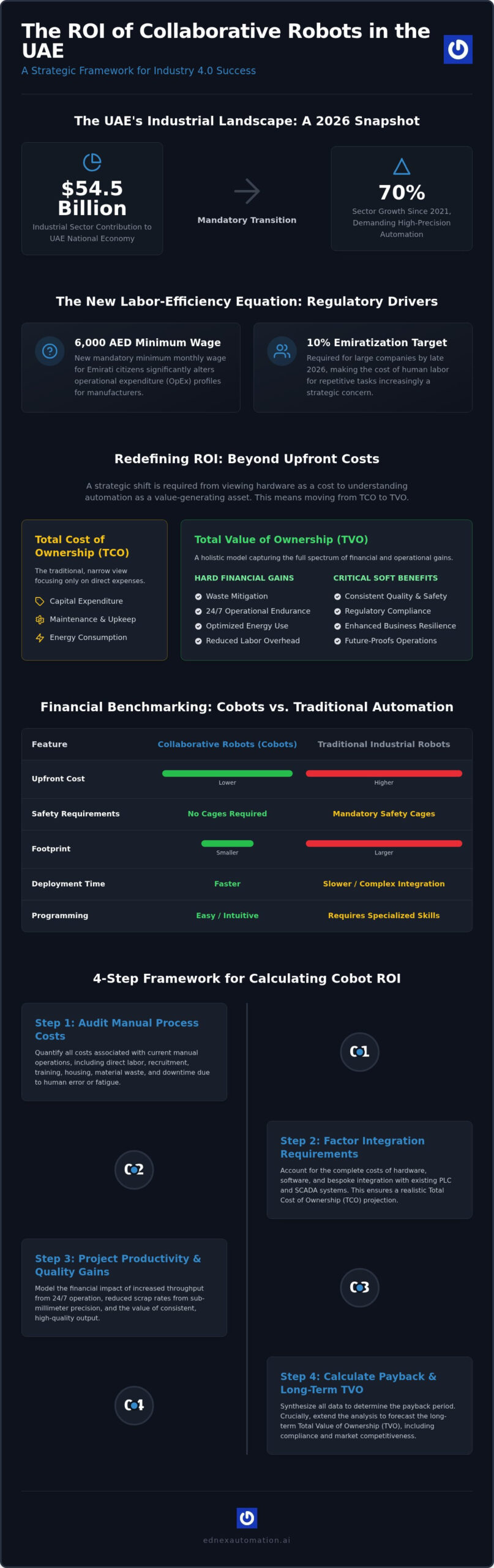
Calculating the ROI of collaborative robots in UAE facilities requires a sophisticated understanding of both Total Cost of Ownership (TCO) and Total Value of Ownership (TVO). While TCO accounts for the capital expenditure and maintenance, TVO captures the holistic impact of automation on business resilience. Relying on simple labor-cost displacement models often underestimates the true financial impact of modern systems. A comprehensive analysis must integrate financial benchmarking and market trends to project how 24/7 operational capability transforms production throughput into a competitive advantage.
Quantifying Hard Financial Gains
Direct fiscal benefits stem from the precision and endurance of advanced automation. Beyond the 6,000 AED minimum wage for Emirati citizens, manufacturers must account for hidden overheads such as recruitment, specialized training, and employee housing. Transitioning to collaborative robots significantly reduces material waste by eliminating human variance in high-frequency tasks. When these units are integrated with intelligent PLC and SCADA systems, they optimize energy consumption by adjusting power usage based on real-time demand, ensuring every kilowatt contributes to output.
- Waste Mitigation: Drastic reduction in material scrap rates via sub-millimeter precision.
- Operational Endurance: Consistent throughput across three shifts without fatigue-related downtime.
- Energy Efficiency: Optimized power management through bespoke PLC control architecture.
The Strategic Value of Soft ROI
Soft benefits are often difficult to quantify but remain essential for long-term business viability. Risk mitigation is a primary driver; by complying with ISO 10218 and ISO/TS 15066 safety standards, organizations reduce workplace injuries and lower insurance premiums. Additionally, the inherent flexibility of cobots allows for rapid repurposing across different production lines without the need for bulky safety cages. This space optimization enables higher density production within existing footprints, maximizing the utility of every square meter of industrial space.
Employee retention also improves as robots take over ergonomically taxing or hazardous duties, allowing the workforce to focus on high-value supervisory roles. For organizations looking to secure their future, evaluating these metrics is the first step toward a comprehensive robotic integration strategy. This systematic approach ensures that the ROI of collaborative robots in UAE is realized through a more agile, safe, and resilient operational model that attracts top-tier talent and enhances brand reputation.
Financial Benchmarking: Cobots vs. Traditional Industrial Robotics
Analyzing the ROI of collaborative robots in UAE industrial environments reveals a stark contrast in capital allocation compared to traditional fixed automation. While conventional industrial robots are engineered for high-speed, heavy-payload tasks, they necessitate a rigid and expensive infrastructure. These traditional systems often require dedicated safety perimeters, specialized reinforced flooring, and extensive downtime during installation. In contrast, collaborative systems are designed for flexibility, allowing manufacturers to bypass the high secondary costs associated with safety cages and massive facility modifications. According to The International Federation of Robotics’ annual “World Robotics” report, the global shift toward flexible automation is accelerating as organizations seek to balance high-precision output with lower entry barriers.
Long-term operational expenditure (OpEx) also differs significantly between the two technologies. Traditional robotics demand highly specialized technicians for even minor programming changes, often leading to reliance on expensive external consultants. Collaborative units utilize modular designs and simplified maintenance protocols, which reduces the total cost of ownership over a five-year horizon. By eliminating the “hidden costs” of safety barriers and expansive floor space requirements, cobots deliver a more efficient use of the industrial footprint, maximizing the revenue potential of every square meter.
Deployment Speed and Opportunity Cost
Rapid deployment serves as a critical differentiator in the competitive UAE market, where time-to-market often dictates business success. While traditional industrial robots typically require months for full operational deployment due to complex logic programming and safety auditing, collaborative systems can be integrated into production lines within a matter of days. This speed minimizes production downtime and mitigates the high opportunity cost associated with stalled manufacturing cycles. Unlike traditional units that require expert-level syntax coding for every new task, cobots feature intuitive graphical interfaces and hand-guiding capabilities that allow existing floor staff to manage routine adjustments independently.
Integration with Existing Infrastructure
Leveraging specialized PLC and SCADA integration services ensures that new robotic assets communicate seamlessly with legacy machinery, preventing the need for total facility overhauls. This intelligent framework allows for the incremental scaling of automation, enabling organizations to add units as production demand fluctuates rather than committing to massive upfront investments. By positioning cobots within a larger automated ecosystem that includes ASRS and AMRs, manufacturers achieve a superior ROI of collaborative robots in UAE through a systematic and scalable approach to modernization. This strategy secures long-term business viability by ensuring that every technological addition enhances the overall efficiency of the existing infrastructure.
A Step-by-Step Framework for Calculating Cobot ROI in the UAE
Achieving a predictable ROI of collaborative robots in UAE manufacturing requires a systematic five-step financial model. This approach moves beyond estimation to provide a concrete roadmap for capital allocation. Organizations must treat automation as a comprehensive system rather than a standalone tool to capture the full economic benefit.
- Step 1: Quantify the current baseline by auditing manual assembly costs, including the 6,000 AED minimum monthly wage for Emirati citizens and associated recruitment overheads.
- Step 2: Aggregate the total integration price, which encompasses the robotic arm, bespoke end-effectors, and essential PLC/SCADA software configurations.
- Step 3: Forecast production throughput gains by modeling 24/7 operational cycles and the reduction in scrap rates achieved through sub-millimeter precision.
- Step 4: Integrate UAE-specific variables, such as the avoidance of non-compliance fines for 2026 Emiratization targets and regional energy consumption rates.
- Step 5: Calculate the final payback period, which typically ranges between 12 and 18 months for optimized industrial applications.
Data-Driven Auditing for Accurate Forecasts
Identifying ‘low-hanging fruit’ applications, such as high-frequency palletizing or hazardous machine tending, ensures an immediate impact on the balance sheet. By utilizing traffic and task data from autonomous mobile robots, facility managers can pinpoint the exact locations where human-robotic collaboration will yield the highest throughput. Setting realistic KPIs for the initial 12 months is vital for securing stakeholder approval for larger-scale automation rollouts. This data-centric approach minimizes the risk of capital misallocation and provides clear evidence of operational improvement.
Accounting for Regional Economic Factors
Regional manufacturers must future-proof their investments against evolving regulatory frameworks. The UAE AI Act 2026 mandates specific compliance standards that are best met through high-level systems integration rather than isolated hardware purchases. Additionally, evaluating the cost of specialized technical personnel against the reliability of an automated system reveals that robots provide a more stable OpEx profile. This stability is critical as companies strive to meet the 10% Emiratization target by December 31, 2026, without sacrificing production speed. By automating repetitive tasks, you’re free to elevate your Emirati workforce into high-value supervisory and technical roles.
If you’re ready to transition from manual bottlenecks to autonomous excellence, consult with our robotic integration specialists to design a bespoke roadmap for your facility.
Maximizing Capital Efficiency with EdNex Automation Systems
Achieving the projected ROI of collaborative robots in UAE facilities depends less on the hardware itself and more on the precision of its integration into the existing industrial fabric. EdNex Automation acts as a high-level consultant and technical partner, ensuring that every robotic deployment is part of a larger, synchronized ecosystem designed for maximum capital efficiency. By moving beyond the role of a simple equipment vendor, we provide the intellectual framework required to bridge the gap between global technological breakthroughs and the specific economic requirements of the UAE national market. Our visionary approach prioritizes the delivery of high-level solutions that solve complex industrial challenges through controlled and deliberate innovation.
Bespoke Integration for Optimized Performance
Maximizing throughput requires a seamless connection between disparate automated components. By customizing automated storage and retrieval systems to work in tandem with cobot pickers, we eliminate the bottlenecks often found in fragmented production lines. The EdNex advantage lies in our specialized expertise in PLC and SCADA synchronization, which allows for real-time data exchange and hardware optimization. This expert-led deployment strategy significantly reduces integration risk, ensuring that your transition to Industry 4.0 is both systematic and reliable. Every clause of our integration plan serves a specific informative purpose, focusing on risk mitigation and the delivery of tangible business outcomes.
Partnering for Sustainable Industrial Growth
Securing long-term business viability in a competitive global trade hub demands more than just a one-time installation. We provide a comprehensive support structure that includes start-to-finish expertise, from initial feasibility studies to advanced technical training for your workforce. Our status as a specialized division of the EdNex group ensures that every solution is backed by official certifications and alliances with global entities, providing the legitimacy required for large-scale industrial transformation. This methodical approach guarantees that the ROI of collaborative robots in UAE is not a short-term gain, but a foundation for permanent operational excellence and modernization.
Every organization wishing to remain competitive in the future must evolve to meet the demands of a high-tech economy. We invite you to contact EdNex Automation to begin your ROI-focused transformation and secure your place at the cutting edge of the UAE’s industrial revolution.
Securing Long-Term Viability through Autonomous Excellence
Transitioning toward a fully automated industrial ecosystem requires a fundamental shift from viewing robotics as a standalone acquisition to treating it as a core component of business resilience. By implementing a clear financial framework that accounts for both hard labor displacement and soft operational agility, manufacturers can reliably project the ROI of collaborative robots in UAE facilities. Ensuring long-term viability, this strategic investment allows your organization to remain competitive while navigating the complexities of the 2026 economic environment and the rising costs of manual labor.
Leveraging industry-leading PLC and SCADA integration expertise, EdNex Automation provides the intellectual framework necessary to scale production without compromising quality. As an authorized partner for world-class robotic technologies with a comprehensive national support network across the UAE, we’re dedicated to ensuring your modernization journey is both systematic and successful. Secure your industrial future with an EdNex Automation ROI consultation and begin building a more efficient, high-precision operation today. We’re ready to help you lead the region’s industrial transformation through controlled and deliberate innovation.
Frequently Asked Questions
What is the typical payback period for collaborative robots in the UAE?
The typical payback period for collaborative robots in the UAE generally ranges between 12 and 18 months for most industrial applications. This timeline is accelerated by the rising costs of manual labor and the high precision required in modern manufacturing. By calculating the total value of ownership rather than just the initial price, facility managers can see a rapid return on their capital through increased throughput and reduced scrap rates.
How do collaborative robots reduce operational costs compared to manual labor?
Cobots reduce operational expenditure by augmenting the human workforce and handling repetitive, high-frequency tasks with sub-millimeter accuracy. They mitigate the financial impact of the 6,000 AED minimum monthly wage for Emirati citizens and help companies meet the 10% Emiratization target by late 2026. This transition allows human employees to focus on high-value supervisory roles, which optimizes the overall production efficiency and reduces the cost of material waste.
Can cobots be integrated with existing PLC and SCADA systems in my factory?
Yes, collaborative robots are designed for seamless integration with existing PLC and SCADA systems to ensure a unified industrial ecosystem. EdNex Automation specializes in these technical configurations, allowing for real-time data exchange and hardware optimization across the factory floor. This connectivity is essential for monitoring the ROI of collaborative robots in UAE facilities, as it provides the granular data needed to track energy consumption and production consistency over time.
What are the hidden costs of implementing collaborative robots?
While the primary investment covers the robotic arm, secondary costs often include specialized end-effectors, software licensing, and comprehensive employee training programs. Facility managers must also budget for annual maintenance and the integration of advanced sensors required for specific safety protocols. Accounting for these variables during the initial planning phase ensures an accurate financial forecast and prevents unexpected budget overruns during the deployment of your automated systems.
Is a cobot investment suitable for small to medium-sized enterprises in the UAE?
Cobot investment is highly suitable for small to medium-sized enterprises (SMEs) due to their lower initial capital requirements compared to traditional fixed robotics. Their modular design and ease of programming allow smaller facilities to automate specific production stages without needing a complete infrastructure overhaul. This flexibility makes them a critical tool for SMEs aiming to scale their operations and remain competitive in a technology-led national economy.
How does the flexibility of a cobot impact its long-term ROI?
The inherent flexibility of a cobot significantly enhances its long-term ROI by allowing for rapid repurposing across different production lines. Unlike traditional robots that are bolted to the floor, cobots can be redeployed to handle new tasks as market demands shift. This adaptability ensures the hardware remains a productive asset for years, providing a sustainable intellectual framework for continuous industrial improvement and long-term business viability.
What safety standards must cobots meet for industrial use in the UAE?
Collaborative robots must comply with international safety standards, specifically ISO 10218 and ISO/TS 15066, to operate alongside human workers without physical barriers. In the national context, organizations must also adhere to the UAE AI Act 2026, which mandates self-assessments for all deployed AI and robotic systems. Ensuring these standards are met is vital for risk mitigation, as it reduces workplace injuries and helps lower corporate insurance premiums.
How do cobots compare to traditional industrial robots in terms of maintenance costs?
Collaborative robots typically incur lower maintenance costs than traditional industrial units because they utilize modular components and simplified programming interfaces. Traditional systems often require expensive external consultants for routine adjustments, whereas cobots can often be managed by internal staff after basic training. This reduction in specialized labor costs, combined with fewer mechanical complexities in lower-payload applications, makes cobots a more cost-effective choice for many regional manufacturers.