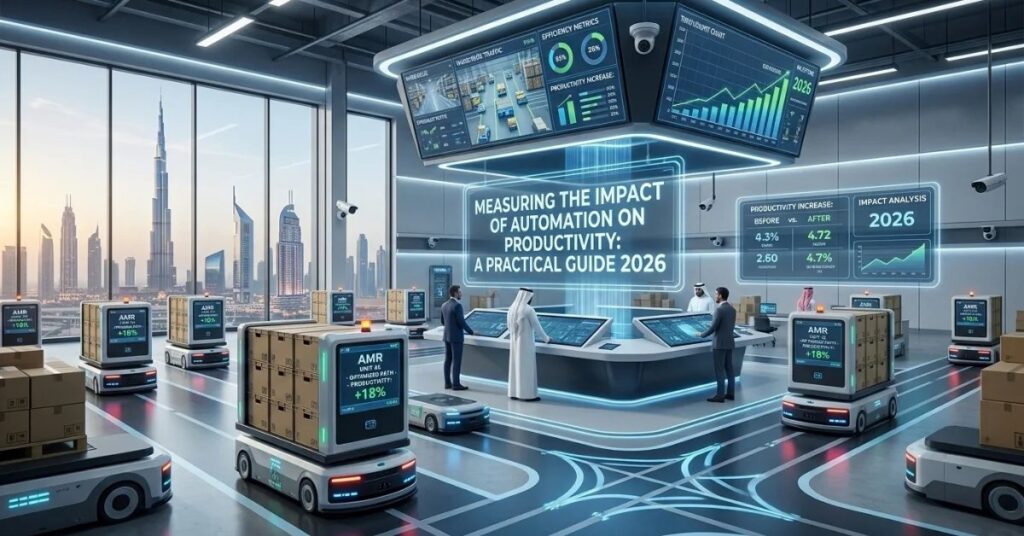
With the global cobot market projected to reach up to $3.6 billion in 2026, many UAE manufacturers still treat automation as a simple hardware purchase rather than a systemic evolution. You likely understand that integrating advanced robotics into legacy environments feels like a high-stakes gamble, especially when balancing the new ISO 10218:2025 safety standards with the need for immediate operational ROI. This cobot implementation guide provides the authoritative technical framework required to bridge the gap between ambitious industrial strategy and functional floor-level execution. We’ll examine how to align your deployment with the UAE’s Operation 300bn strategy, ensuring seamless PLC and SCADA interconnectivity while securing the long-term resilience of your production lines. By following this roadmap, you’ll transform complex infrastructure into a streamlined, high-output ecosystem that leverages the latest in agentic AI and collaborative intelligence. We’ll detail the exact steps to move from fragmented legacy systems to a unified, risk-mitigated environment that meets the rigorous demands of the modern industrial sector.
Key Takeaways
- Align your automation strategy with the UAE’s Industry 4.0 initiatives to ensure your facility meets MoIAT standards for advanced industrial transformation.
- Master the technical specifications of payload and degrees of freedom to select the optimal robotic architecture for your specific workspace constraints.
- Utilize this comprehensive cobot implementation guide to establish secure communication between collaborative systems and existing PLC or SCADA infrastructure.
- Follow a disciplined 5-phase roadmap that prioritizes virtual simulation and infrastructure preparation to minimize deployment risks and operational downtime.
- Implement robust performance analytics to track cycle times and utilize strategic frameworks to realize a quantifiable return on investment.
Evaluating the Strategic Necessity of Collaborative Robotics in the UAE
Defining a collaborative robot (cobot) goes beyond simple machinery; it represents the strategic fusion of human cognitive dexterity with high-precision robotic execution. This cobot implementation guide serves as the intellectual framework for organizations seeking to transition from traditional, isolated automation to a more fluid, integrated production environment. Unlike conventional industrial robots that require heavy cage-based isolation and specialized safety zones, cobots are engineered for proximity. They utilize advanced sensors and power-limiting technologies to allow for a shared workspace that maximizes both safety and operational flexibility. This proximity enables a hybrid workforce where humans and machines collaborate on complex tasks, driving a level of efficiency that rigid, traditional systems cannot replicate.
Aligning these technological deployments with the UAE’s Industry 4.0 initiatives is no longer optional for competitive manufacturers. The Ministry of Industry and Advanced Technology (MoIAT) has established rigorous standards that favor intelligent, interconnected systems capable of driving national productivity. By integrating these autonomous solutions, businesses don’t just upgrade their hardware; they contribute to a broader economic resilience that reduces reliance on external supply chains. These systems are designed for rapid redeployment, making them ideal for the high-mix, low-volume production cycles that define the modern industrial landscape in the region.
The Role of Cobots in Operation 300bn
The UAE government’s Operation 300bn strategy sets an ambitious target to increase the industrial sector’s contribution to the GDP to AED 300 billion by 2031. Collaborative automation acts as a primary catalyst for this growth, providing the scalability required to meet global demand without exponentially increasing overhead. This shift necessitates a transition from manual labor to high-tech supervisory roles, where human workers manage fleets of intelligent systems rather than performing repetitive physical tasks. Establishing local technical partnerships is critical for achieving true industrial autonomy, ensuring that the intellectual property and maintenance capabilities remain within the regional ecosystem. This systematic approach to automation ensures that the UAE remains a global hub for advanced manufacturing and technological innovation.
Identifying Optimal Use Cases for Initial Deployment
Successful integration begins by identifying repetitive tasks that currently bottleneck production throughput. High-impact applications such as palletizing, machine tending, and precision assembly offer the most immediate path to ROI because they offload dull, dirty, or dangerous tasks from the human workforce. Evaluating these bottlenecks allows engineers to deploy cobots where their precision can stabilize cycle times and reduce defect rates. For a deeper tactical analysis of how these systems differ from legacy hardware, consult our cobot vs industrial robot comparison. This cobot implementation guide highlights that the goal isn’t replacement, but the augmentation of human capability to achieve unprecedented levels of manufacturing efficiency. By focusing on ergonomic improvements and safety compliance, organizations can foster a more sustainable and productive industrial environment.
Technical Specification: Selecting the Optimal Cobot Architecture
Selecting the ideal robotic architecture requires a precise alignment between mechanical capabilities and the specific operational intent of the facility. This cobot implementation guide emphasizes that hardware selection is not merely a procurement task, but a critical engineering decision that dictates the long-term viability of the automation cell. Engineers must conduct a rigorous analysis of the total payload, which necessitates calculating the combined mass of the end-effector and the workpiece. Failing to account for the weight of specialized grippers or vacuum tools often leads to premature motor fatigue or safety-stop triggers during high-velocity maneuvers. By matching the robot’s torque limits to the actual application, manufacturers ensure stable operation while maintaining the agility needed to augment and enhance human capabilities within shared workspaces.
Accounting for environmental variables is equally vital, particularly within the unique industrial climate of the UAE. High ambient temperatures and potential exposure to fine particulate matter require robots with appropriate Ingress Protection (IP) ratings, typically IP54 or higher, to prevent internal component degradation. Integrating user-friendly interfaces and lead-through programming capabilities allows floor operators to teach new paths by physically moving the robot arm, which significantly reduces the technical barrier to redeployment. This flexibility ensures that the system remains a versatile asset rather than a static fixture, allowing for rapid transitions between different product lines as market demands shift.
Assessing Payload, Reach, and Precision Requirements
Defining the relationship between cycle time and speed limits is essential for maintaining a safe collaborative environment. While increased speeds improve throughput, they also expand the required safety buffer zones according to ISO standards. Over-specifying payload capacity should be avoided as it leads to unnecessary energy expenditure and larger footprints that may infringe on existing walkways. Precision is measured through repeatability, which in 2026 standards is defined as the system’s ability to return to a programmed position within a sub-millimeter deviation, typically +/- 0.03mm, across thousands of cycles under varied thermal conditions. Balancing these three factors ensures the chosen architecture supports the specific throughput targets of the project without compromising safety.
End-of-Arm Tooling (EOAT) and Sensor Integration
Choosing the correct end-of-arm tooling is what transforms a generic robotic arm into a specialized industrial solution. Whether deploying pneumatic grippers for heavy lifting or high-precision vision systems for quality inspection, the tooling must be fully compatible with the cobot’s native controller. Utilizing advanced vision sensors enhances autonomy, allowing the system to identify part orientation and adjust its path in real-time. To ensure these sophisticated components work in harmony, it’s often beneficial to explore integrated robotic solutions that prioritize seamless hardware handshakes. Establishing a robust communication protocol between the cobot and third-party sensors prevents data bottlenecks, ensuring that the entire system operates as a single, intelligent unit within the production line.
System Architecture: PLC, SCADA, and Safety Compliance
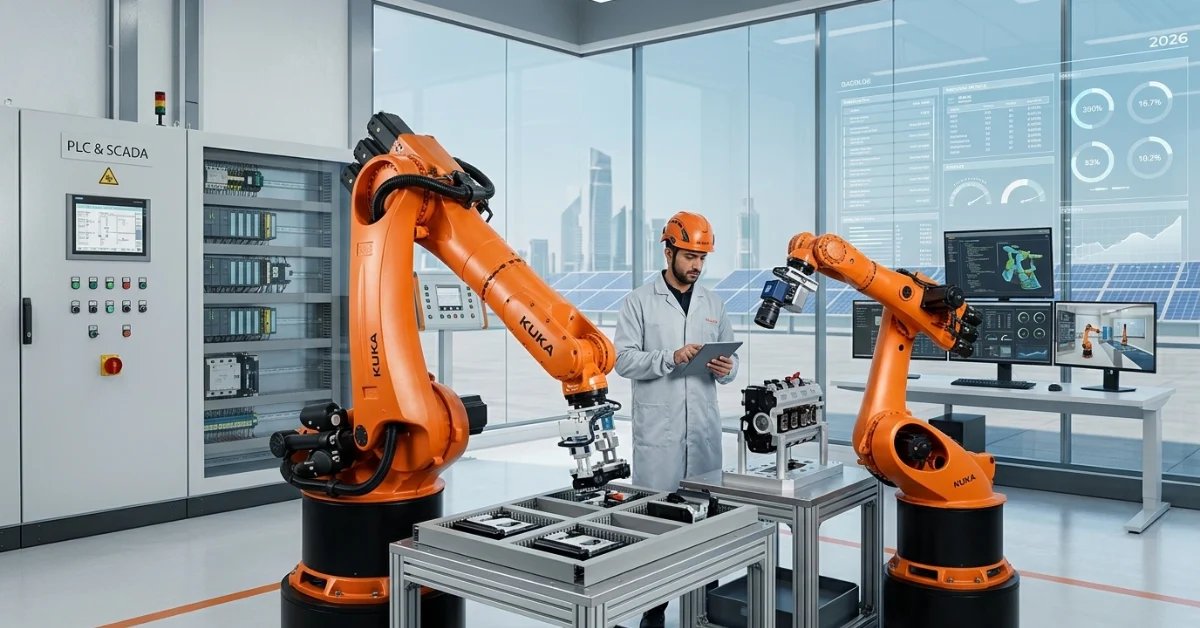
Developing a sophisticated system architecture is the critical phase where physical hardware meets the digital nervous system of the facility. This cobot implementation guide highlights that successful deployment depends entirely on the seamless integration of the robot into the existing PLC (Programmable Logic Controller) and SCADA (Supervisory Control and Data Acquisition) environments. Adhering to the latest ISO 10218 and ISO/TS 15066 standards isn’t just a regulatory requirement; it’s the cornerstone of a safety-first culture that protects the human workforce while maintaining high-speed production. Executing a comprehensive risk assessment before the first power-on ensures that every potential collision point or operational hazard is mitigated through intelligent programming and physical barriers.
Executing Seamless PLC and SCADA Interconnectivity
Achieving true industrial autonomy requires the use of standardized industrial protocols such as EtherNet/IP, PROFINET, or Modbus to facilitate real-time data exchange. These protocols allow the cobot to function as an extension of the primary controller, ensuring that logic commands and safety signals are processed with minimal latency. Utilizing professional PLC and SCADA integration services allows manufacturers to centralize cobot data, transforming raw operational metrics into actionable insights. This centralization is essential for creating unified dashboards that provide facility-wide visibility, allowing supervisors to monitor performance and optimize throughput from a single interface.
Advanced Safety Protocols and Risk Mitigation
Implementing Power and Force Limiting (PFL) settings is the primary method for ensuring safe human-robot proximity without the need for physical fencing. These internal sensors detect even slight resistance, triggering an immediate stop to prevent injury. For high-speed zones where cycle times are prioritized, the addition of safety scanners and light curtains provides an extra layer of protection by slowing or halting the robot as a person approaches. It’s vital to ensure that emergency stop (E-stop) integration is unified across the entire production line; hitting a single button must bring every interconnected machine, including the cobot, to a safe and controlled standstill. This holistic approach to safety ensures that the technological benefits of automation never come at the expense of personnel security.
The 5-Phase Cobot Deployment Roadmap
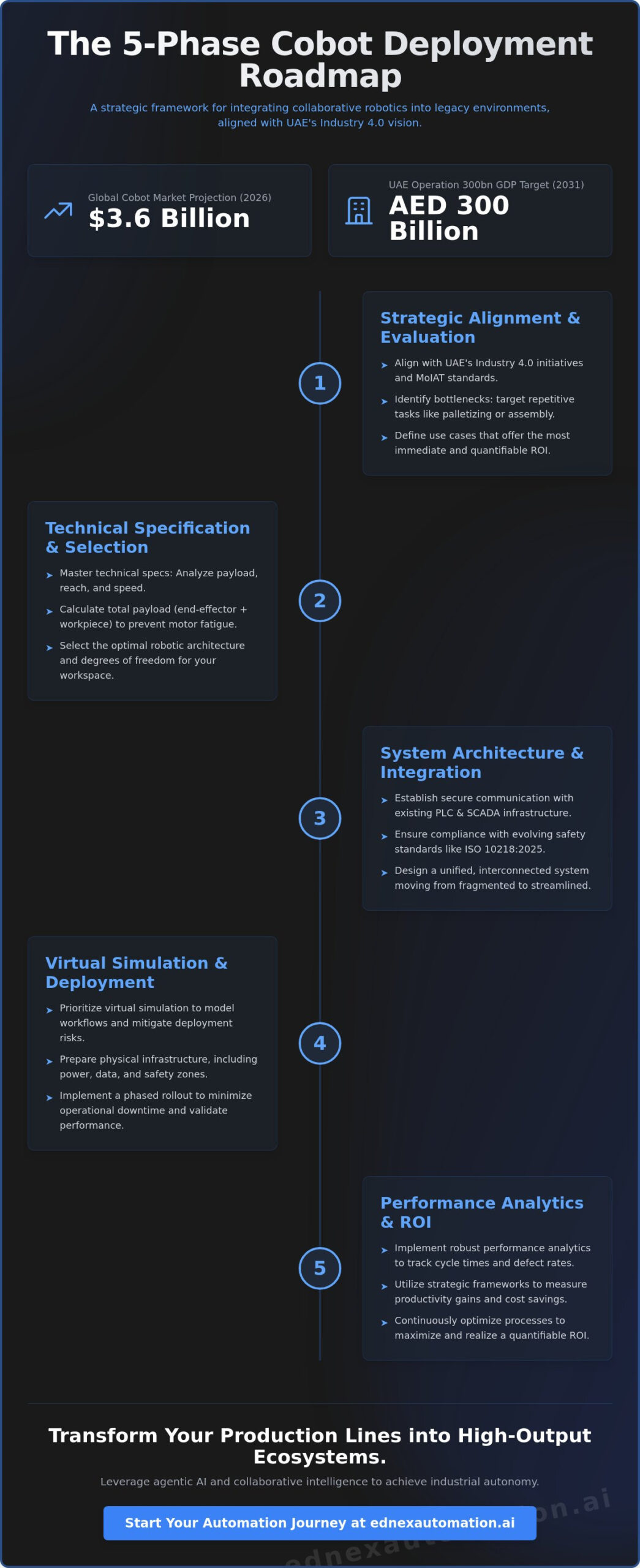
Executing a successful industrial transformation requires a transition from fragmented automation attempts to a disciplined, multi-phase methodology. While simplistic setup guides often overlook the complexities of enterprise-scale integration, this cobot implementation guide establishes a rigorous 5-phase roadmap designed for the 2026 industrial landscape. This systematic approach ensures that every robotic asset, whether performing precision assembly or interacting with an Automated Storage and Retrieval System (ASRS), operates within a validated and optimized framework. By following these structured stages, manufacturers can mitigate the high failure rates associated with poor planning and ensure their systems are ready for the demands of high-capacity production.
- Phase 1: Conceptual Design and Simulation — Validating the workflow virtually to identify potential bottlenecks.
- Phase 2: Infrastructure Preparation — Upgrading power, networking, and physical floor space for site readiness.
- Phase 3: Physical Installation and EOAT Integration — Mounting the robot and configuring specialized end-of-arm tooling.
- Phase 4: Programming and Calibration — Establishing operational logic, safety boundaries, and communication handshakes.
- Phase 5: Pilot Run and Optimisation — Refining cycle times and sensor sensitivity under real-world production loads.
Phase 1 & 2: From Digital Twin to Site Readiness
Utilizing advanced simulation software allows engineers to create a digital twin of the workspace, predicting potential collisions and cycle time bottlenecks before a single piece of hardware is unboxed. This virtual validation is essential for ensuring that the workspace layout allows for ergonomic human intervention and seamless interaction with Autonomous Mobile Robots (AMRs) moving through the facility. During the infrastructure phase, it’s critical to verify that the local network can handle the increased data traffic required for real-time SCADA logging and agentic AI decision-making. Ensuring site readiness involves more than just bolting down a base; it requires a holistic assessment of the facility’s power stability and data throughput to support continuous, high-speed operation.
Phase 3 to 5: Integration, Testing, and Handover
Transitioning from installation to operation involves ‘teaching’ the robot its specific paths through lead-through programming or the intuitive teach pendant interface. This phase focuses on calibrating the robot’s force-limiting sensors to align with the safety protocols discussed in previous sections, ensuring the system remains responsive to its human colleagues. Before full-scale handover, engineers must execute rigorous stress tests to ensure system stability during peak production loads and unexpected power fluctuations. Finalizing the deployment requires comprehensive staff training, empowering the workforce to manage the technology with confidence and safety. To ensure your facility is equipped with the latest in collaborative robotics and inspection robots, it’s vital to partner with an expert in integrated robotic solutions who understands the nuances of the UAE industrial sector. This final optimization phase transforms the cobot from a new installation into a high-performing, reliable component of the national industrial ecosystem.
Performance Analytics and Strategic ROI Realisation
Realising a quantifiable return on investment (ROI) requires moving beyond qualitative observations toward a data-driven analytical framework. This final stage of the cobot implementation guide focuses on the transition from initial deployment to continuous operational optimisation. By defining clear Key Performance Indicators (KPIs) such as cycle time, uptime, and defect rates, organisations establish a baseline for measuring industrial excellence. Utilising a specialized cobot ROI calculator allows financial stakeholders to track the recovery of capital expenditure against real-time production gains. Implementing predictive maintenance schedules further safeguards this investment by utilising sensor data to anticipate component wear, effectively minimising unplanned downtime and extending the mechanical lifespan of the robotic fleet.
Scaling the implementation involves replicating successful automation cells across the facility to create a unified production ecosystem. This modular approach allows for controlled expansion, where lessons learned from the pilot phase inform the deployment of subsequent units. By standardising programming logic and safety protocols across multiple lines, manufacturers reduce the complexity of fleet management and simplify the training requirements for the workforce. This systematic scaling ensures that the technological benefits of collaborative automation are felt across the entire enterprise, driving a comprehensive transformation of the manufacturing floor.
Monitoring KPIs and Operational Efficiency
Tracking the reduction in scrap rates and material waste provides immediate evidence of the system’s precision and stability post-implementation. Beyond material metrics, manufacturers must measure the increase in ‘human-value’ as floor personnel transition from repetitive physical tasks to higher-level supervisory and programming roles. Analysing Overall Equipment Effectiveness (OEE) data via SCADA reports offers a granular view of how effectively the cobot integrates with the broader facility; this transparency ensures that bottlenecks are identified and resolved before they impact the bottom line. These reports serve as the primary evidence for justifying further investments in autonomous technology.
Partnering for Long-Term Automation Success
Sustaining long-term automation success necessitates a partnership with a regional expert capable of providing rapid technical support and bespoke engineering solutions tailored to the local market. The evolution from isolated units to comprehensive collaborative robots UAE ecosystems is a fundamental requirement for remaining competitive in the 2026 industrial market. EdNex Automation serves as the visionary integrator for these Industry 4.0 transitions, offering the intellectual framework and technical expertise needed to scale successful pilots across an entire enterprise. By bridging the gap between global technological breakthroughs and regional industrial needs, we ensure your organisation remains at the cutting edge of the UAE’s economic transformation.
Driving the Future of UAE Industrial Autonomy
Transitioning from manual workflows to a high-output robotic ecosystem requires more than just a hardware acquisition; it demands a systematic integration of intelligence into your facility’s core architecture. By adhering to the technical and operational standards detailed in this cobot implementation guide, your organization can successfully navigate the complexities of ISO compliance and PLC interconnectivity. Establishing a roadmap that prioritizes virtual simulation and data-driven ROI ensures that every robotic asset becomes a long-term catalyst for growth within the UAE’s industrial landscape. This evolution positions your brand at the forefront of the national transformation, securing a competitive advantage in an increasingly autonomous global market.
As the specialized Industry 4.0 Division of the EdNex Group, we offer comprehensive PLC and SCADA integration expertise backed by an official alliance with global robotic technology leaders. We provide the intellectual framework necessary to turn ambitious automation goals into functional, risk-mitigated realities. Partner with EdNex Automation for your strategic cobot implementation to lead your facility into a new era of efficiency and safety. The path to industrial resilience starts with a deliberate, high-tech partnership that connects global breakthroughs with regional expertise. Let’s build the future of your production line together.
Frequently Asked Questions
What is the typical timeline for a cobot implementation guide to be fully executed?
The execution of a professional cobot implementation guide typically spans 12 to 24 weeks from the initial conceptual design to the final pilot run. This timeline accounts for site readiness, hardware procurement, and the complex task of PLC and SCADA integration. While simpler deployments might conclude faster, enterprise-level transformations require meticulous stress testing and staff training to ensure long-term operational stability within the UAE’s rigorous industrial environment.
Do cobots require specialized safety fencing in UAE industrial environments?
Cobots generally don’t require specialized safety fencing, provided that a comprehensive risk assessment confirms the collaborative application is safe for human proximity. Adhering to the updated ISO 10218-1:2025 standards allows these systems to operate in shared workspaces by utilizing power and force limiting (PFL) sensors. If the application involves sharp objects or high-speed maneuvers, secondary safety measures like scanners or light curtains might be necessary to maintain compliance.
Can collaborative robots be integrated with legacy PLC systems?
Collaborative robots can be seamlessly integrated with legacy PLC systems through standardized industrial protocols. Utilizing EtherNet/IP, PROFINET, or Modbus allows the cobot to communicate with existing controllers, ensuring that logic commands and safety signals are synchronized across the production line. This interconnectivity is a vital component of any professional cobot implementation guide, as it prevents data silos and enables centralized monitoring via SCADA systems.
What are the maintenance requirements for a collaborative robot compared to traditional ones?
Maintenance requirements for collaborative robots are significantly lower than those of traditional industrial robots due to their simplified mechanical architecture. While traditional units often require frequent lubrication and belt adjustments, cobots primarily necessitate regular software updates and sensor calibrations to ensure precision. Operators should also conduct periodic inspections of the end-of-arm tooling and electrical connections to prevent minor wear from escalating into unplanned downtime.
How do I conduct a professional risk assessment for a cobot workstation?
Conducting a professional risk assessment involves evaluating the entire collaborative application, including the robot, the end-effector, and the workpiece. Engineers must identify every potential pinch point or collision hazard and determine if the system’s force-limiting settings can mitigate these risks. Following ISO 10218-2:2025 guidelines ensures that the safety of the human worker remains the priority during every phase of the robotic cycle.
What is the average ROI period for a cobot in the UAE manufacturing sector?
The average ROI period for a cobot in the UAE manufacturing sector typically ranges from 12 to 18 months. This timeline depends on factors such as shift frequency, cycle time improvements, and the reduction in defect rates achieved through high-precision automation. By utilizing a strategic financial framework, organizations can track how quickly the system offsets its initial capital expenditure through increased throughput and enhanced operational efficiency.
Is specialized programming knowledge required to operate modern cobots?
Specialized programming knowledge isn’t strictly required for basic operation, as modern cobots utilize intuitive lead-through teaching and graphical pendants. Floor operators can teach new paths by physically moving the robot arm, which significantly reduces the technical barrier to redeployment. However, complex logic integration and PLC handshakes still require a higher level of engineering expertise to ensure the system functions correctly within a larger industrial network.
Can cobots work alongside other autonomous systems like AMRs?
Cobots can be integrated with other autonomous systems, such as Autonomous Mobile Robots (AMRs), to create mobile manipulation units. This synergy allows the robotic arm to move between different workstations, performing tasks like machine tending or inventory replenishment across the entire facility. Combining these technologies enhances the flexibility of the production environment, supporting the UAE’s vision for a fully interconnected and intelligent industrial sector.